

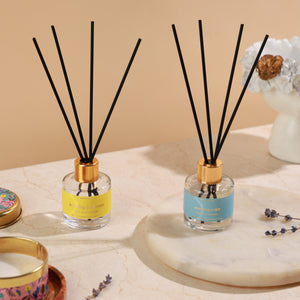

Give back something good and clearly smaller, promptly. A Garden Bloom 50ml at ₹799 or an Evening Calm 50ml at ₹799 is a real object with a stated life of 6–8 weeks.
Choose something that finishes. A consumable leaves no ornament the other person is obliged to display and no permanent reminder of a running score.
Some large gifts are not personal at all. A hamper routed through a company, a distribution list or a vendor relationship is not a gesture from an individual. Do not reciprocate a distribution.
2. Do not match the number, because the number is what persists. An object is forgotten within a month. A level is not. Whatever value you return becomes the reference both households work from next year. That is the trap in one sentence: you are not settling an account, you are setting an opening balance.
3. Speed matters more than size. A reply that arrives within the week reads as a response; the same object handed over weeks later reads as an obligation discharged late. Free shipping starts at ₹499, so a single 50ml clears the line while a ₹379 candle on its own does not.
4. Prefer something that finishes. A gift that runs out leaves no ornament on their shelf that both of you notice when you visit. 50ml runs 6–8 weeks; a jar candle at ₹379 runs roughly 15–18 hours.
5. Check whether the gift was even personal. A vendor's hamper, a builder's basket, something a company sends to a list — nobody chose it for you. Reciprocating a distribution individually is a category error that costs real money.
6. If the giver works for you, invert everything above. House help, a driver, building staff: cash is flexible and it is what most people would choose. An object alongside is a courtesy, never a substitute.
7. Where the gap is genuinely awkward, say something rather than spend something. One honest sentence — that you loved what they sent and are not going to try to keep pace — does more work than any amount of additional spending.
Everything is composed and handmade in small batches in Pune, and a portion of every order supports girl-child education through Nanhi Kali.

Part one — why matching escalates
Nobody sets out to build an escalator. Two households simply behave reasonably in sequence, and the sequence has a direction. The mechanism is invisible from inside a single year: every individual decision looks like courtesy, and only the five-year view shows the slope. The unit that persists between Diwalis is not the object, it is the level.
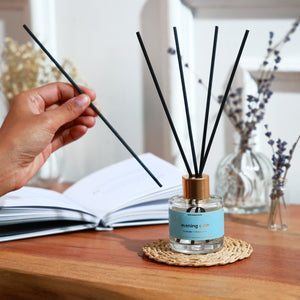
 Evening Calm₹799 · 50mlBefore you decide what to send back, decide what arrived. A great deal of expensive Diwali gifting is not a personal gesture at all: a company sends to a list, a vendor to every client, a builder to every flat. Nobody chose it for you, and a gift nobody chose creates no obligation on you specifically. Then there is the commoner case — a relative who simply gives at a larger scale than you do, because that is how they gift everybody, and who would be startled to learn you had spent an evening working out how to answer. In both cases the debt you feel is one you invented. Evening Calm at ₹799 is the bottle I would send into that second case: Kashmir lavender and chamomile, the softest thing we make, hard to read as either extravagant or grudging.
Part two — five years of the ladder, laid out
The escalation written out year by year, with the matching response in one column and the unmatched response beside it. There is deliberately no rupee figure against what the other household gives: the moment you attach a number to their gift you have started doing the arithmetic this page is trying to talk you out of.
| Year | If you match | Where next Diwali starts | If you deliberately do not match | Who is able to stop it |
|---|---|---|---|---|
| Year one ★ | You return at their level; both feel settled | At their level, now shared | You send a considered 50ml at ₹749–₹849 and say thank you properly | Either of you, easily — nothing has hardened yet |
| Year two | Neither wants to appear to have reduced, so both hold or nudge up | Slightly above last year | You repeat the same scale; they now know your level and it stops being read as a lapse | Still either, with one sentence |
| Year three | The level is now a convention, and conventions are defended | Meaningfully above where you began | The two levels sit side by side as a settled difference in how two households gift | Harder on the matching route; still easy on the other |
| Year four | One household is stretching. Nobody says so | Above what at least one of you would choose | Unchanged, and nobody is doing arithmetic in the gifting fortnight | Requires an awkward conversation on the matching route |
| Year five | The gift has become an obligation with a price attached | A figure neither party ever decided on | Still a gift. Still chosen. Still 6–8 weeks of something on a shelf | Only by someone willing to break the convention publicly |
| The cost of stopping | Visible. A reduction has to be explained | Which is why nobody reduces | Nil. There was never a level to descend from | This is the whole argument |
| The honest caveat: this ladder describes two households in a personal relationship. It does not describe a business relationship with a formal gifting convention, where symmetry is part of the etiquette and a visibly smaller reply reads as a comment rather than a kindness. Nor does it describe the first year of a new in-law relationship, where the scale of the first exchange is doing real social work. Part three deals with both. | ||||
 Sandalwood candle · the small, warm reply₹449Shop → Garden Bloom · the one I would actually send₹799Shop →
 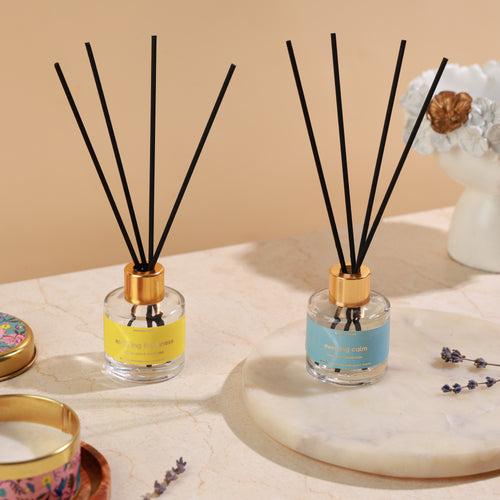 Day & Night duo · the ceiling, for a reason₹1,498Shop →
Part three — when matching is genuinely correct
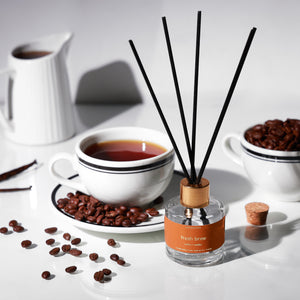
I have spent two sections arguing against symmetry, so let me be fair to the cases where symmetry is the point. In a business relationship with an established gifting convention, a visibly smaller reply is not read as modesty — it is read as a signal. Here the gift is functioning partly as protocol, and protocol is about matching. If that is your situation, match, then take the better decision available to you, which is to standardise. Buy one thing for everyone in that category — the same Fresh Brew 50ml at ₹849 every year — so the level stops being renegotiated annually and becomes a fixed, boring line item. I cannot quote a bulk figure for that, because SOSA publishes no bulk pricing, no discount slab and no minimum order quantity; if the list is long, ask through the contact page before you commit rather than assuming terms that do not exist.
The second exception is more delicate. A first Diwali with a family you have just married into carries genuine social weight, and the exchange is doing real work — establishing that both households take the connection seriously. This is the wrong year to hold a line on principle. Give at the scale the occasion asks for, understand that you are setting a level, and then in year two or three be the one who quietly steps it down. The best moment to break a ratchet is before it has a history. What makes it survivable is doing it in the open — one sentence, in your own words, along the lines of we love what you send and we are going to keep ours simple. People are usually more relieved by that sentence than you expect, because they are usually on the same escalator.
The third case is the one I find hardest to write honestly. Sometimes the person who gave you the expensive gift has considerably more money than you do, and the gap is not etiquette but arithmetic. Trying to match there is the most expensive way of pretending. The answer is specificity rather than scale: send what is right for their actual home. A hallway everyone walks through, Garden Bloom at ₹799. A study lined with books, Mountain Breeze at ₹849. An ultrasonic machine you have seen on their console table, the 100ml Hotel Collection at ₹999. I will not tell you that being specific makes a smaller gift land better; I have no way of measuring that. It is simply the only variable left that you control.
Part four — what I would send back, case by case
Seven versions of the same doorway, and the reply each one wants. Nothing here is priced against what arrived, which is the point — and where the honest answer is to send nothing at all, that is what the column says.
| What arrived, and from whom | What I would send back | What it costs | Why it is deliberately not a match |
|---|---|---|---|
| A large hamper routed through a company or a vendor list ★ | Nothing, beyond a written thank-you to the person who signed it | Nothing | Nobody chose it for you. A distribution is not a gesture and does not create a debt |
| A costly gift from an older relative who gifts big to everyone | Evening Calm 50ml, handed over on a visit rather than at the door | ₹799 | They are not keeping score. Matching would tell them you thought they were |
| A friend at a similar income who has out-given you two years running | Day & Night duo, plus one sentence saying you are keeping yours simple from now on | ₹1,498 | The sentence is doing more work than the money. Year three is the last easy exit |
| Someone who works for you — house help, a driver, building staff | Cash first, in an envelope. Then a Sandalwood jar candle if you want an object too | ₹449 on top of the cash | Cash is flexible and it is what most people would choose. The object is never the substitute |
| A neighbour returning a courtesy at a surprising scale | Misty Mornings or Bookshop jar candle, or a Cloud trinket dish | ₹379 or ₹664 | Neighbour gifting works best when it stays small enough to repeat without thinking |
| A business contact where symmetry is the convention | Match once, then standardise: the same Fresh Brew 50ml for that whole category, every year | ₹849 each | Matching is fine when the level then stops moving. Repeatability is what caps it |
| Someone with far more money than you, whose home you know well | The specific bottle for their actual room — Mountain Breeze for a study, Garden Bloom for a hallway | ₹849 or ₹799 | Scale is not a competition you can win. Specificity is the only variable you control |
Versailles
My family had a version of this running for most of my childhood, with another family we were close to. It started with one genuinely generous year and never came down. By the time I was old enough to notice, both households were spending an uncomfortable amount in a week when neither had the money to spare. Nobody had ever intended any of it. Each year's decision had been kind.
What I have learned since, mostly from watching customers explain their lists to me, is that what people want here is not a product recommendation. It is permission. They want to hear that giving something smaller than what they received is allowed. I cannot promise you how anybody will take anything, and I will not pretend otherwise on a page whose purpose is to sell you a bottle. What I can tell you is that a level, once set, is defended by both parties for years.
So my advice is the least commercial version available: send something good, send it soon, keep it smaller, and say one true sentence alongside it. If that thing is a bottle we made in Pune, I am glad. If it is a candle at ₹379, or a phone call and nothing else, that is a perfectly good answer too.
Frequently asked questions
- How much to spend on a Diwali gift — answered by relationship distance and by who will see it.
- Someone gave you a gift and you have nothing — what to do in the doorway, and what not to.
- Is it rude to give everyone the same gift and is it okay to regift.
- The Diwali gifting etiquette guide — the whole subject in one page.
- Brand: the SOSA founder story.
SOSA range & prices used in this guide (verified from the live store, 27 August 2026): Reed diffusers — alcohol-free, phthalate-free, paraben-free, IFRA-compliant compositions on a heat-stable coconut-derived (CCT) carrier, in a refillable glass bottle with six fibre reeds; 50ml lasts 6–8 weeks, 130ml lasts 14–18 weeks. Morning Freshness 50ml ₹749 · 130ml ₹1,249; Garden Bloom ₹799 · ₹1,299; Evening Calm ₹799 · ₹1,299; Fresh Brew ₹849 · ₹1,349; Mountain Breeze ₹849 · ₹1,349. Duo sets: Day & Night ₹1,498, Fresh & Grounded ₹1,548, Warmth & Bloom ₹1,598 (2 × 50ml); ₹2,498–₹2,598 (2 × 130ml). Oil-only refills 300ml ₹2,399 · 500ml ₹3,499 (vessel and reeds not included). The least expensive SOSA reed diffuser is ₹749 — no reed diffuser exists below that price in any size. Below it: scented jar candles from ₹379 (roughly 15–18 hours), Sandalwood or Smoked Oudh jar candle ₹449, wax melts ₹474 (a burner is needed and is not included), ceramic mugs ₹474, ribbed and face mugs and taper candles ₹569, Amber Rose candle ₹599, ceramic trinket dish ₹664, candle two-pack ₹664 (roughly 30–36 hours). Machines: Boond 300ml ₹899 · Sukoon 500ml ₹1,899 · Megh 6L ₹3,499 (~215 sq ft, a runtime and humidity machine rather than a coverage upgrade) · waterless Vaayu ₹11,999 · Safar car and travel diffuser ₹3,999. The water-based Hotel Collection (15ml ₹299 · 100ml ₹999 · 300ml ₹1,799) is a fragrance for an ultrasonic machine, not a standalone gift. SOSA publishes no bulk or corporate gifting terms — there is no discount slab, no minimum order quantity, no stated GST-invoicing arrangement, no custom branding service and no published lead time — and SOSA sells no gift card, gift hamper, gift box or curated gift set. Larger orders should be discussed with SOSA directly through the contact page before committing. Gift wrapping, gift notes, direct-to-recipient shipping and delivery timing are unconfirmed — check at checkout rather than assuming them; no delivery date is promised anywhere in this guide. Per-head and total costs shown are arithmetic on the listed prices, not quotations. Fragrance adds scent to a room; it does not clean air, remove cooking or smoke smells, or change how anyone feels. Fragrance oil is flammable — keep any diffuser away from diyas, candles and open flame. Composed and handmade in small batches in Pune, India; tested through 45°C summer heat and 85% monsoon humidity. Free shipping above ₹499. A portion of every order supports girl-child education through Nanhi Kali. Prices subject to change — see the live product pages.