

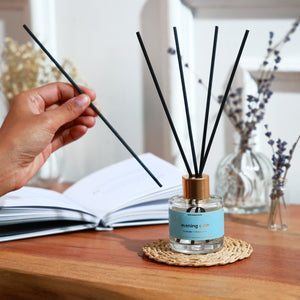

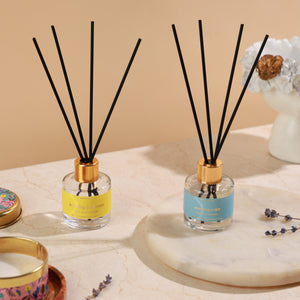

Why week two, not week one: a diffuser laid over a flat that has not been aired reads as a cover-up, not a fragrance.
Running cost: three reeds instead of six, ₹54–₹75 a week, ten to fourteen weeks a bottle.
2. Days 3–5: put the kitchen in the order you actually cook in. Not the order the previous tenant left it, not the order the landlord's inventory sheet describes — the order your hands go when you are cooking. Move the spice rack to the stove, not the sink. Move the pans to where the hob is, not where the cupboard happened to be built. This takes an afternoon and it is the difference between cooking in your kitchen and cooking in someone else's.
3. Week 1: hang or lean the things that carry your history. Photographs, a poster, whatever survived the move — put it up even if the lease is eleven months and you are moving again next year. Adhesive strips, no drilling, about ₹149 for a pack. A wall stays blank for the whole tenancy if it is still blank after week one; nobody hangs a photograph in month nine.
4. Week 1, the same week: air every cupboard and the wardrobe for a full day before a single thing goes in. Doors open, full day, ideally with a window open in the room too. A wardrobe is the single most persistent source of a previous tenant's smell — it is enclosed, it is fabric-lined, and unless you deliberately open it up it holds whatever was in there before you arrived for months.
5. Week 2: lay down one room scent and leave it alone. This is where a Morning Freshness 50ml at ₹749 goes, three reeds if the room is on the smaller side. It comes in week two and not week one because a diffuser laid over an unaired flat reads as a cover-up, not a fragrance — the two things smell completely different to a nose that has been in the room for ten minutes. Then the small unglamorous ones: a doormat at ₹299, a bin that closes at ₹349, one good lamp at ₹899. None of it needs drilling. All of it is reversible. The whole fortnight comes to ₹2,445, comfortably under a ₹3,000 ceiling, and the fragrance is ₹749 of that.
Alcohol-free, IFRA-compliant, composed by an ISIPCA Versailles-trained perfumer and handmade in small batches in Pune — and every purchase funds a girl's education through Nanhi Kali.

Why order beats category in a new apartment
Category-ordered advice treats a flat as a set of independent problems — furniture is one list, decor is another, fragrance is a third — and tells you to work through each list at your own pace. The trouble is that none of these problems is actually independent. A room you have not finished sitting in yet is not ready for a poster. A cupboard you have not aired is not ready for a diffuser. Each step either sets up the one after it or quietly undoes it, and a checklist with no day numbers on it hides that dependency completely. You end up doing the enjoyable bits first — the fragrance, the styling — and the load-bearing bits never, because nothing on the list told you they came first for a reason.
The fourteen-day order in this guide is built the other way round: every step is placed where it is because of what has to be true before it works. The bed and the corner come first because you need one finished place to exist before anything else matters, and because everything after this point happens in a flat you can already stand to be in. The kitchen comes next because you will otherwise spend a fortnight cooking around a layout that was never yours. The wall and the wardrobe come in week one because both are reversible, cheap, and have nothing to do with smell — they can happen in whatever order suits you that week. The scent comes last, deliberately, because it is the one step that only works if the step before it — airing — actually happened.
This is also why the list stays short. Ordering by day naturally excludes anything that does not have an obvious day to sit on. There is no day-3 task called "make it Pinterest-worthy," because that is not a task, it is a mood, and moods do not go on checklists. Everything in this guide is a specific action with a specific cost, which is exactly why it is possible to add the whole thing up and land under ₹3,000 rather than leaving the number open-ended.
The three real decisions in the first fortnight
 Morning Freshness 50ml₹749The instinct with a new flat is to buy everything you think you will eventually need in one weekend and arrange it whenever the mood strikes. That produces a flat that looks finished in patches and unfinished everywhere else, because nothing built on anything else. The alternative is to let each day's task be a precondition for the next one: a finished corner before a rearranged kitchen, an aired wardrobe before a poster goes up, a poster wall before a fragrance goes down. None of this costs more money than the category approach. It just costs a bit of patience, and it produces a flat that feels done in the order a person actually notices it, rather than done in patches a stranger would notice first.
The 14-day plan, task by task
The table below is the whole list laid out against the day it belongs on, with the actual rupee cost against each line rather than a vague "optional." Nothing here needs a drill, a wall socket you cannot spare, or a landlord's permission. Every figure is checked by hand and the column on the right explains why that task sits on that day rather than a different one.
| When | Task | Cost | Why this week |
|---|---|---|---|
| Days 1–2 | Make the bed properly and set up one working corner | ₹0 | Somewhere finished to be, before anything else is |
| Days 3–5 | Rebuild the kitchen into the order you actually cook in | ₹0 | The landlord's arrangement is not yours |
| Week 1 | Air every cupboard and the wardrobe, doors open, a full day each | ₹0 | The single biggest fix for a smell that was never yours |
| Week 1 | Hang or lean the photos, the poster, whatever survived the move | ₹149 | Even on an eleven-month lease — nobody hangs it in month nine |
| Week 2 ★ | Lay down one room scent — Morning Freshness 50ml, three reeds | ₹749 | Only after the flat is aired — never before |
| Week 2 | A doormat | ₹299 | Cheapest fix, first thing a guest touches |
| Week 2 | A bin that closes, one good lamp | ₹1,248 | Unglamorous, but this is what finishes a room |
| Note on the order: nothing here is drilled or fixed in place, and every item leaves in a box when you do. The fragrance is the single largest line on the list and it is also the last thing bought — deliberately, because it is the one step that only works once the step before it, airing, has actually happened. | |||
Morning Freshness · the starter pick50ml ₹749Shop → 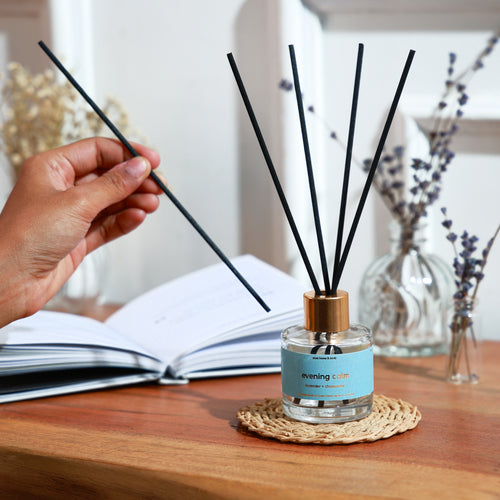 Evening Calm · if calmer50ml ₹799Shop →
 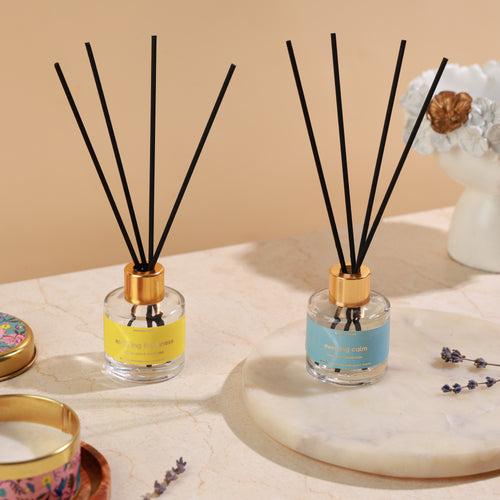 Day & Night · two roomsduo ₹1,498Shop →
Reeds, placement and the deposit-safety rules
A first apartment is very often a single room or a modest bedroom rather than a full house, and the reed count should follow the room, not the bottle. Every SOSA bottle ships with six fibre reeds because that is what suits an open living space with people moving through it. A single room, a PG room or a small first bedroom does not need all six — three is enough, and it is not a compromise. Half the reeds means roughly half the projection and, because the oil is drawn up more slowly, close to double the bottle's life: 10–14 weeks instead of 6–8 from the same ₹749 bottle. That is a genuine cost halving for a smaller room, not a smaller experience.
Flip whichever reeds you are using, saturated-end up, every three to five days — a Sunday flip is the easiest habit to keep. This is the entire maintenance routine, and skipping it is the most common reason a diffuser seems to fade after a fortnight when it has months of oil left in the bottle. Judge the room after seventy-two hours, not on the first evening; the reeds are still drawing oil up on day one and the air has not reached a steady level yet.
The rule that matters more than the fragrance itself, in a rented room: the bottle always stands on something, never directly on the landlord's furniture. A saucer, a small tray, a coaster — anything that catches a wick or a spill before it reaches polished wood, laminate or a painted windowsill. Reed oil that gets onto a rented surface is the one mistake on this entire list that is not reversible, and it is the easiest one to prevent. Keep the bottle off the windowsill for a second reason too — direct sun both heats and fades the oil — and away from a permanent cross-draught, which will carry the scent out of the room faster than the bottle can replace it.
What the first fortnight actually costs
The arithmetic below is built as a ladder — each route adds one more item to the one before it — so you can see exactly where your own ceiling sits, and stop there without guilt. Every total is checked by hand twice before it goes into this guide.
| Route | What you get | Cost per week | Total |
|---|---|---|---|
| The free days | Bed, one corner, kitchen order, a full day airing every cupboard — no purchase at all | — | ₹0 |
| + the wall | Adhesive hooks, two photographs and a poster | — | ₹149 |
| + the scent ★ | Morning Freshness 50ml, three reeds | ₹54–₹75 (10–14 wks) | ₹898 |
| + the doormat | One doormat at the door | — | ₹1,197 |
| The whole fortnight | The four above + a bin that closes and one good lamp | — | ₹2,445 |
Versailles
People ask me for a shopping list for a first apartment, and I always want to hand back a calendar instead. A shopping list tells you what to buy. It says nothing about what to buy first, and in a new flat the "first" matters more than the "what" — because half of what makes a flat feel like yours is not a purchase at all, it is a sequence of ordinary actions done in an order that lets each one work properly.
The habit I would most like people to keep from this list has nothing to do with fragrance. It is the coaster. Every bottle we sell stands on something before it stands on anything of yours — a saucer, a tray, a mat — because the one mistake on this entire list that cannot be undone is a mark on a landlord's wood. Everything else here, done in the wrong order or not at all, can be fixed next weekend. That one cannot.
And the scent itself is not the headline, whatever the price tag suggests. It is one line on a list of seven, it comes second to last on purpose, and it costs ₹749 of a ₹2,445 total. Every purchase, that ₹749 included, funds a girl's education through Nanhi Kali — not a percentage, not a quarterly figure. Every one.
Frequently asked questions
- How to make a rented apartment feel like home — the wider argument, beyond the first fortnight.
- How to make a temporary apartment feel like your own — for a lease measured in months, not years.
- How to feel more at home in a rented flat — the case for small, reversible upgrades.
- How to make your new room feel more personal — the wall, revisited in full.
- Brand: the SOSA founder story.
SOSA products & prices (verified August 2026): Scented candles from ₹379 (small, ~15–18 hrs) · candle duos ₹664 (~30–36 hrs) · wax melts ₹474 · woodenwick and ceramic jar candles ₹949. Reed diffusers: Morning Freshness 50ml ₹749 · 130ml ₹1,249 · Evening Calm 50ml ₹799 · 130ml ₹1,299 · Garden Bloom 50ml ₹799 · 130ml ₹1,299 · Fresh Brew 50ml ₹849 · 130ml ₹1,349 · Mountain Breeze 50ml ₹849 · 130ml ₹1,349; six fibre reeds and refillable glass with every bottle, 50ml lasts 6–8 weeks at six reeds and longer at three, 130ml 14–18 weeks. Reed duo sets 2 × 50ml ₹1,498–₹1,598 · 2 × 130ml ₹2,498–₹2,598. Reed refills 300ml ₹2,399 · 500ml ₹3,499. Ultrasonic diffusers: Boond ₹899 (USB) · Sukoon ₹1,899 (ships with three 15ml fragrances) · Megh ₹3,499; Hotel Collection water-based fragrance 15ml ₹299 · 100ml ₹999 · 300ml ₹1,799 — a fragrance for a machine, not a standalone product. Reed oil and the water-based Hotel Collection are not interchangeable. Alcohol-free, phthalate-free, paraben-free, IFRA-compliant; composed and handmade in small batches in Pune. Every purchase funds a girl's education through Nanhi Kali. Prices and availability subject to change — see the live product pages.