

2. No, after that — and that is correct, not a failure. Olfactory adaptation means a constant background smell fades from conscious awareness within minutes, regardless of how well it was chosen or how good the equipment is.
3. The target is a level that clears awareness by the time a patient sits down. Pitch the intensity so it registers faintly on arrival and has faded from notice by the time a patient reaches a chair — not so it lingers at a nameable level throughout the wait.
4. If a patient can identify the fragrance twenty minutes in, it is too strong. This is a working test, not a guess: a seated patient who can still name the note is proof the level overshot the arrival threshold and needs to come down.
5. This is a dosage decision, not a claim about how anyone feels. None of this implies fragrance calms, soothes or improves a patient's experience — it is a statement about perception and timing only.
Vaayu's scheduling and adjustable intensity are built for exactly this kind of precise, arrival-only dosing.
Why 'yes, then no' is a dosage instruction, not a paradox
The human nose adapts to a constant smell remarkably fast — a sensitivity that exists precisely so that a background smell does not permanently occupy conscious attention. This is not a flaw in a patient's sense of smell or a failure of a clinic's fragrance choice. It is simply how olfaction works, in every room, for every person, regardless of what the smell is.
That single fact decides almost the entire brief for scenting a waiting room. Arrival is the only point in a patient's visit where the nose is encountering the fragrance freshly, which makes it the only point where fragrance is reliably perceived as intended. By the time a patient has been seated for several minutes, the same fragrance at the same strength has already faded from their conscious notice — not because it stopped being there, but because their nose stopped reporting it.
So the instruction to notice it on arrival and not thereafter is not two different goals in tension with each other. It is one goal — a level pitched correctly for the threshold moment — described from two points in time. Get the threshold level right, and the fading is automatic, not something that needs separately managing.
The three decisions behind getting this right
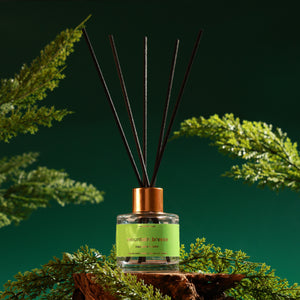
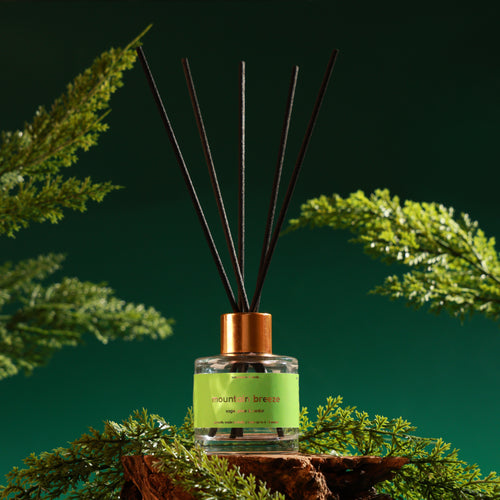
 Mountain Breeze₹849Set the fragrance level with only the entrance moment in mind — a patient walking through the door, encountering the room's air for the first time that day. Every other moment in the visit is downstream of getting this one moment right.
Comparing intensity outcomes over the course of a visit
The same fragrance, at three different intensities, produces three very different experiences across a single visit.
| Intensity | At the door | At five minutes seated | At twenty minutes seated |
| Too low | Barely registers, easy to miss entirely | Not noticed | Not noticed — no threshold moment ever landed |
| Correctly dosed | Registers faintly, a considered first impression | Fading from conscious notice | Gone from awareness — the intended outcome |
| Too high | Immediately identifiable, possibly overwhelming | Still clearly identifiable | Still nameable — this is the overshoot this post is written to prevent |
| Correctly dosed, but drifting upward over the day | Fine in the morning | Fine in the morning | Overshoot by afternoon as staff nudge the setting up to compensate for their own adaptation |
| Staff adaptation is a real trap: the person behind the desk stops noticing the fragrance long before a newly arrived patient does, and turning it up to compensate for their own adapted nose overshoots the level a patient actually experiences. | |||
Mountain Breeze · reed, fixed threshold₹849Shop →  Sukoon · ultrasonic, single arrival point₹1,899Shop →
  Vaayu · scheduled, precisely dosed₹11,999Shop →
Setting the arrival threshold correctly
Calibrate at the door, not at the desk. Staff who work in the reception all day adapt to the fragrance far faster than an arriving patient does, and a level that seems too faint to someone who has been in the room for hours can be exactly right for someone walking in cold.
Test with the twenty-minute rule regularly, not only when setting the machine up for the first time. Fragrance perception at a front desk drifts over weeks as staff adapt further and casually nudge the setting upward — a habit worth checking against periodically rather than trusting to memory.
Keep the threshold effect to the entrance and waiting area only. Consultation rooms, treatment rooms and any enclosed clinical space stay unscented regardless of how well the arrival dosage in reception is calibrated.
What to buy, by how precisely arrival needs dosing
The equipment changes with how tightly the arrival threshold needs to be held; the target curve does not.
| Route | Premises | Why | What it costs |
| Vaayu, scheduled and adjustable | 750 sq ft and above, or anywhere the threshold needs to hold steady across a full clinic day | Precise, repeatable intensity that does not drift upward the way an unmanaged setup does | ₹11,999 |
| Vaayu, wall or HVAC mount | A reception with a single clear arrival point, such as one main entrance door | Concentrates the threshold effect exactly where patients first encounter the room's air | ₹11,999 |
| Sukoon ultrasonic | A modest reception, one arrival point, moderate daily traffic | Real coverage sufficient to produce a genuine threshold moment at a lower commitment | ₹1,899 |
| Reed diffuser, Mountain Breeze | A single small cabin near the entrance, low daily traffic | A fixed threshold effect is proportionate where the arrival point rarely changes | ₹749–₹849 |
| Aangan, HVAC-integrated | A ground floor with more than one arrival point across a large shared premises | Duct-fed distribution can dose several entrances consistently from shared infrastructure | ₹25,999 |
This question comes up more than almost any other, usually phrased as a worry: 'shouldn't the fragrance stay noticeable the whole time, to justify the machine?' My answer is always the same — no, and wanting it to stay noticeable is exactly the instinct that leads clinics to overdose their waiting rooms.
I ask every clinic to run the twenty-minute test themselves before we finalise a setting. Sit in the chairs, at the level currently in use, for a full twenty minutes. If you can still name the fragrance at the end of that, we turn it down — no exceptions, no matter how faint it seemed when it was first set.
The one thing I watch for that clinics rarely catch themselves is staff adaptation. The front desk stops smelling their own fragrance within days and starts nudging it up to compensate, which slowly overdoses every patient who was never adapted in the first place. A scheduled, precisely dosed machine takes that drift out of anyone's hands.
Questions clinic owners ask about arrival timing and dosage
- Patients can spend 20–40 minutes waiting — how strong should the fragrance be? — the dwell-time question this post's arrival dosage instruction answers.
- Best fragrance for an orthopaedic clinic waiting room — the register question that pairs with this post's timing question.
- How do I prevent fragrance from becoming distracting during consultations? — the same overshoot problem, applied past reception into the cabin.
- The most conservative way to introduce ambient scent into a clinic — a cautious starting point for a clinic calibrating this threshold for the first time.
- Brand: the SOSA founder story.
SOSA products & prices (verified September 2026): Reed diffusers 50ml ₹749–₹849 (to 150 sq ft, 6–8 weeks at six reeds) · 130ml ₹1,249–₹1,349 (above 150 sq ft, 14–18 weeks) · reed refill 300ml ₹2,399. Ultrasonic: Boond ₹899 (~150 sq ft) · Sukoon ₹1,899 (270–320 sq ft, ships with three 15ml Hotel Collection fragrances) · Megh ₹3,499 (6L tank, ~100 hrs runtime, ~215 sq ft — a runtime machine, not a coverage upgrade). Waterless cold-air: Safar ₹3,999 (no published coverage figure) · Vaayu ₹11,999 (up to 1000 m³, roughly 2,000–3,000 sq ft; 400ml tank lasting about 90+ days; app and onboard control, 1h/4h/8h/24h run windows, adjustable intensity, key-lock, under 38 dB, freestanding or wall/HVAC mount, 5W, CE/RoHS/SGS) · Aangan ₹25,999 (8,000–10,000 sq ft). Hotel Collection water-based fragrance 15ml ₹299 · 100ml ₹999 · 300ml ₹1,799 is for ultrasonic machines; reed oil and Hotel Collection are not interchangeable. Reed diffusers are alcohol-free, phthalate-free, paraben-free, IFRA-compliant and low VOC, handmade in small batches in Pune. Every purchase funds a girl's education through Nanhi Kali. Prices and availability subject to change — see the live product pages.