



2. The honest target is a room that reads finished, not a room that reads scented. A VIP client should register something composed about the space in the first few seconds without being able to name what did it — the same way good lighting or a well-chosen fabric registers without becoming the subject.
3. Perception fades within minutes regardless of intensity, so raise the register at the door, not in the seat. Reception and the lounge entrance can carry slightly more than the seating itself; the difference does the work that a single loud level cannot.
4. If a client can identify the fragrance by name, the level is already too high for this room. Identifiable is the wrong bar for a VIP lounge — noticed once and then gone is the correct one, and it is a lower level than most operators choose on the first pass.
5. Set it once, low, and leave it — do not chase the fading perception with more product. Staff who raise intensity every time a regular says they can no longer smell it are solving the wrong problem; the client's nose adapting is expected, not a fault to correct.
A VIP lounge that reads as finished rather than scented is doing exactly what an hour-long room should do — and it is a lower register than most operators reach for first.
Why 'noticeable on entry' is the wrong target for a lounge
The instinct to make a VIP lounge announce itself comes from hospitality design built for a different kind of space. A hotel lobby is crossed in under a minute by a stream of different people, so a stronger register earns its keep continuously — nobody is in it long enough to stop noticing. A VIP lounge in an executive health centre is the opposite kind of room: the same person sits in it for an hour or more before their first test, which means the register that impressed them at the door is the same register their nose will stop registering within minutes, while it keeps working at full strength on staff and the next arrival.
The nose adapts to an unchanging scent quickly, and there is no dose that gets around this — raising intensity to compensate only makes the room stronger for everyone except the person it was raised for. That is the specific failure operators fall into when they ask for fragrance that is 'noticeable immediately': they are optimising for a threshold effect and then, when the client stops noticing minutes later, treating the fade as a shortfall to fix with more product rather than as the expected and correct behaviour of a room built for dwell.
A finished room and a scented room read differently to a VIP client, and the distinction matters more here than in a lobby they will forget within the hour. A composed interior — considered lighting, a well-chosen fabric, a register that never becomes the subject — signals that someone thought about the space. A room that announces its fragrance signals that someone wanted them to notice the fragrance, which is a different and less flattering message to send a client about to spend three or four hours in the building.
The three decisions behind an entry impression that does not become a lounge problem
 Vaayu₹11,999Set the target as something registering in the first few seconds without the client being able to name the fragrance a minute later — a lower, more precise bar than most first drafts land on.
Comparing an entry impression against a lounge that has to work for hours
The column that matters here is not the first impression alone — it is what the same setting does to the room forty minutes later.
| Approach | What it does at the door | What it does after 40 minutes | What it costs |
| A single high-intensity setting for the whole lounge | Strong, immediate impression | Adapted out for the seated client; still full strength for staff and new arrivals | Vaayu ₹11,999, run at a level this cluster does not recommend |
| A single low, threshold-only setting throughout | Noticed once, briefly | Correctly out of awareness for everyone seated, unchanged for the next arrival | Vaayu ₹11,999, run as this cluster recommends |
| A gradient — reception above lounge seating | Full threshold impression at the door | Lower, settled register in the seating, where the client actually spends their time | Vaayu ₹11,999, adjustable per zone |
| A reed diffuser at the entrance | A fixed, low, unchanging output; fragrant zone about a metre wide | No control to raise or lower through the day; the same fixed level throughout | ₹749–₹1,349 depending on size |
| A gradient that is stronger at the door and lower in the seating is the only approach on this table built for a room people sit in, not cross. | |||
 Vaayu · reception-to-lounge gradient₹11,999Shop →
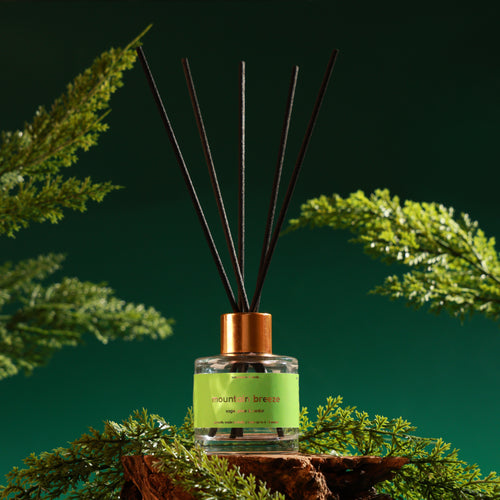
  Sukoon · one settled VIP room₹1,899Shop → Mountain Breeze · a composed, low-key register₹849Shop →
Setting the gradient without letting scent drift into testing areas
Build the gradient from the entrance inward: reception carries the fullest register the building uses, the lounge seating sits a step below it, and consultation — where a result may be discussed — sits lower again or stays unscented entirely. This is the same dwell-time logic that governs the whole facility, applied at the scale of a single VIP room.
Testing and imaging areas, blood collection, and any room where a client is undressed, fasting or being examined stay unscented regardless of how the lounge is set — a faint drift from the lounge doorway into an adjoining corridor is a normal outcome of an open plan, but a scented testing room is not, and mounting away from returns that feed clinical space is how that boundary is kept.
Keep the setting low enough by default that staff never need to negotiate it downward, and make sure whoever is on shift can switch the system off within seconds. If a VIP client ever objects to the lounge's fragrance, the answer is to reduce the setting or switch it off — never to explain or defend a level someone in the room has already told you is too much.
What to specify for a lounge, by size and by how it sits in the building
Every route below assumes clinical and testing areas stay unscented regardless of how the lounge itself is set.
| Route | Lounge size / setup | Why | What it costs |
| Vaayu, one unit, reception set above lounge seating | A VIP lounge that is part of a larger controllable zone | Adjustable intensity is what makes the gradient possible at all, and run windows keep it off overnight | ₹11,999 |
| Two Vaayu units, one per zone | A lounge and a separate reception with genuinely different air handling | One point cannot carry two different registers reliably | ₹23,998 |
| Sukoon, run on its lowest setting | A single VIP room, 270–320 sq ft, not part of a larger zone | Proportionate coverage for one enclosed room without a facility-wide control need | ₹1,899 |
| A reed diffuser at reasonable distance from the seating | A lounge under 150 sq ft | A fixed, low, unchanging output suits a small, simple room | ₹749–₹849 |
| Leave testing, imaging and blood collection unscented, checked against the lounge's own airflow | Any size | The standing zoning rule for this cluster, independent of the lounge's own setting | — |
The request I hear most often for a VIP lounge is some version of 'make it smell like something the second they walk in,' and I understand the instinct — a strong first impression feels like value delivered. What I ask operators to sit with is that the client is not walking through this room, they are staying in it, and a register built for a walk-through punishes exactly the person it was meant to impress.
I have set lounges lower than the operator initially wanted more times than I can count, and the feedback afterward is never that it was too quiet — it is that the room feels composed, considered, finished. That is the word I am actually chasing, and it very rarely comes from more product.
If you are weighing where a scent machine should physically sit to make that gradient work, or whether a reed or a machine is even the right instrument for your lounge's size, both of those are separate, practical questions this cluster answers next — worth reading before you specify anything.
Questions asked about entry impressions in a VIP lounge
- What should a VIP health-check lounge smell like? — the register question this post's answer assumes.
- How strong should fragrance be in a premium health-check waiting lounge? — the intensity question worked through in more depth.
- Clients spend several hours at my executive health centre — how subtle should ambient fragrance be? — the dwell-time doctrine applied across a whole visit.
- Should long-dwell executive lounges use lower fragrance intensity than hotel lobbies? — the hotel-lobby comparison made explicit.
- Brand: the SOSA founder story.
SOSA products & prices (verified September 2026): Reed diffusers 50ml ₹749–₹849 (to 150 sq ft, 6–8 weeks at six reeds) · 130ml ₹1,249–₹1,349 (above 150 sq ft, 14–18 weeks) · reed refill 300ml ₹2,399. Ultrasonic: Boond ₹899 (~150 sq ft) · Sukoon ₹1,899 (270–320 sq ft, ships with three 15ml Hotel Collection fragrances) · Megh ₹3,499 (6L tank, ~100 hrs runtime, ~215 sq ft — a runtime machine, not a coverage upgrade). Waterless cold-air: Safar ₹3,999 (no published coverage figure) · Vaayu ₹11,999 (up to 1000 m³, roughly 2,000–3,000 sq ft; 400ml tank lasting about 90+ days; app and onboard control, 1h/4h/8h/24h run windows, adjustable intensity, key-lock, under 38 dB, freestanding or wall/HVAC mount, 5W, CE/RoHS/SGS) · Aangan ₹25,999 (8,000–10,000 sq ft). Hotel Collection water-based fragrance 15ml ₹299 · 100ml ₹999 · 300ml ₹1,799 is for ultrasonic machines; reed oil and Hotel Collection are not interchangeable. Reed diffusers are alcohol-free, phthalate-free, paraben-free, IFRA-compliant and low VOC, handmade in small batches in Pune. Every purchase funds a girl's education through Nanhi Kali. Prices and availability subject to change — see the live product pages.