Founder Diaries · Clinics & Medical Centres · Shared Waiting Areas
By Sonal Sahani · ISIPCA Versailles 11 min read Updated September 2026
Yes, they should be handled differently, and the difference is not the one most clinics expect. The instinct is to give the children's corner its own fragrance — something lighter, something sweeter, something a child would like. The honest answer is the opposite: scent it less, and in most polyclinics scent it not at all. Children cannot consent to what is in the air of a room they were brought to, their parents did not choose it either, and a glass bottle of fragrance oil at reach height is a spill and an ingestion risk before it is anything else. This page will reduce what you spend rather than increase it, which is the correct outcome here.
Quick answers — read this first
The straight answer: treat them differently by scenting the children's area less, not by choosing a different scent for it. In most polyclinics the honest recommendation for a paediatric waiting area is nothing at all.
Why: children cannot consent and their parents did not choose it · paediatric clinical areas are fragrance-free by default and a paediatric waiting area sits directly against them with doors opening constantly · a glass reed bottle with eight rattan sticks at reach height is a spill and ingestion risk · and a parent asking what that smell is in a children's waiting area is not a question you have a good answer to.
If the two share one hall: put the machine at the reception and adult-seating end, wall-mounted above reach and key-locked, run it lower than you would otherwise, and accept a gradient across the room. Do not add a second machine on the children's side to even it out.
The short answer
Short answer: yes, differently — which here means less. Adults' waiting areas are a normal scented zone. Children's waiting areas should be left alone in most polyclinics, and paediatric clinical areas are fragrance-free and not negotiable. The reasoning is consent, proximity to clinical rooms, and the physical risk of a glass oil bottle at reach height.
What to do instead in a children's area: wipeable flooring and wipeable seating, a lidded bin emptied twice a day, an extracted nappy-change point, a toy policy where everything can be wiped down at close, and the extract fan actually running. Those are the things that decide whether a children's waiting area smells, and none of them is a fragrance.
Shop, for the parts of the building where scenting does belong: the
Vaayu ₹11,999 (waterless, up to 1000 m³, app plus 1h/4h/8h/24h timers, under 38 dB, key-lock, wall or HVAC mountable, four hotel-inspired scents included), the
Aangan ₹25,999 for an atrium, and alcohol-free
reed diffuser from ₹749 for an administrative cabin behind a door. Free shipping above ₹499.
Straight answer
Should a polyclinic handle its children's waiting area differently from its adults' waiting area?
1. Yes, and the difference is less rather than different. A separate children's fragrance is the wrong instinct, and a sweet or fruity one is the wrong instinct twice over. If you are going to do anything differently in a paediatric waiting area, the thing to do differently is to leave it unscented.
2. Because children cannot consent, and their parents did not choose it either. An adult in your lobby chose your clinic. A four-year-old did not choose anything at all, and the parent carrying a sick child through your door is not in a position to raise an objection about the air even if they have one. Where consent is absent, the default should be nothing.
3. Because a paediatric waiting area is effectively continuous with the clinical rooms it serves. Paediatric clinical areas are fragrance-free and that is not a concession. The doors between them and the waiting corner open every few minutes all session, and in most polyclinic layouts there are three metres between a child's chair and an examination couch.
4. Because a reed bottle in a children's area is a physical risk rather than a fragrance decision. A hundred or two hundred millilitres of fragrance oil, in glass, at reach height, with eight rattan handles sticking out of it. A toddler pulls the reeds out, because from a toddler's point of view that is what they are for.
5. What to do instead, and it is all housekeeping. Wipeable floor, wipeable seating, a lidded bin emptied twice a day rather than at close, a nappy-change point with its own extract, a toy policy where everything can be wiped down, and an extract fan that runs the session. Those five decide whether a children's area smells. None of them is a bottle.
6. And if it is one hall with a children's corner in it, which is the usual case: the machine goes at the reception and adult-seating end, wall-mounted above reach, key-locked, run lower than you otherwise would. Accept the gradient across the room rather than adding a second machine to even it up. The
Vaayu at ₹11,999 wall-mounts and key-locks for this reason.
A portion of every order supports girl-child education through Nanhi Kali.
TL;DR: yes, but by scenting the children's area less rather than differently — and in most polyclinics, not at all. Children cannot consent, their parents did not choose it, paediatric clinical rooms next door are fragrance-free, and a glass reed bottle at reach height is a spill and ingestion risk. Where one hall holds both, put the machine at the adult end, wall-mounted and key-locked, and accept the gradient.
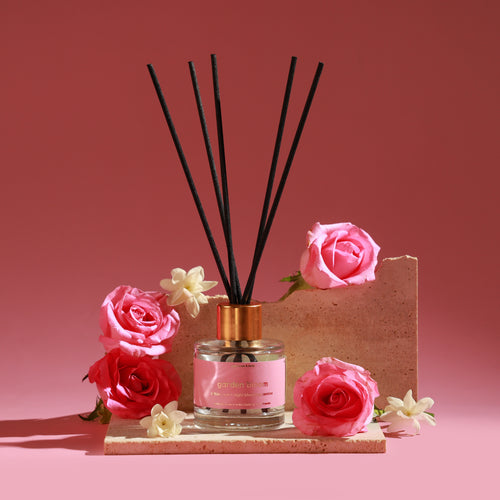
The one place I would not put a reed bottle at any price
SOSA alcohol-free reeds from ₹749
A reed diffuser is a glass bottle holding a hundred or two hundred millilitres of fragrance oil, with eight or ten rattan sticks standing out of the neck of it. In a children's waiting area that is a glass object at reach height, full of liquid, with handles on it. A toddler pulls the reeds out — that is what the reeds are for, from a toddler's point of view — and you have oil on a floor, on a child and possibly in a child. It is not a fragrance question, it is the same question as an unsecured floor-standing fan or a coffee flask on a low table. Put them in the administrative cabin behind a door, where they are exactly right and cost ₹749.
Three reasons to leave the children's side alone
This is one of the few pages in this cluster where my answer costs me money, and I would rather write it than have a clinic work it out afterwards. A paediatric waiting area is the one public space in a polyclinic where every argument for scenting gets weaker and every argument against it gets stronger. The occupants did not choose to be there and cannot say so; the clinical rooms it serves are fragrance-free and three metres away with the doors opening all session; and the products themselves become physical hazards at the height a two-year-old operates at. Three reasons, none of them sentimental, and together they are why I tell most polyclinics to buy nothing for that corner.
1
CONSENT
The people in that room did not choose to be in it
Take the argument at its plainest.
An adult sitting in your main waiting hall selected your clinic, walked in on their own legs and can leave if something about the room does not suit them. A child in a paediatric waiting area did none of those things, and the parent beside them is holding an unwell child, a file, a phone and a bag, and is in no position to raise a point about the air even if they have one. Where consent is absent and objection is impractical, the default ought to be nothing. That is the same principle that keeps fragrance out of examination rooms and out of sample-collection rooms, and it applies here with less ambiguity than anywhere else in the building. There is a practical corollary which matters to whoever runs your front office: in a paediatric waiting area you will eventually be asked what the smell is, and unlike in reception, the person asking is a parent with a sick child, at the end of their patience, in a room they did not choose.
There is no good answer to that question that a parent has to accept, and the fact that a page in a fragrance company's own catalogue says so should tell you how one-sided I think it is. Fragrance sensitivity in patients is a separate and broader question and
handling patients who are sensitive to fragrance and
the asthma and allergy decision both deserve their own reading; but on the specific question of a children's waiting corner, the cautious answer and the easy answer happen to be the same one.
2
PROXIMITY
A paediatric waiting corner is continuous with a fragrance-free clinical area
Then the geometry, which people underestimate because a floor plan makes rooms look separate. Paediatric clinical areas are on the fragrance-free list and that is not a concession: the children's consultation cabins, the immunisation room, the procedure area and any room a child is asked to undress in are left alone as a matter of course. In most polyclinic layouts the paediatric waiting corner is the anteroom to exactly those doors, three to five metres away, with the doors opening every few minutes for the whole session and a nurse walking through with a tray. A scented waiting corner does not stay in the waiting corner; it goes through the door each time the door opens, which is the mechanism by which a fragrance-free clinical room stops being fragrance-free without anybody deciding that it should. The same argument applies with more force here than at an adult department, because the adult consultation corridor usually has a door and a length of corridor between it and the seating, while the paediatric corner typically has neither. There is also a housekeeping reality that any paediatric nurse will describe without being asked: a children's waiting area sees a great deal of spilled milk, dropped food, wet nappies and children being unwell on the floor. The answer to all of that is a wipeable surface, a lidded bin emptied twice a day and an extract fan that runs the session — not a fragrance, which would simply be added to whatever is already there. A persistent smell in that corner is information about a bin schedule or a nappy-change point without extraction, and the job is to find it and fix it rather than covering it.
3
THE PHYSICAL RISK
A glass bottle of oil at reach height, with handles
And then the part that has nothing to do with perfumery at all, which is the height of things.
A reed diffuser is a glass bottle containing a hundred or two hundred millilitres of fragrance oil, with eight or ten rattan sticks protruding from the neck. Put it on a low table in a children's area and you have a glass object full of liquid, at eye level for a two-year-old, with handles on it. The reeds are the handles. A child pulls them, because from a child's point of view that is what they are for, and you have oil on the floor, oil on a child, glass on a hard surface and a conversation with a parent that no amount of housekeeping fixes afterwards. This is the same category of decision as an unsecured floor-standing fan, a coffee flask on a low table or a bin with a swing lid at knee height. Alcohol-free formulation, which is a genuine advantage of our
reed diffuser line in a clinic and which I argue for elsewhere, does nothing about any of that.
A machine is a different question but the same principle: if you scent an adjacent zone, the machine is wall-mounted well above reach or HVAC-mounted, it is key-locked so that nothing can be adjusted by anybody passing, and it is never placed on a low table or a window ledge in a room with children in it. The
Vaayu key-locks and wall-mounts as standard, and in a paediatric context those two specifications matter more than any coverage figure on the box.
The test I would apply to anything you are thinking of putting in a children's waiting area: get down to a metre off the floor and look at it from there. If it is glass, full of liquid, and has handles, it belongs in the administrative cabin instead.
The two areas, side by side
The same seven questions asked of an adults' waiting area and of a children's waiting area in the same polyclinic, with the answers set against each other. The pattern is consistent: everything gets more cautious on the right-hand side, and the last row is where the two differ most.
Adults and children
The same questions, asked of two waiting areas
| The question |
Adults' waiting area |
Children's waiting area |
| Should it be scented at all? ★ |
Yes. It is a normal public zone alongside the entrance, reception and corridors |
In most polyclinics, no. Buy nothing for it, and spend the money on wipeable surfaces instead |
| Who chose to be in the room? |
The patient did, and can leave or say something if the air does not suit them |
Nobody in it chose anything. The child cannot consent and the parent is holding a sick child and a file |
| How close is the nearest fragrance-free clinical room? |
Usually a door and a length of corridor away from the seating |
Three to five metres, with the door opening every few minutes all session |
| Is a reed diffuser appropriate? |
Only in an administrative cabin or a small consultation-suite lobby. Output falls away past about a metre |
No, at any price. A glass bottle of oil at reach height with eight handles in it is a spill and ingestion risk |
| What decides whether it smells? |
Occupancy, air change and fabric seating. The evening arithmetic
|
The bin schedule, the nappy-change extract, wipeable surfaces and the toy policy. Housekeeping, every time |
| Where does the machine go? |
Edge of the reception zone, above waist height, out of the vent throw, key-locked |
Not in the room. If one hall serves both, at the adult end, wall-mounted above reach, run lower |
| What if a parent asks what the smell is? |
There is a straightforward one-line answer for the front desk. The sentence to give reception
|
There is no answer a parent has to accept, which is the strongest argument on this page |
Shop this guide
Where these products do belong
The SOSA principle
A children's waiting area is the one public room in a polyclinic where every argument for scenting gets weaker and every argument against it gets stronger. The cautious answer and the cheap answer are the same answer.
Consent, proximity to fragrance-free clinical rooms, and a glass bottle of oil at the height a two-year-old works at. Spend the money on a wipeable floor and a lidded bin instead.
When it is one hall with a children's corner in it
Most polyclinics do not have two separate halls, they have one hall with a play mat in the far corner, and that is the case worth setting out properly. You cannot zone a single room by fragrance, and anybody who tells you that you can is selling you something. What you can do is create a gradient, which means putting the machine at the reception and adult-seating end, six or eight metres from the children's corner, wall-mounted well above reach and key-locked, and running it at a lower intensity than you would in an adults-only hall. At that distance, in a room with any air movement at all, what reaches the play mat is very little, and very little is the correct amount. The instinct that follows is the one to resist: do not add a second machine at the children's end to make the room even. The unevenness is the point of the arrangement. Set the level by standing at the children's corner rather than at the desk, and if you can identify the fragrance from there, it is too high for the room as a whole. The Vaayu wall or HVAC mount costs a little in fitting and removes the whole question of reach; the key-lock removes the rest of it.
Then the work that actually decides whether a children's area smells, which is housekeeping and which costs almost nothing. The bin is first: a lidded bin, emptied twice during the session rather than at close, with nappies and wipes going into it all day. A nappy-change point needs its own extract; if it does not have one, that is the single most useful thing on this page and it is a maintenance job rather than a fragrance one. Then the surfaces: a wipeable floor rather than a rug, wipeable seating rather than fabric, and a toy policy where everything in the box can be washed or wiped at close — soft toys are a laundry problem that nobody has budgeted for and they are the most common source of a musty children's corner I find. Then the extract fan, running the session rather than on a light switch. Then drinking water and a hand-wash point that works, because the alternative is wet wipes going into a lidless bin. Do all of that and the corner will smell of nothing, which is exactly the result the fragrance was being considered for, at a fraction of the price and with nobody's consent required. Whether paediatric areas should be scented at all goes further into the clinical side of the same question.
And the rest of the building, so that this page is not mistaken for a general argument against scenting. The entrance, reception and registration, the adult and departmental waiting areas, the corridors between departments, the lift and stair lobbies, the administrative and back-office rooms and the café corner are all normal scented zones, and the Vaayu at ₹11,999 covers up to 1000 cubic metres or roughly 2,000 to 3,000 square feet of them from one unit. The fragrance-free list is the other one: consultation and examination rooms, treatment and procedure rooms, day-care surgery and recovery, dressing rooms, blood- and sample-collection rooms, diagnostic laboratories, pharmacy dispensing, sterile stores and CSSD, imaging and radiology rooms, oncology and chemotherapy day-care, paediatric clinical areas, and any room where a patient is asked to undress. On the products, briefly: the ultrasonic Sukoon at ₹1,899, Boond at ₹899 and Megh at ₹3,499 hold standing water and belong in one administrative cabin with a named person emptying and drying the tank daily; an alcohol-free reed diffuser from ₹749 needs 24 to 72 hours to establish, is barely noticed past a metre and belongs behind a door; SOSA candles from ₹379 are not appropriate in a healthcare facility at all, because an open flame is a fire-safety and insurance matter; and SOSA does not make a room spray.
Everybody in your main hall chose to come to your clinic. Nobody in the children's corner chose anything at all, which is the whole of the argument.
— Sonal Sahani, SOSA
The SOSA edit
For a polyclinic with a paediatric department and one honest question about it. The first row is the recommendation and it costs nothing, because the recommendation is to buy nothing. The rest is what to do with the money instead, and where our products genuinely belong.
The SOSA edit
A children's waiting area, in buying order
| Do this |
What it is |
When it earns its place |
Cost |
| 1. Scent the children's area with nothing ★ |
No machine, no reeds, no bottle of anything, in the waiting corner or in the paediatric clinical rooms |
Always, in most polyclinics. Children cannot consent and their parents did not choose it |
₹0 |
| 2. A lidded bin, emptied twice a session |
Not at close. Nappies, wipes and food waste going in all day with a lid on top of them |
First actual spend, and it is a housekeeping instruction rather than a purchase |
Almost ₹0 |
| 3. Extract at the nappy-change point |
Its own extract fan, running the session rather than wired to a light switch |
Second. This is the single most common cause of a paediatric corner that smells, and it is a maintenance job |
A fan |
| 4. Wipeable floor, seating and toys |
Vinyl or polyurethane seating, a hard floor rather than a rug, and a toy box where everything can be washed at close |
Third. Soft toys are an unbudgeted laundry problem and the most common source of a musty children's corner |
Refit |
| 5. Vaayu at the adult end, wall-mounted |
Waterless, up to 1000 m³, app and timers, under 38 dB, key-lock, wall or HVAC mountable, four scents included |
Only where one hall serves both, placed six or eight metres away at the reception end and run lower. Accept the gradient |
₹11,999 |
| Not here at any price: reed diffuser
|
A glass bottle holding 100–200ml of oil, with eight rattan sticks in the neck of it |
In the administrative cabin behind a door, where it is exactly right at ₹749. Never within reach of a child |
from ₹749 |
Honest notes for buyers: fragrance in a medical facility is housekeeping and presentation, never treatment. Nothing on this page claims that a fragrance reduces anxiety, aids recovery, improves sleep, cleans or disinfects air, or has any clinical effect whatsoever, because it does not and a diffuser is not an air purifier. Scenting belongs to the entrance, reception, shared waiting areas, inter-departmental corridors and administrative rooms. Consultation and examination rooms, treatment and procedure rooms, day-care surgery, dressing rooms, blood- and sample-collection rooms, laboratories, pharmacy dispensing, sterile stores, imaging rooms, oncology day-care and paediatric clinical areas should be left fragrance-free. A persistent smell is information about a dry drain trap, a bin, a soiled-linen route or an air-conditioning drain pan: find it and fix it rather than covering it. On the machines: the
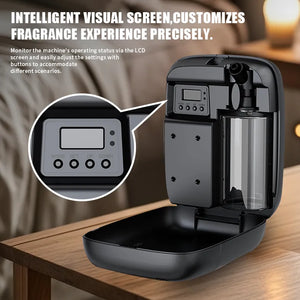
Vaayu at ₹11,999 is waterless cold-air nebulisation with no standing water tank, covering up to 1000m³ or roughly 2,000–3,000 sq ft, with a 400ml tank lasting about 75 days, Bluetooth app control, 1h/4h/8h/24h timers, under-38dB running, auto-stop and a key-lock for public areas. The
Aangan at ₹25,999 covers up to 3,000m³ and connects to HVAC for a whole floor or an atrium. The ultrasonic
Sukoon,
Boond and
Megh are water-based, hold standing water and add 30–50 ml of water an hour to the air, which makes them suitable for a single administrative cabin with a named person emptying and drying the tank daily, and unsuitable for public clinical property. An alcohol-free
reed diffuser needs 24–72 hours to establish and suits a small lobby rather than a large waiting hall. Candles are not appropriate in a healthcare facility because an open flame is a fire-safety matter. SOSA does not make a room spray. The Hotel Collection scents are SOSA's own interpretations inspired by the world's finest hotels; SOSA is an independent Indian fragrance house, not affiliated with or endorsed by any hotel brand. A portion of every order supports girl-child education through Nanhi Kali.
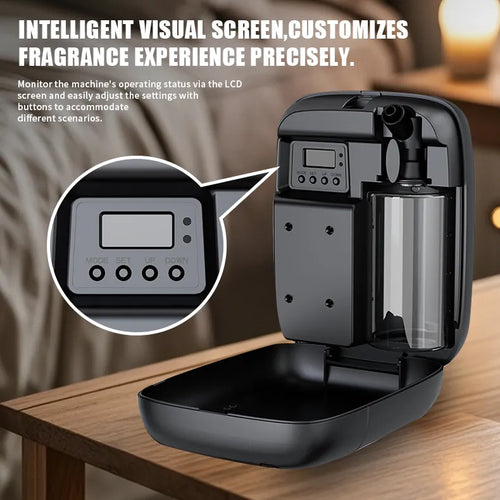
If the adults' hall next door is scented
SOSA Vaayu · wall and HVAC mounted ₹11,999
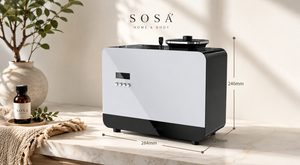
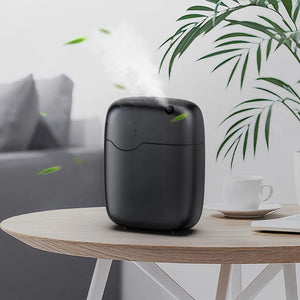
0.9 kg, 165 × 80.5 × 215 mm, freestanding, wall-mounted or tied into the HVAC, with a key-lock and auto-stop. Where a polyclinic has one hall and a children's corner inside it, the machine goes at the far end — the reception and adult-seating end — wall-mounted well above reach, with the children's corner left at whatever reaches it across six or eight metres, which is very little. That is a gradient rather than a zone, and a gradient is the honest thing to promise in a single room. Do not put a second machine on the children's side to even it up. The unevenness is the point.
A note from Sonal
A paediatrician in Thrissur asked me which of the seven scents I would suggest for her waiting area, and I spent two days not answering because I did not want to lose the order. Then I wrote back and said none of them, and explained why: her waiting corner was four metres from two consultation cabins that were fragrance-free by her own policy, the doors opened every few minutes, and the children in the chairs had not agreed to any of it. She replied that she had been uneasy about it and had been waiting for somebody to say so. We did the entrance and the shared adult hall instead, and the paediatric side has never had anything in it.
I think about that exchange more than almost any other, because it is the clearest case I know of the honest answer and the commercially convenient answer pointing in opposite directions. A clinic that is told plainly where not to put a machine will trust what it is told about where to put one, and I would rather have that trust across a whole building than an extra ₹11,999 out of a corner where it does not belong. If you take one thing from this page, let it be the test with the height: get down to a metre off the floor in your own children's area and look at what is on the tables. That is the view the people in that room have, and they did not choose any of it.
Everything is made and supported from Pune, and a part of every order funds girl-child education through Nanhi Kali. You get a space that smells like somewhere looked after; a girl gets a classroom. That equation has always felt right to me.
Frequently asked questions
Should a children's waiting area in a polyclinic be scented differently from the adults' one?
It should be scented less rather than differently, and in most polyclinics not at all. A separate children's fragrance is the wrong instinct and a sweet one is the wrong instinct twice over. Children cannot consent, their parents did not choose it, and the paediatric clinical rooms three metres away are fragrance-free by default.
Can we put a reed diffuser in the children's waiting area?
No. A reed diffuser is a glass bottle holding one or two hundred millilitres of fragrance oil at reach height with eight rattan handles sticking out of it, and a small child will pull them out. That is a spill and an ingestion risk rather than a fragrance decision. Alcohol-free formulation does not change it. Put them in the administrative cabin behind a door.
Our paediatric corner is part of one big waiting hall. What should we do?
Create a gradient rather than a zone, because you cannot zone one room by fragrance. Put the machine at the reception and adult-seating end, six or eight metres away, wall-mounted above reach and key-locked, and run it lower than you otherwise would. Set the level standing at the children's corner, and do not add a second machine to even the room up.
Why does our children's waiting area smell even though it is cleaned every day?
Almost always the bin, the nappy-change point or the soft toys. A lidded bin emptied twice during the session rather than at close, an extract fan at the changing point that runs the session, and a toy policy where everything can be wiped down. A persistent smell is information about one of those three, and the job is to find it and fix it rather than covering it.
Which areas of a polyclinic should never be scented?
Consultation and examination rooms, treatment and procedure rooms, day-care surgery and recovery, dressing rooms, blood- and sample-collection rooms, diagnostic laboratories, pharmacy dispensing, sterile stores and CSSD, imaging and radiology rooms, oncology and chemotherapy day-care, paediatric clinical areas, and any room where a patient is asked to undress.
The full list, with the reasons.
The page that reduces the order
Scent the children's side with nothing — and spend it on the bin and the floor
Where scenting does belong — the entrance, reception, adult and departmental waiting areas, corridors between departments, lift lobbies, administration and the café corner — the Vaayu is ₹11,999: waterless, up to 1000 m³ or roughly 2,000–3,000 sq ft, a 400ml tank lasting about seventy-five days, app control with 1h/4h/8h/24h timers, under 38 dB, auto-stop, key-lock, and wall or HVAC mountable so it sits above reach. Free shipping above ₹499, and a portion of every order supports girl-child education through Nanhi Kali.
See the Vaayu · ₹11,999 Reeds for an admin cabin · ₹749
Continue the read
More from SOSA
Editorial standards & sources
About this guide: Written by Sonal Sahani, ISIPCA Versailles-trained founder and perfumer at SOSA Home & Body, on whether children's and adults' waiting areas in a polyclinic should be handled differently, arguing that the difference is less scenting rather than different scenting, on grounds of consent, proximity to fragrance-free paediatric clinical rooms and the physical risk of a glass oil bottle at a child's reach height, with the housekeeping work that genuinely fixes a children's corner.
Facts verified August 2026: Product facts used in this guide. SOSA Vaayu ₹11,999: waterless cold-air nebulising diffuser, atomises undiluted fragrance oil to a dry residue-free nano-mist with no water reservoir, coverage up to 1000m³ (approximately 2,000–3,000 sq ft), 400ml refillable tank lasting up to about 75 days per fill, Bluetooth app plus onboard control, 1h/4h/8h/24h timer scheduling, adjustable intensity, under 38 dB, DC 12V/1A at 5W, 165 × 80.5 × 215 mm and 0.9 kg, freestanding or wall or HVAC mounted, auto-stop and key-lock, CE, RoHS and SGS certified, supplied with four hotel-inspired fragrances. SOSA Aangan ₹25,999: HVAC-connected or standalone commercial nebulising diffuser, coverage up to 3,000m³ (roughly 8,000–10,000 sq ft), 800ml reservoir, metal body, programmable schedules, under 42 dB. Ultrasonic machines are water-based, hold standing water and consume 30–50 ml of water an hour: Sukoon ₹1,899 (500ml, 270–320 sq ft, 16–18 hours on low, 3–6 drops per tank, steady/2H/4H timers, three 15ml Hotel Collection scents included), Boond ₹899 (300ml), Megh ₹3,499 (6 litres). Hotel Collection water-based fragrance 15ml ₹299, 100ml ₹999, 300ml ₹1,799, Pack of 7 at 15ml ₹1,799 against ₹2,093 bought singly; the Vaayu and Aangan take their own undiluted oil rather than these water-based bottles. Alcohol-free reed diffusers from ₹749, requiring 24–72 hours to reach their working level. Free shipping above ₹499. Coverage arithmetic: cubic metres equal floor area in square feet divided by 10.76 and multiplied by ceiling height in metres, counting only the volumes that are actually scented. This guide makes no medical, therapeutic or clinical claim of any kind for fragrance: a diffuser does not purify, disinfect or clean air, and does not treat, calm or affect any patient or condition. Fragrance is housekeeping and presentation. Clinical areas should be left fragrance-free, and a persistent odour should be traced to its source and corrected rather than covered. SOSA is not affiliated with or endorsed by any hotel brand. Prices subject to change — see the live product pages.