



Why not fresh: lemon, pine and eucalyptus are category-locked to cleaning products, so they imply an event and therefore a cause.
What freshness really is: air movement, temperature and air change — a physical sensation you cannot buy in a bottle.
If you still want something: low-contrast rather than bright — white tea and cedar at the reception desk only, at three drops.
2. “Fresh” is a description of a product category, not of air. Ask ten people what a fresh room smells like and nine will describe lemon, pine or eucalyptus. Those are the note structures of phenyl, floor cleaner, bathroom spray and aerosol freshener. That association is not a matter of taste — it is decades of domestic exposure, and it is stronger in India than almost anywhere, because the cleaning category here is unusually uniform in its top notes.
3. The problem with “just cleaned”. A smell that signals a cleaning event tells the parent two things: somebody cleaned, and something needed cleaning. In a paediatric clinic the second half lands harder than the first. A neutral room makes no claim and invites no inference, and parents who are already alert for signals of hygiene tend to read the absence of any smell as the strongest available evidence that nothing requires covering.
4. Fresh accords are also the wrong shape for a long wait. Citrus and eucalyptus materials are volatile and top-heavy: they present strongly on arrival and fall away quickly. That is precisely the profile you do not want in a room where a child sits for thirty to sixty minutes. The reception smells bright at nine, thin by one, and something else again by evening once footfall, humidity and a filling bin have had their say. Staff, adapted within twenty minutes and unable to judge, respond by adding more.
5. What parents actually mean by fresh is physical. Cool, moving, low-stale air. That is a ventilation and temperature outcome, not an olfactory one, and no fragrance produces it. A closed clinic sits at roughly 0.2–0.5 air changes an hour; a ventilated one at 3–8. If the reception feels stuffy, the honest fix is airing the space before opening, cleaning the AC filter and drain pan, and moving air — not choosing a brighter fragrance.
Made in India, composed by an ISIPCA Versailles-trained perfumer — and a portion of every order supports girl-child education through Nanhi Kali.
Why “fresh” reads as cleaning product, and why that costs you
The associations attached to a fragrance family are not aesthetic preferences; they are learned from repeated exposure in a particular context, and in India the context that owns lemon, pine and eucalyptus is the cleaning cupboard. Phenyl, floor cleaner, bathroom spray, aerosol freshener and disinfectant wipes are overwhelmingly built on those materials, and the average parent has met them ten thousand times in that setting. Put a bright citrus accord into a clinic reception and it does not land as “fresh air”; it lands as “cleaning product, applied recently”. In a building where the odour you are actively trying not to have is phenolic disinfectant, that is an unforced error — you have paid for a fragrance that occupies the same mental category as the smell you were escaping, and if any real disinfectant is still present, the parent now receives both.
The second cost is that fresh accords behave badly over a working day. Citrus terpenes and eucalyptus-type materials are volatile: they diffuse quickly, read strongly for the first hour and then decay, leaving whatever base sits underneath. A reception on a fresh direction therefore smells like three different rooms between nine in the morning and seven in the evening, and only one of those is the room you chose. Compare that with a dry tea-and-cedar accord, which is flatter by construction and holds a similar character from the first hour to the last. In a clinic, where nobody on the premises can judge the level after twenty minutes and where the correction is always upward, a fragrance with a flat curve is worth more than a fragrance with an attractive opening.
The three positions clinics take, and what each one costs
 Excellent — elsewhereFrom ₹749We sell a lemon, peppermint and eucalyptus reed blend called Morning Freshness and it is genuinely good in a kitchen, a utility area or a bathroom, which is where those associations belong. On a paediatric reception desk it is the closest thing in our range to the cleaning cupboard, and clinics choose it more often than any other because “fresh” is the word they arrived with. The clinic that smells aggressively fresh is not read as cleaner than the clinic that smells of nothing — in our experience it is read as the one with something to tidy away.
Fresh, neutral or nothing — zone by zone
Notice that the neutral column is the long one. In a well-run children’s clinic most of the floor plan is deliberately left to smell of nothing at all.
| Area of the clinic | Scented? | Why | What we would use |
|---|---|---|---|
| Entrance and reception desk ★ | Low-contrast, not fresh | A bright citrus here reads as cleaning product; a dry tea note reads as considered | White tea and cedar on Sukoon, three drops |
| Parent and child waiting seating | Neutral preferred | Longest dwell in the building, and the upholstery holds whatever you add | Ventilation and laundering, not a second unit |
| Washrooms and nappy-change | Neutral — extraction | This is an air-handling and bin problem; fragrance here gives parents two smells instead of one | Working extraction, lidded bins, frequent emptying |
| Consultation and examination rooms | Neutral, always | Clinicians rely on unaltered air, and a seated child cannot move away from anything added | Nothing |
| Vaccination, injection and procedure rooms | Never scented | Any identifiable note repeatedly present at a painful moment becomes attached to it | Nothing |
| Nebulisation, asthma, neonatal and isolation areas | Never scented | Respiratory patients and newborns — the groups with least tolerance for added airborne load | Nothing |
| Before any of this: air the building before opening and check the AC filter and drain pan. A clinic that smells closed at nine in the morning has a ventilation problem, and neither fresh nor neutral is achievable until that is dealt with. | |||
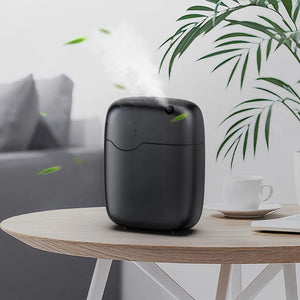
Small reception · no power neededFrom ₹749Shop →  Mid reception · has an off switch₹1,899Shop →
 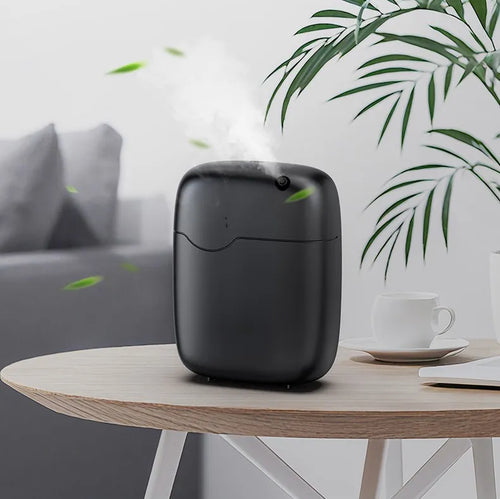 Large lobby · timed, dialable₹11,999Shop →
Getting actual freshness, which is an air problem
Air the space before you open it, every day. Most clinic receptions that feel stuffy are simply rooms that have been shut for fourteen hours. Twenty minutes of cross-ventilation before the first appointment does more for perceived freshness than any diffuser setting, and it costs a housekeeping instruction. Where the building genuinely cannot be opened — a basement unit, a mall location, a road frontage with heavy traffic — the answer is mechanical fresh-air supply specified by your services engineer, not a stronger fragrance.
Understand what the air conditioner is and is not doing. A split unit cools and recirculates; it does not bring in outside air, so a sealed, air-conditioned reception can be comfortable and stale at the same time. The filter collects dust and organic material, and the drain pan holds standing water, which is why so many clinics describe a closed or slightly sour smell that gets worse in monsoon. Cleaning both on a written schedule removes an odour source and often removes the entire reason the clinic was considering fragrance.
Only then, if you still want something, keep it low and keep it at the desk. Three drops on a Sukoon in intermittent mode, or the shortest duty cycle on a Vaayu, scheduled to clinic hours. Set the level with a nose that has been outside for thirty minutes, because olfactory adaptation is essentially complete within twenty and the whole staff will be judging it wrong by ten in the morning. Be able to switch it off in seconds for a family who asks, and put the decision through your own clinical governance, infection-control and housekeeping leads.
What we would actually install
Read this table with the last row in mind. For a clinic whose real question was freshness rather than fragrance, the last row is usually the honest answer.
| Option | Suits | Control you get | Price |
|---|---|---|---|
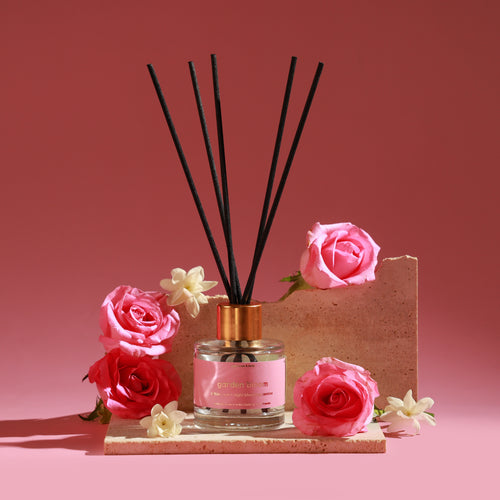
| Reed diffuser | A small reception desk — Mountain Breeze on three reeds if the desk needs something; never Morning Freshness in a clinic | Reed count only — no switch, no timer | from ₹749 |
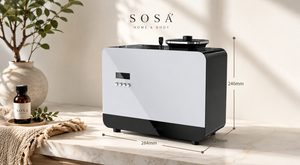
| Sukoon 500ml | A reception up to ~320 sq ft — up to about 320 sq ft, white tea and cedar at three drops, intermittent, clinic hours only | On/off, intermittent mode, you control the drops | ₹1,899 |
| Vaayu | A large lobby or a zoned duct — a large lobby or separately ducted reception, at the lowest duty cycle the machine allows | Duty cycle in seconds, timer, app scheduling | ₹11,999 |
| Aangan | Whole-facility HVAC — a zoned 8,000–10,000 sq ft facility where clinical branches can be excluded at the duct | Zone-level control, but only if the ducting is zoned | ₹25,999 |
| Nothing at all ★ | Every clinic whose complaint was staleness rather than smell — that is ventilation, and no fragrance in this range will deliver it | Complete — and the correct answer more often than the trade admits | ₹0 |
Versailles
When a clinic tells me it wants to smell fresh, I ask what they mean, and almost always the answer describes a physical sensation: the air should feel moving and cool, not thick. That is a window, a fan and a clean filter, and I cannot sell it to them. I say so, because the alternative is that they buy a citrus fragrance, discover a month later that the reception smells like an expensive floor cleaner, and conclude that ambient scenting does not work.
The lemon-and-eucalyptus family is not a bad family. Morning Freshness is one of the blends I am fondest of and it lives in my own kitchen. But a fragrance carries the room it was learned in, and in this country that family was learned in the cleaning cupboard. A children’s clinic is the one place where you least want the air to remind anybody of disinfectant, and a bright citrus does exactly that at a higher price.
So my recommendation is dull and cheap: air the place before you open, get the filter and the drain pan on a schedule, put lids on the bins, and see how the reception smells after a fortnight of that. If it still feels bare, a dry white tea at three drops on the desk is a real and pleasant detail. Keep every clinical room out of it and let your own infection-control people set the policy. A portion of every order funds a girl’s classroom through Nanhi Kali.
Frequently asked questions
- Which direction for a clinic reception? — dry, low-sweetness, and why.
- Why does an air-conditioned clinic smell closed? — recirculation, filters, drain pans.
- Why does it smell stale at opening? — fourteen hours of shut air.
- Ambience without fragrance — the levers that outperform scent.
- Brand: the SOSA founder story.
SOSA products & prices (verified August 2026): Hotel Collection water-based ultrasonic diffuser fragrance 15ml ₹299 · 100ml ₹999 · 300ml ₹1,799 · Pack of 7 (15ml, all fragrances) ₹1,799; refills 100ml from ₹999. Seven scents: The Ritz-Carlton-inspired (white tea · bergamot · cedar), Westin-inspired (white tea · aloe · cedar), 1 Hotels-inspired (cedarwood · vetiver · green leaves), The St. Regis-inspired (amber · violet · woods), Shangri-La-inspired (jasmine · green tea · white tea), Four Seasons-inspired (citrus · floral · sandalwood), W Hotels-inspired (citrus · pepper · amber). Diffusers: Boond 300ml ₹899 · Sukoon 500ml ₹1,899 · Megh 6L ₹3,499. Water-based, phthalate-free, composed to IFRA standards for home diffusion; 3–6 drops per tank. Made in India, Pune. The Hotel Collection scents are SOSA's own interpretations inspired by the world's finest hotels; all hotel names are trademarks of their respective owners and are used only to describe the scent style — SOSA is an independent Indian fragrance house, not affiliated with or endorsed by any hotel brand. Prices and availability subject to change — see the live product pages.