



Why the recovery bay counts: a curtain between two trolleys divides sight, not air. A four-bay recovery area is one room, so there is no such thing as scenting half of it. Post-anaesthetic nausea is routine in that bay and it is not a room to add anything to.
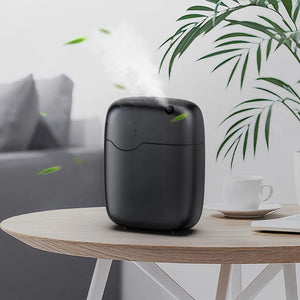
Where the machine goes: the relatives' waiting area on the corridor side of the suite doors. One Vaayu at ₹11,999, wall-mounted at 1.8 to 2 metres, plume pointing away from the suite, on the lowest useful setting, with the suite doors on working closers.
2. A curtain divides sight, not air. Most day-care recovery areas are one room with three or four curtained bays in it, sharing one air supply and one extract. There is no arrangement in which you scent the nursing station and not the trolleys, because there is only one volume and the curtain is a privacy screen.
3. Everyone in that suite is fasting, sedated or waking up. A day-care list runs on patients who have had nothing since midnight, and post-anaesthetic nausea is an ordinary event in a recovery bay rather than an unusual one. I am not going to claim that a fragrance causes it and I am certainly not going to claim that one helps. I am going to say that a bay where that is routine is a bay you add nothing to.
4. And nobody in there chose the room. A patient in a waiting hall who dislikes a fragrance can move seats or step outside. A patient on a trolley with a cannula in her hand, in a gown, waiting for a list that is running forty minutes late, has no such option. That asymmetry is why the rule is absolute rather than a matter of degree.
5. The staff have a vote too, and they are in there all day. The anaesthetist, the operating practitioner and the recovery nurse spend nine hours in that suite. A patient meets it once; they meet it four hundred times a year. Ask them before you decide anything, and expect the answer to be no.
6. What does belong there is the relatives' waiting area outside the doors. That room is ordinary public property and people sit in it for hours. One Vaayu at ₹11,999 on the corridor side, wall-mounted, plume pointing away from the suite, on the lowest useful setting, and the suite doors on working closers.
A portion of every order supports girl-child education through Nanhi Kali.
A curtain divides sight, not air
Almost every request I get about a day-care department is really a request about the recovery bay, and it arrives in the same shape: the procedure room is obviously out of scope, so could something light go in the recovery area, where patients are only lying down for an hour and the room can feel bleak. The answer is no, and the reason is not squeamishness about surgery. It is that a four-bay recovery area with curtains between the trolleys is one room sharing one air supply, so the question of scenting part of it does not arise — you are either scenting all four patients or none of them, and one of those four is the person who has just been sick into a bowl. Everything else on this page follows from that single piece of geometry.
The day-care department, room by room
Every space in a typical day-care and procedure department, what happens in it, and whether anything goes into its air. Two of the nine are public and the other seven are not, which is roughly the ratio for the whole building. The right-hand column is what to do about the smell of a room that is not going to be scented, because that is the question the exclusions actually raise.
| Space | What happens in it | Scented? | What to do instead |
|---|---|---|---|
| Relatives' waiting area ★ | Family sit for three or four hours with nothing to do, on the corridor side of the suite doors | Yes — this is the one | One Vaayu wall-mounted, plume away from the suite, lowest useful setting |
| The corridor and lift lobby outside | Public circulation, patients arriving, porters and trolleys passing | Yes, at a low level | Machine mid-run, never opposite the suite door leaf, doors on working closers |
| Admission and pre-operative bay | Fasting patients changing into gowns, consent being taken, cannulas being sited | No | Ventilation and a linen rota. If it smells, that is a bin or a basin trap |
| Anaesthetic or preparation space | Drugs drawn up, checks performed, a patient going under sedation | No | Nothing added, ever. This is a clinical lead's room and not a facilities one |
| Procedure and minor-operation room | The list itself, with a door and usually a pressure regime of its own | No | Leave the door shut and leave the air alone. Check the suite door closer |
| Recovery bay | Three to six trolleys behind curtains, nausea routine, patients waking and being observed | No — and the curtain does not create a zone | Extract working, bowls emptied, a window if the room has one |
| Dirty utility and sluice | Waste, specimens, soiled linen leaving the department | No | This is a schedule problem. A smell here is information, not a fragrance gap |
| Sterile store attached to the suite | Stock, packs, wrapped instruments waiting to be used | No | Added airborne anything here is a conversation with your own quality lead |
| Day-care sister's office | One named person, a door, a desk and a kettle | If she wants it | An alcohol-free reed diffuser at ₹749 is exactly right for one small room |
Outside the suite doors₹11,999Shop → 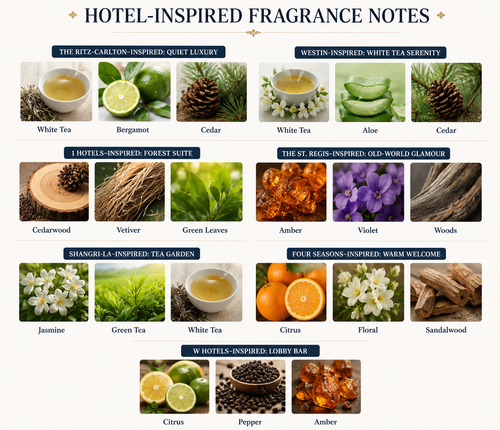 The lightest of seven₹299Shop →
 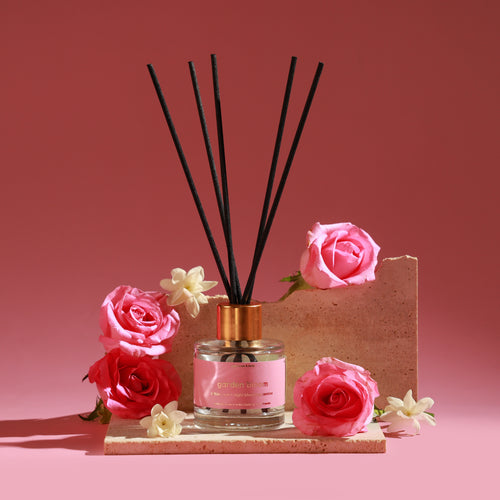 The sister's office only₹749Shop →
Where the machine goes, and how far away that is
Start with the line itself, because in this department it is unusually easy to draw and unusually easy to get wrong by two metres. The boundary is the suite door, and the machine belongs on the corridor side of it with at least three metres of clear run and its plume pointing away from the leaf rather than along it. If your relatives' waiting area is a widening of the corridor immediately outside those doors — which in a 4,000 sq ft polyclinic it almost always is — then put the unit at the far end of that widening, on the wall opposite the seating, at 1.8 to 2 metres. Cold-air mist falls rather than rises, so a machine on a low table beside the suite entrance is aimed at precisely the threshold you are trying to protect, and the Vaayu wall bracket on a 0.9 kg unit takes ten minutes. Then check the doors themselves, because this department has the worst door discipline in most clinics and it is not the staff's fault: a suite door that has to admit a trolley gets propped. A wedge under a day-care door is the single commonest carryover path I find, it usually appears because the closer is over-tightened rather than because anybody is careless, and the fix is a maintenance call and a hold-open device that releases properly. Get the closers on every clinical door in the department serviced before you buy anything, and walk the transfer paths with a sheet of paper while you are at it.
Then the level and the hours, which in a department that runs lists are a scheduling question rather than a dial one. A day-care suite does not open at nine and it does not close at six. In most polyclinics the first patients arrive at seven for an eight o'clock list, and the last discharge can be at eight in the evening. Run the machine on the actual hours the relatives' area is occupied through the app or the onboard 1h, 4h, 8h and 24h timers, start it about thirty minutes before the first family sits down, and let the timer stop it rather than a person. The level should be set from the wrong side of the suite doors, not from the waiting area: have somebody stand inside the empty suite with the doors shut for five minutes in week one, then have the doors opened normally for a trolley, and if the fragrance is nameable from in there, come down a step and repeat. Keep coming down until it is not. And then lock it, because the risk in this department is not the public — it is the well-meaning person who turns it up in week six because she has stopped noticing it. Habituation is guaranteed and it is not a character flaw. Your own staff will lose the building inside a fortnight while every visiting family still receives the level you set on day one, and the key-lock on the Vaayu exists for exactly that. Nobody turns it up at lunchtime because the waiting area got busy, either — busy is an air-change problem and raising the fragrance makes it worse.
Then the part this page is really for, which is what to do about a day-care department that smells of something, because that is the question hiding behind most requests to scent one. A recovery bay that smells has a source and it is almost always one of four things. A dirty utility or sluice door standing open onto the bay, which is a door-discipline problem and costs nothing to fix. Clinical waste and vomit bowls being taken out when the round happens rather than when they are used. A macerator or sluice hopper whose trap has dried out over a quiet weekend, which takes thirty seconds and a jug of water and is the single commonest cause of a clinic that smells. Or trolley mattresses and pillows wiped between patients but not stripped and laundered on any rota anybody can produce. None of those is a fragrance problem and none of them should be answered with fragrance, because doing so removes the signal that told housekeeping something was wrong — and in a recovery bay that signal is worth more than in almost any other room in the building. Find it and fix it first. The full pre-purchase checklist is the honest order of work. On the products, briefly: the Vaayu at ₹11,999 runs its own undiluted oil rather than the water-based Hotel Collection bottles; the ultrasonic Sukoon at ₹1,899, Boond at ₹899 and Megh at ₹3,499 hold standing water and belong in one administrative cabin with a named owner rather than in a surgical department; candles are not appropriate in a healthcare facility at all, because an open flame near piped oxygen is a fire-safety and insurance matter rather than a preference; and SOSA does not make a room spray, which in this department is just as well.
The SOSA edit
In working order for a polyclinic with a day-care and procedure department. The first three rows cost nothing and the fourth is a maintenance call, which is the honest shape of this list. The last row states plainly what we will not sell you for this department rather than leaving it to a sales visit.
| Do this | What it is | When it earns its place | Cost |
|---|---|---|---|
| 1. Nothing inside the suite doors ★ | No diffuser, no reeds, no plug-in, no morning spray, in any bay or room past that threshold, including recovery | First and permanently. It is the default rather than a concession | ₹0 |
| 2. Write the exclusion into the list | Nine spaces named in one line of your scenting policy, so the next facility manager inherits the decision instead of reopening it | Before anybody is asked to approve anything | ₹0 |
| 3. Water the sluice and utility traps | Thirty seconds and a jug per trap, especially after a quiet weekend or a week with no lists | Before you conclude anything about a bay that smells | ₹0 |
| 4. Service every closer in the department | A propped suite door moves more air in ninety seconds than an undercut does in an hour, and day-care doors get propped for trolleys | Second, and before a machine is bought | A service visit |
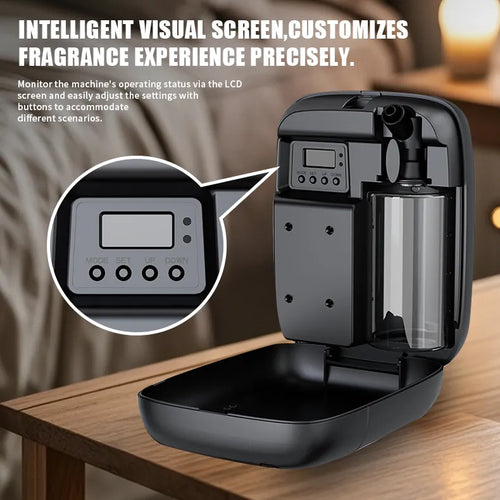
| 5. Vaayu in the relatives' waiting area | Waterless with no standing tank, up to 1000 m³, app and 1h/4h/8h/24h timers, under 38 dB, key-lock, wall-mounted three metres clear of the suite door | Third, and only once the department is clean and the doors shut properly | ₹11,999 |
| Not for this department: reed diffuser or a candle | Reeds at ₹749 are right for the day-care sister's office behind a door. An open flame near piped oxygen is a fire-safety matter, not a preference | There is no discreet product for a recovery bay and we do not sell one | — |
Versailles
A day-care sister in Nashik gave me the sentence I have used ever since, and she gave it to me while emptying a bowl. I had asked whether a light fragrance in the recovery area might make it feel less bleak, and she said that the room already smells of nothing most of the time, and that the mornings it does not are the mornings she needs to know about. Then she pointed out, quite mildly, that the curtain I had been gesturing at while proposing a zone was a piece of polyester on a rail. I had spent twenty minutes drawing a boundary that did not exist.
The other thing she said has stayed with me longer. She counted up her hours and pointed out that she would meet whatever I installed about two thousand times a year, and that nobody from the company or from the clinic had thought to ask her about it. That is the part of this job I would most like to see change. The people who breathe a scented building hardest are not the patients, who pass through, but the staff who stand in it all day, and in a day-care department they are also the people with the best reason to refuse. Ask them first. If they say no, the answer is no, and the relatives' waiting area outside is a perfectly good place to put a machine instead.
Everything is made and supported from Pune, and a part of every order funds girl-child education through Nanhi Kali. You get a space that smells like somewhere looked after; a girl gets a classroom. That equation has always felt right to me.
Frequently asked questions
- Should clinical treatment areas in a clinic ever be scented? — the position stated once, plainly.
- Should a blood-collection or sample-collection room be scented? — the sharpest no in the cluster.
- How do I keep fragrance out of clinical zones while scenting the public areas? — the engineering, with a method you can walk.
- Which areas of a medical centre should always be left fragrance-free? — the full exclusion list.
- Brand: the SOSA founder story.
Facts verified August 2026: Product facts used in this guide. SOSA Vaayu ₹11,999: waterless cold-air nebulising diffuser, atomises undiluted fragrance oil to a dry residue-free nano-mist with no water reservoir, coverage up to 1000m³ (approximately 2,000–3,000 sq ft), 400ml refillable tank lasting up to about 75 days per fill, Bluetooth app plus onboard control, 1h/4h/8h/24h timer scheduling, adjustable intensity, under 38 dB, DC 12V/1A at 5W, 165 × 80.5 × 215 mm and 0.9 kg, freestanding or wall or HVAC mounted, auto-stop and key-lock, CE, RoHS and SGS certified, supplied with four hotel-inspired fragrances. SOSA Aangan ₹25,999: HVAC-connected or standalone commercial nebulising diffuser, coverage up to 3,000m³ (roughly 8,000–10,000 sq ft), 800ml reservoir, metal body, programmable schedules, under 42 dB. Ultrasonic machines are water-based, hold standing water and consume 30–50 ml of water an hour: Sukoon ₹1,899 (500ml, 270–320 sq ft, 16–18 hours on low, 3–6 drops per tank, steady/2H/4H timers, three 15ml Hotel Collection scents included), Boond ₹899 (300ml), Megh ₹3,499 (6 litres). Hotel Collection water-based fragrance 15ml ₹299, 100ml ₹999, 300ml ₹1,799, Pack of 7 at 15ml ₹1,799 against ₹2,093 bought singly; the Vaayu and Aangan take their own undiluted oil rather than these water-based bottles. Alcohol-free reed diffusers from ₹749, requiring 24–72 hours to reach their working level. Free shipping above ₹499. Coverage arithmetic: cubic metres equal floor area in square feet divided by 10.76 and multiplied by ceiling height in metres, counting only the volumes that are actually scented. This guide makes no medical, therapeutic or clinical claim of any kind for fragrance: a diffuser does not purify, disinfect or clean air, and does not treat, calm or affect any patient or condition. Fragrance is housekeeping and presentation. Clinical areas should be left fragrance-free, and a persistent odour should be traced to its source and corrected rather than covered. SOSA is not affiliated with or endorsed by any hotel brand. Prices subject to change — see the live product pages.