



Reception: inside the boundary too, whenever newborn families wait in it. Reception is only reviewable if it is a genuinely separate air space that newborn families never use.
What replaces it: housekeeping, ventilation, bin discipline, drainage and airing — the same list as every other clinic, except that here it is the entire toolkit.
Who decides: your clinical governance and infection-control leads, not a fragrance supplier.
2. Because the boundary should follow the baby, not the floor plan. Room labels are a poor guide. What matters is the route: through the door, past the counter while a parent gives details, into seating with the carrier at knee height, to the weighing bay, into the consulting room, back out to wait for a review. Every one of those is a place a newborn breathes for an extended period, and four of them sit outside the conventional clinical-room definition. Draw the line around the route and the answer comes out as the whole clinic.
3. Because a newborn has no exit and no complaint. The argument for conservatism in paediatrics generally rests on the patient being small, unwell and unable to leave the room. A newborn is the limiting case of all three. Nothing about the exposure is chosen, nothing about it is reported back, and the parent — anxious, sleep-deprived, in a clinic for a reason — is not in a position to raise it either. That asymmetry is enough on its own.
4. Because newborn behaviour is scent-mediated background you have no business adding to. It is uncontroversial, and not a claim of any benefit, that a newborn’s early world is heavily olfactory: the baby is orienting to the mother, to skin, to milk, to being held. We make no assertion about what an ambient fragrance would do in that context and we would not know how to measure it. The point is the reverse — nobody has established that a clinic’s ambient signature belongs in that environment, so the conservative position is to keep out of it entirely.
5. And because the clinic loses nothing by declining. The commercial worry behind this question is that an unscented reception will read as institutional. It will not, if the rest of the work is done. Parents of newborns are reading for cleanliness, quiet, warmth, a place to feed, staff who are unhurried, and air that does not smell of anything at all. A newborn clinic that gets those right is read as premium without a single millilitre of fragrance in the building.
Made in India, composed by an ISIPCA Versailles-trained perfumer — and a portion of every order supports girl-child education through Nanhi Kali.

Why a newborn clinic is not simply a paediatric clinic with smaller patients
The standard paediatric compromise rests on a transit assumption. Reception is understood as a place people pass through — the parent stands at the counter for twenty seconds, the family sits for a while, and the clinically significant part of the visit happens elsewhere, in a room we keep unscented. A newborn clinic inverts that. The visit is a weight, a feed, a wait, a second weight; a jaundice review that means sitting until a result comes back; a lactation conversation that has no natural end point. Two hours in the building is an ordinary morning, and the great majority of it is spent in the exact area a conventional scenting plan would treat as the one place fragrance belongs. The plan is not slightly wrong for this clinic type. It is pointed the wrong way round.
There is a second structural difference, and it is physical rather than clinical. A newborn is carried, placed in a carrier on a seat, or laid on a changing surface. Those positions put the baby somewhere between roughly half a metre and a metre from the floor, and often within arm’s length of a reception counter, a side table or a console — which is precisely where clinics put a reed diffuser or a small ultrasonic unit, because that is where the power point and the free surface are. An older child’s breathing zone of 0.8–1.2 m already sits below an adult’s 1.5–1.7 m; a newborn in a carrier sits below that again. Every practical placement in a small reception delivers more to the smallest occupant than to the adult who chose it, and in this clinic type the smallest occupant is the entire patient list.
Drawing the boundary, in three moves
 What we would useElsewhere, not hereStart at the pavement and walk the exact path a newborn takes, at the height a newborn takes it. Front door. The counter, where a parent stands and gives details with the carrier resting on the ledge. The seating. The weighing and measuring bay. The feeding or changing corner. The consulting room. The corridor back out and the second wait. Everything on that walk is inside the fragrance-free boundary, whatever the room is called on the plan. In most newborn clinics that walk covers the entire tenancy, which is exactly why the answer to this article’s title is a flat no rather than a zoning exercise.
Zone by zone, for a clinic built around newborn care
This is the shortest table in the cluster, because almost every row says the same thing. It is printed in full anyway, since the value of a policy is that it names the areas explicitly rather than leaving staff to interpret a principle.
| Area of the clinic | Scented? | Why | What we would use |
|---|---|---|---|
| Entrance and reception desk ★ | No | Newborn families queue, wait and often feed here — it is not a transit space in this clinic type | Nothing |
| Waiting seating and feeding corner | No | The longest single exposure in a newborn visit, at carrier height rather than adult height | Nothing |
| Weighing, measuring and changing bay | Never | The baby is undressed, close to the surface, and the parent is concentrating on a reading | Nothing |
| Neonatal and newborn follow-up rooms | Never | A standing rule across this cluster and not open to local variation | Nothing |
| Consultation, examination and procedure rooms | Never | Clinicians rely on their own sense of smell, and the patient cannot move away | Nothing |
| Back office or records room, separate air | Reviewable | No newborn family enters it, and it is on its own return air — the only row that is even a question | A reed at three reeds, if governance agrees |
| Before any of this: the whole of this table assumes housekeeping and ventilation are already right — disinfectant choice and dilution, bin type and emptying, drainage under basins, AC filter and drain pan, and airing before opening. In a newborn clinic that list is not the first step before fragrance. It is the entire programme. | |||
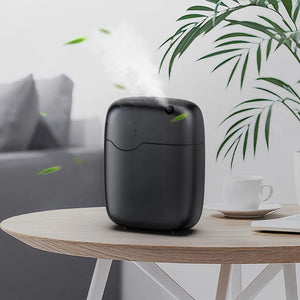
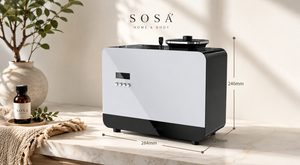
Small reception · no power neededFrom ₹749Shop →  Mid reception · has an off switch₹1,899Shop →
 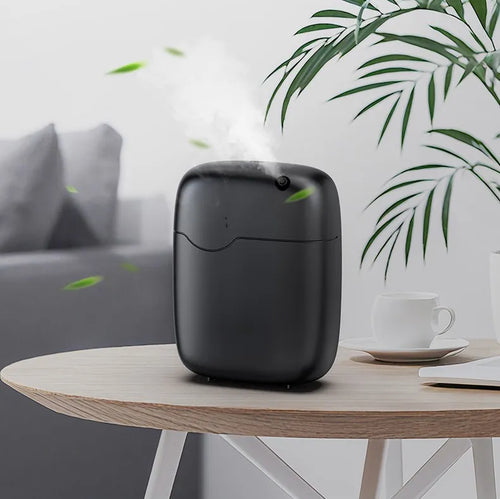 Large lobby · timed, dialable₹11,999Shop →
What to do instead, since fragrance is off the table
Spend the fragrance budget on air changes. A closed clinic sits at roughly 0.2–0.5 air changes an hour; a ventilated one runs somewhere between three and eight. Air conditioning does not close that gap, because it recirculates rather than ventilates — it cools the same air repeatedly and its filter and drain pan are two of the commonest odour sources in a small clinic. In a newborn clinic the practical programme is a genuine airing window before the first appointment, a fresh-air path that is actually open during the day rather than sealed for the sake of the AC, filters cleaned on a schedule someone signs, and the drain pan checked at the start of every humid season.
Then attack the sources, in order. The smells a newborn clinic actually gets complaints about are nappy bins, a sluice or basin trap that has dried out, a mop bucket stored wet, phenolic disinfectant used at the wrong dilution or applied with every window shut, and soft furnishings that have absorbed months of the above. Sorption is the quiet one: cushions, curtains, upholstered seating, rugs and soft toys take up odour and release it back slowly, so a room can smell of something that was removed weeks ago. Wipeable seating, washable covers that genuinely go through a wash, lidded and frequently emptied bins, and running water into every trap on a Monday morning will do more for a newborn clinic than any product we sell.
And say out loud that the clinic is fragrance-free. This is the part clinics skip, and it is the part that converts a restriction into a signal. A short, plainly worded line at the desk and on the appointment confirmation — that the clinic does not use added fragrance in any patient area — costs nothing and tells a parent something specific about how the place is run. It also gives staff a script when a well-meaning supplier, a landlord or a new receptionist arrives with a plug-in. The policy belongs to the facility’s clinical governance and infection-control leads; our job is to supply what they decide, including nothing.
What we would install — and what we would not
The starred row is the recommendation for this clinic type. The rest of the ladder is here so that an owner comparing a newborn clinic with a general paediatric practice can see exactly where the two diverge, and why.
| Option | Suits | Control you get | Price |
|---|---|---|---|
| Reed diffuser | A small reception desk — a back office or staff room on separate air, three reeds not six — not a patient area, ever | Reed count only — no switch, no timer | from ₹749 |
| Sukoon 500ml | A reception up to ~320 sq ft — a mixed practice where newborns are a small part of a wider list and reception is a genuine transit space | On/off, intermittent mode, you control the drops | ₹1,899 |
| Vaayu | A large lobby or a zoned duct — a large general paediatric lobby on its own duct zone — not a newborn clinic of any size | Duty cycle in seconds, timer, app scheduling | ₹11,999 |
| Aangan | Whole-facility HVAC — a multi-speciality facility with genuinely zoned ducting, where the newborn floor is excluded at the duct | Zone-level control, but only if the ducting is zoned | ₹25,999 |
| Nothing at all ★ | A clinic built around newborn care — every patient area, reception included, and this is the row we would star | Complete — and the correct answer more often than the trade admits | ₹0 |
Versailles
I have written most of this cluster arguing that a light, dry note at a paediatric reception is a real and defensible detail. I will not argue it for a newborn clinic. When the entire patient list is a few weeks old, the only honest recommendation is to install nothing and to be clear about why — not because we know of a harm, but because nobody has established that our product belongs in that room, and the occupant cannot tell us.
The thing owners find hardest to accept is that reception is included. They have usually been told, by us among others, that reception is the safe zone. It is, in a general practice where a family crosses it in a few minutes. It is not, in a clinic where the same family sits in it for ninety minutes waiting for a second weight, feeding, settling and waiting again. The rule did not change; the room did.
So the sale I would rather make to a newborn clinic is a conversation about its bins, its traps, its filter schedule and its morning airing window, and then nothing on the invoice. Put the question through your own infection-control and clinical governance people and let them own the answer. If they come back and say the staff room may have a reed in it, that is a reasonable place to land. A portion of every order funds a girl’s classroom through Nanhi Kali, and I am content for that to come from a different customer.
Frequently asked questions
- Neonatal follow-up: patient areas fragrance-free? — yes, and where the line sits.
- How should a clinic serving babies handle reception? — the shared-waiting test.
- The most conservative strategy — fragrance-free by default, one reviewable exception.
- What to consider before scenting at all — the checklist before you buy.
- Brand: the SOSA founder story.
SOSA products & prices (verified August 2026): Hotel Collection water-based ultrasonic diffuser fragrance 15ml ₹299 · 100ml ₹999 · 300ml ₹1,799 · Pack of 7 (15ml, all fragrances) ₹1,799; refills 100ml from ₹999. Seven scents: The Ritz-Carlton-inspired (white tea · bergamot · cedar), Westin-inspired (white tea · aloe · cedar), 1 Hotels-inspired (cedarwood · vetiver · green leaves), The St. Regis-inspired (amber · violet · woods), Shangri-La-inspired (jasmine · green tea · white tea), Four Seasons-inspired (citrus · floral · sandalwood), W Hotels-inspired (citrus · pepper · amber). Diffusers: Boond 300ml ₹899 · Sukoon 500ml ₹1,899 · Megh 6L ₹3,499. Water-based, phthalate-free, composed to IFRA standards for home diffusion; 3–6 drops per tank. Made in India, Pune. The Hotel Collection scents are SOSA's own interpretations inspired by the world's finest hotels; all hotel names are trademarks of their respective owners and are used only to describe the scent style — SOSA is an independent Indian fragrance house, not affiliated with or endorsed by any hotel brand. Prices and availability subject to change — see the live product pages.