

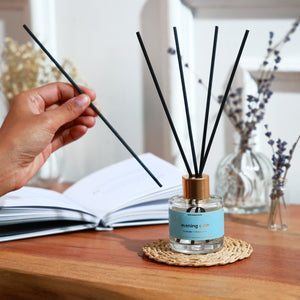



Dose is set by dwell time, and dwell time here is long. Cataract assessments, multi-test circuits and dilated reviews put the same person in the same air for forty minutes to three hours. Three reeds of the six supplied, one source, and the lowest machine setting that registers at all.
Design around the chairs that cannot move. Priority seating near the desk is usually fixed for mobility reasons, so the source moves instead — far end of the arrival zone, out of the air-conditioning path, and never beside the seat somebody has been directed to.
For plenty of practices the honest answer is not yet. A small, shut arrival zone plus two-hour circuits plus fixed seating you cannot rearrange is a combination where I would recommend buying nothing and fixing the air and the layout first.
2. Three of the six reeds supplied, and one source in the whole arrival zone. Six is where SOSA calibrates every composition and where the published strength positions are measured — those positions are on SOSA's own internal scale, not an industry standard — so three is a deliberate step below the published figure rather than a different product.
3. The dose is set by dwell time, and this caseload has the longest dwell time in ophthalmology. A cataract assessment, a multi-test workup or a dilated review keeps the same person in the same air for forty minutes to three hours. Set the level for the end of that, not for the door.
4. Count people, not chairs. Most patients in this caseload arrive with a family member or an attendant, so a room with twenty chairs frequently holds thirty people. A fuller, warmer room carries a fragrance differently from an empty one, which is another argument for judging the level at your busiest hour rather than at eight in the morning.
5. Place the source around the seating you cannot move. Priority chairs near the desk exist for mobility reasons and should stay exactly where they are. So the source goes to the far end of the arrival zone, turned into the room, out of the air-conditioning return path and away from the corridor to consultation — and never immediately beside a seat somebody has been directed to.
6. The fragrance-free seat has to be a place people were going to sit anyway. A seat across the room, up two steps or behind a pillar is not an option, it is a gesture. In this caseload it should be part of the ordinary seating plan, and every person on the desk should know which chairs those are.
7. A quiet room makes a machine's noise the first thing you notice. If you go to a machine at all, under 38 dB is the specification that matters most — a waiting area where the equipment is audible is worse than one with no fragrance in it. That is the honest reason a clinic is a defensible environment for a Vaayu ₹11,999 at all, and it applies only past roughly 320 sq ft of connected arrival zone.
8. Nothing here is a claim about anybody, and nothing here goes past the consultation door. No product or setting on this page is described as safe, unsafe or suitable for any patient group, and no assumption is made about how any age group perceives fragrance. Examination rooms, diagnostics, consultation cabins, the procedure suite and post-operative areas take nothing at any level. Composed and made in small batches in Pune, and a portion of every order supports girl-child education through Nanhi Kali.
Part one — what to design around, and what to refuse to assume
This question is usually asked in good faith and answered badly, because the tempting answer is to describe a group of people and design a room for the description. I am not going to do that, and the refusal is not squeamishness — a room built on an assumption is a room you cannot troubleshoot, because when it goes wrong there is nothing measurable to change. Here is what to design around instead.
 Evening Calm₹799 · softest at 8.9Three things about a senior-heavy caseload are observable from your own appointment book, and all three point the same way. The first is dwell time. Cataract assessments, dilated reviews and multi-station workups mean the same person occupies the same air for forty minutes to three hours, often with little to occupy them, which is a fundamentally different exposure from the ten to forty minutes a browser spends in a shop. The second is the number of people per chair. Most of these appointments arrive as two people rather than one, so a room designed around its chair count routinely holds a third more bodies than it was planned for — and a full, warm room with people moving through it carries a fragrance quite differently from the empty room you judged it in. The third is frequency. A pre-operative assessment, a procedure, a review and a follow-up mean the same person is in your arrival zone several times in a few months, so a composition that is merely tolerable on a first visit has several more chances to become tiring. All three arguments are the same argument: less, and lower.
Part two — four things that genuinely differ, and what each changes
The whole argument in one table: what is different, what it honestly tells you, what it changes about the room, and what it changes about the fragrance. The second column exists to stop each row being over-read.
| What is observably different | What it tells you — and what it does not | What it changes about the room | What it changes about the fragrance |
|---|---|---|---|
| Dwell time of 40 minutes to 3 hours ★ | That exposure is long and continuous. It tells you nothing about anyone's sensitivity | The level must be judged at the end of a visit, not at the door | Three reeds of six, one source, or the lowest machine setting that registers |
| Most appointments arrive as two people | That your people count exceeds your chair count. Not that the room is crowded in any clinical sense | A fuller, warmer room with more movement through it | Judge and set the level at your busiest hour, with every chair occupied |
| The same person returns several times in a few months | That first impressions matter less and repetition matters more | Consistency becomes worth more than character | Choose a composition that wears well on a fourth visit, not one that impresses on a first |
| Priority seating near the desk is fixed | That the seating plan has reasons unrelated to fragrance and should not be altered for it | The diffuser becomes the movable object in the room | Far end of the arrival zone, turned inward, out of the AC return path, never beside a directed seat |
| The waiting room is often noticeably quiet | That the noise floor is low, so equipment is audible. Nothing more than that | Any machine has to disappear acoustically as well as visually | If you use a machine at all, under 38 dB is the specification to check first |
| Staff exposure is unchanged by any of this | That your receptionist is still in that air eight or nine hours a day | The desk remains the group whose opinion sets the level | Ask them at week two and week four with an open question, and act on the answer |
| The honest caveat: every row describes the arrival zone only — reception and waiting. Examination rooms, diagnostic areas, consultation cabins, the procedure suite and any post-operative area take nothing at any level, in any format, at any hour, and that is the practice's own clinical judgement rather than a supplier's recommendation. Nothing here is medical, clinical or safety advice; no claim of any kind is made about how any age group perceives, tolerates or responds to fragrance, and no product or setting is described as safe or unsafe for any patient group. Some people are sensitive to airborne fragrance, which is why the clinical pathway stays fragrance-free and why a fragrance-free seat must genuinely exist. Appointment lengths and companion patterns are ordinary descriptions of how such clinics tend to run, not standards. A diffuser adds a scent to the air; it does not clean, purify, filter or freshen it, and it removes no existing smell. | |||
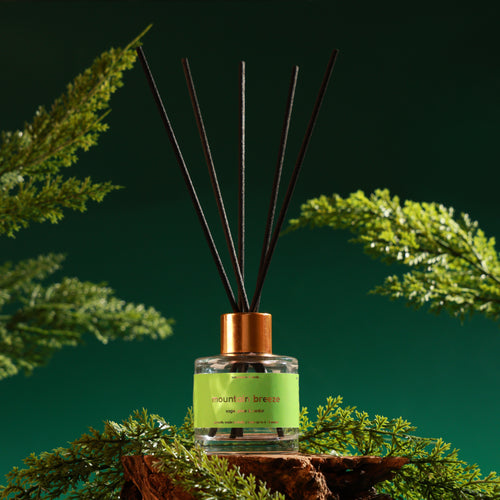
Mountain Breeze · hardest to name₹849Shop → 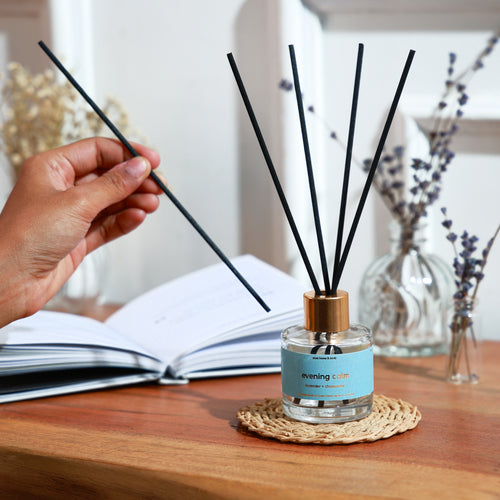 Evening Calm · softest, but nameable₹799Shop →
  Sukoon · lowest mode only₹1,899Shop →
Part three — when a senior-heavy practice should buy nothing
I want to be direct about this, because it is the part of the answer that a fragrance brand has every commercial reason to leave out. There is a common configuration in which the correct recommendation is to spend nothing at all, and a large senior caseload is one of the two places in this entire cluster where it arises most often. The configuration is this: a compact arrival zone, often under 150 square feet; poor air exchange, because the room is sealed and air-conditioned and the front door is the only opening; appointment circuits that keep the same people in that air for two hours or more; and seating that cannot be rearranged because it is placed for mobility. Each factor on its own is workable. Together they produce a room where any source accumulates rather than disperses, is experienced continuously rather than in passing, and cannot be escaped by moving chair. That is not a fragrance problem to be solved with a smaller bottle. It is a ventilation and layout problem, and the honest sequence is to deal with the air and the seating first, then ask again in a quarter.
The second case for buying nothing is simpler and it is settled by asking. If the people at your front desk would rather have nothing, that is a complete answer, and it does not need to be justified further. They are in that air for eight or nine hours a day against a patient's forty minutes to three hours, and they have the least ability to leave it. Ask them properly — not "does this bother you", which invites a polite no from anyone who thinks the boss has already decided, but "if you could change one thing about this room, what would it be", which lets fragrance come up on its own or not at all. Then ask again a fortnight later, because the first answer is usually about novelty and the second is about living with it. And if a member of staff raises it unprompted, treat that as a measurement rather than an outlier: in a room where most people say nothing, one person saying so is exactly what an over-set level looks like from the inside.
The third thing worth saying is about what a waiting room in this specialty is actually competing with, because it changes the ambition. A practice is judged on competence, and every other signal in the building should stay well behind that one. An arrival zone that smells like a spa reads as a practice trying to be something it is not — and in a caseload where a person may be attending for a procedure they are taking seriously, that mismatch is more conspicuous, not less. The target is considered, never scented: clean surfaces, uncluttered counters, chairs that are easy to get out of, decent light, a queue that moves, and — only if all of that is already true — a low, dry scent at the far end of the room that a visitor could not name.
Part four — the compositions, and how identifiable each one is
Five reed compositions and the machine range, what each leads with, how easily a visitor could put a name to it in a quiet room, how it reads in a clinical building, and what I would run it at. The third column is the one that decides this page.
| Composition | What it leads with | Could a visitor name it? | How it reads in a clinic arrival zone | What I would run it at |
|---|---|---|---|---|
| Mountain Breeze · ₹849 / ₹1,349 ★ | Himalayan pine and sage over Indian cedar — dry, no sweetness | Rarely — most people register "clean and dry" rather than a material | Considered rather than decorated; the least to announce of anything in the range | Three of six reeds, one source, far end of the arrival zone |
| Evening Calm · ₹799 / ₹1,299 | Kashmir lavender and chamomile — the softest composition SOSA makes, at 8.9 | Often. Lavender is among the most recognisable materials in perfumery | Gentle, but a room that can be named is a room set too high | Three reeds at most, and only if you have verified nobody is naming it |
| Morning Freshness · ₹749 / ₹1,249 | Malabar lemon, peppermint and Nilgiri eucalyptus — bright and sharp | Usually, and often as a category rather than a scent | In a medical building a bright citrus-eucalyptus profile can read as a cleaning product rather than as ambience | Three reeds if you use it at all; it is a better fit for a compact, well-ventilated entrance |
| Garden Bloom · ₹799 / ₹1,299 | British rose and night-blooming jasmine — floral weight | Almost always | Reads as decoration, which competes with the signal a clinic wants read | I would not specify it for this room; it belongs in an entryway or a living room |
| Fresh Brew · ₹849 / ₹1,349 | Coorg coffee and Kerala vanilla — warm, deep, gourmand, 9.5 on SOSA's scale | Immediately | Reads as a café. The wrong register for a clinical building at any strength | Not in a clinic arrival zone |
| Hotel Collection · 15ml ₹299 · 100ml ₹999 · 300ml ₹1,799 | Water-based fragrance for ultrasonic machines only — a separate line from the reeds | Depends entirely on the dose in the tank | Fewer drops in the same volume of water is the cheapest step down an ultrasonic has | Sukoon on its lowest mode, dosed light; hotel-inspired only, SOSA is independent and unaffiliated |
Versailles
A practice manager wrote to me asking which of our compositions was "best for elderly patients", and I did not have a good answer, because there is no such composition and I do not think there should be. What I asked her instead was a set of questions that had nothing to do with fragrance: how long is your longest wait, how many people arrive per appointment, which chairs cannot move, and how many square feet is your reception on its own — not the clinic, the reception.
Her answers made the specification obvious in about four minutes. A hundred and eighty square feet of arrival zone; waits of up to two hours on assessment mornings; nearly every patient arriving with a son or a daughter; and a row of fixed chairs immediately beside the desk, which was exactly where she had been planning to put the bottle. Nothing about that required a theory about anybody. It required one bottle, three reeds, at the opposite end of the room, judged at eleven in the morning rather than at half past eight.
What stayed with me was her last message. She said the useful part had not been the recommendation but being asked about her own room, because it had made her realise she had been about to buy a solution to a question she had never actually measured. I make fragrance for a living, but the number of eye clinics that need more fragrance is far smaller than the number that need their reception measured, their air moving and their chairs somewhere sensible. Composed and made in small batches in Pune, and a part of every order funds a girl's classroom through Nanhi Kali.
Frequently asked questions
- How to verify that "subtle" is actually subtle — the measurement half of this page.
- Long multi-test waits and a premium cataract clinic.
- The most conservative way to introduce fragrance at all — the staged sequence this page assumes.
- Handling patients who are sensitive to strong fragrance.
- Brand: the SOSA founder story.
SOSA range, specifications and prices used in this guide (verified August 2026): Vaayu ₹11,999 — waterless cold-air nebulisation of undiluted fragrance oil; no water, no heat, no added humidity, no white mineral dust. Coverage up to 1000 m³, about 2,000–3,000 sq ft. 400ml refillable tank lasting roughly 90+ days at a mid setting. Bluetooth app plus onboard controls, 1h / 4h / 8h / 24h run windows, day selection, adjustable intensity, auto-stop and key-lock. Under 38 dB. DC 12V / 1A, 5W. Freestanding or wall / HVAC mount. CE, RoHS and SGS certified. SOSA does not currently sell a separate Vaayu cold-air refill oil; the 400ml supplied in the box is the fragrance available at the time of writing, so a practice planning continuous or multi-site use should confirm current refill availability with SOSA before committing. The water-based Hotel Collection is made for ultrasonic machines and must not be used in a Vaayu. Other machines: Boond 300ml ₹899 (~150 sq ft, ultrasonic) · Sukoon 500ml ₹1,899 (270–320 sq ft, 16–18 hours on low, remote and steady/2H/4H timers, three 15ml fragrances included, ultrasonic) · Megh 6L ₹3,499 (~215 sq ft — a runtime and humidity machine that covers less than a Sukoon, never a coverage upgrade) · Safar ₹3,999 (waterless cold diffusion, cordless, 20ml, about 6.9cm, three speeds, 1/2/3-hour auto-off — sold as a car and travel diffuser, personal-scale only; SOSA publishes no coverage figure for it) · Aangan ₹25,999 (HVAC nebulising, ~8,000–10,000 sq ft) · Meenar ₹38,500 (commercial HVAC, 12,000–18,000 sq ft). Water-based Hotel Collection for ultrasonic machines: 15ml ₹299 · 100ml ₹999 · 300ml ₹1,799 · pack of seven ₹1,799; scents are inspired by the atmosphere of well-known hotels — SOSA is an independent Indian brand and is not affiliated with, endorsed by or supplying any hotel group. Reed diffusers ₹749–₹1,349 (50ml 6–8 weeks, 130ml 14–18 weeks, six fibre reeds, no 100ml size; replacement reeds are not sold separately). Reed oil cannot be used in an ultrasonic machine and Hotel Collection oil cannot be used in reeds. SOSA sells no room spray or home spray — every SOSA spray is a car perfume. Nothing in this guide is medical, clinical or safety advice. A fragrance diffuser adds a scent to the air. It does not clean, purify, filter, sanitise or disinfect air, does not remove or neutralise disinfectant, damp or occupancy smells, and has no effect on comfort, anxiety, waiting time, recovery or any clinical outcome. Some people are sensitive to airborne fragrance, which is why this guide recommends that examination rooms, diagnostic areas, consultation cabins, procedure suites and post-operative areas remain fragrance-free, that a fragrance-free seating option always exist, and that a diffuser is never mounted into shared HVAC in a clinical building. Decisions about clinical policy, ventilation standards, infection control and patient suitability rest entirely with the practice and its clinicians. A persistent stale, damp or disinfectant smell is a ventilation, moisture or cleaning problem — SOSA sells no dehumidifier and no air purifier, and fragrance should never be used to cover one. Coverage, runtime and longevity figures are manufacturer specifications and typical ranges, not guarantees, and vary with room volume, ceiling height, air exchange, occupancy and season. SOSA publishes no commercial or bulk pricing, no corporate account, no annual maintenance contract, no installation service, no stated warranty term and no multi-location programme; warranty length, spare parts, servicing and app platform availability are unconfirmed, and larger or multi-site enquiries should go through the contact page before any commitment. Composed and made in small batches in Pune, India. Free shipping above ₹499. A portion of every order supports girl-child education through Nanhi Kali. Prices subject to change — see the live product pages.