
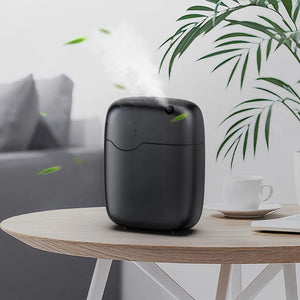

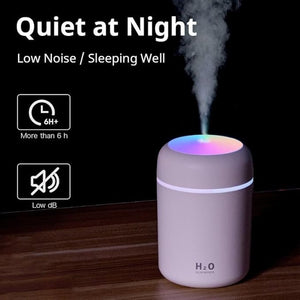


A timer and a schedule are different machines. A timer runs for a duration from the moment somebody presses it, so the person is the clock. A schedule runs on chosen days without anybody deciding anything that morning. In a clinic with three people on the front desk, that difference is the whole feature.
Hours do not create the boundary — this is the correction this page exists to make. Scheduling decides when reception is scented. It cannot make a consultation cabin or a procedure room appropriate to scent at a quiet hour, because that decision is spatial and clinical, and it belongs to the practice rather than to a timer.
Switching it off does not empty the room. Fragrance already in the air leaves at the rate the room exchanges air, not at the moment of the off command — so plan a lead-out, not a cut-off.
2. The two real schedules in the SOSA range are different animals. A Sukoon ₹1,899 has steady / 2H / 4H timer modes and a remote — a duration that starts when a person acts. A Vaayu ₹11,999 publishes 1h / 4h / 8h / 24h run windows with day selection in its Bluetooth app, which is a schedule that survives the person forgetting.
3. The run windows come in fixed sizes, and that is worth knowing before you plan a rota. The published options are 1, 4, 8 and 24 hours. A clinic open from nine to seven has a ten-hour day and no ten-hour window, so it chooses eight and places it where the waiting is heaviest, or it chooses four and accepts that the late list runs unscented. Exactly how a start time is anchored is a question for the app itself, and I would confirm that in the app before building a staff rota around it rather than taking my word for it.
4. The key-lock is what makes a schedule a schedule. An unlocked machine on a front desk is not scheduled; it is merely set, and settings on a shared desk drift. Lock it and the window you agreed in March is still the window in November.
5. Under 38 dB is why a machine can sit in a waiting room at all. A run window is worthless if the thing keeping it is audible over a quiet room. That specification is the reason a clinic is a defensible environment for a Vaayu in the first place, and it matters more here than the fragrance does.
6. A schedule reduces consumption, which matters because of a real supply gap. The 400ml supplied in a Vaayu box runs roughly 90+ days at a mid intensity setting — 400 ÷ 90 is about 4.4 ml a day on that arithmetic. An eight-hour window on six clinic days is 48 hours a week against 168 for a machine left on, a little under 30 per cent of the hours. The direction is obvious; the exact multiple is not, because SOSA does not publish the run hours behind the 90-day figure. SOSA does not currently sell a separate Vaayu cold-air refill oil, so a practice planning continuous or multi-site use must confirm current refill availability through the contact page before committing.
7. Off is not instant, and the room is the reason. Fragrance already in the air leaves at whatever rate that room exchanges air. Plan a lead-out — stop the window before your last patients are seated, not as they stand up.
8. None of this touches the boundary, and nothing on this page should be read as though it did. A quiet hour does not make an examination room, a diagnostic bay, a consultation cabin, a procedure suite or a post-operative area appropriate to scent. That is the practice's own clinical judgement and SOSA does not advise into it. Composed and made in small batches in Pune, and a portion of every order supports girl-child education through Nanhi Kali.
Part one — three things a run window is, and one it is not
Practices arrive at this question from two directions. Some want the arrival zone quieter for most of the day and pleasant for the busy hour; others want a guarantee that nothing is running while a particular list is in progress. Both are reasonable, both are achievable, and both are answered by hardware rather than by good intentions. Here is what a run window genuinely gives you, and then the thing it cannot give you at any price.
 Sukoon 500ml₹1,899 · 2H, 4H, remoteA Sukoon holds 500ml, runs 16–18 hours on low, and offers steady, 2H and 4H modes with a remote. That is a timer: somebody presses two hours, and two hours later it is done. It is genuinely useful in a 150–320 sq ft arrival zone and it is the sized product for most Indian eye clinics. But the clock in it starts when a person acts, so the person is the schedule — and on a desk staffed by three people across a week, the person is the least reliable component in the building. A Vaayu publishes run windows of 1, 4, 8 and 24 hours with day selection in the app, which is a different proposition: you choose clinic days once and the machine keeps them. If your practice closes on Sundays, takes a half day on Wednesday and runs a heavy Saturday, day selection is not a luxury feature. It is the feature.
Part two — the clinic day, block by block
A working day in an Indian eye clinic is not one continuous state, and a schedule ought to follow its actual shape rather than its opening hours. The rightmost column is where the argument lives: most blocks of the day are better unscented, and saying so is the point of building a window at all.
| Block of the day | What is happening in the arrival zone | Running? | The reasoning |
|---|---|---|---|
| The first arrivals, roughly 30–60 min after opening ★ | Doors moving constantly, the room filling, air still settling from the overnight close | Yes — this is the window worth having | If you only ever run one block, run this one: it is the busiest air and the most doors |
| Pre-opening clean-down | Staff only, cleaning products in the air, windows or doors often open | No | Fragrance layered onto cleaning chemistry makes a third smell nobody designed; let the room clear on its own |
| The mid-morning lull | Two or three people waiting, doors mostly still | Not usually | Low occupancy means the same output sits in the same air far longer — the identical setting reads stronger |
| The long waits — dilation, multi-test workups | The same people in the same chairs for 40 minutes to 3 hours | Only at the lowest setting, if at all | Constant exposure is the hardest case in the building; if you are uncertain anywhere, be uncertain here |
| The lunch or list changeover | Room nearly empty, staff eating, kitchen or tiffin smells present | No | Nothing to serve, and food and ambient fragrance are a poor combination in any building |
| The evening peak | The second-busiest hour, often the fullest room of the day | Yes, if your day has two peaks | Same reasoning as the morning; stop it before the last patients are seated, not after |
| After the last patient | Closing down, staff finishing notes, cleaners arriving | No | Nobody is being received; this is the block practices most often leave running by accident |
| Closed days and holidays | Empty building, air-conditioning off, no exchange at all | No — this is what day selection is for | Running into a sealed empty building concentrates it and wastes supply you may not be able to replace |
| The honest caveat: every row above describes the arrival zone only — reception and the waiting area. Examination rooms, diagnostic bays, consultation cabins, the procedure suite and any post-operative area take nothing in any block, on any day, at any setting, and that is a clinical decision for the practice rather than a scheduling one. Nothing here is medical, clinical or safety advice, and no run window is described as safe or unsafe for anyone: some people are sensitive to airborne fragrance, which is exactly why the clinical pathway stays fragrance-free and why a fragrance-free seat should exist in the waiting area whatever the schedule says. Block names and durations are ordinary descriptions of how clinic days tend to be shaped, not standards. A diffuser adds a scent to the air; it does not clean, purify, filter or freshen it, and switching it off removes nothing that is already there. | |||
Vaayu · windows plus days₹11,999Shop →  Sukoon · timer, not schedule₹1,899Shop →
  Morning Freshness · no clock at all₹749Shop →
Part three — why "only during certain hours" fails in practice
Almost every practice that tells me its scenting is scheduled means something looser than that. What they usually have is an intention, held by a person, executed on the days that person is calm. The commonest arrangement is a machine switched on by whoever opens up and switched off by whoever locks up, and it fails in a specific and predictable way: the failures are asymmetric. Nobody notices the morning it did not get switched on, because the room simply smells of nothing and no one complains about nothing. Everybody eventually notices the fortnight it did not get switched off, because the level has crept, the tank has emptied faster than expected, and somebody has decided the machine is faulty. A manual routine therefore drifts in one direction only, and it drifts towards more. If a practice wants hours, the hours have to live in the equipment. That is the entire argument for the key-lock and the day selection, and it is why I am comfortable recommending a machine on operational grounds in a building where I would recommend restraint on every other grounds.
The second failure is a misunderstanding of what "off" means in a room. An off command stops production; it does not retrieve anything. What is already suspended in the air of your waiting room leaves at the rate that room exchanges air with everywhere else, and in a sealed, air-conditioned Indian clinic in May that rate can be slow. The practical consequence is that a window has a tail on both ends. It takes some minutes after the start for the room to reach the level you intended, and considerably longer after the stop for the room to return to nothing. So build in a lead-out: end the window well before your last group is seated rather than at the moment they stand up. And if you have a clinical reason to want the arrival zone genuinely clear by a particular time, the honest answer is not a tighter schedule, it is an earlier one — with the doors and the ventilation doing the work that no machine setting can do for you.
The third failure is the one I find hardest to argue people out of, because it comes from good hospitality instincts: the boost. A visiting surgeon is coming, a camp is running, an inspection is expected, and somebody turns the machine up or extends the window for the day. The trouble is that the boost never gets reversed on the same day it was applied, and after three or four of them the elevated setting has become the setting. This is exactly why the key-lock earns its place — not to stop misuse, but to stop well-intentioned generosity. If you want the room to read differently for one morning, use the levers that are free and reversible: open the room out, move the chairs, clear the desk, get the light right. Fragrance is the wrong lever for a one-day event.
Part four — which format can actually keep hours
Six formats, what timekeeping each genuinely has, what the schedule looks like in practice, who has to do something for it to happen, and the honest limit of each. Read the fourth column before the price.
| Format | Timekeeping it actually has | What the schedule looks like | Who has to act, and how often | The honest limit |
|---|---|---|---|---|
| Vaayu ₹11,999 ★ | 1h / 4h / 8h / 24h run windows, day selection in the app, key-lock, adjustable intensity, under 38 dB | Chosen once; the machine keeps clinic days on its own | Nobody, after setup — which is the whole point | Windows come in fixed sizes, so a ten-hour day gets an eight-hour window; and no separate refill oil is currently sold |
| Sukoon ₹1,899 | Steady / 2H / 4H timer modes, remote, 16–18 hrs on low per 500ml fill | A duration begun by a person, once or twice a day | A member of staff, every session | No day selection and no lock, so it holds hours only as well as your rota does |
| Boond ₹899 | None published beyond its ~6 hours a fill and a USB supply | The fill is the schedule — it runs until the water is gone | Whoever fills it, daily | ~150 sq ft, so it suits a small desk area rather than a waiting room |
| Megh ₹3,499 | 6L tank, roughly 100 hours of runtime | Long-running rather than scheduled; runtime is not a timetable | Rarely — which is exactly the problem here | Covers about 215 sq ft, less than a Sukoon: a runtime and humidity machine, never a coverage upgrade |
| Safar ₹3,999 | 1 / 2 / 3-hour auto-off, cordless, 20ml, three speeds | Genuinely timed, but at personal scale | A person, each time | No published coverage figure at all; it is a 6.9cm car diffuser, not a room product |
| Reed diffuser ₹749–₹1,349 | None. Passive capillary — no power, no fan, no switch | There is no schedule; 50ml runs 6–8 weeks, 130ml runs 14–18 weeks | Nobody can act, which is the honest weakness and also the honest strength | The only "off" is removing the bottle from the room, and that never survives a busy desk |
Versailles
A clinic manager wrote to me with what she thought was a simple purchasing question and what turned out to be the most useful correspondence I had that month. She wanted to know whether a machine could be set to run only between half past nine and half past eleven, because that was when her waiting room filled, and she did not want anything running for the rest of the day. She had assumed this was an exotic request.
It is not exotic; it is the most sensible thing anybody has asked me to specify. What she had actually worked out, without using the words, was that the correct amount of scenting for her building was two hours out of eleven — and that the reason she had been unhappy with the bottle on her desk was not the composition, or the strength, or the placement. It was that the bottle had no opinion about eleven o'clock. She had been trying to solve a timekeeping problem with a chemistry product.
What I want practices to take from her question is the order of the decisions. First decide whether the room should be scented at all, and be willing to answer no. Then decide which zone, and never let that answer include anything past the consultation door. Then decide the hours — and only then decide the format, because the hours are what tell you whether you are buying a bottle or a machine. Deciding the format first is how a clinic ends up with equipment that cannot do the one thing it was bought for. Composed and made in small batches in Pune, and a part of every order funds a girl's classroom through Nanhi Kali.
Frequently asked questions
- The most conservative way to introduce fragrance into an ophthalmology practice — the staged version of everything above.
- Why a clinic runs materially below a salon or a showroom — the level, where this page covers the hours.
- Stopping reception fragrance travelling into clinical areas and keeping procedure areas fragrance-free.
- Handling patients who are sensitive to strong fragrance.
- Brand: the SOSA founder story.
SOSA range, specifications and prices used in this guide (verified August 2026): Vaayu ₹11,999 — waterless cold-air nebulisation of undiluted fragrance oil; no water, no heat, no added humidity, no white mineral dust. Coverage up to 1000 m³, about 2,000–3,000 sq ft. 400ml refillable tank lasting roughly 90+ days at a mid setting. Bluetooth app plus onboard controls, 1h / 4h / 8h / 24h run windows, day selection, adjustable intensity, auto-stop and key-lock. Under 38 dB. DC 12V / 1A, 5W. Freestanding or wall / HVAC mount. CE, RoHS and SGS certified. SOSA does not currently sell a separate Vaayu cold-air refill oil; the 400ml supplied in the box is the fragrance available at the time of writing, so a practice planning continuous or multi-site use should confirm current refill availability with SOSA before committing. The water-based Hotel Collection is made for ultrasonic machines and must not be used in a Vaayu. Other machines: Boond 300ml ₹899 (~150 sq ft, ultrasonic) · Sukoon 500ml ₹1,899 (270–320 sq ft, 16–18 hours on low, remote and steady/2H/4H timers, three 15ml fragrances included, ultrasonic) · Megh 6L ₹3,499 (~215 sq ft — a runtime and humidity machine that covers less than a Sukoon, never a coverage upgrade) · Safar ₹3,999 (waterless cold diffusion, cordless, 20ml, about 6.9cm, three speeds, 1/2/3-hour auto-off — sold as a car and travel diffuser, personal-scale only; SOSA publishes no coverage figure for it) · Aangan ₹25,999 (HVAC nebulising, ~8,000–10,000 sq ft) · Meenar ₹38,500 (commercial HVAC, 12,000–18,000 sq ft). Water-based Hotel Collection for ultrasonic machines: 15ml ₹299 · 100ml ₹999 · 300ml ₹1,799 · pack of seven ₹1,799; scents are inspired by the atmosphere of well-known hotels — SOSA is an independent Indian brand and is not affiliated with, endorsed by or supplying any hotel group. Reed diffusers ₹749–₹1,349 (50ml 6–8 weeks, 130ml 14–18 weeks, six fibre reeds, no 100ml size; replacement reeds are not sold separately). Reed oil cannot be used in an ultrasonic machine and Hotel Collection oil cannot be used in reeds. SOSA sells no room spray or home spray — every SOSA spray is a car perfume. Nothing in this guide is medical, clinical or safety advice. A fragrance diffuser adds a scent to the air. It does not clean, purify, filter, sanitise or disinfect air, does not remove or neutralise disinfectant, damp or occupancy smells, and has no effect on comfort, anxiety, waiting time, recovery or any clinical outcome. Some people are sensitive to airborne fragrance, which is why this guide recommends that examination rooms, diagnostic areas, consultation cabins, procedure suites and post-operative areas remain fragrance-free, that a fragrance-free seating option always exist, and that a diffuser is never mounted into shared HVAC in a clinical building. Decisions about clinical policy, ventilation standards, infection control and patient suitability rest entirely with the practice and its clinicians. A persistent stale, damp or disinfectant smell is a ventilation, moisture or cleaning problem — SOSA sells no dehumidifier and no air purifier, and fragrance should never be used to cover one. Coverage, runtime and longevity figures are manufacturer specifications and typical ranges, not guarantees, and vary with room volume, ceiling height, air exchange, occupancy and season. SOSA publishes no commercial or bulk pricing, no corporate account, no annual maintenance contract, no installation service, no stated warranty term and no multi-location programme; warranty length, spare parts, servicing and app platform availability are unconfirmed, and larger or multi-site enquiries should go through the contact page before any commitment. Composed and made in small batches in Pune, India. Free shipping above ₹499. A portion of every order supports girl-child education through Nanhi Kali. Prices subject to change — see the live product pages.