

Ultrasonic Sukoon ₹1,899: adjustable, schedulable, switchable and stronger. Living rooms, offices, kitchen-adjacent spaces.
Critical: reeds take oil-based reed fragrance; the Sukoon takes the water-based Hotel Collection. Never interchange them.
2. Sukoon ₹1,899, if you want to control it. Living rooms, offices, open-plan spaces and anywhere adjacent to a kitchen. An ultrasonic is adjustable, schedulable and switchable, and it scents actively rather than waiting for the room to do the work. It is meaningfully stronger.
3. Never mix the liquids. Reed fragrance is oil-based and climbs fibre by capillary action. The Hotel Collection is water-based and made to be atomised by a vibrating plate. Reed oil in an ultrasonic clogs the plate; water-based fragrance in a reed will not wick. There is no Hotel-inspired reed.
4. Understand the honest weakness of each. A reed is passive, so it cannot fight a tadka or a monsoon draught — it will simply lose. An ultrasonic needs water, a socket and a decision, so it spends more of the year switched off than owners like to admit.
5. Most homes should buy both, in that order. Start with a reed for the bathroom or foyer, because those rooms have no alternative. Add the Sukoon when you want the living room turned up for an evening. Together they cover passive and active scenting for ₹2,648 with a 50ml reed, or ₹3,148 with a 130ml.
Made in India, composed by an ISIPCA Versailles-trained perfumer — and a portion of every order supports girl-child education through Nanhi Kali.
Two different mechanisms, not two grades of the same thing
A reed diffuser is a capillary system. Oil climbs the porous core of each fibre reed, reaches the exposed tip and evaporates into the room at whatever rate the temperature and airflow allow. Nothing pushes it, which is why it is silent, needs no power and runs indefinitely without attention — and also why it has no volume control beyond the number of reeds. An ultrasonic diffuser is an atomiser: a plate vibrating at high frequency breaks water and fragrance into a fine cool mist and a small fan pushes it out. One waits for the room; the other acts on it. That difference explains every practical distinction between them, including the one nobody mentions in the shop.
The one nobody mentions is that the liquids are not compatible. Reed fragrance is oil-based because it has to wick up fibre against gravity; the Hotel Collection is water-based because it has to disperse through a tank and be atomised without gumming a vibrating plate. Put reed oil into an ultrasonic and you will spend an evening cleaning the plate; put water-based fragrance into a reed and it will not climb. This also means there is no Hotel-inspired reed diffuser and there cannot be one — if those particular scents are what you want, the honest answer is the ultrasonic Sukoon at ₹1,899 and not a reed at all. For very large connected spaces there is also the waterless Vaayu at ₹11,999, which is a commercial machine rather than a domestic choice.
The three decisions that settle it
 SOSA reedsFrom ₹749This decides more cases than taste does. Most Indian entrance foyers have no plug point, and bathrooms rarely have one anywhere sensible relative to water — in both rooms a reed is frequently the only option, not merely the nicer one. Bedsides are a third case: a machine with a light and a fan next to your head all night is a genuine annoyance, and three reeds in a 50ml is not. Living rooms, studies and offices almost always have a socket, so the choice there is a real choice rather than a constraint.
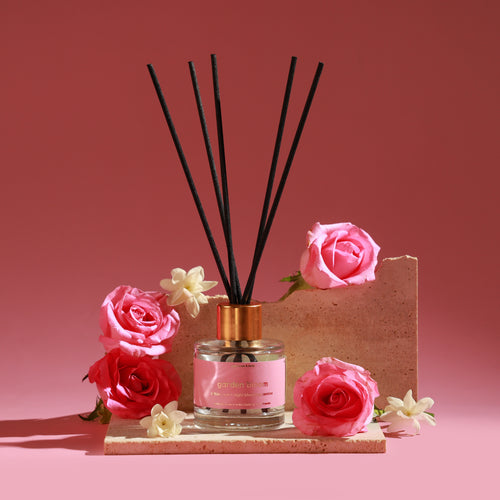
The five SOSA reed diffusers, for the rooms where a reed wins
All five reeds are oil-based, 50ml from ₹749 or 130ml from ₹1,249, in refillable glass with six fibre reeds included. None of these will work in an ultrasonic machine, and the water-based Hotel Collection will not work in these.
| Reed diffuser | Notes | Character | Best for |
|---|---|---|---|
|
Morning Freshness ★ ₹749 / ₹1,249 |
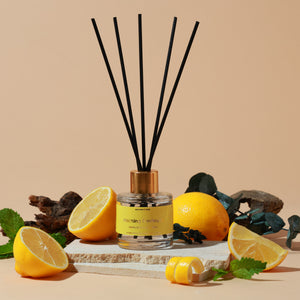
Malabar lemon · peppermint · eucalyptus | Bright, cool, clean — the sharpest throw in the range | Bathrooms and utility rooms, where there is no socket near water |
|
Mountain Breeze ₹849 / ₹1,349 |
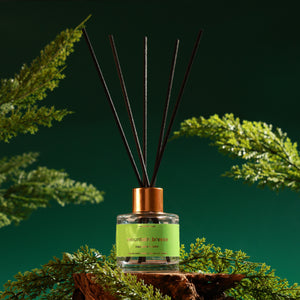
Himalayan pine · sage · cedar | Dry, green, grounded — the steadiest of the five | Entrance foyers and landings, which usually have no plug point at all |
|
Evening Calm ₹799 / ₹1,299 |
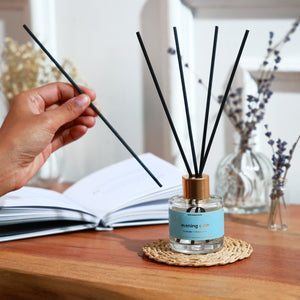
Kashmir lavender · chamomile | Soft, herbal, settling — the quietest | Bedsides, where a humming machine with a light would not be welcome |
|
Garden Bloom ₹799 / ₹1,299 |
British rose · night-blooming jasmine | Floral, romantic, dressed | Guest rooms and dressing rooms you want occasion-ready |
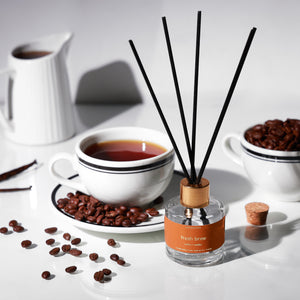
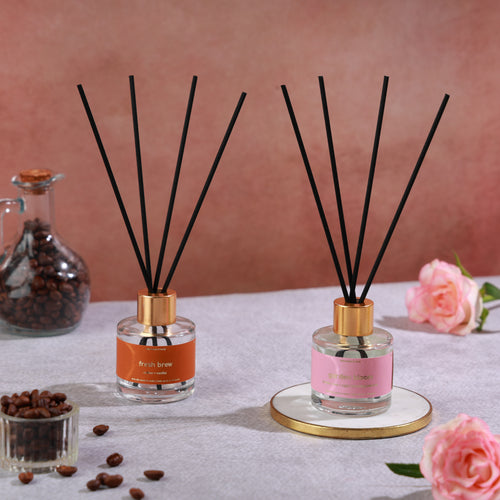
| Also in the range: Fresh Brew (₹849 / ₹1,349) completes the range with Coorg coffee and Kerala vanilla — a study blend rather than a passive-room one. See all five reed diffusers. | |||
The reed range · five scentsFrom ₹749Shop → 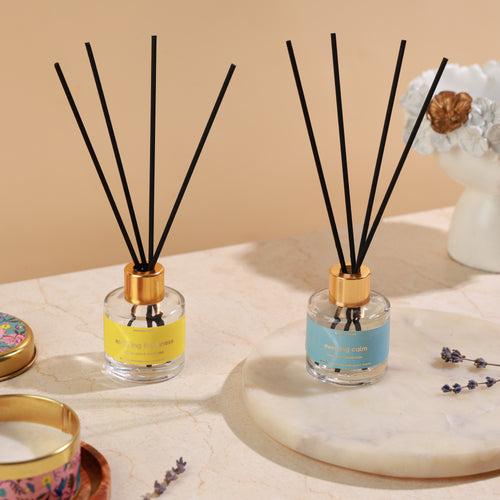 Day & Night duo · two rooms₹1,498Shop →
  Refills · 300ml₹2,399Shop →
Reeds, placement and drops — the controls each one gives you
On the reed side, the only control is reed count and it is a good one. Six fibre reeds come in the box: use all six in an entrance, a kitchen or a room of around 200 sq ft; four in a living room or standard bedroom; two or three in a compact bathroom, where a 50ml can then run close to three months. More reeds means stronger scent and faster consumption, which is a genuine trade rather than a free upgrade. Wait forty-eight hours before judging anything, because the fibre has to saturate along its whole length before it throws at all — this is the single commonest reason a perfectly good bottle gets written off on the first evening.
Placement matters more for a reed than for a machine, because the reed depends on the room to move its scent while the machine brings its own fan. Put it where air moves gently — a console near a doorway, a hall shelf — and keep it out of direct sunlight, which fades the fragrance and heats the oil, and away from the direct blast of an AC vent or ceiling fan, which drains the bottle fast and pushes everything against one wall. Stand it on a tray, because reed oil marks polished wood and untreated stone permanently if the bottle is knocked over, and keep it out of reach of children and pets. Never decant it, and never top a part-full bottle up with a different scent.
On the ultrasonic side the controls are different in kind. The Sukoon at ₹1,899 takes three to six drops of water-based Hotel Collection fragrance per tank, has adjustable mist and a timer, and can be switched off entirely — which is the whole reason to own one. It also adds a little humidity to the room, welcome in a dry or heavily air-conditioned flat and less so in a coastal monsoon, and the tank needs rinsing between scents. Use filtered water in hard-water areas. Neither machine is a substitute for the other, and the two liquids must be kept strictly to their own systems.
What to buy
The head-to-head, row by row, with the honest verdict in the last column. Note that the two together cost less than most people expect, because they are solving different problems rather than duplicating one.
| The question | Reed diffuser | Sukoon · ₹1,899 | Verdict |
|---|---|---|---|
| No socket in the room? | Needs no electricity at all — foyers, bathrooms, landings | Requires a plug point within reach | Reed, and usually by default rather than by preference |
| Want to turn it up or off? | Reed count only, set once — six full, three soft | Adjustable mist, timer and an off switch | Sukoon — active scenting is what it is for |
| Want it running unattended? | Continuous for 6–8 weeks (50ml) or 14–18 (130ml), untouched | Tank needs refilling every day or two | Reed — it is working while the house is empty |
| Fighting cooking smells or a big room? | Passive, so it will lose to a tadka; covers to about 150 sq ft | Actively atomises, meaningfully stronger, 500ml tank | Sukoon — a reed cannot win this one |
| What does it cost to start? | 50ml ₹749 or 130ml ₹1,249 — complete, nothing else to buy | ₹1,899 plus fragrance from ₹299 — ₹2,198 to start | Reed on entry cost; the Sukoon buys control, not scent |
| The liquids: reeds take oil-based reed fragrance. The Sukoon takes the water-based Hotel Collection. They are not interchangeable, and there is no Hotel-inspired reed diffuser. | |||
Versailles
I am asked to declare a winner here several times a week and I decline, because the question has a room-shaped answer rather than a product-shaped one. My own flat has both. A reed in the bathroom, where there is no socket within two metres of anything dry, and a Sukoon in the living room for the two hours in the evening when I actually want the room turned up.
The thing I most want people to take away is the liquid point, because it is the one that costs money when it goes wrong. Reed fragrance is oil-based and the Hotel Collection is water-based. They are made for entirely different mechanisms, and there is no Hotel-inspired reed — if those scents are what you are after, buy the machine and not a bottle of reeds.
If you can only buy one thing this year, buy the reed, and buy it for the room that has no alternative. It is cheaper, it needs nothing from you, and it is running at four in the afternoon when someone arrives without warning. A portion of every order funds a girl's classroom through Nanhi Kali.
Frequently asked questions
- Best reed for effortless luxury — the honest ownership count.
- Best reed diffuser for a living room — where a reed struggles, honestly.
- Best reed diffuser for a bathroom — the room reeds were made for.
- The SOSA luxury reed buying guide — every decision in one place.
- Brand: the SOSA founder story.
SOSA products & prices (verified August 2026): Hotel Collection water-based ultrasonic diffuser fragrance 15ml ₹299 · 100ml ₹999 · 300ml ₹1,799 · Pack of 7 (15ml, all fragrances) ₹1,799; refills 100ml from ₹999. Seven scents: The Ritz-Carlton-inspired (white tea · bergamot · cedar), Westin-inspired (white tea · aloe · cedar), 1 Hotels-inspired (cedarwood · vetiver · green leaves), The St. Regis-inspired (amber · violet · woods), Shangri-La-inspired (jasmine · green tea · white tea), Four Seasons-inspired (citrus · floral · sandalwood), W Hotels-inspired (citrus · pepper · amber). Diffusers: Boond 300ml ₹899 · Sukoon 500ml ₹1,899 · Megh 6L ₹3,499. Water-based, phthalate-free, composed to IFRA standards for home diffusion; 3–6 drops per tank. Made in India, Pune. The Hotel Collection scents are SOSA's own interpretations inspired by the world's finest hotels; all hotel names are trademarks of their respective owners and are used only to describe the scent style — SOSA is an independent Indian fragrance house, not affiliated with or endorsed by any hotel brand. Prices and availability subject to change — see the live product pages.