
 Morning Freshness ₹749
 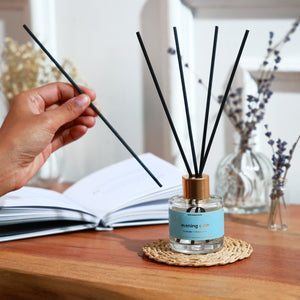 Evening Calm ₹799
  Garden Bloom ₹799
 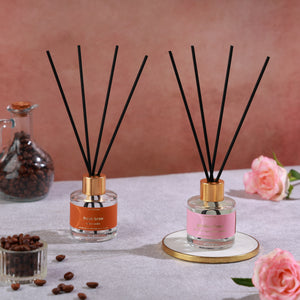 Oil refill 300ml ₹2,399
 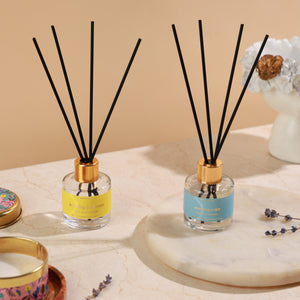 Day & Night duo ₹1,498
Check the calendar before the reeds. Inside the first fortnight, a quiet room is the bottle settling, not a reed fault, and the correct spend is nothing.
Replacement reeds are not sold separately. New SOSA fibre reeds arrive only inside a new bottle — 50ml ₹749 or 130ml ₹1,249, six reeds in each box.
A refill will not fix a reed problem. The 300ml at ₹2,399 is oil only. Pouring it into stalled reeds buys months of oil going into a wick that cannot carry it.
2. Then run the wet-line test, which takes four seconds. Lift one reed with a glove and find the boundary between the oil-soaked part and the dry part. High and dark means saturated and stalled. Barely above the liquid means it is not wicking. Partway up and evenly coloured means the reed is fine.
3. Cross-check against the level in the glass. A 50ml still two-thirds full at week ten is not a bottle with life left; it is a bottle whose contents cannot get out. The level tells you how many weeks are left, never how strong the room is.
4. Flip all six reeds and give it a day. A clear lift for about a day means the reeds still carry oil and your quiet room has another cause — position, airflow, room volume, or simply living with a constant. No lift at all is the reading that condemns the reeds.
5. If they are genuinely stalled, buy a fresh bottle rather than a refill. 50ml ₹749–₹849 or 130ml ₹1,249–₹1,349, each with six new fibre reeds. Replacement reeds are not sold on their own — an honest gap, and the reason the sequencing matters.
6. Keep the old reeds if they are still pale, and keep the glass always. Wipe them, stand them upright somewhere dry, and you own a spare set — after which a 300ml refill at ₹2,399 is genuinely the cheaper way to live, roughly ₹7–8 per ml against ₹15–17.
7. Do not simply add reeds to a stalled bottle. Six clogged reeds plus three more carries no more than six did.
Everything is composed and handmade in small batches in Pune, tested through 45°C summer heat and 85% monsoon humidity, and a portion of every order supports girl-child education through Nanhi Kali.

Part one — why the oil level misleads you
Almost everyone judges a reed diffuser the way they judge a bottle of shampoo: plenty left means plenty of product. With a passive diffuser that reasoning runs backwards. Oil in the glass is inert until a reed carries it somewhere it can evaporate, so a level that refuses to drop is your clearest evidence that the carrying has stopped.
 Evening Calm₹799 · 50mlPut on a glove and draw one reed out. A healthy reed shows a clear boundary partway up: soaked below, dry above, an even colour along its length. A finished reed shows the wet line pushed high and holding there, the top noticeably darker than the rest, and a surface that feels slightly tacky rather than merely oily. In a dusty room, or where the bottle has stood in a draught, you may also see a dull film on the exposed length. None of that is a manufacturing fault and none of it means the oil has gone off. It means the wick has done its weeks.
Part two — reading your own reeds
Five pictures you might be looking at, sorted by how often they turn out to be the real answer. The starred row is the one this page was written for. Take the reading with a glove on and the bottle standing on a tray.
| What the reeds look like | Where the wet line sits | What the oil level has been doing | What it means | What to do |
|---|---|---|---|---|
| Darkened at the top, faintly tacky ★ | High and holding there | Barely moved for a month or more | Saturated and stalled — the wick is finished | A fresh bottle, 50ml ₹749, for its six new reeds |
| Pale almost to the neck | Barely above the liquid | Falling very slowly, if at all | Never soaked properly, or fitted after a top-up without a flip | Flip all six, wait a week, read again before spending |
| Even colour, no film, no tackiness | Partway up and steady | Dropping roughly on schedule | The reeds are fine — this is not a reed problem | Move the bottle, or take a reading at the doorway instead of the sofa |
| Dull grey film on the exposed length | Anywhere | Slower than it was in month one | Room dust settling onto an oily surface and staying | Fresh bottle, and stand the new one out of the dust and the draught |
| Normal, but the glass is nearly empty | Low, because there is little left to soak | Gone down through the stated range | The bottle is finishing correctly — nothing is wrong | 300ml oil refill ₹2,399 into your own glass and these reeds |
| The honest caveat: a reading taken inside the first fortnight tells you very little — the bottle is still coming down from its opening to its designed level and the reeds are meant to be dark. Warmth raises the evaporation rate and a humid stretch slows it from the reed surface, so the same reeds present differently in different months; these are directions of effect, not measured rates. And a room goes quiet for reasons that have nothing to do with reeds: a draught from an AC or a fan, an open balcony, or having lived with the fragrance long enough to stop registering it. Check the reeds, then the room, then who is doing the smelling. | ||||
Morning Freshness · the least polarising restart₹749Shop → 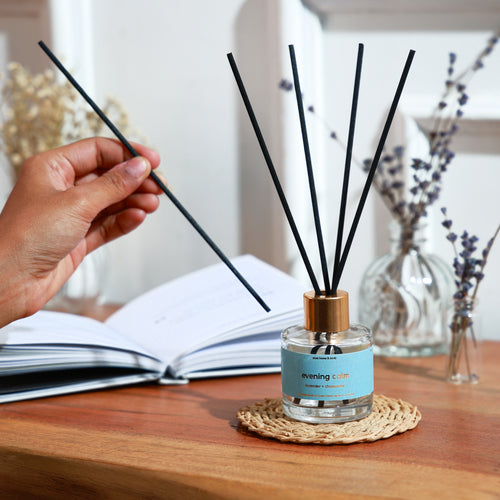 Evening Calm · the softest, for a bedroom₹799Shop →
 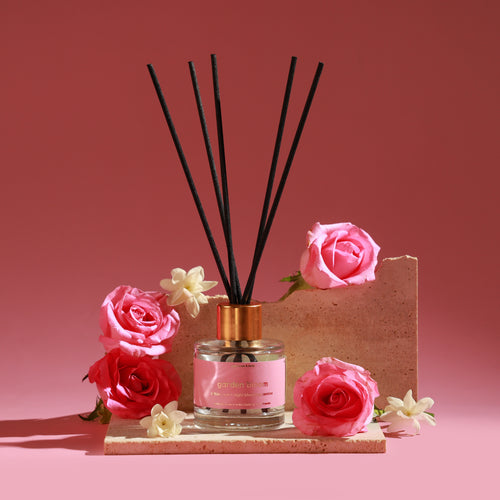 Garden Bloom · rose and jasmine, for an entryway₹799Shop →
Part three — the reed gap, and what it means for you
Here is the gap, stated without decoration. SOSA does not sell replacement reeds as a separate product. There is no packet of six you can add to a basket. Our own guidance is to refresh reeds every few months, which means the guidance and the catalogue do not currently line up, and I would rather write that sentence than let you spend twenty minutes hunting for a listing that does not exist. It is a gap in the range, in the same category as having no oud, no musk-forward scent and no aquatic among the reed diffusers. Gaps get named here rather than papered over with the nearest thing that almost fits.
What it means in practice is a small change to the order in which you buy things. New SOSA fibre reeds arrive only inside a new bottle — six in every 50ml at ₹749–₹849 and every 130ml at ₹1,249–₹1,349, and twelve across a duo set such as Day & Night at ₹1,498. The refills are oil only by definition: 300ml at ₹2,399 for roughly 8–11 months, 500ml at ₹3,499 for roughly 14–18, at about ₹7–8 per ml against ₹15–17 for a fresh 50ml. A real saving, and the right purchase for a great many people — but only for people whose reeds still wick. Pouring a refill into stalled reeds is buying nine months of oil for a wick that cannot carry it. Fix the reeds first, economise on oil second.
Which gives you one useful habit, and it costs nothing. Keep the reeds from every bottle you finish. When a bottle empties through its stated range with the reeds still pale and even — the normal, healthy ending — lift them out, wipe them with a paper towel while wearing gloves, stand them upright somewhere dry, and you have a spare set. Do that once and you no longer need a whole bottle to obtain reeds: you can run refills for a year and swap in a stored set whenever a working one darkens. It is the same reason I ask people never to throw away the glass. And I will not point you at a substitute stick from elsewhere — we chose fibre over rattan deliberately and tested it through a monsoon, and I have no basis to tell you how something untested will behave in your flat.
Part four — what to order, and what not to
Seven versions of "there is still oil in it". Two of them cost nothing, one is a deliberate refusal to sell you a refill, and the starred row is the situation that brought you here.
| Where you actually are | What I would order | What arrives in the box | What I would not order, and why |
|---|---|---|---|
| Past 8 weeks on a 50ml, oil high, wet line high, no lift from a flip ★ | A fresh 50ml at ₹749–₹849 | Oil, a glass bottle, and six new fibre reeds | Not a refill — it is oil only, and oil is not your problem |
| Past 18 weeks on a 130ml, same picture | A fresh 130ml at ₹1,249–₹1,349 | Oil for 14–18 weeks, and six new reeds | Not more reeds into the old bottle; nine clogged reeds carry no more than six |
| Bottle nearly empty, reeds still pale and even | 300ml refill ₹2,399 into your own glass | Oil only — no vessel, no reeds | Not a new bottle; you would be paying for reeds you already have |
| You want to live on refills from now on | One more full bottle now, so you bank a spare set of reeds | Twelve reeds across two bottles if you take a duo at ₹1,498 | Not the 500ml ₹3,499 yet — 14–18 months of oil with one ageing set of reeds |
| Day nine, the room has gone quiet, reeds dark | Nothing at all. Write the open date on the box and wait | — | Nothing. Dark reeds in week one are the bottle working, not failing |
| Reeds healthy, level dropping, room still quiet to you | Nothing. Read the room at the doorway, or ask someone arriving | — | Not a bigger bottle — size buys weeks, never metres |
| You want the room scented at a chosen moment instead | Sukoon ₹1,899, bought for control rather than strength | 500ml machine, remote, steady/2H/4H timers, three 15ml fragrances | Not a third reed bottle; a passive diffuser has no on switch by design |
Versailles
The first time I met this properly was on my own kitchen windowsill, with a test bottle left running far past its weeks to see what the end of a plateau looked like. Plenty of oil. Nothing in the room. I had been treating the glass as the product and the reeds as the packaging, which is precisely backwards. The oil in a sealed bottle is the stable half of this object; the reed is the half that lives in your air and does the work.
We chose fibre over rattan for exactly this reason. Rattan is a beautiful natural cane whose pores swell and clog where the air stays heavy for months on end, which in most of India is a good part of the year. Fibre holds a more consistent path for longer. It does not hold it forever, and I have never claimed it does.
What I have not solved is the packet of six reeds you cannot buy. It is a real gap and I will not dress it up as a design choice: today, refreshing reeds means a fresh bottle or a set you had the foresight to keep. So keep them, and never throw away the glass. The most economical customer we have owns three vessels, two spare sets of reeds and one 500ml of oil, and I would rather write the page that creates her than sell one more bottle this week. Made in small batches in Pune, and a part of every order funds a girl's classroom through Nanhi Kali.
Frequently asked questions
- Flipped the reeds and it came back for a day — what that one day proves about your wick.
- How long before a reed diffuser settles — why nothing in week two is a reed fault.
- Weak bottle or adapted nose? and move it before you buy bigger.
- When to stop tuning reeds and buy a Sukoon — control and room size, never strength.
- Brand: the SOSA founder story.
SOSA range, specifications and prices used in this guide (verified from the live store, 27 August 2026): Reed diffusers — alcohol-free, phthalate-free, paraben-free and IFRA-compliant compositions on a heat-stable coconut-derived (CCT) carrier, low-VOC, in a refillable glass bottle with six fibre reeds; flip weekly. 50ml lasts 6–8 weeks and 130ml lasts 14–18 weeks; there is no 100ml reed diffuser size. Morning Freshness (Malabar lemon · peppermint · Nilgiri eucalyptus) 50ml ₹749 · 130ml ₹1,249; Garden Bloom (British rose · night-blooming jasmine) ₹799 · ₹1,299; Evening Calm (Kashmir lavender · chamomile) ₹799 · ₹1,299; Fresh Brew (Coorg coffee · Kerala vanilla) ₹849 · ₹1,349; Mountain Breeze (Himalayan pine · sage · Indian cedar) ₹849 · ₹1,349. Duo sets ₹1,498–₹1,598 for 2 × 50ml and ₹2,498–₹2,598 for 2 × 130ml. Oil-only refills 300ml ₹2,399 · 500ml ₹3,499 — the glass vessel and reeds are not included, and replacement reeds are not sold as a separate product. Machines: Boond 300ml ₹899 (~150 sq ft, about 6 hours a fill) · Sukoon 500ml ₹1,899 (270–320 sq ft, 16–18 hours on low, three 15ml fragrances included) · Megh 6L ₹3,499 (~215 sq ft — a runtime and humidity machine that covers less than a Sukoon, never a coverage upgrade) · waterless Vaayu ₹11,999 · Safar ₹3,999 (a car and travel product) · Aangan ₹25,999 · Meenar ₹38,500. The water-based Hotel Collection for ultrasonic machines (15ml ₹299 · 100ml ₹999 · 300ml ₹1,799 · pack of seven 15ml ₹1,799) cannot be used in a reed bottle or a Vaayu. Below ₹749: jar candles ₹379, Sandalwood or Smoked Oudh candle ₹449, wax melts ₹474 (a burner is required and not included), mugs ₹474, bubble and taper candles ₹569, Amber Rose candle ₹599, ceramic trinket dish and candle two-pack ₹664. A reed diffuser adds fragrance to a room. It does not clean, purify or filter air, remove or neutralise cooking, damp or smoke smells, reduce humidity, or change how anyone feels. A reed diffuser adds no moisture to the air; ultrasonic machines work by aerosolising water and therefore do. A persistent musty smell indicates moisture that needs finding and drying, and SOSA sells no dehumidifier or air purifier. Ventilate or extract first; add fragrance second. Evaporation rate rises with warmth and falls with humidity, and airflow carries scent away from the bottle — so performance varies with season, ventilation, ceiling height and room use; longevity figures are typical ranges, not guarantees. Not noticing a constant fragrance is ordinary olfactory adaptation; the reliable checks are leaving the room and returning, or asking someone who has just arrived. Strength figures are positions on SOSA’s own internal scale, not an industry standard. Fragrance oil is flammable — keep bottles away from open flame and out of direct sunlight, and out of reach of children and pets. Composed and handmade in small batches in Pune, India; tested through 45°C summer heat and 85% monsoon humidity. Free shipping above ₹499. A portion of every order supports girl-child education through Nanhi Kali. Prices subject to change — see the live product pages.