
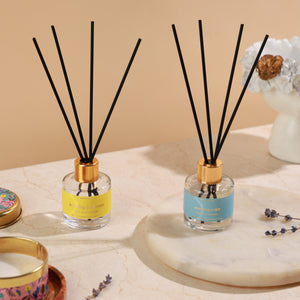



What the walk actually feels like: high at bottle one, a steep-feeling fall over the first metre, a long flat-low middle, then a rise as bottle two takes over. Two arrivals and one dead stretch. Better than one bottle. Not the same thing as a filled room.
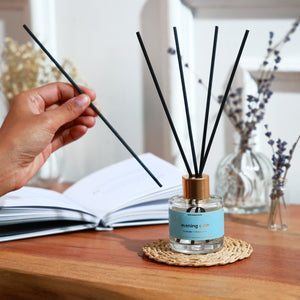
Free first, and genuinely: ceiling fan on low with the door shut — a fan is the transport a reed does not have, and it is the best free change in this whole subject. Then halve the distance to where you sit, nose height on a surface, out of the draught but not in a dead corner, six reeds in an open room or three at a bedside.
If you buy two anyway: do not place them opposite. Place each one beside a place you occupy, and pair one deep scent with one soft — two deep scents meeting mid-room read as neither.
- The straight answer
- Walk the room: what happens between the two bottles
- Why symmetry of sources is not uniformity of field
- Three things to check before you place anything opposite
- Opposite walls against three better arrangements
- The cost of the second bottle, and the reed’s own case
- What to buy, in what order
- A note from Sonal
- FAQs
2. No if you picked “opposite” because it looked balanced. This is the crucial distinction. Opposite walls is the most symmetrical placement available and it produces the least even room, because the two concentration peaks sit as far apart as the room allows and the trough between them is therefore as wide as it can possibly be. If you had put them closer together the low point would be narrower, though there would then be more of the room outside both.
3. Walk it before you spend. Stand at your existing bottle: high. Take two steps away: a sharp-feeling drop, because your nose reports change far better than steady state. Cross the middle: a long, level, unremarkable stretch. That middle is what a second bottle on the far wall does least for, since it is the farthest point from both sources at once.
4. Do the free things first, all of them. Ceiling fan on low with the door closed, and the bottle in the circulation rather than directly under the blades — this is the only free change that adds transport instead of more output, and it will do more for the middle of your room than a second bottle. Halve the distance to where you actually sit. Nose height, on a surface, never the floor and never a high shelf. Out of the draught of a window or an air conditioner, but not in a dead corner. Six reeds for an open room, three at a bedside where three roughly doubles the life.
5. If the middle is the requirement, buy the mechanism. Sukoon at ₹1,899 covers 270–320 sq ft, runs 16–18 hours on low from a 500ml tank and includes three 15ml Hotel Collection scents. It moves air, which is why it produces a room rather than a corner. It also dilutes the oil in water, adds humidity, needs filling and a socket, and can leave a fine white dust in a hard-water city. Weigh both halves.
Alcohol-free, phthalate-free, paraben-free, IFRA-compliant, 0 ppm formaldehyde, six fibre reeds in a refillable glass bottle, composed in Pune. Free shipping above ₹499, and a portion of every order supports girl-child education through Nanhi Kali. SOSA is an independent Indian fragrance house and is not affiliated with any hotel brand.
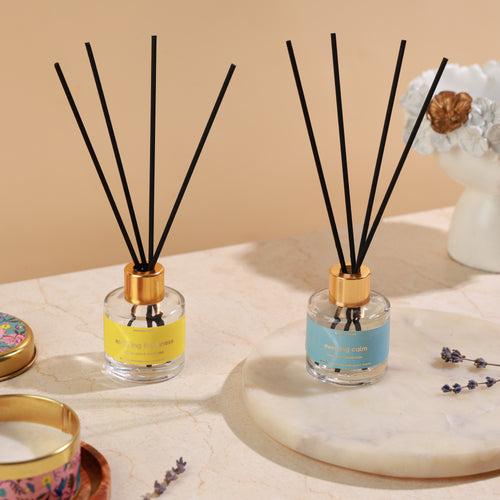
Walk the room: what actually happens between the two bottles
This is the part worth doing in your head before you spend anything, because the arrangement you are considering has a shape and the shape is knowable. Imagine your bedroom is twelve feet across, with the diffuser you own on the left-hand wall and a second one newly placed on the right. Start with your nose beside the first bottle. Concentration here is at its maximum — this is the part you already like, and it is the reason you are on this page rather than looking for a different fragrance.
Take one step. Then a second. Over that first metre the fall is steep in both fact and feeling: physically because concentration from a point source drops away quickly as the same amount of vapour spreads through a rapidly growing volume of air, and perceptually because your nose reports change far better than it reports level. You are an excellent detector of differences and a rather poor meter of absolute quantities, which is why a smooth decline is experienced as an edge. People describe this as the fragrance “stopping” at a certain point. Nothing stops. You simply cross the part of the gradient where the rate of change is greatest, and your nose files that as a boundary.
Now the middle four or five feet. Here the first bottle is far away and the second is not yet close, and because neither bottle moves air, nothing is carrying either plume towards you. What reaches the centre arrives by molecular diffusion, which is far too slow to cross metres of a room usefully, and by whatever air the room happens to be moving on its own — convection off a warm wall, a draught under the door, an air conditioner if one is running. That last item does nearly all the work in every home, and it is not under the bottle’s control. So the middle is not empty, but it is low and it is level. It is the longest stretch of your walk and the least eventful part of it.
Then the climb, as the second bottle takes over, and a second peak at the right-hand wall. Two hills and a valley. Look at what you have actually purchased: not a room that reads the same everywhere, but two good places and a wider dull stretch between them than you had before, because you have moved the two sources as far apart as the walls permit. If that dull stretch is where your bed is, you have spent ₹799 to improve two places you do not sit in. If your bed is at one of the walls, you have spent ₹799 improving the wall you do not sleep at.
Why symmetry of sources is not uniformity of field
The instinct behind “opposite sides” is a good one and worth respecting. In lighting, two lamps at opposite ends of a room do produce a reasonably even wash, because light travels in straight lines at speed and floods a space almost instantly. Fragrance has no equivalent of that. A reed diffuser is a point source with no transport: oil climbs six fibre reeds by capillary action and evaporates from their surface at whatever rate temperature, humidity and airflow allow, and then it waits for the room to move it. There is no beam, no throw and no propagation. A symmetrical arrangement of two sources that cannot deliver anywhere gives you a symmetrical arrangement of two undelivered zones.
There is a second, quieter reason opposite walls disappoints, and it is about where opposite walls usually are. The far side of a bedroom is frequently the window side, the balcony side or the wall with the wardrobe. A windowsill is the single worst placement in the house, because air that leaves a room takes the fragrance with it — the bottle is not weaker, the room is being flushed. Directly in the blast of a split air conditioner is nearly as bad: it strips the reeds fast and throws everything at one wall. And a dead corner behind a wardrobe is the opposite failure, where the air never turns over at all and the fragrance simply pools. Before you buy a bottle for the far wall, check whether the far wall is a place a bottle should be.
One more thing worth knowing, because it changes what you conclude from your own experiment. If you have been sitting in that room for an hour deciding it smells of nothing, your nose is not a reliable witness. Receptors adapt to a constant stimulus within minutes: the signal keeps arriving and the brain stops forwarding it. Leave for fifteen minutes and walk back in, or better, ask someone who does not live there. A visitor is a far better instrument than a resident, and I have lost count of the letters that end with somebody discovering their room was fine and their nose had simply stopped mentioning it.
Three things to check before you place anything opposite
If after all that you still want a second bottle — and for plenty of rooms you should — these three checks decide where it goes and what goes in it.
 Mountain Breeze₹849Walk to the far side and look at what is there. A windowsill will empty the bottle into the street; an open balcony door does the same on a much larger scale, because the whole room’s air turns over. Under a running split unit strips the reeds and throws the result at the ceiling. Behind a wardrobe, the air barely moves at all. What you want is a surface at or slightly below nose height, in the room’s circulation but not in its draught — a chest of drawers, a console, the end of a dressing table. Choose the spot for its air, then for its symmetry, and never the other way round.
 Evening Calm₹799Two bottles of the same scent will not fight; they will simply give you the same idea twice, which is fine and slightly dull. Two different scents facing each other is more interesting and needs a little judgement. In the middle they meet at low concentration, so they blend rather than clash — but if both are deep, that blend flattens into one thick sweet or sharp impression, which is exactly what people mean when they say a house smells of air freshener. Dose is the culprit far more often than composition. Pair one deep with one soft. Evening Calm at 8.9 is the softest thing we make; Fresh Brew at 9.5 is the deepest, and two of those facing each other across a bedroom is a mistake I would rather you did not make with your money.
 Morning Freshness₹749Take a minute and list the places in that room where you are actually stationary for more than five minutes: the pillow, the desk chair, the armchair, the dressing stool. Usually there are one or two, occasionally three. Now place bottles beside those, at nose height for each of them, rather than on the walls that look balanced from the doorway. This single change — placing for occupancy rather than for symmetry — is free, and it is the difference between a room that is technically scented and a room that smells lovely wherever you happen to be sitting. If you only have one such place, you probably do not need a second bottle at all; you need the one you own to be two feet from it.
Opposite walls, against three better arrangements
The same two bottles, arranged four ways, plus the machine. Scored for what each one actually delivers rather than for how tidy it looks on a floor plan. The last row names the gap in our own range.
| Arrangement | What the room does | Best for | Cost |
|---|---|---|---|
| One bottle, moved beside where you sit ★ | One strong zone exactly where you are; the rest low | Almost every bedroom with one place that matters. Do this before spending | Free |
| One bottle plus the ceiling fan on low, door shut | The zone widens noticeably; the room’s own air becomes the delivery system | The closest a passive setup gets to evenness. Shortens bottle life | Free |
| Two bottles, one beside each place you occupy | Two good zones with a low stretch between, which nobody stands in | A long or L-shaped room used at both ends; two scents by hour | ₹1,498–₹1,598 as a duo |
| Two bottles on opposite walls for symmetry | Two peaks with the widest possible trough between them | Very little, unless the walls happen to be where you sit | ₹1,498–₹1,598 |
| One Sukoon ₹1,899 | Moves air across 270–320 sq ft, so the middle stops being the worst part | When evenness across one volume is the actual requirement | ₹1,899 plus oil |
| The honest gap: no mid-sized waterless machine | Between Safar ₹3,999 — named and sold as a car and travel diffuser, with no published room coverage figure, a 1/2/3-hour timer and a battery to recharge — and Vaayu ₹11,999 at 1000 m³, roughly 2,000–3,000 sq ft, there is nothing built for one bedroom. Vaayu in a bedroom is nine-tenths wasted | Named, not sold around | |
Two zones · Day & Night₹1,498Shop → 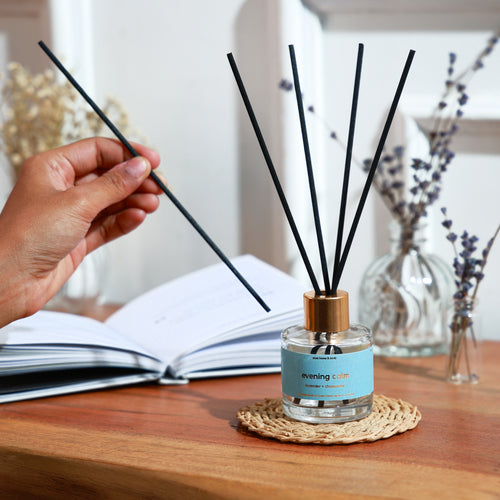 One zone · Evening Calm₹799Shop →
  No valley · Sukoon₹1,899See it →
The cost of the second bottle, and the reed’s own case
The arithmetic first, because it is easy to get slightly wrong in your head. A 50ml SOSA reed is ₹749 to ₹849 and runs six to eight weeks, which is roughly ₹13 to ₹15 a day — a fairer way to see it than the sticker price, since a bottle that runs two months is a different purchase from an object that costs the same. A second bottle doubles that, and it keeps doubling it for as long as you want the room scented. Against that sits Sukoon at ₹1,899 once, plus oil. I will not compute a running cost for the machine and put it beside the reed’s, because SOSA publishes no oil-consumption rate for its machines and an invented number would be worse than no number.
There is also a running air conditioner in most of the bedrooms this question comes from, and it is worth understanding because it cuts both ways. A closed room with the AC on recirculates its own air, which distributes fragrance rather well — it is why a bedroom often smells strongest at night — while the dry air speeds evaporation and shortens the bottle. Better distribution, shorter life. The same trade as the fan, and worth making deliberately. What is never worth doing is placing a bottle directly in the outflow, which strips the reeds within days and leaves you with the base notes only.
And the reed’s own case, which I will not soften on the way to recommending a machine. It is silent, and in a bedroom that matters more than people expect. It needs no socket, and bedroom sockets are usually spoken for. It works right through a power cut. There is nothing to fill, nothing to charge and nothing to remember beyond flipping the reeds every three to five days. It never breaks, because there is nothing in it that can. It is an object rather than an appliance. Two of them also have no single point of failure, whereas if a machine stops the room stops with it. Those are real advantages, and none of them is evenness — which is precisely the point of this page.
What to buy, in what order
Free options first, because a page that withholds them in order to sell a second bottle has earned nothing. The last row is the honest gap in our range.
| Step | What it is | When it is the right answer | Price |
|---|---|---|---|
| 1. Move the bottle you own ★ | Halve the distance to where you actually sit; nose height on a surface; out of the draught, out of the dead corner | First, always. Most rooms have one place that matters and the bottle is not beside it | Free |
| 2. Ceiling fan on low, door shut | The only free change that supplies transport rather than more output. Not directly under the blades at full speed | When the middle of the room is the complaint. It shortens bottle life — a trade worth making knowingly | Free |
| 3. Reed count | Six is full output, three is a soft bedside level and roughly doubles the life. Flip every 3–5 days | Six in an open room, three at a pillow. It is a volume dial in both directions | Free |
| 4. A second reed — a duo | Two separate 50ml bottles. Day & Night ₹1,498, Fresh & Grounded ₹1,548, Warmth & Bloom ₹1,598; 130ml duos ₹2,498–₹2,598 | Two ends genuinely used, two rooms behaving as one, or two scents by hour. Place beside the seats, not on the walls | ₹1,498–₹1,598 |
| 5. Sukoon ultrasonic | 500ml, 270–320 sq ft, 16–18 hours on low, three 15ml Hotel Collection scents. Moves air. Water-diluted, adds humidity, needs filling and a socket | When the middle of one volume is the requirement. Very often the correct bedroom answer, and never to be skipped on the way to something dearer | ₹1,899 |
| The honest gap: two peaks are not a plateau | No arrangement of passive sources produces evenness. And between Safar ₹3,999, named and sold as a car and travel diffuser with no published room coverage figure, and Vaayu ₹11,999 at 1000 m³, SOSA has no mid-sized waterless bedroom machine | Stated plainly. Vaayu is the wrong purchase for one bedroom | ₹1,899 |
Versailles
“One isn’t enough” is a sentence I read as a compliment, because the people who write it are not asking me for a different fragrance. They like the one they have and they want more of it in more of their house. That is a satisfied customer with an unmet requirement, and it deserves a straight answer rather than a second sale.
Opposite walls is a good instinct from the wrong discipline. We arrange lamps that way and it works, because light floods a room. Fragrance does not flood anything; it waits for the air to move it, and if the air is still then a bottle on the far wall is simply a second small event happening a long way from the first. So my advice is almost boringly practical: forget the walls, list the places in that room where you are actually stationary, and put fragrance beside those. If there are two such places, buy the second bottle, put one at each, and think about running two scents so that moving between them is worth noticing. If there is only one, move the bottle you already own and keep the ₹799.
And try the fan first. It costs nothing, it is the only free change that supplies the transport a reed structurally lacks, and it does more for the middle of a bedroom than any second bottle will. It will shorten the life of the oil, which is a fair trade and one I would rather you made with your eyes open. Everything is composed in Pune, and a part of every order funds a girl’s classroom through Nanhi Kali.
Frequently asked questions
- Should I buy two if one isn’t filling my bedroom? — the four cases where two is right.
- Two smaller reeds or one active diffuser? — strong at a point against strong everywhere.
- One by the bed and one by the door? — a reasonable setup, and its limits.
- Better coverage, or two strong corners? — two corners, stated plainly.
- I keep buying more to make it stronger — a rational response to a wrong diagnosis.
- Cheaper long-term: several reeds or a waterless diffuser? — the arithmetic and the counterweights.
- Two reeds against Safar — head-to-head, with the car-and-travel disclosure.
- How many reeds before a machine makes more sense? — a real decision rule.
- About to buy a third for one room? — the kindest version of the answer.
- Brand: the SOSA founder story.
SOSA facts verified August 2026: Reed diffusers in 50ml and 130ml only — Morning Freshness ₹749 / ₹1,249, Evening Calm ₹799 / ₹1,299, Garden Bloom ₹799 / ₹1,299, Mountain Breeze ₹849 / ₹1,349, Fresh Brew ₹849 / ₹1,349. 50ml suits rooms up to about 150 sq ft and runs 6–8 weeks; 130ml suits above 150 sq ft and runs 14–18 weeks; roughly ₹13–₹15 a day. Strength scale, which measures perceived intensity rather than quality: Evening Calm 8.9, Garden Bloom 8.9, Morning Freshness 9.0, Mountain Breeze 9.4, Fresh Brew 9.5. Six fibre reeds rather than rattan, in a refillable glass bottle, on a heat-stable CCT carrier rather than DPG, alcohol-free, phthalate-free, paraben-free, IFRA-compliant, 0 ppm formaldehyde, tested at 45°C and 85% RH, composed in Pune. Six reeds is full output; three is a soft bedside level and roughly doubles the life; flip every 3–5 days. Duos are two separate 50ml bottles: Day & Night ₹1,498, Fresh & Grounded ₹1,548, Warmth & Bloom ₹1,598; 130ml duos ₹2,498 / ₹2,548 / ₹2,598. Refills 300ml ₹2,399 and 500ml ₹3,499 — oil only, never a first purchase. Machines: Boond ₹899, Sukoon ₹1,899 (500ml, 270–320 sq ft, 16–18 hours on low, three 15ml Hotel Collection scents included), Megh ₹3,499 (6 litres, about 100 hours runtime, only about 215 sq ft), Safar ₹3,999 (waterless cold diffusion of undiluted oil, 20ml, three speeds, 1/2/3-hour timer — named and sold as a car and travel diffuser, with no published room coverage figure and a battery that needs recharging), Vaayu ₹11,999 (up to 1000 m³, roughly 2,000–3,000 sq ft). Between Safar and Vaayu SOSA has no mid-sized waterless bedroom machine. Reed oil and the water-based Hotel Collection are separate products and are not interchangeable in either direction; there is no hotel-inspired reed diffuser, and the ₹299 Hotel Collection 15ml is a machine refill rather than a first purchase. No health, air-quality, allergy or sleep claims are made for any SOSA product, and fragrance does not remove an unwanted smell — deal with the source, then ventilate, then fragrance. Free shipping above ₹499. A portion of every order supports girl-child education through Nanhi Kali. SOSA is an independent Indian fragrance house; the Hotel Collection is SOSA’s own interpretation inspired by the world’s finest hotels, and SOSA is not affiliated with or endorsed by any hotel brand. Prices subject to change — see the live product pages.