

Several small units win on: resilience, per-room variety, spreading the spend, and reaching behind closed doors that no single source can cross.
The arithmetic, on list prices: four Sukoons is 4 × ₹1,899 = ₹7,596. One Vaayu is ₹11,999. The gap is ₹4,403 and it buys coverage and evenness, not more fragrance.
The gap that argues for keeping some redundancy: SOSA does not currently sell a separate Vaayu refill oil. The 400ml in the box is the supply available today.
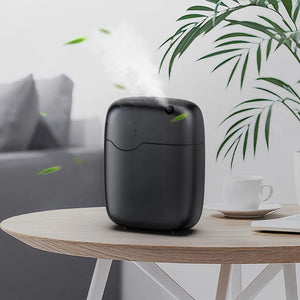
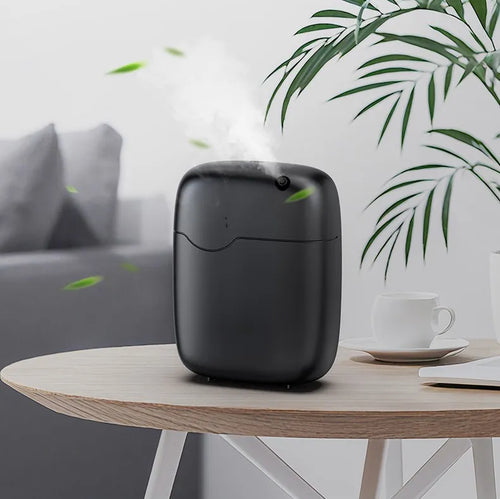
2. If the volume is continuous, one machine is the better answer. One scent field, one intensity, no seams, one thing to schedule and one thing to refill. The Vaayu covers up to 1000m³ with 1h / 4h / 8h / 24h timers and adjustable intensity, from a 400ml tank that runs 90+ days.
3. If you cannot afford a dead week, several is the better answer. One machine is one point of failure. Three Sukoons degrade gracefully — one out of action leaves you with a slightly weaker house, not an unscented one.
4. Do not run two different scents in one connected volume. If you must, make them share a note. Two unrelated compositions meeting in an open dining area is not layering; it is a seam, and everyone notices it without being able to name it.
5. Price the attention, not just the purchase. Six reed diffusers means six bottles flipped weekly. Four ultrasonics means four tanks topped up. One Vaayu means one fill every 90+ days. For a household with staff this is a small thing; for a busy owner it is often the deciding one.
6. Do the arithmetic honestly. On list prices, four Sukoons is ₹7,596 and one Vaayu is ₹11,999 — a difference of ₹4,403. Six 130ml reed diffusers at ₹1,349 is ₹8,094 and each lasts 14–18 weeks, so that is a recurring number rather than a one-off one.
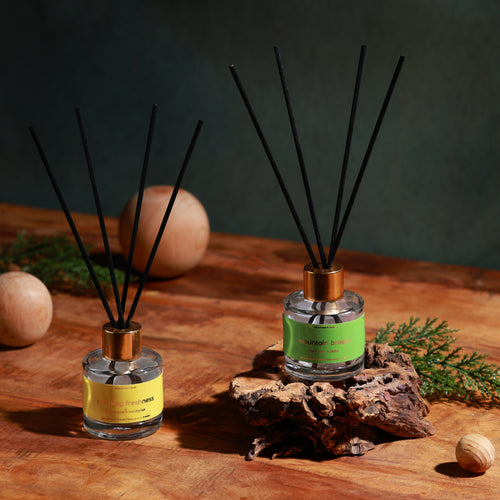
7. Keep one cheap backstop whatever you decide. A ₹749 reed diffuser in the entryway costs almost nothing and means the house is never entirely without a scent when a machine is down or a tank is empty.
Everything is composed and handmade in Pune, and a portion of every order supports girl-child education through Nanhi Kali.
Part one — the three trade-offs that actually decide it
Strip out the marketing on both sides and three genuine differences remain. Each of them cuts a different way, which is why this question has no universal answer and why anyone who gives you one has not asked about your house. Work through all three before you look at a price.
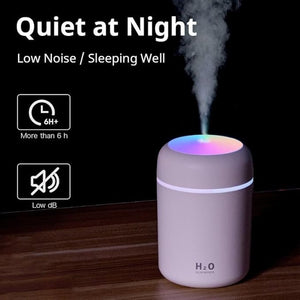
 Sukoon₹1,899 · 270–320 sq ftA distributed system fails gracefully; a centralised one fails completely. If you run three Sukoons and one is being descaled, the house is a shade quieter for a day. If you run one machine and it is out — being serviced, waiting on a part, or simply out of oil — the house is unscented until it is back. For an owner-occupied home that is an inconvenience. For a property you hand to guests, or a villa used for events, it is the difference between a small annoyance and an arrival that does not happen. There is a second, specific version of this worth naming: the Vaayu ships with 400ml of cold-air oil and SOSA does not currently sell a separate refill for it. If continuity matters to you, keeping a couple of inexpensive reed diffusers in the house is cheap insurance, and asking SOSA about refill availability before you spend is cheaper still.
Part two — one against several, scored on what you actually care about
Rows are the things people tell me matter once they have lived with a system for six months. The verdict column is my honest view, not a tie-break in favour of the more expensive option.
| What you care about | Several small units | One large machine | Verdict |
|---|---|---|---|
| One consistent smell throughout ★ | Gradients and seams between sources | A single field, no boundaries to manage | One machine, clearly |
| Reaching behind closed doors | Solved — you put something in each room | Not solved — a shut door is a wall | Several, clearly |
| Resilience when something fails | Degrades gracefully; the house still smells of something | Single point of failure; house goes quiet | Several |
| Upfront spend | 4 × Sukoon ₹1,899 = ₹7,596; can be bought one at a time | ₹11,999 in one go | Several, by ₹4,403 on list prices |
| Weekly attention | Four tanks, or six reed bottles flipped every week | One fill per 90+ days | One machine, by a wide margin |
| Scheduling and control | Set each unit separately; no lock on most formats | App plus onboard, 1h / 4h / 8h / 24h, key-lock | One machine |
| Different scents in different zones | Easy, and the main reason to choose it | Not possible from a single tank | Several |
| Water in the room during monsoon | Every ultrasonic adds humidity; four of them, four times over | Cold-air nebulisation adds none | One machine |
| Long-term fragrance supply | Reed oil and water-based Hotel Collection are both stocked | 400ml in the box; no separate Vaayu refill sold today | Several, at the time of writing |
| The honest caveat: this table assumes the space genuinely needs more than one normal room's worth of scenting. If your "open plan" is a 400 sq ft living-dining, neither column applies — one Sukoon at ₹1,899 covers 270–320 sq ft and the question does not arise. And note that a Megh at ₹3,499 is not a middle option here: its 6L tank buys ~100 hours of runtime at roughly 215 sq ft, which is less coverage than the Sukoon. | |||
Vaayu · the single-source answer₹11,999Shop →  Sukoon · four of these is ₹7,596₹1,899Shop →
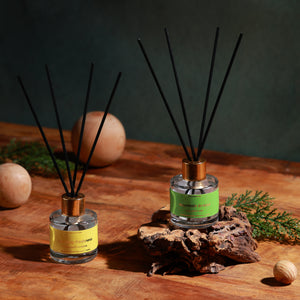
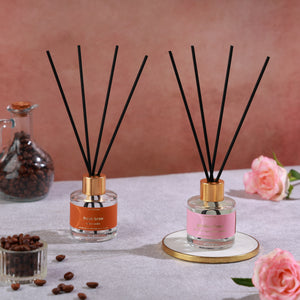
  Reed duo · the no-electricity backstopfrom ₹1,548Shop →
Part three — when several is genuinely right, and when to spend nothing
I sell the Vaayu and I would still tell a good number of the people reading this to buy four cheaper things instead. Three situations make the multi-unit approach clearly correct. The first is a property chopped into rooms behind doors. Bedrooms, guest rooms, bathrooms and studies that are shut most of the day are not part of any connected volume, and a machine rated at 1000m³ will not reach a single one of them if the door is closed. In a house like that, a machine in the common area plus a ₹749–₹849 reed diffuser in each closed room is not a compromise; it is the correct architecture, and it costs a fraction of buying reach you cannot use.
The second is any space you hand over to other people. If a villa is let, or used for events, or run as a property where an unscented arrival would be a genuine failure, the resilience argument outranks the evenness one. Three Sukoons at ₹1,899 each, staggered across the floor with the same fragrance in all three, gives you a system where a single failure is invisible. The third is simple budget staging. Several units can be bought one at a time; a single machine cannot. Starting with one Sukoon in the main living area for ₹1,899, seeing how much difference it makes, and adding a second in three months is a far more sensible path than committing ₹11,999 to a diagnosis you have not tested.
And here is the arithmetic said plainly, because it is closer than most people assume. On list prices: four Sukoons is 4 × ₹1,899 = ₹7,596, one Vaayu is ₹11,999, a difference of ₹4,403. Six 130ml reed diffusers at ₹1,349 is ₹8,094, and since a 130ml lasts 14–18 weeks that is a figure that repeats roughly three times a year unless you move to oil refills at ₹2,399 for 300ml. These are sums on list prices, not a running-cost model — actual consumption depends on how hard and how often you run anything. What the ₹4,403 gap buys is coverage across a volume no group of small units is rated for, plus scheduling, a key-lock and one chore instead of four. What it does not buy is more total fragrance, and I would not want anyone to read it as strength for money. The one figure that genuinely complicates the comparison is supply: reed oil and the water-based Hotel Collection are both stocked in several sizes, while the Vaayu's 400ml is the whole cold-air supply available today and no separate refill is sold. Ask SOSA about that before you decide, because for a long-horizon buyer it is a real factor and not a small one.
Part four — choosing, by the situation you are actually in
Find the row that matches your home rather than the one that matches your budget. The prices are list prices at the time of writing.
| Your situation | One or several | What I would buy | Spend |
|---|---|---|---|
| Open living-dining under 400 sq ft ★ | Neither — one unit is the whole answer | One Sukoon, or two reed diffusers at opposite ends | ₹1,899 · or from ₹1,548 |
| Open-plan floor, few doors, owner-occupied | One | Vaayu in the traffic path, fans on low | ₹11,999 |
| Large house, six rooms behind closed doors | Both — hybrid | One machine in the common area, a reed diffuser per closed room | ₹11,999 + from ₹749 each |
| Property handed to guests; a quiet week is unacceptable | Several | Three Sukoons, same fragrance in all three | 3 × ₹1,899 = ₹5,697 |
| Different scents wanted in different zones | Several | Reed diffusers chosen per room; share a note where zones connect | From ₹749 each |
| Want to test before committing | Several, staged | One Sukoon now, decide in three months | ₹1,899 |
| Humid coastal house, monsoon | One | Cold-air rather than four ultrasonics adding water | ₹11,999 |
| Not a middle option: the Megh | Neither | 6L and ~100 hrs, but ~215 sq ft — less coverage than the Sukoon | ₹3,499 |
Versailles
The first large house I ever helped scent belonged to a family in Lonavala who had already bought seven diffusers. Seven. Three different brands, four different fragrances, all of them running at once, and a ground floor that smelled like a duty-free shop. Their problem was never a shortage of fragrance; it was a shortage of agreement. We switched off five, matched the remaining two on a shared note, and the house immediately felt more expensive than it had with all seven going.
That is the lesson I would want anyone to take from this page. Adding sources adds total output, and total output was probably not what was wrong. What goes wrong in a large open home is usually coherence — a smell that changes as you walk, or vanishes in the corridor, or arrives in the dining room a beat after you do. A single well-placed source solves coherence in a way that no number of small ones can, and that is a real and underrated thing to buy.
But I will not pretend it is the answer for everyone, and I would rather sell someone a ₹1,899 Sukoon they use for four years than a ₹11,999 machine they resent. If your house is full of closed doors, or you cannot risk a quiet week, buy several. If it is one continuous volume and you want it to feel deliberate, buy one. And in either case, ask us about Vaayu refill availability before you commit — the 400ml in the box is the supply today, and you should decide with that in front of you. Everything is composed in Pune, and a part of every order funds a girl's classroom through Nanhi Kali.
Frequently asked questions
- Best diffuser for a large open living and dining area — the answer by size band.
- How airflow affects fragrance in large open spaces — why one source can cover a whole floor at all.
- Can the Vaayu scent a large open-plan home? — measure your volume before you decide.
- The complete large open-space guide — this page and the eight around it, in one place.
- Brand: the SOSA founder story.
SOSA Vaayu specifications (verified from the live product page, August 2026): ₹11,999 (the product page displays a rounded ₹12,000). Waterless cold-air nebulisation — pressurised air atomises undiluted fragrance oil into a dry nano-mist; no water, no heat, residue-free. Coverage up to 1000m³, about 2,000–3,000 sq ft. 400ml refillable tank, 90+ days per fill at a mid intensity setting. Bluetooth app plus onboard buttons, 1h / 4h / 8h / 24h timers, adjustable mist intensity, auto-stop and key-lock. Under 38 dB. DC 12V / 1A, 5W. 165 × 80.5 × 215 mm, 0.9 kg, black or white. Freestanding or wall / HVAC mount. CE, RoHS and SGS certified. Ships with four SOSA Hotel Collection fragrances at 100ml each (400ml in total) in one of three combos chosen at checkout. SOSA does not currently sell a separate Vaayu refill oil; the 400ml supplied in the box is the fragrance available at the time of writing, and buyers who need long-term supply should confirm current refill availability with SOSA before purchasing. The cold-air oil supplied with the Vaayu is a different product from the water-based Hotel Collection sold for ultrasonic machines (15ml ₹299 · 100ml ₹999 · 300ml ₹1,799), which must not be used in a Vaayu despite sharing scent names. Other SOSA machines: Boond 300ml ₹899 (~150 sq ft) · Sukoon 500ml ₹1,899 (270–320 sq ft) · Megh 6L ₹3,499 (~215 sq ft — a runtime and humidity machine, not a coverage upgrade) · Aangan ₹25,999 (~8,000–10,000 sq ft) · Meenar ₹38,500 (12,000–18,000 sq ft) · Safar car diffuser ₹3,999. Reed diffusers 50ml ₹749–₹849 (6–8 weeks) · 130ml ₹1,249–₹1,349 (14–18 weeks) · duo sets ₹1,498–₹1,598 · oil-only refills 300ml ₹2,399 / 500ml ₹3,499. Runtime, consumption and coverage figures are manufacturer specifications and vary with intensity setting, run hours, ceiling height, ventilation and season; any per-month or per-day figure in this guide is arithmetic on those specifications, not a measurement. Electricity costs vary by state tariff. No claim is made that scenting affects ratings, reviews, bookings, occupancy, revenue, health, mood or air quality. Free shipping above ₹499. A portion of every order supports girl-child education through Nanhi Kali. Prices subject to change — see the live product pages.