

Accelerator two — dry recirculated air: an AC condenses moisture out of the room's air, and dry moving air takes up volatile material more readily. The same unit also circulates that air past the reeds, which is why the bedroom reads beautifully and consumes quickly at the same time.
What has not happened: you did not get a weak or short-filled bottle, and the fragrance has not turned. Every millilitre eventually leaves the bottle through the reeds; a faster bottle delivered the same contents over a shorter period.
The one thing to check, and the thing not worth buying: check that the bottle is not sitting in the AC's discharge or in direct sun, both of which strip the top notes off within days. Do not buy a 300ml refill at ₹2,399 to solve this — it is oil alone, it is not a first purchase, and it does not slow anything down. It is the item on our own shelf most often bought by mistake.
2. The nightly AC adds a second, separate accelerator. An air conditioner cools partly by condensing moisture out of the air and draining it away, so the room is drier after an hour. Drier air takes up volatile material more readily than saturated air does — and the unit is also circulating that dry air through the room, which keeps carrying away what has just evaporated from the reed instead of letting it linger. Two mechanisms, one machine.
3. Which is also why the room smells so good at night. Recirculation is what distributes fragrance evenly in a closed bedroom, and a reed diffuser has no fan and cannot do that for itself. An AC bedroom is simultaneously the best distribution environment in the flat and the fastest-consuming one. The two are the same fact read from opposite ends, and it is worth accepting both together.
4. Nothing has been wasted. A reed diffuser holds nothing in reserve: every millilitre eventually leaves the bottle through the reeds and into the room. A faster bottle has not lost oil, it has delivered the same oil over a shorter period. The only genuine waste in this category is fragrance released into a room nobody is in, which is a placement and occupancy question rather than a product one.
5. The lever you have is reed count, not bottle size. Three reeds instead of six roughly halves the release rate and roughly doubles the life, at very little cost in perceived strength in a sealed recirculating room. Move the bottle out of the AC's direct discharge and off any surface that catches afternoon sun, and that is the whole of what can honestly be done.
Alcohol-free, phthalate-free, made in Pune. A portion of every order supports girl-child education through Nanhi Kali.
Two accelerators, and they are not the same accelerator
People usually credit one cause and then feel vaguely cheated when the arithmetic does not add up. Separating them helps, because they respond to different remedies: the heat is largely out of your hands, and the AC's contribution is partly a placement decision. Both are ordinary physical behaviour and neither says anything about the oil in the bottle.
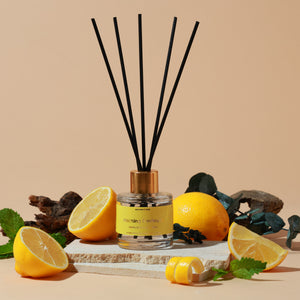
 Morning Freshness₹749The daytime half of the story. Evaporation is molecules leaving a liquid surface, and raising the temperature gives more of them enough energy to do it, so a bottle sitting through a hot afternoon releases more than the same bottle in a cool room. There is nothing to be fixed here and nothing to complain to a manufacturer about. What you can do is remove the avoidable heat: a bottle on a windowsill or on a surface that catches the afternoon sun is being cooked for several hours a day, and direct sun also strips the lightest, most volatile materials off first, so you lose both the oil and the top of the composition. Move it to an inner shelf and you have recovered a real fraction of the difference for nothing.
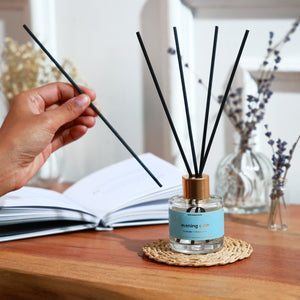
 Evening Calm₹799The night half, and the more interesting one. An air conditioner cools by condensing water out of the air — that is what the drain pipe on the balcony is for — so a room that has run one for a few hours is a drier room. Dry air takes up volatile material more readily than saturated air, which is the inverse of the monsoon behaviour people notice, where humid air makes fragrance hang close and project less. On top of that the unit is recirculating: the same air passes the reeds again and again, continuously carrying away what has just evaporated instead of allowing it to sit. That recirculation is exactly what distributes the fragrance so evenly through a closed bedroom, and exactly what shortens the bottle. One machine, one behaviour, two consequences.
 Garden Bloom₹799Most of what is dissolved in a reed diffuser is carrier rather than fragrance, and the carrier is the part nobody can smell and nobody thinks about. It decides whether the part you can smell survives. The industry standard is DPG, which is inexpensive and effective and which can crack and turn bitter above about 40°C — an ordinary afternoon in much of India, and the mechanism behind every diffuser anybody has ever described as having gone sour or acrid in the heat. Every SOSA reed sits on CCT, a coconut-derived triglyceride that is heat-stable, and the range is tested through a 45°C heat soak and 85% relative humidity. The point of that decision is not longevity. It is that a hot flat should shorten your bottle and never change what it smells like.
The difference between running down and going wrong
There is a related effect that gets misread as the fragrance changing when it is nothing of the sort. The first days of any new bottle run hot, because the reeds are still saturating and the lightest, most volatile materials leave first. What you are smelling in week three is the heart and base of the composition, which is how it was designed to sit in a room over time. It is not fading, it is settling, and in the heat that settling arrives sooner because the top has gone sooner. Flip the reeds and you restore projection without opening anything new. If your instinct in a hot month is to buy a replacement, flip first and give it a day.
The genuine seasonal difference is one of curve rather than of content. A higher temperature lifts the top notes off faster and lets the base dominate earlier; higher humidity slows diffusion and makes everything feel closer and heavier. The same bottle honestly does read warmer in a humid coastal flat than in a dry inland one, and no formulation prevents that either — it is the air doing it, not the oil. What a good carrier prevents is the third thing, which is the composition actually degrading. Those are three separate phenomena and only the last is a defect.
Two compositions in the range illustrate what formulation can and cannot buy you. In Morning Freshness, citrus top notes are the smallest and lightest molecules in perfumery and normally leave a reed diffuser inside ten to fourteen days; a eucalyptus globulus base slows the lemon's evaporation by roughly three to four times, which is what turns a fortnight into six to eight weeks. That is a structural decision, and it buys duration. In Garden Bloom, indole occurs naturally in jasmine and is much of what makes it smell alive rather than synthetic — but above a certain perceived concentration it reads animalic, and heat pushes perception upward, which is why so many jasmine products go wrong in an Indian summer. Holding it below that threshold keeps the jasmine floral above 30°C. That decision buys stability. Neither buys immunity from evaporation, and I would not claim it did.
| What you notice | Cause | Is it normal? | What to do |
|---|---|---|---|
| The bottle finishes sooner ★ | Heat plus dry recirculated AC air — two accelerators stacking | Yes. Expected in any warm flat with a nightly-AC bedroom | Three reeds instead of six; off the sill; out of the AC's discharge |
| The top notes seem to go early | Higher temperature lifts the lightest materials off first | Yes, and it is the same effect as week one being loud | Flip the reeds — it restores projection without a new bottle |
| It reads warmer and closer than it used to | Humidity slows diffusion; the base dominates sooner in heat | Yes. The same oil on a different evaporation curve | Move it into the room's airflow path rather than a corner |
| It smells strong at night and absent by afternoon | The room is sealed and circulating at night, open and exchanging by day | Yes, and it is the family mechanism rather than a fault | Flip in the evening so the burst lands in the closed hours |
| It has gone bitter, sour or acrid | Carrier failure — DPG can crack above 40°C. SOSA uses heat-stable CCT | No. This one is a fault, not physics | Not something to accept. Faster is normal; different is not |
| You cannot smell it but guests can | Adaptation, plus real variation in sensitivity between people | Yes, and it is very common | Leave the room for fifteen minutes and walk back in. Do not add reeds |
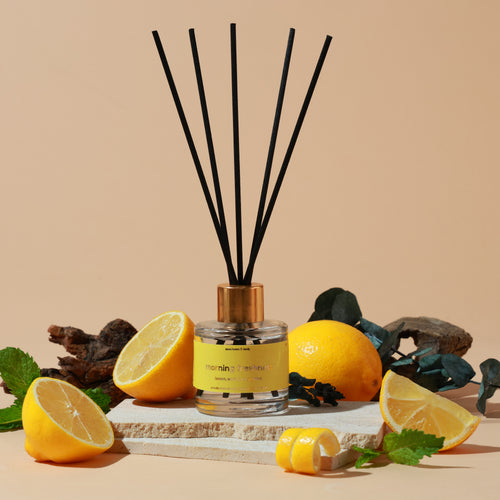 Slowed citrus · Morning Freshness₹749Shop →
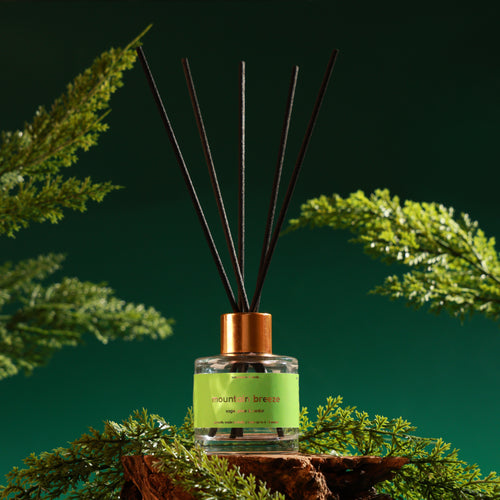
 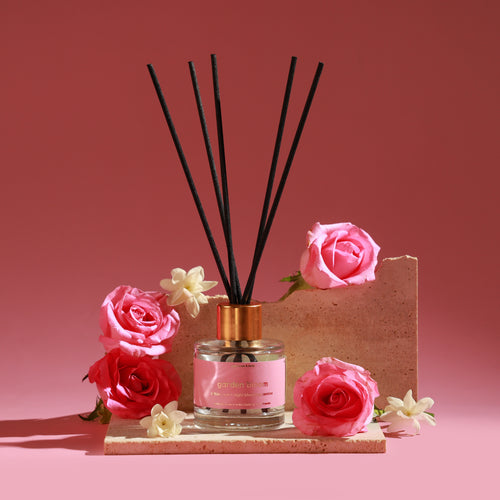 Stable jasmine · Garden Bloom₹799Shop → Resin that holds · Mountain Breeze₹849Shop →
How to make the bottle go further, honestly
There are four things worth doing and none of them costs anything. The first and largest is reed count. Six reeds is full projection; three is a soft bedside level and roughly doubles how long the bottle lasts, and in a sealed recirculating bedroom the perceived difference between the two is much smaller than the difference in consumption. If the heat has been shortening your bottles, this single adjustment recovers more than any change of scent or size will. Keep the spare reeds dry and upright in the box.
The second is placement, and it has two parts in this household. Off any sunlit surface, because direct sun both heats the bottle and strips the lightest materials. And out of the AC's direct discharge, because air blasting onto the reeds carries away the top of the composition within days and leaves you sitting with the base earlier than you should be. The bottle wants the room's circulation, not the unit's jet. An inner shelf or a chest of drawers, at or slightly below nose height, on something that will not be damaged, where nothing needs to be cleaned around it — a diffuser that gets moved daily performs worse and eventually spills.
The third is timing: flip in the evening, before the room closes, rather than in the morning, so the burst of restored projection lands in the hours you are in the room instead of the hours you are not. Every three to five days, or five to seven for Garden Bloom. And the fourth is simply to size correctly — a 50ml for a room up to about 150 sq ft and a 130ml above that. A 130ml holds more oil and runs 14–18 weeks instead of 6–8; it does not release more slowly, so it buys you a longer interval between purchases rather than a slower rate. In a large bedroom that is genuinely the better value. In a small one it is over-specified, and the honest recommendation is the 50ml with fewer reeds.
What to buy — and the one thing not to buy for this problem
The free adjustments come first because they do most of the work. The purchases below are for somebody who has already made them and wants a longer interval or a composition better suited to a hot flat.
| Do this / buy this | What it is | When it is the right answer | Cost |
|---|---|---|---|
| 1. Three reeds, off the sill, out of the AC's discharge ★ | Halves the exposed wet surface and removes the two avoidable accelerators | First, always. It recovers more than any purchase will | ₹0 |
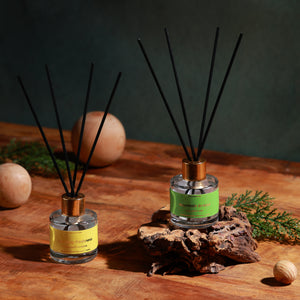
| 2. Morning Freshness 50ml | Malabar lemon, peppermint, eucalyptus globulus — the base slows the lemon three to four times | If your last citrus diffuser died in a fortnight in the heat | ₹749 |
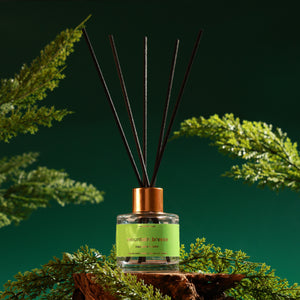
| 3. Mountain Breeze 50ml | Himalayan pine, sage, Indian cedar — dry resinous woods that hold in heat | If you want something that does not read sweeter as the base takes over | ₹849 |
| 4. The 130ml, but only for the right room | 14–18 weeks instead of 6–8, for rooms above about 150 sq ft | A larger bedroom. It buys a longer interval, never a slower rate | ₹1,249–₹1,349 |
| The honest gap: the 300ml refill, and any product that claims to resist heat | The 300ml refill at ₹2,399 is oil alone and is only sensible if you already own the bottle and reeds — as a response to a fast-finishing bottle it is an incomplete product, and it is the item on our own shelf most often bought by mistake. Nothing in this range, or any range, slows heat-driven evaporation. There is no plug-in, timer or subscription at SOSA, and no reed diffuser that runs longer because the flat is hot | Said plainly, because it is the purchase this question most often leads to | ₹0 |
Versailles
I trained in Versailles, where a reed diffuser sits in a cool room in still air and behaves itself for months. Almost nothing about that assumption survives contact with an Indian flat. Here the bottle spends its afternoons warm and its nights in dry, moving, conditioned air, and both of those speed it up. A range designed for the first climate and sold into the second will always disappoint somebody, and the disappointment usually arrives phrased exactly as you have phrased it.
So the honest answer has two halves and I would rather give both. The half I cannot help with is duration: heat accelerates evaporation, an AC dries and moves the air, and no formulation on earth stops either. The half I can control is what happens to the composition while that is going on. DPG is the standard carrier and it can crack above about 40°C, which is an ordinary afternoon in Delhi or Nagpur, and that is the mechanism behind every diffuser anyone has ever told me went bitter in the heat. We use CCT instead and test at a 45°C soak. It costs more and it is invisible and it is the reason the product works here at all.
Which is why I would rather you read a shorter bottle as a receipt than as a defect. Everything in it reached the room. If you want it to reach the room more slowly, take three reeds out — that is free, it is reversible, and it does more than anything you could buy. Everything is composed in Pune, and a part of every order funds a girl's classroom through Nanhi Kali.
Frequently asked questions
- When to flip the reeds — the evening, and the reason why.
- Why the bedroom smells stronger at night — three real mechanisms.
- Windows open by day, AC at night — the commonest pattern of all.
- Fewer reeds in a sealed bedroom? — the free correction, in full.
- The lowest-effort night setup — and when to switch Sukoon on.
- Reed or Sukoon for a night-only bedroom — the honest split.
- Do I need it running all day? — and the economics of a night-only bedroom.
- Brand: the SOSA founder story.
SOSA reed diffusers — facts verified August 2026: Five scents, all alcohol-free, on a heat-stable CCT (caprylic/capric triglyceride, coconut-derived) base rather than DPG, which can crack and go bitter above 40°C; phthalate-free, paraben-free, IFRA-compliant, 0 ppm formaldehyde, six fibre reeds rather than rattan in a refillable glass bottle, composed and made in Pune, India, and climate-tested through a 45°C heat soak and 85% relative humidity. Morning Freshness 50ml ₹749 · 130ml ₹1,249 · 9.0, with a eucalyptus globulus base that slows lemon evaporation three to four times, turning a 10–14 day citrus fade into 6–8 weeks. Evening Calm 50ml ₹799 · 130ml ₹1,299 · 8.9, the softest in the range. Garden Bloom 50ml ₹799 · 130ml ₹1,299 · 8.9, with indole held below the fecal threshold so jasmine stays floral above 30°C. Mountain Breeze 50ml ₹849 · 130ml ₹1,349 · 9.4. Fresh Brew 50ml ₹849 · 130ml ₹1,349 · 9.5, the deepest. Longevity 6–8 weeks on 50ml and 14–18 weeks on 130ml; 50ml suits rooms up to about 150 sq ft and 130ml above that. Six reeds is full projection, three is a soft bedside level and roughly doubles the life; two or three reeds in a 50 sq ft bathroom can make a 50ml last nearly three months. Flip cadence every 3–5 days, or 5–7 days for Garden Bloom. Cost per day roughly ₹13 for Morning Freshness or Garden Bloom 50ml and ₹15 for Evening Calm, Mountain Breeze or Fresh Brew 50ml. Duos: Day & Night ₹1,498, Fresh & Grounded ₹1,548, Warmth & Bloom ₹1,598. Refills 300ml ₹2,399 · 500ml ₹3,499, oil only and not a first purchase. Machines: Boond ₹899 (300ml, up to about 150 sq ft, around 6 hours, USB, night light), Sukoon ₹1,899 (500ml, 270–320 sq ft, 16–18 hours on low, three 15ml scents included), Megh ₹3,499 (six-litre tank, around 100 hours, but only about 215 sq ft — a runtime and humidity machine, never a coverage upgrade). The reed line contains no oud, sandalwood, vetiver or amber; Smoked Oudh and Sandalwood exist as ₹449 jar candles. SOSA sells no room spray, air purifier, dehumidifier, odour eliminator, plug-in, timer or subscription, and every SOSA spray is a car perfume. Reed oil and the water-based Hotel Collection are separate systems and are not interchangeable in either direction. Free shipping above ₹499. SOSA is an independent Indian fragrance house and is not affiliated with or endorsed by any hotel brand. Prices subject to change — see the live product pages.