




Buy in two months: the third bottle, for the room you use third-most. Deliberately out of step, so the reorders never land together.
Buy never: anything for the other 900-odd sq ft. Empty rooms consume fragrance at the same rate as occupied ones and return nothing for it.
2. Ignore the 1,200 sq ft entirely. It is not the number you are buying against. Floor area suggests eight bottles at ₹9,992 because a diffuser holds up to about 150 sq ft. But that coverage figure describes an air space with somebody in it, not a share of a floor plan, and about 900 of your square feet are corridors, a second bathroom, a utility area and rooms that are entered to fetch something. Buy for hours occupied, not for area owned.
3. The third room waits two months, and that is a feature. All three at once is ₹3,847 — ₹847 over a ₹3,000 budget — and it would put three bottles on an identical cycle, so every fourteen to eighteen weeks the entire house goes quiet at the same time and you face one bill of roughly ₹3,800. Buy the third when the first is about half down. It costs the same money and you will never again replace more than one bottle at a time.
4. If the living room is over about 200 sq ft, consider the machine build instead. A Sukoon at ₹1,899 covers about 270–320 sq ft, which a reed diffuser cannot. With a 50ml at ₹749 for the bedroom that is ₹2,648 — but it runs the water-based Hotel Collection, so add a 15ml at ₹299 and the honest total is ₹2,947, leaving ₹53. Reed oil never goes in a Sukoon and Hotel Collection never goes in a reed bottle.
5. Then count doors before you count anything else. Fragrance does not pass a closed door. If your three used rooms are behind three closed doors, they are three air spaces and no bottle can serve two of them. If the living, dining and kitchen run together with no door between them, that is one air space of perhaps 400 sq ft, and the honest answer there is two positions within it or a machine, not one bottle per named room.
Made in India, composed by an ISIPCA Versailles-trained perfumer — and a portion of every order supports girl-child education through Nanhi Kali.

Why 1,200 sq ft is the wrong number to start from
The coverage figure for a reed diffuser is up to about 150 sq ft on six reeds, and it is tempting to divide. 1,200 ÷ 150 = 8, so eight bottles, so ₹9,992 in 130ml. The arithmetic is right and the conclusion is nonsense, because the coverage figure describes an enclosed air space with a person in it, not a share of a floor plan. A diffuser has no fan and no pump: fragrance climbs the porous core of each reed, evaporates at the exposed tip, and from there the room's own air decides where it goes. It does not travel down a passage, turn a corner and charge a second bedroom. So the rated area is the size of pocket one bottle can hold at equilibrium, and a 1,200 sq ft flat is not one pocket — it is six or seven, most of which contain nobody.
The better counting rule is doors, then hours. Count the air spaces first: a 1,200 sq ft flat with six closed internal doors is six separate spaces, while the same flat with the living, dining and kitchen running together is perhaps four. Then ask how many waking hours each of those spaces actually holds a person. In most homes of this size the answer collapses fast — the living room and the main bedroom take the bulk of it, a third room takes a couple of hours, and everything else is measured in minutes of passing through. Since a reed diffuser evaporates at the same rate whether or not anybody is in the room, an unoccupied space converts your money into fragrance nobody smells at precisely the same speed as an occupied one converts it into fragrance somebody does. That single fact is what makes concentrating cheaper and better at the same time.
Two builds for ₹3,000, and one you should refuse
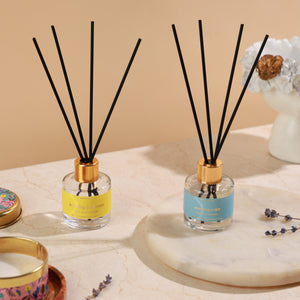
 Two 130ml₹2,548One 130ml Morning Freshness at ₹1,249 for the living room on six reeds. One 130ml Evening Calm at ₹1,299 for the main bedroom on four. ₹1,249 + ₹1,299 = ₹2,548, and ₹3,000 − ₹2,548 = ₹452 change. That is 14–18 weeks in each, about ₹78 a week of use per bottle, and two reorders rather than eight. Keep the ₹452 — it is most of the way to the third bottle you will buy in two months.
Sizing by space — what each part of 1,200 sq ft actually gets
Read down the list of spaces in a flat this size. Three rows here spend nothing, and between them they account for most of the floor area you were about to buy for.
| Space | What it needs | How many | Cost |
|---|---|---|---|
| Living room, 180–220 sq ft, used every evening ★ | One 130ml on six reeds — the first purchase, because this is where the hours are | One 130ml | ₹1,249 |
| Main bedroom, 140–160 sq ft, used every night | One 130ml on four reeds. Four is the bedroom setting and it stretches the bottle past eighteen weeks | One 130ml | ₹1,299 |
| Third room in daily use — study, or the second bedroom somebody sleeps in | One bottle, bought in about two months rather than today, so the three reorders never land together | One, later | from ₹749 |
| An open living-dining-kitchen run of 300 sq ft or more | Past what one passive bottle holds — two positions within the space, or a Sukoon at about 270–320 sq ft | Two bottles or one machine | ₹2,548 or ₹1,899 + ₹299 |
| The second bedroom nobody sleeps in, and the store room | Nothing. A bottle here empties on the same schedule as one in the living room and is noticed by nobody at all | None | ₹0 |
| Passages, the utility balcony, the second bathroom nobody uses | Nothing. A passage is a transit space, and a balcony is being ventilated faster than any passive source can charge it | None | ₹0 |
| A note on all of the above: all coverage above assumes six reeds, a closed room, still air and a standard ceiling. In a 1,200 sq ft home the variable that matters most is not size but doors — if the used rooms stand open to each other all day, you have fewer air spaces than rooms and can often buy one bottle fewer. | |||
One room · the unitFrom ₹749Shop → 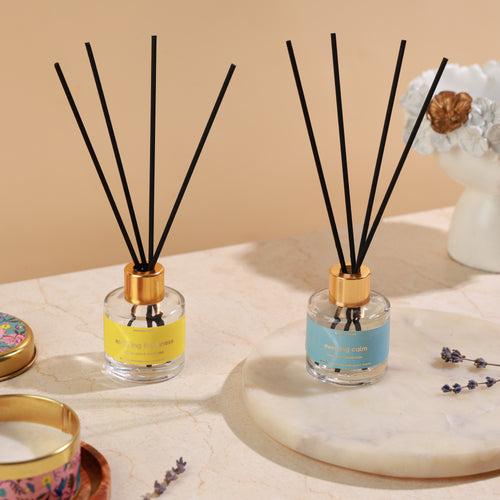 Two rooms · better value₹1,498Shop →
  Large room · a switch₹1,899Shop →
Reeds, doors, and when the third bottle should arrive
Set the reeds per room, not per house. Six in the living-room bottle, four in the bedroom, and two or three if you later add one to a small bathroom. Reed count is the only volume dial a reed diffuser has and it works in both directions at once: more reeds means more exposed surface evaporating, so a stronger room and a shorter bottle. In a home this size that matters twice over, because the same ₹1,299 bottle can run fourteen weeks in a warm living room and past eighteen in an air-conditioned bedroom on four reeds. Before you conclude any room needs a second bottle, add a reed to the one it already has — that is free, and it settles the question more often than not.
Then take one walk through the flat with the doors as they actually sit. This is the step that decides whether you need two bottles or three. If the living room, dining area and passage stand open to each other all day, they are one air space with one long dimension, and one bottle placed centrally does more than two placed at the ends. If every door is closed, you have as many spaces as doors and no bottle can help a room it is not in. Note also that a run longer than about twenty-two to twenty-four feet, an L-shape, or a blind leg off a main room genuinely does need a second position — that is a shape problem rather than a size one, and it is the one honest reason to put two bottles in what looks like a single room.
Then buy the third bottle when the first is half down, and refill rather than rebuy after that. The ₹452 change from build one is most of a 50ml already. Buying the third bottle eight or nine weeks late costs nothing extra and puts your three bottles permanently out of step, so you replace one at a time instead of facing a ₹3,800 restock twice a year. When the first bottles do run out, a 300ml refill at ₹2,399 fills a 130ml roughly twice, and refilling is the natural moment to fit fresh reeds — clogged fibre is the commonest reason throw falls away after a few months, and it is usually mistaken for an empty bottle.
What to buy
Two lines of this table are the purchase. The rest exists so you can see what the other options are genuinely for in a home of this size, rather than guessing from the price.
| Buy | What it covers | Lasts | Price |
|---|---|---|---|
| One 50ml | A single reed diffuser — the third room, bought two months after the first two — ₹749 on four reeds | 6–8 weeks | from ₹749 |
| One 130ml ★ | The value size — each of the two rooms that hold the hours — ₹1,249 and ₹1,299, ₹2,548 together with ₹452 change | 14–18 weeks | from ₹1,249 |
| The duo | Day & Night duo — the two-room build in one purchase if you would rather have both today at 6–8 weeks each | 6–8 weeks each | ₹1,498 |
| Sukoon | 500ml ultrasonic — an open living-dining run past about 200 sq ft — about 270–320 sq ft, plus ₹299 of Hotel Collection to run it | Runs when you switch it on | ₹1,899 |
| 300ml refill | The running cost — the point where running two or three bottles in a big flat stops being expensive | Roughly 2 × 130ml fills | ₹2,399 |
Versailles
The floor area is the first thing people tell me and the least useful thing they could tell me. A 1,200 sq ft flat where three rooms are in use is not a 1,200 sq ft problem. It is a two-room problem with a third room to think about later, and the honest bill for it is ₹2,548 rather than the ₹9,992 the area arithmetic suggests.
I get asked to approve the eight-bottle version fairly often and I will not. Not because it is too much money for us to take, but because a bottle in a store room evaporates exactly as fast as a bottle in your living room and is smelled by nobody. Four months later, eight bottles finish in the same fortnight, and the person who bought them concludes the category is a racket. It is not. The plan was.
So buy two, keep the ₹452, and put the third bottle in your calendar for about two months out. If, when the time comes, you find the third room does not miss it, do not buy it at all — that is a perfectly good outcome and it is the one I would quietly bet on in most homes this size. A portion of every order funds a girl's classroom through Nanhi Kali.
Frequently asked questions
- Why counting doors beats counting square feet — the single most useful rule.
- Should I fragrance rooms nobody uses? — the ₹2,247 that buys nothing.
- How many for a 1,500 sq ft home? — the same counting, one size up.
- Which three rooms come first — the order of purchase.
- Brand: the SOSA founder story.
SOSA products & prices (verified August 2026): Hotel Collection water-based ultrasonic diffuser fragrance 15ml ₹299 · 100ml ₹999 · 300ml ₹1,799 · Pack of 7 (15ml, all fragrances) ₹1,799; refills 100ml from ₹999. Seven scents: The Ritz-Carlton-inspired (white tea · bergamot · cedar), Westin-inspired (white tea · aloe · cedar), 1 Hotels-inspired (cedarwood · vetiver · green leaves), The St. Regis-inspired (amber · violet · woods), Shangri-La-inspired (jasmine · green tea · white tea), Four Seasons-inspired (citrus · floral · sandalwood), W Hotels-inspired (citrus · pepper · amber). Diffusers: Boond 300ml ₹899 · Sukoon 500ml ₹1,899 · Megh 6L ₹3,499. Water-based, phthalate-free, composed to IFRA standards for home diffusion; 3–6 drops per tank. Made in India, Pune. The Hotel Collection scents are SOSA's own interpretations inspired by the world's finest hotels; all hotel names are trademarks of their respective owners and are used only to describe the scent style — SOSA is an independent Indian fragrance house, not affiliated with or endorsed by any hotel brand. Prices and availability subject to change — see the live product pages.