



What you can copy: weekly linen with protectors and a proper dry, a ten-minute purge, fewer loaded soft things in the room, and one scent kept at a low setting for a year.
What you cannot: your own nose. You arrive at a hotel room adapted to nothing. You have never once smelled your own bedroom fresh.
2. Because the room is being ventilated whether anyone is in it or not. Hotel rooms run on mechanical systems that supply outside air and extract from the bathroom continuously. Housekeeping props the door open while servicing. The room stands empty and moving air for most of the day. Your bedroom is shut for eight hours with a person in it and often shut for the rest of the day too, at 0.2 to 0.5 air changes an hour.
3. Because there is very little in the room that can hold a smell. Hard headboards or panelled ones, stone and laminate surfaces, lined curtains cleaned on a schedule, no accumulated cushions, no clothes on a chair, no ten-year-old rug. Porous material is what stores and re-releases odour, and a hotel room is deliberately short of it. The one exception is the carpet, which is exactly what goes wrong in a tired hotel.
4. Because the scent is faint, constant and never changed. It is not strong. It is the same on Tuesday as it was in March, at a level you register in the first eight seconds and then stop noticing. Consistency is what reads as expensive; strength reads as a cover-up. Almost everyone trying to reproduce this at home overshoots on the fragrance and undershoots on the other three.
5. And because you always arrive at a hotel with a reset nose. Twenty minutes is all it takes to adapt to a steady smell, and you have lived in your bedroom for years. You have literally never smelled it the way you smell a hotel room. Walk out for half an hour and come back before you conclude anything.
Made in India, composed by an ISIPCA Versailles-trained perfumer — and a portion of every order supports girl-child education through Nanhi Kali.

Why the fragrance is the smallest part of the hotel effect
Rank the four factors by how much of the difference they explain and fragrance comes last, comfortably. A hotel room has had its entire fabric load removed and replaced within the last twenty-four hours; yours is on a weekly cycle at best, with a pillow and mattress underneath that have never been washed at all. A hotel room is mechanically ventilated around the clock; yours runs at 0.2 to 0.5 air changes an hour with the door shut. A hotel room contains a fraction of the porous material your bedroom does, so there is far less to absorb and re-release anything in the first place. By the time you get to the fragrance, most of the work has already been done by things that are not fragrance. That is why buying a stronger scent for your bedroom does not produce the effect: you are turning up the last variable to compensate for the first three, and the result reads as a scented room rather than a fresh one.
There is also a measurement problem, and it is the reason this question feels so stubborn. You arrive at a hotel room from a corridor, a lift and a taxi, with a nose that has adapted to none of it, and you get one clean, unrepeatable first impression. You arrive at your own bedroom having lived in your flat all evening. Olfactory adaptation is essentially complete within about twenty minutes, so you have never in your life smelled your own bedroom the way you smell a hotel room, and you never will from inside it. The honest comparison is to leave your flat for half an hour and walk back in — most people find their bedroom is a good deal closer to the hotel than they assumed, and that what they were missing was the arrival, not the room.
The four things hotels do, in order of how much they matter
 Step fourFrom ₹749Skin lipids transfer into bedding every night, sit at body temperature and oxidise — that is the actual chemistry of a slept-in room. A hotel removes the entire loaded layer daily, so the reaction never has more than one night to run. At home you cannot and need not do that, but you can close most of the gap: sheets and pillowcases weekly, a washable protector on the pillow and one on the mattress, and — the part people miss — dry the laundry properly and fully. Hotel linen is washed hot and dried completely; a home wash left half dry in a heap on a monsoon afternoon is where a great many "clean" beds go wrong.
Symptom to cause: closing the hotel gap
Each row is one of the four factors failing, plus the two that are never a fragrance question. Work out which one is actually missing before buying anything.
| What you notice | Most likely cause | How to confirm it | What actually fixes it |
|---|---|---|---|
| Clean sheets feel fresh for two nights, then flat again ★ | The layers under the sheet — pillow, duvet and mattress — never reset | Smell the pillow against a laundered one from the cupboard | Protectors on pillow and mattress; wash the duvet cover; air the stack in sun |
| Room reads flat even with clean linen and an open window | No continuous scent layer, and a nose adapted to the room | Leave the flat for thirty minutes and judge the first breath back | One scent, kept low and unchanged; three or four reeds, not six |
| Linen smells faintly sour even straight off the line | Laundry not fully dried, or left folded damp — very common in monsoon | Compare a load dried in sun with one dried indoors on a wet day | Wash warm, dry completely, never leave a load sitting; sunlight where possible |
| Bedroom is fine but the en-suite drags it down | Extraction that stops too soon, leaving permanently wet surfaces | Run the fan twenty minutes after a shower and see if the bedroom changes | Long fan run-on, squeegee the screen, en-suite door shut at night |
| A sewer note near the bathroom, worse when the room is unused | A dry P-trap or failed seal — plumbing, not fragrance | Pour a mug of water down each drain and wait an hour | Refill traps weekly; call a plumber if it returns. No scent belongs here. |
| Musty note and dark speckling on a wall, ceiling corner or curtain hem | Mould — a health issue and a building one | Inspect external walls behind furniture and the ceiling corners in daylight | Find the moisture source and remove the growth. Fragrance is not part of this. |
| If none of these fit: book nothing and change one thing: put a protector on the pillow and leave the bedroom door open all day for a week. That is the cheapest half of the hotel effect. | |||
Reeds · always-on roomsFrom ₹749Shop →  Sukoon · when you want a switch₹1,899Shop →
  Hotel Collection · the scentFrom ₹299Shop →
What to copy, in order of value
Start with the linen, because it is the biggest factor and the most copyable. You are not going to change the bed daily and you do not need to. Sheets and pillowcases weekly, duvet cover monthly, a washable protector on the pillow washed monthly and one on the mattress washed each season. Wash warm and — this is the part that separates linen that feels hotel-fresh from linen that does not — dry it completely. A load left half dry, or folded slightly damp on a humid afternoon, arrives on the bed already carrying something. Sunlight helps more than people expect, because UV and heat clear absorbed volatiles out of fibre faster than shade. And every morning, throw the duvet fully back rather than making the bed, so the whole stack dries out during the day instead of sealing the night in.
Then approximate the ventilation, and thin out the reservoirs. Window and bedroom door open together for ten to fifteen minutes each morning; the bedroom door left open during the day so the room is not sitting in its own air; the en-suite fan left running well after a shower rather than switched off with the light, and the en-suite door shut at night. Then look around the room and count the porous things. Clothes over a chair, a pile of cushions, an old rug, a fabric headboard, heavy unlined curtains — each is a reservoir that absorbs and slowly re-releases. A hotel room has almost none of them, and that is a design decision you can partly copy for nothing: clothes into a basket, curtains washed seasonally, upholstery vacuumed with the brush attachment rather than only the floor.
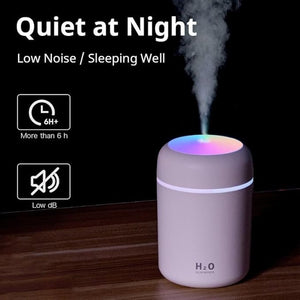
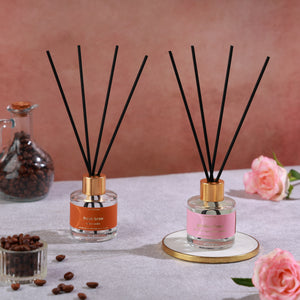
Then the scent, last, and lower than instinct suggests. The hotel model is faint and constant, so pick one blend and stay with it — changing scents every few months is the surest way to sound like a home that is trying rather than a room that simply is. A reed diffuser from ₹749 matches the behaviour exactly: continuous, passive, nothing to switch, and the reed count is the volume dial, so use three or four of the six in a bedroom and put it across the room from the bed. Dry and clean profiles suit this better than sweet ones: Morning Freshness reads cool and unfussy, Mountain Breeze reads dry, green and grounded. If you specifically want the hotel-lobby character, that lives in the water-based Hotel Collection from ₹299 run on the Sukoon at ₹1,899 — 3–6 drops per tank, roughly 270–320 sq ft of coverage, and a switch so the room is silent at 2am. There is no hotel-inspired reed diffuser, and the oil-based reed fragrance and the water-based Hotel Collection are not interchangeable.
What to do, in order
Ranked the way a hotel would rank it: linen, air, surfaces, then scent. The first three cost nothing but attention, and they are three-quarters of the answer.
| Step | What to do | When | Cost |
|---|---|---|---|
| 1. Remove the source | Protectors on pillow and mattress, linen washed warm and dried completely, clothes off the chair and into a basket | Before anything else | ₹0 |
| 2. Move the air | Window and bedroom door open together each morning; bedroom door left open by day; long en-suite fan run-on | Daily, five to ten minutes | ₹0 |
| 3. Deal with what holds it | Curtains washed seasonally, upholstery and mattress vacuumed, fewer soft things in the room overall | Weekly to monthly | ₹0 |
| 4. Then the always-on layer ★ | A SOSA reed diffuser — the hotel model exactly — low, continuous, unchanging, on three or four reeds, one scent kept for a year | 50ml 6-8 weeks · 130ml 14-18 | from ₹749 |
| 5. Or the on-demand layer | Sukoon with a Hotel Collection scent — the hotel-inspired scents themselves, water-based, at 3–6 drops per tank with a switch for the night | Run it when you want it | ₹1,899 |
Versailles
People come to me asking which fragrance smells like a hotel room, and the honest answer is that the fragrance is the last quarter of it. A hotel changes every sheet, case and towel daily, runs mechanical ventilation whether anybody is in the room or not, and furnishes with hard surfaces precisely so that nothing can hold on to anything. You are being asked to buy the smallest of the four levers, and I would rather tell you that than sell you a bottle to do a laundry basket's job.
The second thing is a genuine kindness rather than a technique. You have never smelled your own bedroom properly. You adapt to it in twenty minutes and you live there, so the comparison you are making — hotel room on arrival versus your room from inside it — is not a fair one, and it never can be. When people finally leave the flat for half an hour and walk back in, most of them discover their bedroom is fine and what they were missing was the arrival.
If you do want the fragrance part, copy the hotel discipline rather than the hotel strength. Choose one scent. Keep it faint. Do not change it for a year. Three reeds in a bedroom, across the room from the bed. And if it is specifically the lobby character you are after, that is the water-based Hotel Collection on a Sukoon — there is no hotel-inspired reed, and I would rather correct that than let you buy the wrong thing. A portion of every order funds a girl's classroom through Nanhi Kali.
Frequently asked questions
- How hotels keep bathrooms fresh — the same discipline, one room over.
- Pillow, duvet and mattress — the reservoir hotels reset daily.
- Clean and expensive rather than sweet — why dry notes read better in a bedroom.
- Fresh without being perfumed — restraint as the technique.
- Brand: the SOSA founder story.
SOSA products & prices (verified August 2026): Hotel Collection water-based ultrasonic diffuser fragrance 15ml ₹299 · 100ml ₹999 · 300ml ₹1,799 · Pack of 7 (15ml, all fragrances) ₹1,799; refills 100ml from ₹999. Seven scents: The Ritz-Carlton-inspired (white tea · bergamot · cedar), Westin-inspired (white tea · aloe · cedar), 1 Hotels-inspired (cedarwood · vetiver · green leaves), The St. Regis-inspired (amber · violet · woods), Shangri-La-inspired (jasmine · green tea · white tea), Four Seasons-inspired (citrus · floral · sandalwood), W Hotels-inspired (citrus · pepper · amber). Diffusers: Boond 300ml ₹899 · Sukoon 500ml ₹1,899 · Megh 6L ₹3,499. Water-based, phthalate-free, composed to IFRA standards for home diffusion; 3–6 drops per tank. Made in India, Pune. The Hotel Collection scents are SOSA's own interpretations inspired by the world's finest hotels; all hotel names are trademarks of their respective owners and are used only to describe the scent style — SOSA is an independent Indian fragrance house, not affiliated with or endorsed by any hotel brand. Prices and availability subject to change — see the live product pages.