

Do this first, and it costs nothing: extraction on before the pan heats and left running afterwards, and a deliberate airflow path — two openings, or one window with a fan pointed out of it, for ten or fifteen minutes while you eat.
Then the fabric: in a 1BHK the sofa, the curtains and often the bed are all inside the cooking's reach. They hold the deposited fraction and release it slowly through the morning. A wash rota does more here than any product.
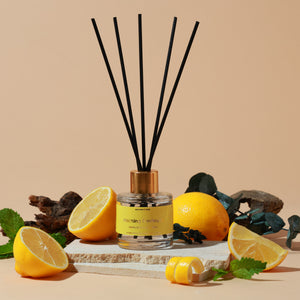
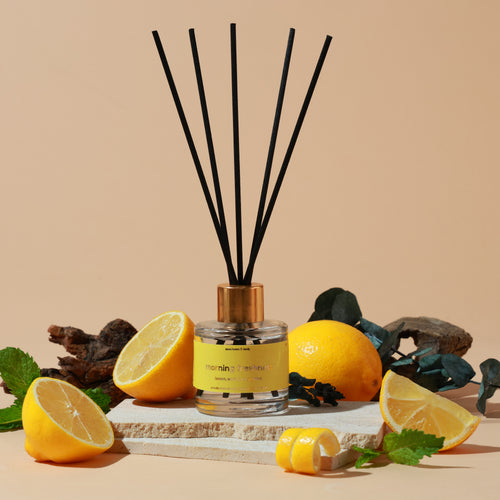
Then fragrance: Morning Freshness 50ml at ₹749 — the 50ml is built for rooms up to about 150 sq ft, which is most 1BHK living areas. Three or four reeds, not six.
The honest limit: no diffuser removes a cooking smell, and SOSA makes no odour eliminator, air purifier or room spray. Fragrance follows airing; it never replaces it.
2. Run the extraction earlier and longer than feels necessary. On before the oil goes into the pan, not when the smell arrives; still running ten minutes after you switch the hob off. In a small flat the plume reaches the sofa in seconds, so anything not captured above the pan is already a furniture problem rather than an air problem.
3. Air the flat while you eat, not after you have left for work. This is the timing detail that changes a 1BHK. Breakfast lasts until lunch largely because the flat is shut at half past eight and stays shut — the deposited fraction keeps releasing all morning into air that is never replaced. Fifteen minutes of genuine airflow immediately after cooking, while the release is at its highest, removes far more than an hour of airing in the afternoon.
4. Treat the soft furnishings as part of the problem, because in a 1BHK they are inside the kitchen's reach. The sofa, the cushion covers, the curtains and frequently the bedding are all within a few metres of the hob. They take the oily fraction and give it back slowly. Covers and curtains on a routine wash, cushions out on the balcony or by an open window while the flat airs, and a wipe of the hard surfaces near the hob. This is the step that moves the flat's baseline.
5. Now fragrance, sized down rather than up. Morning Freshness 50ml at ₹749 with three or four reeds, placed at the far end of the living area from the kitchen. It will not remove the breakfast and it is not meant to; it gives the aired flat a character of its own for the hours you are in it.
Alcohol-free, phthalate-free, made in Pune. A portion of every order supports girl-child education through Nanhi Kali.
Three reasons a small flat holds breakfast longer than a big one
People assume a small home is easier to keep fresh because there is less of it. The opposite is true for cooking, and it is worth understanding why, because each of the three reasons has a different remedy and only one of them has anything to do with fragrance.
 Morning Freshness₹749Cooking releases a quantity of material that depends on the food and the heat, not on the size of the home receiving it. Put that quantity into a large flat and it is diluted across a great deal of air; put it into a 1BHK and the concentration in the room is simply higher from the first minute. This is also why the same 50ml bottle behaves so differently in the two homes, and why the honest sizing advice here is down: a 50ml is specified for up to about 150 sq ft, and a 130ml in a compact living area is over-specified. The room is not asking for more fragrance. It is asking for less cooking concentration.
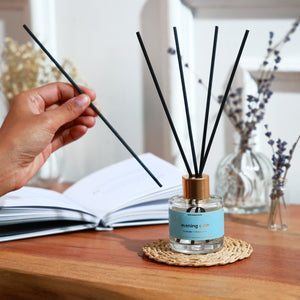
 Evening Calm₹799A 1BHK has a high ratio of surface to air. Walls are closer, the sofa is closer, the curtains are closer, and in many flats the bed is in the same volume as the hob. Cooking produces an oily aerosol that settles onto whatever it meets and then re-releases slowly, so the more absorbent surface sits within reach of the kitchen, the larger the reservoir that keeps supplying the room all morning. That is the actual answer to "why until lunch": the flat is not still cooking, it is still releasing. Ventilation cannot reach a fraction that has stopped being airborne, which is why washing and airing the textiles is not housekeeping advice tacked onto a fragrance page — it is the load-bearing step.
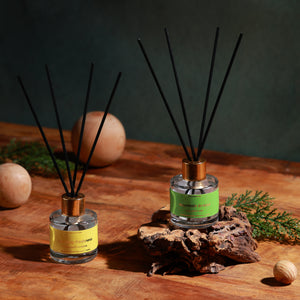
 Mountain Breeze₹849The third reason is a timetable rather than a physical property. Breakfast is cooked, the flat is shut against heat, dust or simply because everyone leaves, and from then until lunch there is almost no air exchange at all. The deposited fraction keeps releasing into air that is never replaced, so the concentration builds back up rather than decaying. Add adaptation — your nose stops reporting a constant smell within minutes, so you only notice it when you walk back in — and you get precisely the experience you have described. The remedy is timing: air the flat while the release is highest, in the fifteen minutes after cooking, rather than when you get home.
Making an airflow path where the building did not give you one
Cross-ventilation is a straight line between two openings on different pressures, and a great many 1BHKs cannot produce one because every opening faces the same way. When that is true, opening more windows achieves surprisingly little: without a difference between one side and the other, air does not so much travel as loiter. The cheapest fix is to create the difference yourself. A fan placed in or facing a window and blowing outward makes that window the exhaust, and air is then drawn across the flat from every other gap and opening towards it. Set it at the far end from the kitchen and prop the internal doors, and you have a path where the architecture gave you none. It is not an elegant solution and it is comfortably the most effective thing on this page.
The second half is the extraction hood, and the mistake is nearly always timing rather than power. Switch it on before the oil is hot, use the burner the hood covers best, and leave it running for ten minutes after the hob is off — the release from a hot pan and a hot cooktop does not stop the moment you finish. If your kitchen has a window, open it while the hood runs so the hood has make-up air to work with; a sealed kitchen makes an extractor fight the whole flat for every cubic metre it moves. And where there is a door between kitchen and living area, use it during cooking. In a small flat that door is the difference between a plume that leaves through the kitchen window and a plume that crosses the sofa on its way out.
Now the part I have to be plain about, because it is the reason this page exists. Fragrance does not remove a smell. A pleasant odour added to a cooking odour gives you a mixture, not a subtraction, and in a small flat — where concentrations are already high — that mixture becomes obvious faster than in a large one. SOSA makes no odour eliminator, no air purifier and no room spray of any kind; every SOSA spray is a car perfume. What a reed diffuser does in a 1BHK is give the aired flat a consistent character, which is a real thing to want and a modest thing to claim. Buy it for that, after the airflow and the washing, and it will do exactly what it says. Buy it to solve the breakfast and it will disappoint you by lunchtime.
What each step is worth in a small flat, honestly ranked
The same five interventions, weighted for a 1BHK rather than a large home. Note that the ordering differs from a bigger flat: in a small home the airflow path climbs above everything, because there is no dilution to fall back on. The bottom row is what we sell, and it is at the bottom deliberately.
| Step | What it addresses | How much it changes | Effort | Cost |
|---|---|---|---|---|
| 1. A fan making one window the exhaust | The missing pressure difference in a single-aspect flat | The largest change available, and most people never try it | Two minutes, twice a day | A fan you likely own |
| 2. Extraction on early, off late, kitchen window open | The plume before it reaches the living area | Very large — in a 1BHK the sofa is seconds away | A habit | Nothing |
| 3. Airing while the release is highest | The timing error that makes breakfast last until lunch | Large, and free | Fifteen minutes after cooking | Nothing |
| 4. Covers, curtains and cushions on a rota | The deposited fraction, which is the reservoir | Moves the flat's baseline rather than one morning | Real and recurring | Washing |
| 5. Morning Freshness 50ml, after the above | Gives the aired living area a character of its own | Meaningful for how it reads, nil for odour removal | Flip reeds every 3–5 days | ₹749 |
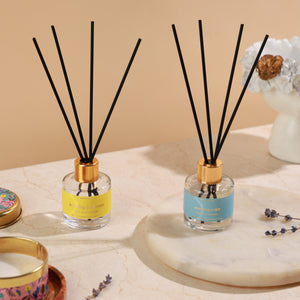
Bright · Morning Freshness₹749Shop → 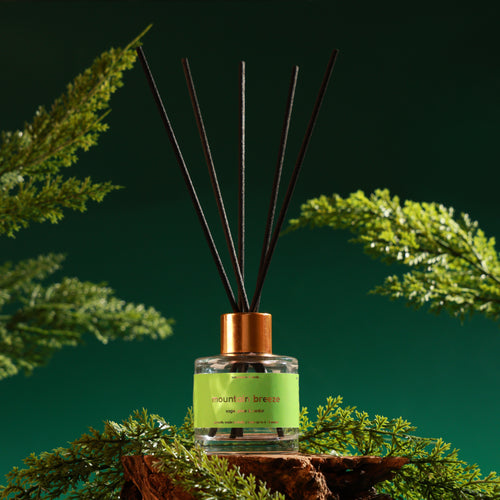 Dry woody · Mountain Breeze₹849Shop →
 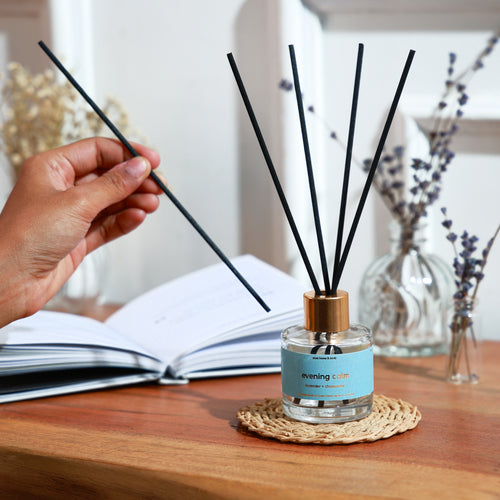 Softest · Evening Calm₹799Shop →
Size, dose and where the bottle actually goes
Sizing first, because it is where money is most often wasted in a small home. A 50ml is specified for rooms up to about 150 sq ft and a 130ml for above that, and most 1BHK living areas sit comfortably inside the first bracket. The 130ml is genuinely better value per week — 14 to 18 weeks against 6 to 8, for roughly ₹500 more — but only if the room needs it, and yours probably does not. A 130ml in a compact flat does not give you a better-smelling home; it gives you a stronger one, and stronger is the direction in which a fragrance stops sounding layered and starts sounding like a product. Buy the 50ml at ₹749, which works out at roughly ₹13 a day.
Dose second. Every bottle ships with six fibre reeds, and the reed count is the volume dial rather than a set of instructions. Six is full projection, suited to a living room above 150 sq ft. Three is a soft level and roughly doubles how long the bottle lasts. In a 1BHK I would start at three, wait a week, and add a fourth only if someone arriving from outside genuinely does not notice anything. That last part matters, because you are the worst possible judge of your own flat — your receptors adapt to a constant smell within minutes, so the honest test is to be out for a quarter of an hour and walk back in. Households consistently over-dose because they cannot smell what a visitor smells.
Placement last, and in a single room it comes down to distance from the hob. Put the bottle at the point in the living area furthest from the kitchen, in the room's ordinary air movement but not in the path a fan is pulling along, at or slightly below nose height, out of direct sun and away from any flame — fragrance oil is flammable, so it does not belong beside a diya, an agarbatti or a lit candle. If the flat has a bed in the same volume, consider Evening Calm at ₹799 instead: at 8.9 it is the softest thing we make, and in a single-volume home the living-area fragrance is also the bedroom fragrance whether you intended that or not.
What to buy for a 1BHK — and what is over-specified
In buying order for a compact flat where the kitchen, the sofa and often the bed share one volume. The last row is the honest gap, and on this page it has two halves: nothing here removes a cooking smell, and the larger bottle you may be tempted by is the wrong purchase for your room.
| Buy | What it is | When it is the right answer | Price |
|---|---|---|---|
| 1. Morning Freshness 50ml ★ | Malabar lemon, peppermint, eucalyptus — bright, 9.0 | The default for a 1BHK living area. Three or four reeds | ₹749 |
| 2. Evening Calm 50ml | Kashmir lavender, chamomile, soft musk — 8.9, the softest we make | When the bed is in the same volume and you want the flat quiet | ₹799 |
| 3. Mountain Breeze 50ml | Himalayan pine, sage, cedar — dry and resinous, 9.4 | If citrus reads too close to a cleaning product for you | ₹849 |
| 4. Day & Night duo | Two 50ml bottles — bright for the day, soft for the evening | Only if you genuinely have two separable spaces to run them in | ₹1,498 |
| The honest gap: the 130ml, and the idea of odour removal | A 130ml at ₹1,249 is specified for above 150 sq ft and is over-specified in most 1BHKs. And nothing in this range removes a cooking smell — there is no SOSA odour eliminator, air purifier or room spray | Both said plainly, because both save you money | — |
Versailles
The letters we get from 1BHKs are the ones I find hardest to answer commercially, because the honest reply begins with a fan and a wash cycle rather than a bottle. A compact flat has no dilution to hide behind. Everything that leaves the pan is in the room at a higher concentration, lands on more surface per cubic metre, and then sits there through a morning in which the flat is shut. That is three separate mechanisms, and a fragrance addresses none of them.
What I would genuinely do, in that flat, in this order: extraction on before the oil, the internal door shut while the pan is hot, a fan making one window the exhaust for fifteen minutes while I eat, and covers and curtains washed more often than a household that eats out would ever bother with. Only then a diffuser, and the smallest one, with half the reeds in it.
The reed advice is the part people skip, and it is free. Six reeds is designed for a living room above 150 sq ft. In a small flat three is usually right, it roughly doubles how long a bottle lasts, and it is the difference between a fragrance that reads as considered and one that reads as an air freshener. Morning Freshness at ₹749 is what I would put there, and the eucalyptus base under the lemon is why it lasts six to eight weeks instead of the ten to fourteen days an ordinary citrus reed manages. Everything is composed in Pune, and a part of every order funds a girl's classroom through Nanhi Kali.
Frequently asked questions
- Tadka twice a day, and it reaches the living room — the two fractions, explained in full.
- Frying fish in a 2BHK — the highest-deposition case in the family.
- The chimney works but masala reaches the sofa — why upholstery is the reservoir.
- Should you avoid sweet fragrances if you cook nightly? — the gourmand problem.
- Citrus, floral or woody after heavy cooking — the registers scored.
- One AC across kitchen and living room — one volume, one decision.
- A reed with the kitchen a few feet away — yes, with a caveat.
- Cooking at 7, guests at 8 — what an hour can actually do.
- Sukoon or a reed for speed after cooking — control against continuity.
- Brand: the SOSA founder story.
SOSA reed diffusers — facts verified August 2026: Five scents, all alcohol-free, on a heat-stable CCT (caprylic/capric triglyceride) base rather than DPG, phthalate-free, paraben-free, IFRA-compliant, 0 ppm formaldehyde, six fibre reeds in a refillable glass bottle, composed and made in Pune, India. Morning Freshness (Malabar lemon · peppermint · eucalyptus globulus) 50ml ₹749 · 130ml ₹1,249 · 9.0. Evening Calm (Kashmir lavender · chamomile · soft musk) 50ml ₹799 · 130ml ₹1,299 · 8.9, the softest in the range. Garden Bloom (British rose · night-blooming jasmine) 50ml ₹799 · 130ml ₹1,299 · 8.9. Mountain Breeze (Himalayan pine · sage · Indian cedar) 50ml ₹849 · 130ml ₹1,349 · 9.4. Fresh Brew (Coorg coffee · Kerala vanilla · soft caramel) 50ml ₹849 · 130ml ₹1,349 · 9.5, the deepest in the range. Longevity 6–8 weeks on 50ml and 14–18 weeks on 130ml; 50ml suits rooms up to about 150 sq ft and 130ml above that; six reeds give full projection and three roughly double the life. Climate-tested through 45°C heat and 85% RH monsoon humidity. The reed line contains no oud, sandalwood, vetiver or amber. Reed oil and the water-based Hotel Collection are not interchangeable and there is no hotel-inspired reed diffuser. Fragrance oil is flammable — keep diffusers away from diyas, agarbatti and open flame. Free shipping above ₹499. A portion of every order supports girl-child education through Nanhi Kali. SOSA is an independent Indian fragrance house and is not affiliated with or endorsed by any hotel brand. Prices subject to change — see the live product pages.