


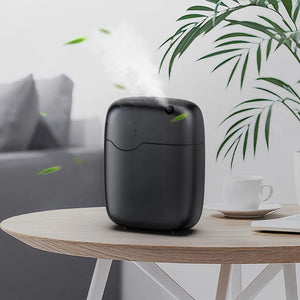
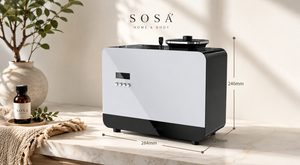
The hybrid: Vaayu below plus three Sukoons above, ₹17,696 — the right machine for each direction.
If the budget stops short: three Sukoons and a Boond at ₹6,596 is a genuinely good duplex.
2. The hybrid at ₹17,696 is the recommendation, and it is ₹10,100 more. One waterless Vaayu at ₹11,999 for the open lower floor — up to 1000m³ of connected space, no tank, no added humidity, under 38dB, a Bluetooth app with genuine scheduling — plus three Sukoons above. ₹15,797 with two bedroom machines.
3. In a duplex the deciding factor is verticality, not labour. In a flat this argument is about weekly tanks. Here it is about one floor that is structurally harder than its floor area suggests, because warm air rises through the stairwell continuously and takes fragrance with it.
4. Buying the Vaayu alone would be the expensive mistake. A nebuliser rated for a thousand cubic metres is exactly as helpless against a shut bedroom door as a 500ml ultrasonic unit, and a duplex has two, three or four of those doors upstairs, closed for the hours that matter.
5. If the budget stops short, buy neither of these. Three Sukoons at ₹5,697 and a Boond at ₹899 is ₹6,596, covers both storeys and the junction between them, and is a genuinely good duplex.
A portion of every order supports girl-child education through Nanhi Kali.

What each setup actually is at duplex scale
This comparison is usually written as though the two options were two sizes of the same idea, with price doing the deciding. They are not. One is four identical ultrasonic machines placed one per enclosed air mass; the other is two different technologies aimed at two different problems in the same building. In a duplex there is also a third thing in the room that no flat has to account for, which is that one of the two floors is structurally harder than its square footage suggests. So it is worth setting out what each setup is before deciding which is better.
The head-to-head, line by line
Four machines, one machine and the hybrid across the six lines that actually decide it in a two-storey home, with nothing rounded in anybody's favour. The middle column is on the table because people ask about it, not because I would ever recommend it on its own in a duplex.
| The line | Four Sukoons · ₹7,596 | One Vaayu · ₹11,999 | The hybrid · ₹17,696 |
|---|---|---|---|
| The open floor below | 270–320 sq ft of an 800–1,300 sq ft volume that is losing its top layer to the stairwell | Up to 1000m³ of connected space, treated as one body of air rather than a room | The nebuliser downstairs — the only line on this table where the two setups genuinely differ in kind |
| The bedrooms above | One machine each, comfortably inside the rating, on low with the 2H timer | Nothing at all — no machine of any technology crosses a shut door | One Sukoon per bedroom, each on a character its occupant chose |
| Refill labour, with stairs in it | Four 500ml tanks on one morning a week, collected on the way down rather than in two trips | None — no water and no tank | Two or three easy bedroom tanks that go most of a week on low, and none downstairs |
| Scheduling | Remote with steady, 2H and 4H duration timers — it runs for a set number of hours and cannot start itself at a clock time | Bluetooth app with genuine scheduling; under 38dB | Real scheduling on the arrival floor, duration timers where the person is in the room anyway |
| Humidity | A little added in four rooms — welcome in an AC-dry bedroom, a consideration on the coast in monsoon | None anywhere | A little upstairs where it is usually pleasant, none in the largest volume in the house |
| The verdict ★ | Complete on paper, honest in the bedrooms, and permanently short on the floor below. ₹8,495 with a Boond | A superb lower floor and bedrooms exactly as they were. Never buy it alone in a duplex | The recommendation — ₹10,100 more than four machines, and the only setup that answers both directions |
Sukoon · four is ₹7,596₹1,899Shop → 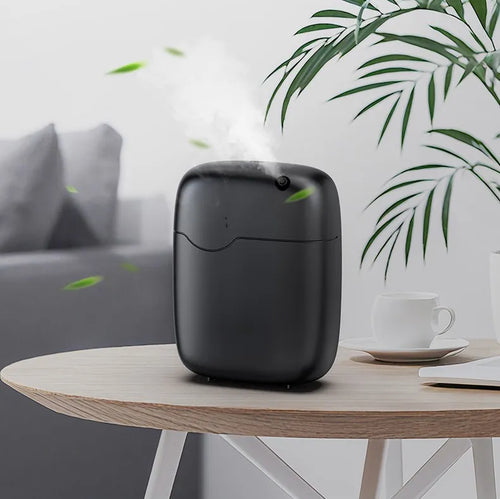 Vaayu · the open floor below₹11,999Shop →
  300ml refill · the running cost₹1,799Shop →
Why verticality decides it
Take the four-machine setup first, because most people arrive leaning towards it and the instinct is sound. Three of the four machines are doing exactly what they were designed for. An upstairs bedroom is 110–220 sq ft against a 270–320 sq ft rating, so the unit runs on low with the 2H timer at least 1.5m from the pillow and goes most of a week on a single 500ml fill; the door is shut for the hours that matter, so nothing escapes; and each machine belongs to a person, with its own switch, its own remote and three 15ml Hotel Collection bottles of that buyer's choice. No central system of any kind can give three people three fragrances behind three doors, and that is not a limitation anybody can spend their way out of. Then there is the fourth machine. It stands on an open lower floor of 800–1,300 sq ft, it runs the longest hours in the house, it empties fastest, and the volume it is serving has a continuous outflow at the top of it. The result is not that the floor smells of nothing — it is that it reads thin at the ends, never builds the way a closed room of the same area would, and quietly deposits a good part of its output at the ceiling above the landing. The tempting fix is a second unit at the far end of the same floor, and it is the one purchase I would argue against hardest in this whole cluster: two ultrasonic machines in one air mass overlap in the middle rather than adding their ratings together, so the centre gets heavier, the ends stay much as they were, and ₹1,899 that would have finished a bedroom has gone into a room that already had a machine.
Now the hybrid, and the honest way to present it is as more money rather than as a clever saving. One Vaayu and three Sukoons is ₹17,696 with nine 15ml bottles — ₹10,100 above four Sukoons and ₹9,201 above four Sukoons with a Boond. Anybody telling you it works out cheaper is doing arithmetic backwards. What the difference buys is four specific things and nothing else. It buys the right machine for the one volume that defeats an ultrasonic unit, which in a duplex is not a matter of a room being large but of a room being open at the top. It buys the removal of the tank from the space that runs longest and empties fastest, which is where nearly all the labour in a multi-machine house actually sits — and in a two-storey home the refill circuit has stairs in it, so the machine you least want to be carrying is the biggest one at the bottom. It buys genuine scheduling in the only part of the house where scheduling means anything, since the Sukoon's steady, 2H and 4H timers are duration timers rather than a clock: you press 4H when you come home and it stops four hours later, and it cannot start itself, because it has no idea what six in the evening is. And it buys no added humidity in the largest volume in the building, which is a real consideration in Mumbai, Chennai or Kochi in the rains and an irrelevance in Delhi in April. If two or more of those describe a problem you actually have, the hybrid is straightforwardly the right buy — and ₹15,797 with two bedroom machines is its entry version.
And if none of them does, here is the recommendation I would actually make to somebody with about ₹8,000 to spend, which is neither of the setups this article compares: three Sukoons at ₹5,697 plus a Boond at ₹899 on the landing — ₹6,596, with nine 15ml bottles included, and a 300ml 300ml refill at ₹1,799 a month later if the house has settled on a character. That home has a machine on each storey, a machine behind the two bedroom doors people actually sleep behind, and something at the junction where the two floors meet, and it will read as one designed building rather than two half-scented ones. Before you decide, do the free things, because they are worth more than the fourth machine: raise the downstairs unit to 90–120cm on a console rather than leaving it low, since cool mist is denser than room air and descends as it spreads; move it central to the open volume; and keep it as far from the foot of the stairs as the furniture allows, because that position feeds the column directly. Give it a fortnight. If the ends of the floor still read thin after that, or the living area is double-height so the volume grew without the floor plan changing, you have arrived honestly at the point where the answer changes technology rather than adding another tank. Two things not to buy on the way: the Megh at ₹3,499 is a genuinely good 6-litre unit that solves refill frequency in one large space and still occupies exactly one floor of one house, because a tank is a duration and never a direction; and the Aangan at ₹25,999 is an HVAC nebulising system for 8,000–10,000 sq ft, which is a hotel floor rather than a home. One practical note on the Vaayu itself: it runs undiluted oil rather than the water-based Hotel Collection bottles your Sukoons take, so check its live product page for what feeds it rather than assuming one bottle serves the whole house.
The SOSA duplex edit
Both contenders, the answer, and the version for a budget that stops short of it, in the order I would buy them. The last two rows are the two ways this decision goes wrong, and I see the second one more often than the first.
| Buy | What it does | When it earns its place | Price |
|---|---|---|---|
| 1. Three Sukoons + a Boond ★ | A machine on each storey, one behind each bedroom door people sleep behind, and ₹899 at the junction — nine 15ml Hotel Collection bottles between them | First, on any budget. This half of the answer never changes | ₹6,596 |
| 2. 300ml refill | The ground-floor character across the downstairs tank and the landing at roughly ₹6 per ml against about ₹20 per ml in 15ml bottles — ₹8,395 all in | After a month, once one of the nine included bottles has won | ₹1,799 |
| 3. Vaayu for the open lower floor | Waterless nebulising up to 1000m³, no tank, no added humidity, under 38dB, real app scheduling — the one volume in a duplex that is open at the top | Only after height, central placement and distance from the stairs have been tried for a fortnight | ₹11,999 |
| 4. The hybrid, complete | One Vaayu below and three Sukoons above — the only setup that answers both directions. ₹15,797 with two bedroom machines, ₹18,595 with a Boond as well | The recommendation for a duplex with a genuinely open lower floor | ₹17,696 |
| Not this: four Sukoons with the fourth downstairs | Complete on paper, four tanks with stairs in the refill circuit, and a lower floor still rated for a third of what it is standing in | When the lower floor is walled and modest, this is fine. When it is open, it is not | ₹7,596 |
| Not this: one Vaayu alone | A superb lower floor and two or three bedrooms exactly as they were, because no machine crosses a shut door | Never on its own in a two-storey home | ₹11,999 |

Versailles
The version of this question I am asked in flats is really a question about Sundays — how many tanks am I willing to fill. In a duplex it is a different question wearing the same clothes, and it took me a while to hear the difference. Duplex owners do not usually write to me about refilling. They write to say that the upstairs is perfect and the downstairs has never quite worked, whatever they put in it, and could a bigger machine fix it. The honest answer is that their downstairs is not too big. It is open at the top, and that is a different fault requiring a different machine.
So: Sukoons upstairs, always, and the decision is only ever about the floor below. The hybrid at ₹17,696 is what I would recommend for a genuinely open lower storey, ₹15,797 with two bedroom machines, and I will not pretend ₹10,100 above four Sukoons is a small difference. What I would ask you to do before spending it is the free half: raise the downstairs machine, move it central, get it away from the stairs, and live with that for a fortnight. Plenty of duplexes with a walled living room are finished at that point and should stop. And if your budget is around ₹8,000, please buy neither setup on this page — three machines and a Boond at ₹6,596 is a good two-storey house, and being talked down eleven thousand rupees is a better outcome than being sold a machine for a problem you may not have.
Everything is made and supported from Pune, and a part of every order funds girl-child education through Nanhi Kali. You get a home that smells like somewhere you chose; a girl gets a classroom. That equation has always felt right to me.
Frequently asked questions
- Best home fragrance diffuser setup for a duplex — six configurations, fully costed.
- Can one Sukoon fragrance more than one floor? — why no single machine answers a duplex.
- How to create a luxury hotel fragrance experience across a duplex — what the hardware is for.
- The complete SOSA Sukoon and Vaayu buying guide for duplex homes — the pillar guide.
- Brand: the SOSA founder story.
Facts verified August 2026: SOSA Sukoon — 500ml tank, 2.4MHz ultrasonic cool mist, 270–320 sq ft coverage, 16–18 hours runtime on low and 9–12 on high, 30–50 ml/h mist output, 7-colour LED, remote and steady/2H/4H timers, BPA-free ABS with auto shut-off and overheat protection, ~17cm high — ₹1,899, including three 15ml Hotel Collection fragrances of your choice. Boond 300ml ₹899; Megh 6-litre ₹3,499. Hotel Collection water-based fragrance 15ml ₹299, 100ml ₹999, 300ml ₹1,799, Pack of 7 × 15ml ₹1,799; 100ml and 300ml refills from ₹999. Seven scents: The Ritz-Carlton-inspired (white tea, bergamot, cedar), Westin-inspired (white tea, aloe, cedar), 1 Hotels-inspired (cedarwood, vetiver, green leaves), The St. Regis-inspired (amber, violet, woods), Shangri-La-inspired (jasmine, green tea, white tea), Four Seasons-inspired (citrus, floral, sandalwood), W Hotels-inspired (citrus, pepper, amber). Waterless systems for larger and connected spaces: Vaayu ₹11,999 (up to 1000m³), Aangan ₹25,999 (8,000–10,000 sq ft), Meenar ₹38,500 (12,000–18,000 sq ft). The Hotel Collection scents are SOSA's own interpretations; SOSA is not affiliated with or endorsed by any hotel brand. Prices subject to change — see the live product pages.