

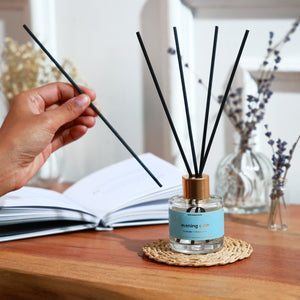
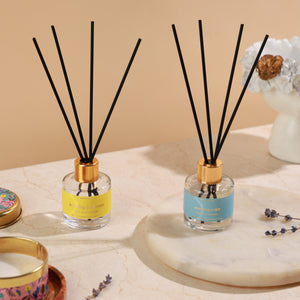

The herbal-floral wins for a bedroom, a guest room or a light sleeper: Evening Calm — Kashmir lavender and chamomile, 8.9 and the softest thing we make, ₹799.
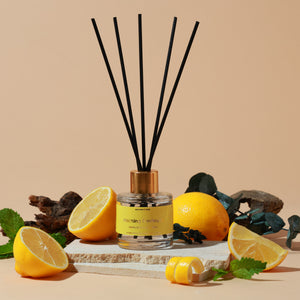
For a kitchen-adjacent living room, neither wins: every floral fuses with cooking and jasmine fuses hardest. Morning Freshness at ₹749 is the honest answer there.
The honest gap: SOSA makes no rose-only, tuberose, gardenia, ylang-ylang, magnolia or champa reed diffuser. A true multi-way floral comparison inside this range is therefore a two-way one, and I would rather say that than pad a table.
2. If the room is a bedroom or a guest room, buy the herbal-floral. Evening Calm at ₹799 — Kashmir lavender, real chamomile, a soft musk drydown, 8.9 and deliberately the softest thing in the range. Low diffusiveness is a defect in a hall and a virtue two feet from a pillow. Anyone who sleeps lightly should stop reading here and buy this one.
3. If the living room shares air with the kitchen, buy neither floral. Florals fuse with cooking smells rather than covering them, and jasmine fuses hardest of all because it sits in the same warm register as garam masala. Morning Freshness at ₹749 is the honest answer: citrus and dinner coexist, florals and dinner argue.
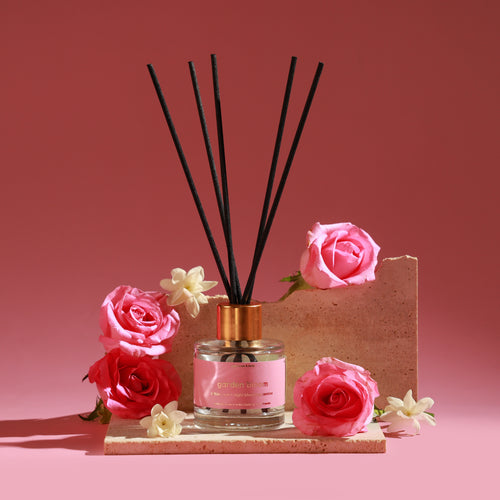
4. Decide on heat before you decide on the flower. Real jasmine contains indole, which is floral at low concentration and frankly fecal above it, and an Indian room crosses that line every summer — which is why cheap jasmine goes off in April. Garden Bloom holds indole below that threshold on purpose, and sits on a heat-stable CCT carrier tested through 45°C and 85% monsoon humidity.
5. Buy for the failure mode you can tolerate. You will overdose whichever bottle you buy at least once. Jasmine overdosed reads as staged, rose overdosed reads as soapy, lavender overdosed reads as clinical. Knowing that is more useful than knowing the note list, and it is fixed for free by pulling reeds out.
Alcohol-free, phthalate-free, made in Pune. A portion of every order supports girl-child education through Nanhi Kali.
The three dimensions that decide which floral you should buy
There are six things worth comparing florals on and three of them settle the question before the others get a vote. None of the three is about which flower is lovelier. All three are about physics and about the specific conditions of an Indian house, and all three are missing from every floral comparison I have ever read, which tend to describe the smell of each flower at length and then declare a winner as though rooms were interchangeable.
 Garden Bloom₹799Jasmine is the most diffusive floral there is. Rose is moderate. Lavender and chamomile are the least diffusive of the common florals — they hang close to their source and stop. This is a property of the materials themselves and no amount of formulation reverses it. It matters more for reeds than for anything else you might buy, because a reed diffuser has no fan: whatever the fragrance cannot do for itself, nothing in the box will do for it. So jasmine is the only floral I would put in a hall, and Garden Bloom is the only floral we make that will cross a drawing room. Note that this has nothing to do with the strength number: Garden Bloom and Evening Calm are both 8.9, and they are both accurate.
Sambac + rose₹799The three florals fail differently as a room warms, and this is where a comparison written for a European flat becomes useless. Jasmine is the floral most sensitive to heat, because real jasmine contains indole: floral at low concentration, unmistakably fecal above it, and heat is what mobilises it. That is the mechanism behind every jasmine diffuser that smelled correct in a shop in January and wrong in the same room in April. Rose thins rather than turns — a hot rose loses its centre and reads flat and papery, which is disappointing but never unpleasant. Lavender is the most stable of the three but can go sharp, its edges lifting into something medicinal. Garden Bloom is formulated with the indole deliberately held below the threshold so it stays warm and floral past 30°C, and every SOSA reed sits on a heat-stable CCT carrier rather than DPG, which cracks above about 40°C and takes the fragrance with it.
Garden Bloom₹799Jasmine is the most diffusive floral there is. Rose is moderate. Lavender and chamomile are the least diffusive of the common florals — they hang close to their source and stop. This is a property of the materials themselves and no amount of formulation reverses it. It matters more for reeds than for anything else you might buy, because a reed diffuser has no fan: whatever the fragrance cannot do for itself, nothing in the box will do for it. So jasmine is the only floral I would put in a hall, and Garden Bloom is the only floral we make that will cross a drawing room. Note that this has nothing to do with the strength number: Garden Bloom and Evening Calm are both 8.9, and they are both accurate.
Sambac + rose₹799The three florals fail differently as a room warms, and this is where a comparison written for a European flat becomes useless. Jasmine is the floral most sensitive to heat, because real jasmine contains indole: floral at low concentration, unmistakably fecal above it, and heat is what mobilises it. That is the mechanism behind every jasmine diffuser that smelled correct in a shop in January and wrong in the same room in April. Rose thins rather than turns — a hot rose loses its centre and reads flat and papery, which is disappointing but never unpleasant. Lavender is the most stable of the three but can go sharp, its edges lifting into something medicinal. Garden Bloom is formulated with the indole deliberately held below the threshold so it stays warm and floral past 30°C, and every SOSA reed sits on a heat-stable CCT carrier rather than DPG, which cracks above about 40°C and takes the fragrance with it.
 Evening Calm₹799Knowing a fragrance's failure mode is more useful than knowing its notes, because you will meet the failure and you will never once check the notes again after the first week. Jasmine overdosed reads as staged — the room stops feeling like a home and starts feeling like a set dressed for guests, which is the precise complaint behind "too much" in a jasmine review. Rose overdosed reads as soapy, and soapy is the shortest possible distance from expensive to cheap. Lavender overdosed reads as clinical, a hospital corridor rather than a bedroom, which is why so many people believe they dislike lavender when what they disliked was six reeds of it. In every case the cure is free and takes ten seconds: pull reeds out, wait a day, judge again.
The three dimensions that decide whether you keep it
The first three settle which floral is correct. The next three settle whether you go on liking the one you chose, and they are the reason a single house frequently wants two different florals in two different rooms rather than one bottle repeated everywhere.
Behaviour with food smells. All florals fuse with cooking rather than masking it, and the fusion is not always unwelcome — but it is always a fusion, so you should choose it deliberately. Jasmine fuses hardest, because it occupies the same warm, slightly spiced register as the food itself; put jasmine near a kitchen and you do not get jasmine and dinner, you get a third smell that is neither. In a room a comfortable distance from the hob, that same property is the thing people love: a buyer in Gurugram wrote that his living room "used to smell like whatever we cooked. Now it smells like a quiet luxury hotel even after Sunday biryani." That is jasmine winning the fusion rather than losing it, and the variable was distance. Lavender and chamomile are markedly more separable — they stay recognisably themselves alongside food — but they are also too quiet to make any difference to a kitchen. Which is why the honest answer for a kitchen-adjacent living room is a citrus, and Morning Freshness at ₹749 is the one I would send you to, floral page or not.
Time of day it suits. This is the dimension people find most surprising and then find most useful. Jasminum sambac is a night-blooming flower and the fragrance keeps that clock: it is quiet in the morning and peaks after dark, which is exactly the wrong shape for a breakfast room and exactly the right shape for a house that entertains in the evening. Rose reads daylit — it is at its best in a room with morning sun and holds up all afternoon. Lavender and chamomile read as evening-and-inward, the end of the day rather than the social part of it. A house is not one time of day, so it should not necessarily be one floral: jasmine in the hall for the hours when people are in it, the herbal-floral in the bedroom for the hours after.
How it reads to a guest. Fragrance in a shared room is a message whether or not you intended to send one, and the three registers send different ones. Jasmine reads as occasion and warmth — something is happening here, you were expected. It is why a Delhi buyer's entryway had "three different guests asked which hotel it reminded them of." Rose reads as composure, a room that is looked after. Lavender reads as care and calm — you are meant to rest here — which is precisely the right sentence for a guest room and precisely the wrong one for a drawing room where you want the evening to lift. A living room and a guest room want different messages, and this is the dimension that tells you so.
Jasmine versus the other floral registers, on all six dimensions
The full comparison in one table. The rose column describes the register as a perfumer uses it, and I should be straightforward about something: SOSA does not make a rose-only reed diffuser. Rose appears in Garden Bloom as the structure underneath the jasmine, which is a genuinely different thing from a solo rose. There is also no tuberose, no gardenia, no ylang-ylang, no magnolia and no champa in the range. So the column tells you how rose behaves, and the shopping decision underneath this table is honestly a two-way one.
| Dimension | Jasmine · Garden Bloom ₹799 | Rose · no SOSA rose-only reed | Herbal-floral · Evening Calm ₹799 | What it decides |
|---|---|---|---|---|
| 1. Diffusiveness | Highest of any floral — crosses a room | Moderate — fills its own end of a room | Lowest — stays close to the bottle | Your reed count, and then your room |
| 2. Behaviour in heat | Most heat-sensitive — indole mobilises. Garden Bloom holds it below the threshold | Thins rather than turns — flat, papery, never unpleasant | Most stable, but can go sharp and medicinal at the edges | Whether you still like it in May |
| 3. With food smells | Fuses hardest — shares a warm register with spice | Fuses, and turns sweet against fried food | More separable — stays itself, but too quiet to help | Whether a floral belongs in this room at all |
| 4. Time of day | Night-blooming — quiet by day, peaks after dark | Daylit — best in a room with morning sun | Evening and inward — the end of the day | Why one house wants two different florals |
| 5. How a guest reads it | Occasion and warmth — you were expected | Composure — a room that is looked after | Care and calm — you are meant to rest here | Living room versus guest room |
| 6. Failure mode | Staged — the room reads as a set | Soapy — the shortest route from expensive to cheap | Clinical — a corridor rather than a bedroom | Which mistake you can live with |
| Strength · longevity · price | 8.9 · 45 days–2 months on 50ml, 14–18 weeks on the ₹1,299 130ml · ₹799 | Available only as the structure inside Garden Bloom | 8.9, softest in the range · 6–8 weeks on 50ml, 14–18 weeks on the ₹1,299 130ml · ₹799 | Roughly ₹13 a day for jasmine, ₹15 for the herbal-floral |
Jasmine · Garden Bloom₹799Shop → 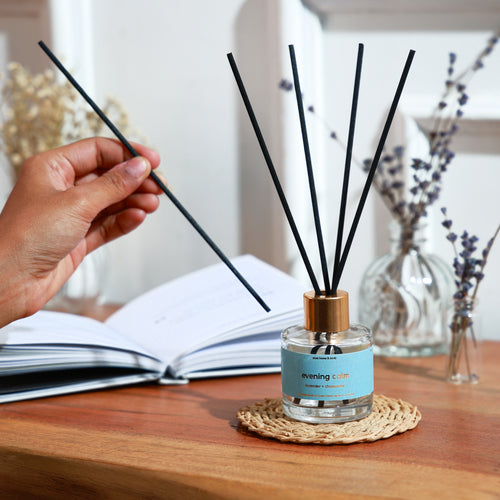 Herbal-floral · Evening Calm₹799Shop →
 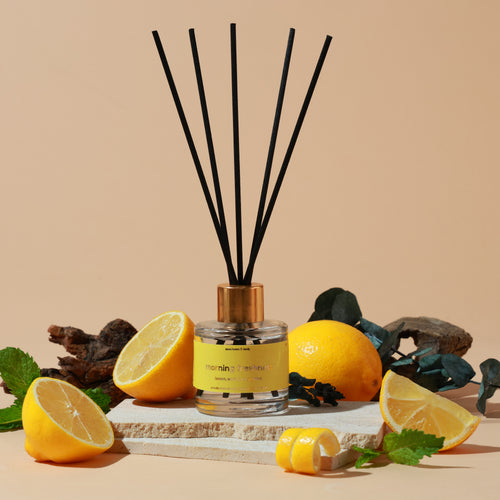 Kitchen-adjacent · Morning Freshness₹749Shop →
What this comparison changes about how you actually use the bottle
A comparison that ends at the checkout has done half a job, because the two florals want to be used differently once they are in the house. Jasmine should be dosed downward and the herbal-floral upward. With Garden Bloom I would start at three or four of the six fibre reeds even in a large room, live with it for a week, and only then add the rest; the diffusiveness that makes it the right choice for a hall is exactly what makes six reeds too many on day one. With Evening Calm the mistake runs the other way — people put three reeds in a bedroom because a bedroom sounds like a three-reed room, then decide the bottle is weak, when the material simply does not travel and wanted more. Flip Garden Bloom's reeds every five to seven days. Two or three reeds in a 50 sq ft bathroom will make a 50ml last close to three months.
Sizes follow the same logic. The 50ml is built for rooms up to about 150 sq ft and the 130ml for anything above, which in practice means the herbal-floral is usually a 50ml at ₹799 and jasmine in a drawing room is usually a 130ml at ₹1,299 with all six reeds. Placement matters more here than for any other family, because a reed diffuser relies entirely on the room's own air movement: put jasmine where air already travels — a console near the door, a shelf in the line between two rooms — and keep it out from under a running split AC, which strips the top off in days and leaves you with the drydown. The herbal-floral is the opposite; it wants to be close to where you will be, on the bedside table rather than across the room, precisely because it will not come to find you.
One more honest note about buying both. The pairing this page most often recommends — jasmine in the hall, the herbal-floral in the bedroom — is not one of our three boxed duos, so you would buy two 50mls separately at ₹799 each. The Warmth & Bloom duo at ₹1,598 pairs Garden Bloom with Fresh Brew, which is a winter-evening pairing rather than a floral one, and the Day & Night duo at ₹1,498 pairs Morning Freshness with Evening Calm, which is the right box for the kitchen-adjacent house. I would rather tell you the duo does not exist than sell you the one that nearly fits.
The verdict, room by room — and the honest gap
Given properly, without hedging. For a hall, a drawing room or a house whose life happens in the evening, jasmine wins and Garden Bloom is the buy. It is the only floral with the diffusiveness to do the job, it peaks at the hours you care about, and it reads to a guest as occasion. For a bedroom, a guest room or anyone who sleeps lightly, the herbal-floral wins and Evening Calm is the buy — the low diffusiveness that disqualifies it from a hall is the entire reason it works beside a bed. And for a kitchen-adjacent living room neither of them wins, because the fusion problem beats both of them, so Morning Freshness at ₹749 is the honest answer even though this is a floral page.
| Your room | Which side wins | Why, in one line | Buy |
|---|---|---|---|
| Hall, entryway, drawing room | Jasmine — Garden Bloom ★ | The only floral diffusive enough to cross a room without a fan; peaks after dark; reads as occasion | ₹799 · ₹1,299 for 130ml |
| Bedroom, guest room, light sleeper | Herbal-floral — Evening Calm | Lowest diffusiveness in the family, 8.9 and the softest we make, reads as care rather than occasion | ₹799 |
| Kitchen-adjacent living room | Neither — Morning Freshness | Florals fuse with cooking and jasmine fuses hardest; citrus coexists with food instead of arguing with it | ₹749 |
| A house that wants both | Two 50mls, not a duo | There is no boxed Garden Bloom and Evening Calm pairing; Day & Night ₹1,498 is the kitchen-house box instead | ₹799 + ₹799 |
| A lighter, greener jasmine | Shangri-La-inspired, ultrasonic only | Jasmine with green tea and white tea — the green-jasmine register. Water-based, so it needs a Sukoon ₹1,899 or a Boond ₹899. It cannot go in a reed bottle | ₹299 · 15ml |
| No rose-only, tuberose or gardenia: the honest gap | Said plainly, not padded | SOSA makes no rose-only, tuberose, gardenia, ylang-ylang, magnolia or champa reed diffuser. Rose exists only as the structure inside Garden Bloom, so a true multi-way floral comparison in this range is a two-way one | ₹799 |
Versailles
I was taught to compare florals by their materials, and it took me a few years in Indian houses to work out that the materials are the least useful thing to compare them by. Two people can love the identical jasmine and one of them will be delighted for two months while the other quietly moves the bottle to a cupboard, and the difference between them is not taste. It is a hall versus a bedroom, and a flower that travels versus a person who did not want to be found.
The heat dimension is the one I would most like to see written about honestly by somebody other than us. Indole is not a flaw in jasmine, it is what makes jasmine smell like jasmine rather than like a soap advertisement — but it is dose-dependent and heat-dependent, and a formula composed for a 20°C European room is simply a different object at 35°C in Chennai. That is a decision made at the bench, months before anybody smells it, and it is the whole reason Garden Bloom holds through April. The British rose underneath is doing structural work too: it gives the jasmine an edge to stop against, which is why the bottle reads composed rather than tropical.
And I would rather lose the sale than pretend this range is bigger than it is. There is no rose-only reed here, no tuberose, no gardenia, no champa. If a solo rose is what you came for, this page has told you how rose behaves so you can buy one well somewhere, and if what you actually wanted was soft rather than white-floral, Evening Calm at ₹799 is the answer and it is the better answer for most bedrooms. Everything is composed in Pune, and a part of every order funds a girl's classroom through Nanhi Kali.
Frequently asked questions
- Jasmine in India and A jasmine home — real sambac, and the indole problem, and where to put the one bottle.
- Bedrooms and Living rooms — night-blooming jasmine at three reeds, and jasmine, dinner and the third smell.
- White florals and Not too sweet — what the category actually contains, and why cheap jasmine goes syrupy.
- Sophisticated white florals — restraint, and the indole threshold.
- The decision tree — one bottle, no reading, if you want one bottle and no argument.
- The complete jasmine guide — every decision in one place.
- Brand: the SOSA founder story.
SOSA reed diffusers — facts verified August 2026: Five scents, all alcohol-free, on a heat-stable CCT (caprylic/capric triglyceride) base, phthalate-free, paraben-free, IFRA-compliant, 0 ppm formaldehyde, six fibre reeds in a refillable glass bottle, composed and made in Pune, India. Garden Bloom (British rose · night-blooming jasmine, sambac/mogra · soft musk drydown) 50ml ₹799 · 130ml ₹1,299 · 8.9 on the SOSA strength scale · 45 days to two months on the 50ml and 14–18 weeks on the 130ml · 4.9 from 138 verified buyers · indole held below the fecal threshold so the jasmine stays floral above 30°C. Evening Calm (Kashmir lavender · chamomile · soft musk) 50ml ₹799 · 130ml ₹1,299 · 8.9, the softest in the range · 4.9 from 164 verified buyers, 97% would recommend. Morning Freshness (Malabar lemon · peppermint · eucalyptus globulus) 50ml ₹749 · 130ml ₹1,249 · 9.0. Mountain Breeze (Himalayan pine · sage · Indian cedar) 50ml ₹849 · 130ml ₹1,349 · 9.4. Fresh Brew (Coorg coffee · Kerala vanilla · caramel) 50ml ₹849 · 130ml ₹1,349 · 9.5, the deepest in the range. Duos: Day & Night ₹1,498, Fresh & Grounded ₹1,548, Warmth & Bloom ₹1,598 (50ml × 2). Refills 300ml ₹2,399 · 500ml ₹3,499. Climate-tested through 45°C heat and 85% RH monsoon humidity. The reed line contains no rose-only, tuberose, gardenia, ylang-ylang, magnolia, champa or jasmine-solo fragrance, and no oud, sandalwood, vetiver, amber or orange blossom; where this guide is asked for one of those it says so rather than stretching the nearest scent to cover it. Reed diffuser oil and the water-based Hotel Collection are separate products and are not interchangeable in either direction; there is no hotel-inspired reed diffuser. Hotel Collection 15ml ₹299 · 100ml ₹999 · 300ml ₹1,799, for use in the Sukoon ₹1,899 or Boond ₹899 ultrasonic diffusers. Free shipping above ₹499. A portion of every order supports girl-child education through Nanhi Kali. SOSA is an independent Indian fragrance house; the Hotel Collection scents referenced here are SOSA's own interpretations inspired by the world's finest hotels and SOSA is not affiliated with or endorsed by any hotel brand. Prices subject to change — see the live product pages.