

Three times it is not: a hosting evening, a genuine heat wave, and a bottle running nine or ten reeds. Each of those loads the exposed end of a reed faster than seven days allows for.
One time it is more than enough: four reeds in a cool, sealed, low-traffic bedroom. That bottle is forgiving and will outlast the stated window.
The check: on day four, lift one reed and find the wet line where soaked fibre meets dry. Steady and mid-way means your cadence is right. High and dark by mid-week means the room wants a second flip.
2. Seven days is chosen, not inherited. It is roughly how long a fibre reed takes to develop a meaningful difference between its two ends in an ordinary Indian room. Flip much sooner and there is little to invert; leave it much longer and delivery has already fallen away for days before you correct it.
3. Deviate upward for heat. Through a 45°C summer, on a west-facing wall, or in a kitchen, the oil is thinner and moves faster, and the exposed end loads sooner. Twice a week for those weeks, then back to once.
4. Deviate upward for reed count. Nine or ten reeds in a 50ml is a deliberately fast configuration and it wants weekly flipping without exception — realistically twice weekly if you are also in heat. Six is calibrated; anything above it is you overriding the dose, and overriding comes with maintenance.
5. Deviate upward for hosting, but only for a day. Flip all six the morning people are coming and close the room for an hour beforehand. That is not a change of cadence, it is a single extra flip placed where it earns its keep.
6. And deviate downward, honestly, if you run four reeds in a cool sealed room. That bottle is slow by design, forgiving about timing, and will comfortably outlast the stated window. Every ten days is fine. Do not let a rule make you fussier than your own room requires.
7. What weekly cannot fix. If the room is quiet on the day after a flip, cadence is not your problem — that is placement, reed count or a composition quieter than the space needs.
Composed and handmade in small batches in Pune, and a portion of every order supports girl-child education through Nanhi Kali.
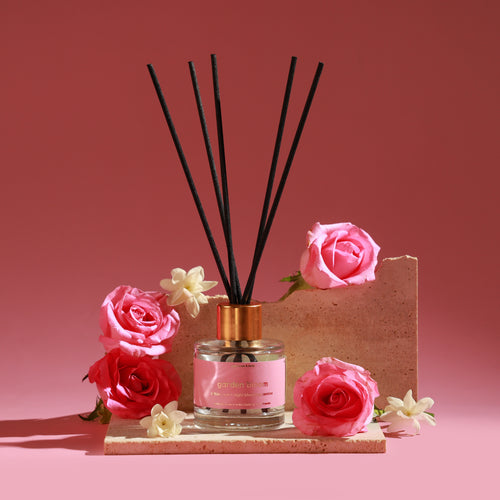
Part one — why seven days is the dose rather than a suggestion
A composition for a reed diffuser is not written in the abstract. It is written against an assumed rate of delivery, because the format has no switch and no fan and cannot be adjusted afterwards. That assumed rate has three inputs: the number of reeds, the character of the room, and how often the reeds are turned — and of those three, the only one a perfumer can fix in advance is the flip cadence. So the cadence goes into the brief. Six reeds, weekly, ordinary room. Everything downstream — the strength rating on the product page, the six-to-eight weeks, the balance between the lemon and the peppermint in a bright composition — is decided with that rhythm assumed.
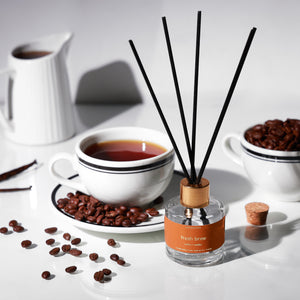
 Fresh Brew₹849 · 9.5/10Seven days sits at the top of a curve. Before it, the two ends of a reed have not diverged enough for inversion to return much, so you are spending handling for very little. After it, delivery has already been sliding for days and you spend the back half of a fortnight in a quieter room than you paid for. Weekly captures nearly all of the available benefit at the lowest possible frequency, and it has the enormous practical advantage of attaching to a day of the week rather than to a count. Sunday morning, gloves on, all six reeds, thirty seconds. A cadence you can attach to a habit is a cadence you will keep — which matters more, in practice, than any refinement of the interval itself.
Part two — is weekly enough for your room?
Six real situations, and whether the standard rhythm covers them. Strength references are positions on SOSA's own internal scale at six reeds — our scale, not an industry standard, and not a measure of concentration or quality.
| Your situation | Is weekly enough? | What to do instead | Why the dose changes |
|---|---|---|---|
| Six reeds, ordinary flat, out of the sun ★ | Yes — this is the specification | Nothing. Sunday morning, all six, gloves on | It is the configuration every published figure assumes |
| 45°C summer, or a west-facing shelf | No, for those weeks only | Twice a week through the heat, then back to once | Warm oil is thinner and loads the exposed end sooner |
| Nine or ten reeds in a 50ml | Barely — weekly without exception | Weekly minimum; twice weekly if it is also hot | More surface accumulating residue, and a faster bottle |
| Guests arriving on Saturday evening | Yes, plus one extra flip | All six on Saturday morning, room closed for an hour | You want the surge timed, not a permanent change |
| Four reeds, cool sealed bedroom, little traffic | More than enough | Every ten days is fine; the bottle is slow by design | Less exposed surface and a cooler room slow everything |
| 85% monsoon humidity | Yes, on fibre reeds | Keep to weekly and watch for a dull, crusted neck | Fibre resists the pore-clogging that ruins rattan reeds |
| The honest caveat: if the room is quiet on the day after a flip, none of these rows will help you, because the problem is not cadence. That is placement, reed count or a composition quieter than the space needs — start with the fifteen-minute doorway test and then move the bottle before you buy anything. | |||
Garden Bloom · 8.9/10from ₹799Shop → 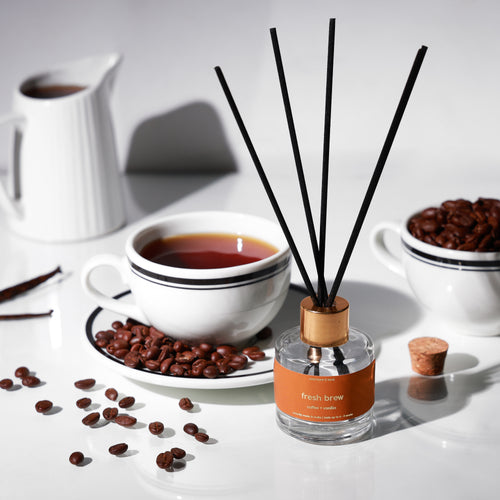 Fresh Brew · 9.5/10from ₹849Shop →
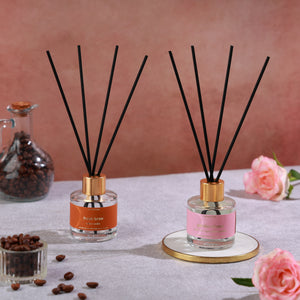
 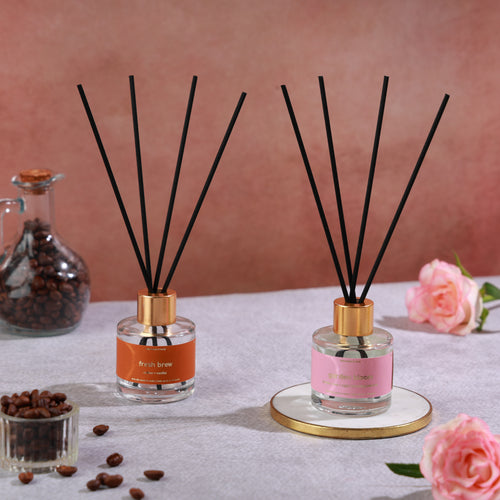 Warmth & Bloom duo₹1,598 / 2×50mlShop →
Part three — testing whether weekly is enough in your own room
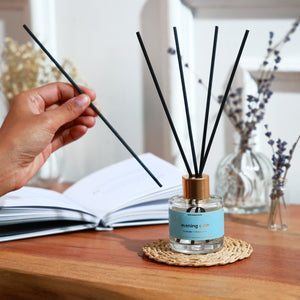
You do not have to take the specification on trust, and there is a simple mid-week check that settles it. On day four, lift one reed out and find the wet line — the boundary between the oil-soaked part of the fibre and the dry part above it. On a bottle whose cadence is right, that line sits some way up the reed and looks unremarkable, and the fibre above it is dry without being dusty. If by day four the line is high and the fibre below it looks dark and heavy, the reed is loading faster than seven days allows and your room wants two flips a week — that is the heat signature, and it usually appears in May and disappears in October. If the line sits barely above the oil after four days, the reed is not wicking properly, and no cadence fixes that; those reeds want refreshing, which is the honest weak point in our range because we do not sell reeds separately.
The other test is longer and worth more. Keep a four-week note of two things: the day you flip, and how the room reads on day two and on day six. Ask someone who does not live with you on one of those day-six evenings, because you are the worst possible judge of your own home — your nose stops reporting a constant within minutes and adapts hardest in familiar surroundings. If day two and day six read about the same to a visitor, weekly is comfortably enough and you can stop thinking about it. If day six is clearly thinner, add a mid-week flip and repeat. Four weeks of that gives you a cadence tuned to your own flat, your own ceiling height and your own season, which is worth more than any rule I can write.
One caution about what this test can and cannot tell you. It measures the slope across a week, not the height of the plateau. A bottle that reads identically on day two and day six but is too quiet on both is telling you the cadence is fine and something else is wrong — the bottle is in dead air behind a sofa, or in a draught from a split AC that strips the reeds and empties the bottle early, or the composition is a quieter one than a large open living-dining needs. Cadence is a maintenance question; volume is a placement, reed-count and composition question. Keeping those two apart is most of what makes this format easy to live with, and confusing them is how people end up flipping every morning in a room that was never going to respond.
Part four — the week, planned, and what it costs
Four kinds of week, the flip plan for each, and the reed count that goes with it. Nothing in the first three rows is a purchase.
| Your week | Flip plan | Reeds in the bottle | What to buy, if anything | Price |
|---|---|---|---|---|
| An ordinary week ★ | All six, Sunday morning, gloves on | Six — the calibrated count | Nothing at all | Free |
| A May or June week | Sunday and Wednesday, until the heat breaks | Six, and keep it out of the afternoon sun | Nothing — move the bottle rather than buy | Free |
| A quiet, cool, sealed bedroom | Every ten days is enough | Four — deliberately slow and gentle | Evening Calm at 8.9, the softest we make | ₹799 / 50ml |
| A hosting week | Usual Sunday flip, plus all six on the morning itself | Six on ordinary days, nine from Friday to Sunday | Fresh Brew at 9.5 for the living room | ₹849 / 50ml |
| Two rooms on the same Sunday | Both bottles, one after the other, same habit | Six each — two sources beat one bigger bottle | Warmth & Bloom duo, two scents that share warmth | ₹1,598 / 2×50ml |
| A year of weekly flips | Unchanged — the cadence does not depend on the fill | Six, refreshed every few months | 300ml oil refill, oil only, keep your vessel | ₹2,399 · 8–11 months |
Versailles
When I was training at ISIPCA the thing that took longest to sink in was that a fragrance is never evaluated in isolation. It is evaluated on a medium, at a dose, over a time. For a reed diffuser the medium is a fibre reed, the dose is six of them, and the time is a week — and if you change any of those three you are no longer smelling the thing that was composed.
That is why I am fussy about publishing the cadence next to the strength rating rather than tucked into a care card. A customer who has never flipped their bottle and finds it quiet at week five has not bought a weak fragrance. They have bought a fragrance that has been running at a fraction of its designed rate since about week two, and they will usually blame the composition, which is the wrong lesson to learn from a perfectly good bottle.
The three exceptions on this page are the only ones I would defend. Heat is real, hosting is real, and if you have put ten reeds into a 50ml then you have written your own specification and you get to maintain it. Everything else is people being more diligent than the product needs. Composed and handmade in Pune, and a part of every order funds a girl's classroom through Nanhi Kali.
Frequently asked questions
- How often should you flip? — the same question answered by condition rather than by specification.
- Can you flip every day? — the upper bound, the arithmetic and the mess.
- How often to flip SOSA reeds and why flipping works at all — fibre, rattan and the residue gradient.
- The complete reed-flipping guide — this page and the eight around it, in one place.
- Brand: the SOSA founder story.
SOSA reed diffuser range & prices (verified August 2026): alcohol-free, phthalate-free, paraben-free and IFRA-compliant compositions on a heat-stable coconut-derived (CCT) carrier, low-VOC, supplied in a refillable glass bottle with six fibre reeds; 50ml lasts 6–8 weeks and 130ml lasts 14–18 weeks. Morning Freshness (Malabar lemon · peppermint · Nilgiri eucalyptus) 50ml ₹749 · 130ml ₹1,249 · 9.0/10; Garden Bloom (British rose · night-blooming jasmine) 50ml ₹799 · 130ml ₹1,299 · 8.9/10; Evening Calm (Kashmir lavender · chamomile) 50ml ₹799 · 130ml ₹1,299 · 8.9/10; Fresh Brew (Coorg coffee · Kerala vanilla) 50ml ₹849 · 130ml ₹1,349 · 9.5/10; Mountain Breeze (Himalayan pine · sage · Indian cedar) 50ml ₹849 · 130ml ₹1,349 · 9.4/10. Reed diffuser refills are oil only — you reuse your own vessel and reeds: 300ml ₹2,399 (roughly 8–11 months) · 500ml ₹3,499 (roughly 14–18 months), about ₹7–8 per ml against ₹15–17 per ml for a 50ml bottle. Duo sets ₹1,498–₹1,598 for 2 × 50ml and ₹2,498–₹2,598 for 2 × 130ml. Strength figures are positions on SOSA’s own internal strength scale, not an industry standard. Replacement reeds are not sold as a separate SKU; SOSA guidance is to refresh reeds every few months. The reed line is separate from the water-based Hotel Collection for ultrasonic machines (15ml ₹299 · 100ml ₹999 · 300ml ₹1,799) and the two are not interchangeable. Diffusers: Boond 300ml ₹899 · Sukoon 500ml ₹1,899 · Megh 6L ₹3,499 · waterless Vaayu ₹11,999. Composed and handmade in small batches in Pune, India; tested through 45°C summer heat and 85% monsoon humidity. Free shipping above ₹499. A portion of every order supports girl-child education through Nanhi Kali. Prices subject to change — see the live product pages.