


I'm Hosting Dinner at Home — How Do I Stop the House Smelling Like Cooking When Guests Arrive?

I'm Hosting Dinner at Home — How Do I Stop the House Smelling Like Cooking When Guests Arrive?

★ ★ Hosting dinner · cooking smells, open kitchens and the hour before people arriveCandle ₹379 · reed ₹749 · Boond ₹899 · Sukoon ₹1,899 · free shipping above ₹499A portion funds girl-child education
★ SOSA · when people are coming over
You cannot fragrance your way out of a fried-onion kitchen. You can, however, clear it and then put something clean on top — and the timing is the recipe
★ ★ ★ ★ ★
★★★★★
"Biryani for eight and I was panicking about the smell. Extractor through cooking, windows wide for twenty minutes, then the diffuser. The living room was completely clear by the time they sat down."
Nandini R. Dinner party, Hyderabad
Air, then scent
★★★★★
"My kitchen opens into the living room. Told me to keep fragrance out of the dining area entirely while people eat, which I had never considered. It was right."
Imran Q. Open kitchen, Mumbai
Nothing at the table
★★★★★
"The bit that helped: turn it on an hour before, off when guests arrive. The room holds it and nothing competes with the food."
Shalini D. Hosts often, Pune
On early, off at 8
★★★★★
"Twelve people in a small 2BHK. The advice was less fragrance, more airflow — the room was going to get warm regardless. Completely correct."
Gaurav L. 12 guests, Delhi
Less, not more
★★★★★
"Same scent at the entrance and the living room so the flat reads as one place. Small thing, made it feel considered."
Ritika S. Entrance + living, Bengaluru
One signature
★★★★★
"Frying happens. Twenty minutes of proper cross-ventilation afterwards does more than any product, and then the product actually works."
Harish M. Fried food, Chennai
Cross-ventilate
★★★★★
"Biryani for eight and I was panicking about the smell. Extractor through cooking, windows wide for twenty minutes, then the diffuser. The living room was completely clear by the time they sat down."
Nandini R. Dinner party, Hyderabad
Air, then scent
★★★★★
"My kitchen opens into the living room. Told me to keep fragrance out of the dining area entirely while people eat, which I had never considered. It was right."
Imran Q. Open kitchen, Mumbai
Nothing at the table
★★★★★
"The bit that helped: turn it on an hour before, off when guests arrive. The room holds it and nothing competes with the food."
Shalini D. Hosts often, Pune
On early, off at 8
★★★★★
"Twelve people in a small 2BHK. The advice was less fragrance, more airflow — the room was going to get warm regardless. Completely correct."
Gaurav L. 12 guests, Delhi
Less, not more
★★★★★
"Same scent at the entrance and the living room so the flat reads as one place. Small thing, made it feel considered."
Ritika S. Entrance + living, Bengaluru
One signature
★★★★★
"Frying happens. Twenty minutes of proper cross-ventilation afterwards does more than any product, and then the product actually works."
Harish M. Fried food, Chennai
Cross-ventilate
✓ Candle: scent in the room in 15–20 minutes · Sukoon: about 20 minutes from cold ✓ A reed diffuser needs 24–72 hours — the wrong buy when guests arrive tonight ✓ Ventilate first · fragrance is the finishing layer, never the cover-up


Founder Diaries · Home Fragrance · Hosting Dinner
By Sonal Sahani · ISIPCA Versailles 11 min read Updated August 2026
The question is asked backwards, and that is why it is so hard to answer. By the time you can smell cooking in the sitting room, the smell is already in the sitting room, and nothing you buy will take it out again. Every effective thing on this page happens before that moment rather than after it, and the most effective of them is free and takes one second: shut the kitchen door whilst you cook. Deal with containment first and the air in the rest of the flat never becomes a problem to solve. Then, and only then, a Bookshop candle at ₹379 or a Sukoon at ₹1,899 has something clean to sit on top of.
Quick answers — read this first
The principle: a cooking smell cannot be removed from a room after it arrives — it can only be prevented from arriving. All the work is upstream of the moment you notice it.

The four free actions, in order: extraction on before the pan is hot, not when the smoke starts. Kitchen door shut whilst you cook. Windows open in the rest of the flat so air moves toward the kitchen and out through it. Chimney filter degreased beforehand, because a loaded filter recirculates rather than extracts.

Then fragrance, last: twenty minutes of cross-ventilation, then a Bookshop candle at ₹379 for tonight or the Sukoon at ₹1,899, which reaches a steady level in about twenty minutes from cold and can be timed. A reed diffuser needs 24–72 hours and is the wrong product for a dinner tonight.
The short answer
Short answer: stop the smell leaving the kitchen rather than trying to clear it from the living room. Extraction on before the oil is hot, the kitchen door closed for the whole of cooking, windows open elsewhere in the flat, and a chimney filter that has been degreased. Then twenty minutes of cross-ventilation once you are finished, then fragrance.
The pick: for guests arriving tonight, a Bookshop candle at ₹379 gives scent in the room in 15–20 minutes; the Sukoon at ₹1,899 reaches a steady level in about twenty minutes from cold, covers 270–320 sq ft, has steady, 2H and 4H timers and comes with three 15ml Hotel Collection scents of your choice. A reed diffuser from ₹749 needs 24–72 hours and is a purchase for next month, not for this evening.
Shop: candles from ₹379 (Bookshop 80g, ~15–18 hours) and ₹599 for the Amber Rose 130g; the Sukoon at ₹1,899 and the Boond at ₹899; Hotel Collection scents at ₹299 for 15ml, ₹999 for 100ml and ₹1,799 for 300ml at about ₹6 per millilitre, dosed at three to six drops per tank. Free shipping above ₹499.
Straight answer
How do I stop my house smelling of cooking when guests arrive for dinner?
1. Switch the extraction on before the pan is hot, not when you can see smoke. A chimney or an exhaust fan catches a plume that is still rising in a column. Once that column has broken up and spread across the ceiling, the fan is pulling at air that has already gone everywhere else. Two minutes of running an empty hood before you start cooking is worth more than twenty minutes of running it afterwards.

2. Shut the kitchen door whilst you cook. This is the single most effective free action available to anybody hosting dinner in a flat with a door on the kitchen, and almost nobody does it, because the kitchen gets warm and the cook wants to hear the conversation. Keep it shut anyway. A closed door does not slow the cooking down and it decides what the rest of the flat smells like at eight.

3. Open windows in the rest of the flat, not in the kitchen. The direction of the airflow is the whole point. You want air travelling from the bedrooms and the sitting room toward the kitchen and out through the extraction, so that the kitchen is the last room the air visits. A single window open beside the hob and everything else shut does the opposite: it makes the kitchen a source that feeds the flat.

4. Degrease the chimney filter beforehand, ideally the day before. A baffle or mesh filter loaded with old oil does not stop the new smell, and worse, it holds the last three weeks of cooking in a warm airstream and hands them back to you. Hot water, dishwashing liquid, twenty minutes of soaking, dry completely. It is the least glamorous line on this page and it is the one that changes the most.

5. When you have finished cooking, give it twenty minutes of proper cross-ventilation. Two openings on opposite sides of the flat, both fully open, extraction still running. Twenty minutes with two openings does more than two hours with one. Then close up, let the flat settle for ten minutes, and only then start the fragrance.

6. Fragrance is the last step and it should be running before people arrive, not as they do. A Bookshop candle at ₹379 gives scent in 15–20 minutes; the Sukoon at ₹1,899 takes about twenty from cold and can be set on a 2H timer so it stops on its own. A reed diffuser needs 24–72 hours and will do nothing for tonight.

A portion of every order supports girl-child education through Nanhi Kali.

TL;DR: a cooking smell cannot be removed from a room once it has arrived, only prevented from arriving — so extraction on before the pan is hot, kitchen door shut whilst you cook, windows open everywhere else so air moves toward the kitchen, and a degreased filter. Then twenty minutes of cross-ventilation, then a candle at ₹379 or the Sukoon at ₹1,899. Fragrance is the finish, never the fix.
SOSA Sukoon
The machine that does the last twenty minutes, not the first two hours
SOSA Sukoon ₹1,899
A 500ml BPA-free tank rated for 270–320 sq ft, about twenty minutes to reach a steady level from cold, 16–18 hours per fill on low at 30–50 ml/h against 9–12 on high, a 2.4MHz cool-mist plate, a remote, auto shut-off and steady, 2H and 4H timers — with three 15ml Hotel Collection scents of your choice included. Its usefulness on a dinner night is entirely in the timers: you set it going once the flat has been aired and it stops itself before anybody sits down to eat. Nothing about it removes a cooking smell, and this page will not pretend otherwise. It gives an already-clear room a level to hold.

Why you are trying to remove something that cannot be removed

Almost everybody arriving at this question is looking for the wrong verb. They want to remove a cooking smell from a living room, and they are looking for the product that does the removing. There is no such product, from us or from anybody else, because a cooking smell in a room is not a layer sitting on top of the air — it is dissolved into it, and adsorbed onto every soft surface the air has touched since. Once a plume of tempered cumin has spread across the ceiling of a 750 sq ft flat, the only things that shift it are time and a complete change of air. What you can do, and what almost nobody does properly, is stop it getting out of the kitchen in the first place. That is a different job, it is much easier, and it is free.

1
THE MECHANISM
A smell leaves the kitchen as a rising column, and then it stops being catchable
It is worth understanding what is physically happening, because the timing of everything else follows from it. Hot oil, a tempering, a roasting masala or a searing piece of meat produces a fast, buoyant plume of hot air carrying aromatic molecules, and for the first few seconds that plume is a coherent column rising more or less straight up. That is the only moment at which an extraction hood can catch it efficiently, because a hood is not a vacuum cleaner for a room — it has a capture zone of a few inches around and below its opening, and outside that zone its influence collapses very quickly. Catch the column and you have caught most of the smell. Miss it, and the plume hits the ceiling, spreads outward in a thin warm layer, cools, and starts drifting down and sideways into the rest of the flat. From that moment the smell is no longer a stream you can intercept; it is a property of the volume of air in your home. Which is why the instruction is to switch the extraction on before the pan is hot rather than when the smoke appears. The fan needs to be already moving air by the time the first plume exists. Two minutes early costs you nothing and it is the difference between capturing eighty per cent of a smell and capturing a quarter of it. The same logic explains why the back burners of a hob are so much easier to control than the front ones, and why a kadhai of hot oil at the front edge of a hob defeats an otherwise adequate chimney.
2
THE FREE ACTION NOBODY TAKES
The kitchen door, shut, for the whole of cooking
Then the part I put in bold in every email I write on this subject. If your kitchen has a door, shut it whilst you cook, and keep it shut for ten minutes after you have finished. It is the single most effective thing available to you on a dinner night and it costs nothing at all. The reason people do not do it is social rather than practical — the kitchen gets hot, the cook feels shut away from the evening, somebody is carrying things in and out. All true, and none of it changes the physics. A closed door turns your kitchen into a small volume with active extraction and a defined boundary, which is a solvable problem. An open door turns your entire flat into the kitchen's plenum. The second half of the trick is the direction of travel, and this is where most well-meaning ventilation advice actually makes things worse. Open the windows in the sitting room and the bedrooms, not the one beside the hob. What you want is a gentle pressure gradient with air entering the flat at the far end, moving through it toward the kitchen, and leaving through the extraction — so that the kitchen is the last room the air visits before it goes outside. A window open beside the hob with everything else closed produces exactly the opposite: outside air comes in at the kitchen, picks up the cooking, and pushes it into the rest of the house. If there is a bathroom exhaust near the kitchen, run that too. Two fans pulling in the same direction give you a boundary you can actually feel at the doorway.
3
THE THING NOBODY CLEANS
A loaded chimney filter recirculates rather than extracts
And then the maintenance point, which I would put ahead of any purchase on this site for a household that cooks Indian food daily. A chimney filter that has not been degreased in three months is not extracting your cooking. It is warming three months of previous cooking and handing it back to the room. Baffle filters and mesh filters both collect a film of condensed oil, and oil is where aroma molecules go to live: it holds them, concentrates them, and then releases them slowly whenever a warm airstream passes over it. A loaded filter also chokes the airflow, so the fan you can hear working hard is moving far less air than its rating suggests. Both failures happen at once, which is why the symptom people describe — a chimney that used to work and now does not — is almost always this and almost never a motor. Soak the filters in very hot water with dishwashing liquid for twenty minutes, scrub, rinse, dry completely before refitting. An hour, once a month, the day before you host. If your flat is genuinely open-plan and the kitchen has no door at all, none of the containment argument on this page is available to you, and the strategy changes completely: you stop trying to defend a boundary that does not exist and start managing the whole volume instead. That is a different article and it is the one about a dining table beside an open kitchen.
The rule I would put on the inside of every kitchen door in India: extraction before the oil, door shut through the cooking, windows open everywhere except the kitchen. Three things, all free, all upstream of the moment you notice a smell — and by a distance the most useful fragrance advice on this page.

What actually works, ranked, with the free things at the top

Everything available to you on a dinner night, in order of how much difference it makes to what the flat smells like when the doorbell goes. The free actions occupy the top of the table because that is honestly where they belong, and the products appear lower down doing the job they can actually do. The third column is the one to read if you are short of time: it says when the thing has to happen.

Ranked by effect, not by price
What moves the needle on a dinner night, in order
What What it actually does When it has to happen Cost
Extraction on before the pan is hot ★ Catches the plume whilst it is still a rising column, which is the only moment it is catchable Two minutes before you start cooking, and for ten minutes after you stop Free
Kitchen door shut whilst cooking Turns the flat's smell problem into a small-room smell problem with a defined boundary The whole of cooking, plus ten minutes afterwards Free
Windows open elsewhere, not in the kitchen Sets the airflow so the kitchen is the last room the air visits before it leaves From when you start cooking until twenty minutes after Free
Degreased chimney filter Stops the last three weeks of cooking being warmed and released back into the room The day before, not the evening of An hour and some dishwashing liquid
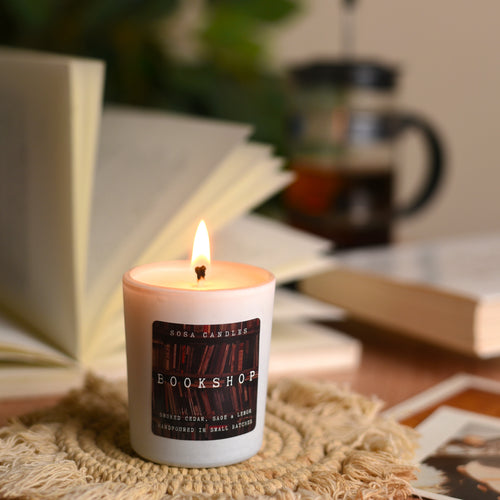
Bookshop candle 80g Puts fragrance into an already-cleared room in about 15–20 minutes. Attend it, put it out before you eat Lit once the air has turned over, roughly an hour before people arrive ₹379
Sukoon + Hotel Collection Reaches a steady level in about twenty minutes from cold, 270–320 sq ft, steady/2H/4H timers, three 15ml scents included Started 60–90 minutes before arrival, set to stop before dinner is served ₹1,899
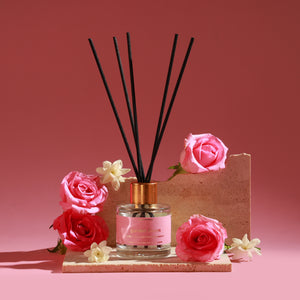
Reed diffuser Holds a low steady background in a room for months with no electricity and no routine Not tonight. It needs 24–72 hours to reach the room, so buy it for next month from ₹749
Shop this guide
What the evening actually needs, in three products
The SOSA principle
You are not trying to clean the air in your living room. You are trying to make sure the cooking never gets there. One of those is impossible and the other takes a closed door.
Extraction catches a plume only whilst it is still rising in a column. After that the smell is a property of the whole volume of air in the flat, and no product on any shelf takes it back out.

The evening, hour by hour, and where fragrance goes in it

Take a dinner at eight and work backwards, because the sequence matters more than any individual step in it. The day before: degrease the chimney filter and wash the tea towels and the kitchen curtain if you have one — cloth in a kitchen is a reservoir, and a tea towel that has been in the room through three weeks of frying carries more smell than the hob does. At five, when you start cooking: extraction on two minutes early, kitchen door shut, a window open in the sitting room and another in a bedroom on the opposite side of the flat. At half past six, when the cooking is done: leave the extraction running for another ten minutes, then open both kitchen and living-room windows fully and give the whole flat twenty minutes of genuine cross-ventilation. Twenty minutes with two openings on opposite walls achieves more than two hours with a single window, because one opening gives you diffusion and two give you a current. At ten past seven: close everything, wipe down the hob and the wall behind it, take the bin out, and let the flat sit quietly for ten minutes. At half past seven: start the fragrance. That is the entire schedule, and the only part of it involving a purchase is the last line.

Then the fragrance itself, which by this point in the evening has an easy job. If people are arriving tonight and you own nothing, a Bookshop candle at ₹379 is the correct purchase: fifteen to twenty minutes from lighting to a scented room, around 15 to 18 hours of burn in an 80g jar, and no waiting. If you host more than three or four times a year, the Sukoon at ₹1,899 is better value and better behaved — about twenty minutes from cold to a steady level, 270–320 sq ft of coverage, 16–18 hours per fill on low at 30 to 50 ml/h, a 2.4MHz cool-mist plate, auto shut-off, a remote, and steady, 2H and 4H timers, with three 15ml Hotel Collection scents of your choice included in the price. The Boond at ₹899 does the same job in a hall or a smaller sitting room, and a genuinely open-plan or double-height flat is the case for the Megh at ₹3,499 with its six-litre tank. What you should not buy for tonight is a reed diffuser. The oil has to travel up the reeds and the room has to reach equilibrium, and that takes somewhere between 24 and 72 hours. Buy one from ₹749 next week, for the months of ordinary evenings between dinner parties, and it will be excellent. Buy one this afternoon for tonight and you will conclude, wrongly, that reeds do not work. On dose: three to six drops per tank, and the dose is per tank rather than per litre, since you are scenting the mist and not the water — so a 300ml Boond takes the same three or four drops as a 500ml Sukoon. Placement is waist height or above, at the edge of the sitting room, never in a doorway, never in the kitchen, and out of the path of a fan.

Then the two things that go wrong even when everything above is done properly. The first is nose-blindness, and on a hosting night it is at its most dangerous, because you have been in the flat all day and your nose has been recalibrating to the cooking for hours. Your reading of the room at half past seven is not what a guest walking in from the corridor will experience — you will be under-reading the cooking and over-reading the fragrance, in both directions at once. The fix is not a product: walk out of the flat, stand on the landing for three or four minutes, and walk back in through the front door. That is the closest you will get to a stranger's nose in your own home, and it is worth doing before you decide to add another two drops. The second failure is adding fragrance on top of air that has not been cleared, which produces something worse than either component alone — a room that smells of dinner and of something covering dinner, which is the one impression a host should never give. Fragrance layers onto clean, moving air. It does not replace it. And it certainly does not fix a source: a bin that needs emptying, a sink of soaking dishes, a fridge that wants wiping and a damp cloth on a counter are all producing smell continuously, and scenting the room they are in makes them read as concealed rather than as absent. Deal with all four before you light anything. The whole of this cluster runs on that order, and the close of the group, hosting twelve people in a small 2BHK, is the case where it matters most.

A cooking smell is not a layer sitting on your living room. It is dissolved into the air and settled into the cushions, and the only cure that has ever worked is not letting it in.
— Sonal Sahani, SOSA

The SOSA edit

In buying order for somebody hosting dinner at home, with the free work stated first because that is the order the evening actually happens in. The last row is the product I would talk most people out of buying today, which is not a sales technique so much as a way of not being blamed on Thursday.

The SOSA edit
Hosting dinner tonight, in buying order
Buy What it is When it earns its place Price
0. The free part, first ★ Extraction on early, kitchen door shut, windows open elsewhere, filter degreased the day before Always, and before any of the rows below. It decides more than any product on this page ₹0
1. Bookshop candle 80g Around 15–18 hours of burn, and fragrance in the room in about 15–20 minutes Tonight, if you own nothing and people arrive in an hour. Attended, and put out before you sit down ₹379
2. Sukoon + three 15ml scents 500ml, 270–320 sq ft, about 20 minutes from cold, 16–18h on low, steady/2H/4H timers, three scents included If you host more than a few times a year. The timers are what stop it running through dinner ₹1,899
3. Hotel Collection 15ml Water-based ultrasonic fragrance, seven hotel-inspired scents, three to six drops per tank A second and third bottle once you know which room wants what. ₹999 at 100ml, ₹1,799 at 300ml ₹299
4. Boond or Megh 300ml for a hall or a small sitting room; six litres for a genuinely open-plan or double-height flat A second zone, or the honest answer when the kitchen has no door and the volume is large ₹899 / ₹3,499
Not for tonight: a reed diffuser Alcohol-free reeds, from ₹749 at 50ml and ₹1,249 at 130ml, holding a room for months 24–72 hours before it is doing its job. Excellent next month, useless this evening — buy it deliberately from ₹749
Honest notes for buyers: fragrance is the last step, not the first — it layers on air that is already clean and moving, and it will not cover cooking, damp or a room that has been shut for weeks. Timing matters as much as product: a candle scents a room in fifteen to twenty minutes and a Sukoon in about twenty, which is why both work when people are arriving tonight, while a reed diffuser needs a day to three days before it is doing its job properly — it is the wrong buy for a deadline and the right buy for a room you want to hold a steady scent for months. SOSA does not make a room spray for the home; the sprays in the range are formulated and sized for a car. The Hotel Collection is water-based and runs in the Sukoon, Boond and Megh only — not in reeds, and not in the waterless Vaayu. Reed diffusers are a separate alcohol-free line with their own scents. Candles must be attended and put out before guests leave a room unattended. The Hotel Collection scents are SOSA's own interpretations inspired by the world's finest hotels; SOSA is an independent Indian fragrance house, not affiliated with or endorsed by any hotel brand. A portion of every order supports girl-child education through Nanhi Kali.
SOSA Bookshop candle · 80g
If the cooking overran and people are twenty minutes away
SOSA Bookshop candle · 80g ₹379
Roughly 15 to 18 hours of burn time and noticeable fragrance in a normal room within about fifteen to twenty minutes, which on a night that has gone slightly wrong is the specification that matters. Light it at the far end of the sitting room rather than on the dining table, and put it out before you sit down to eat. The Bookshop and Cozy Corner pair is ₹664 for around 30 to 36 hours, and the Amber Rose candle is ₹599 for 130g and ₹799 for 220g if you want something warmer for later in the evening. A candle must be attended and put out before a room is left empty.
SS
ISIPCA
Versailles
A note from Sonal

I have spent a fair amount of my working life standing in Indian kitchens at six in the evening, and the thing I notice first is almost never the cooking. It is that the kitchen door is open and every window in the flat is shut except the one directly above the hob. That single arrangement is responsible for more sitting rooms smelling of dinner than any absence of product, and it is the arrangement almost every household in this country defaults to, because it feels like ventilation. It is the exact opposite of ventilation. It is a chimney pointed inward.

So I would rather this page changed what you do at five o'clock than what you buy at seven. Shut the door, run the fan early, open the far end of the flat, and clean the filter the day before — and then, on air that has already been dealt with, put something clean on top. That last step is the one we sell, and I am content for it to be the smallest step, because it is the only one that works when the other four have been done. A candle at ₹379 on a cleared room is a lovely thing. The same candle in a room that still smells of a tempering is just a second smell in an argument, and everybody who walks in can tell.

Everything is made and supported from Pune, and a part of every order funds girl-child education through Nanhi Kali. You get a home that smells like somewhere you chose; a girl gets a classroom. That equation has always felt right to me.

Frequently asked questions

How do I stop my house smelling of cooking before guests arrive?
Prevent it rather than remove it. Extraction on two minutes before the pan is hot, the kitchen door shut for the whole of cooking, windows open in the rest of the flat rather than beside the hob, and the chimney filter degreased the day before. Then twenty minutes of cross-ventilation with two openings, then fragrance.
Should I open the kitchen window while I cook?
Not on its own, and not if the rest of the flat is closed. That arrangement makes the kitchen the source that feeds the house. Open windows at the far end of the flat instead, so air travels toward the kitchen and out through the extraction. Open the kitchen window fully afterwards, during the twenty-minute clear-out.
Will a reed diffuser help if I am cooking for guests tonight?
No. A reed diffuser needs roughly 24 to 72 hours for the oil to travel the reeds and the room to settle, so it will not have done anything by eight o'clock. For tonight, a Bookshop candle at ₹379 gives scent in 15–20 minutes and the Sukoon at ₹1,899 takes about twenty minutes from cold.
How long should I ventilate after cooking before I use home fragrance?
Twenty minutes of genuine cross-ventilation with two openings on opposite sides of the flat, with the extraction still running for the first ten of them. Then close up, let the room settle for ten minutes, and start the fragrance about an hour before guests arrive.
What if my flat is open-plan and the kitchen has no door?
Then containment is not available to you and the strategy changes. You manage the whole volume instead: longer extraction, more cross-ventilation, the diffuser at the far end of the living area rather than near the cooking, and a scent that occupies a different register from food entirely. The open-kitchen page covers it properly.
Once the air is actually clear
Fifteen minutes for a candle — twenty for a Sukoon, three days for a reed
The Bookshop candle is ₹379 for 80g and around 15 to 18 hours; Bookshop and Cozy Corner together are ₹664, and the Amber Rose is ₹599 for 130g or ₹799 for 220g. The Sukoon is ₹1,899 for 270–320 sq ft with steady, 2H and 4H timers and three 15ml Hotel Collection scents of your choice, and the Boond is ₹899. Hotel Collection scents are ₹299 for 15ml, ₹999 for 100ml and ₹1,799 for 300ml at about ₹6 per millilitre. Free shipping above ₹499, and a portion of every order supports girl-child education through Nanhi Kali.
See the Sukoon · ₹1,899 Candles from ₹379 →
Continue the read
More from SOSA
Editorial standards & sources
About this guide: Written by Sonal Sahani, ISIPCA Versailles-trained founder and perfumer at SOSA Home & Body, on why a cooking smell can be prevented but not removed, how an extraction hood's capture zone works and why it must be running before the pan is hot, why a closed kitchen door is the most effective free action available to an Indian host, why a loaded chimney filter recirculates rather than extracts, and where fragrance belongs in the sequence of a dinner evening.

Facts verified August 2026: Timings in this guide: a scented candle puts noticeable fragrance into a normal room in roughly 15–20 minutes; a Sukoon ultrasonic diffuser reaches a steady level in about 20 minutes from cold; a reed diffuser needs roughly 24–72 hours for the oil to travel the reeds and the room to settle, so it is not a same-day solution. SOSA products and prices: Sukoon 500ml ultrasonic diffuser ₹1,899 (270–320 sq ft, 16–18h on low, 9–12h high, 30–50 ml/h, 2.4MHz cool mist, 7-colour LED, remote, steady/2H/4H timers, BPA-free, auto shut-off, includes three 15ml Hotel Collection scents of your choice); Boond 300ml ₹899; Megh 6-litre ₹3,499; waterless Vaayu ₹11,999 (up to 1000m³); Aangan ₹25,999; Meenar ₹38,500. Hotel Collection water-based fragrance 15ml ₹299, 100ml ₹999, 300ml ₹1,799, Pack of 7 at 15ml ₹1,799 / 100ml ₹5,999 / 300ml ₹10,799; dose 3–6 drops per tank. Reed diffusers (separate alcohol-free line): Morning Freshness from ₹749, Garden Bloom and Evening Calm from ₹799, Fresh Brew and Mountain Breeze from ₹849; 130ml from ₹1,249; duos from ₹1,498; 300ml refills ₹2,399. Scented candles: Bookshop 80g ₹379 (~15–18 hours), Bookshop + Cozy Corner ₹664 (~30–36 hours), Amber Rose 130g ₹599 (~25–30 hours) and 220g ₹799 (~40–50 hours), ceramic jar candles ₹949, Pure Calm wax melt set ₹854. Free shipping above ₹499. SOSA does not make a room or linen spray for the home — the sprays in the range are car perfumes. The Hotel Collection scents are SOSA's own interpretations; SOSA is not affiliated with or endorsed by any hotel brand. Prices subject to change — see the live product pages.
Back to blog