

Why it smells artificial: cheap room sprays are built almost entirely from high-impact volatile top notes with very little middle and almost no base. What survives twenty minutes is a thin residue with nothing underneath it to fall to.
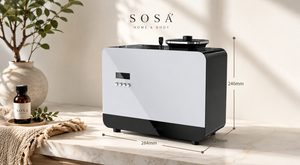
What to use instead: the Vaayu at ₹11,999 — a continuous source at an intensity you set, running compositions that end in cedar, vetiver, sandalwood or amber. SOSA makes no home room spray.
2. The fading is not a defect in what you bought. A spray puts a fixed quantity of material into the air in about a second. It peaks roughly a minute later, then falls away as the air in the property exchanges and as the heavier fractions settle onto surfaces. Nothing is replacing what leaves, because there is no source in the room.
3. You are the only person in the building who meets the peak. You spray, you stand in it, you judge the level from inside it, and then you go and wait by the lift. Your buyer arrives fifteen or twenty minutes later and meets the tail. That gap is why the answer always feels like using more, and using more is not the answer.
4. The artificiality is a composition problem, not a strength problem. Inexpensive room sprays lean heavily on high-impact, highly volatile top-note materials because that is what sells at the shelf and in the first ten seconds. There is very little middle and almost no base. What is left after twenty minutes is a thin residue with nothing underneath it to fall to, and thin residue is exactly what a nose reads as synthetic.
5. So buy a source rather than a dose, and buy a composition with a base. The Vaayu at ₹11,999 holds an intensity you choose for as long as you choose, and every one of the seven Hotel Collection compositions ends in cedar, vetiver, sandalwood, woods or amber. A scent that has somewhere to fall to does not go thin.
6. And do the free work first anyway. Twenty minutes of cross-ventilation and a mug of water down every trap will do more than any product, and no fragrance of any kind should be used over a defect: damp, a leak or a drain fault is a material fact about the property.
A portion of every order supports girl-child education through Nanhi Kali.
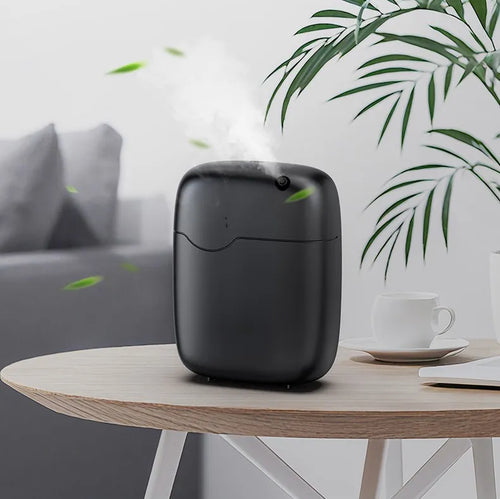
Why a spray fades, and why it smells the way it does
These are two separate problems that happen to arrive in the same can, and separating them is most of the answer. One is about how a fixed quantity of material behaves in a volume of air over time. The other is about what was in the can in the first place. Neither is solved by spraying more, which is what almost everybody tries first, and both are solved by different halves of the same replacement. I am going to take them in that order, because the second is the one nobody has ever explained to you properly.
Your two complaints, and what each of them actually is
Six things that go wrong with a spray before a viewing, what is physically happening in each case, and which of them a different spray would fix. The answer in that last column is almost always none of them, which is the useful finding rather than a sales line.
| What you notice | What is happening | What does not fix it | What does |
|---|---|---|---|
| It fades before the buyer arrives ★ | A single dose peaking at about a minute, then decaying by air exchange and settling | Spraying more, or spraying later. There is still no source in the room | A continuous source: the Vaayu at ₹11,999, on low, from two hours before |
| It smells artificial after twenty minutes | Volatile top notes with almost no base beneath them, leaving a thin fragment | A more expensive spray of the same construction | A composition built on cedar, vetiver, sandalwood or amber, which has something to fall to |
| It smells too strong to you and weak to them | You calibrate from inside the peak; nobody else is ever present for it | Judging the level in the room you just sprayed | Leaving and re-entering through the front door, or a level set two hours ahead and adjusted down at T-30m |
| It sits in a band by the front door | A hand-held dose is applied where you are standing, not distributed through a volume | Spraying room by room, which produces several bands and a hallway that reads as treated | One source three or four metres inside the entrance, at waist height, with internal doors open |
| Back-to-back viewings need re-spraying | Every appointment starts a new decay curve, and you are working between them | A bigger can | A timer: 1h, 4h, 8h or 24h holds one level across a whole Saturday of slots |
| It sometimes reads as a cover-up | A sharp burst over an underlying smell is legible as exactly that | Anything at all from a bottle | Find the source. If it is damp, a leak or a drain fault, that is a material fact — fix it or disclose it |

What polished means in practice, and the registers to use
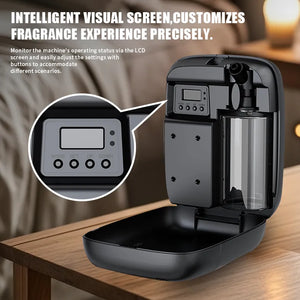
Start with what you actually gain, because it is not what people expect. Moving from a spray to a machine does not give you a stronger smelling property. In almost every case it gives you a quieter one, and the improvement is in consistency rather than in intensity. Set the Vaayu to a low intensity two hours before the appointment and the flat holds that level: the same at eleven as at half past twelve, the same for the buyer who is punctual and the one who is forty minutes late, the same for the second viewing at one o'clock and the third at three. That is the whole of what polished means in this context. A hotel lobby does not smell strong; it smells identical every time you walk into it, and that identicality is what reads as professional. The other thing you gain is the ability to stop being present for the fragrance step at all. With 1h, 4h, 8h and 24h timers and Bluetooth control, the machine can be placed on Friday and armed for Saturday morning, which removes the single most common failure in your current routine, which is arriving eight minutes before a buyer and doing the fragrance in a hurry with your coat still on. Nothing done in a hurry eight minutes before a viewing has ever improved a viewing.
Then the registers, which is where a change of format lets you make a better choice than a spray ever allowed. The brief for a property somebody is about to buy is narrow: clean, dry, quiet, and impossible to dislike. It is not impressive, and it is certainly not distinctive. Three of the seven fit that brief and I would rotate between them by property rather than by mood. The Ritz-Carlton-inspired Quiet Luxury — white tea, bergamot and cedar — is the default, and the one I would run in three quarters of listings: cool, polished, legible at a low setting, with nothing sticking out of it that a stranger could object to. The Westin-inspired White Tea Serenity — white tea, aloe and cedar — is the lightest of the seven and belongs in a smaller flat where the default would be a shade too present. The 1 Hotels-inspired Forest Suite — cedarwood, vetiver and green leaves — is the dry one, and it is the right answer where the property runs warm, faces west, or has a kitchen open to the living area, because a dry woody note occupies a different address in the nose from food and never argues with it. What I would keep out of a viewing: anything heavily floral, anything sweet, and anything a buyer might recognise as a perfume they know. Recognition is the failure mode nobody warns about — the moment a buyer can name the smell, they are thinking about the smell instead of the room. Nothing in the seven is sweet, which removes half the danger before you start.
Then placement, habituation and the constraints. Put the machine three or four metres inside the front door, at waist height or above, out of the direct throw of an air-conditioning vent and never in the doorway itself. A source in a doorway reproduces the exact fault you have with the spray: a concentrated band at the threshold and a property that fades behind it. On habituation, the honest warning is that a machine makes nose-blindness easier to fall into, not harder — a spray at least announces itself when you use it, while a machine that has been running since nine simply becomes the smell of your working day. Walk in from outside at T-30m, with street air in your nose, and adjust downwards; I have never once had cause to adjust upwards at that point. On the constraints: the Vaayu runs its own undiluted oil and does not take the water-based Hotel Collection bottles, which are for ultrasonics, and four hotel-inspired scents come with the machine. The Sukoon at ₹1,899 is the proportionate answer if what you really need to handle is one occupied living room rather than a whole flat, and it includes three 15ml scents; but it is water-based, adding 30 to 50 ml of water an hour, which makes it wrong for a closed or humid vacant property. A reed diffuser needs 24 to 72 hours and suits a listing shown over months. A candle has to be attended, so it is out of any property you leave. And the rule that sits above the whole question: if a spray was ever doing the job of covering something, stop. Damp, a leak, drains or smoke are material facts about a property — find it, fix it or disclose it, and scent only a listing that is genuinely sound.
The SOSA edit
In buying order for a realtor replacing a spray. The first row is free and still outranks the rest, and the last row states the thing we do not make, because a page about room sprays written by a fragrance house is worth nothing unless it says which side of the counter it is standing on.
| Buy | What it is | When it earns its place | Price |
|---|---|---|---|
| 1. Ventilation and drain traps | Twenty minutes of cross-ventilation and a mug of water down every trap in the property | Before anything. Most sprays are being asked to solve a problem that twenty minutes of open windows solves better | Free |
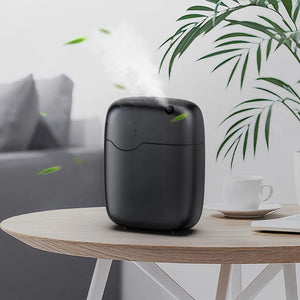
| 2. SOSA Vaayu | Waterless cold-air nebulisation, adjustable intensity, 1h/4h/8h/24h timers, up to 1000 m³, under 38 dB | The replacement for the can. A rate you set rather than a dose you release | ₹11,999 |
| 3. Ritz-Carlton-inspired | White tea, bergamot and cedar — cool, dry, and built on a base rather than on a top note | The default for three quarters of viewings. Four hotel-inspired scents come with the machine | ₹299 / 15ml |
| 4. 1 Hotels-inspired or Westin-inspired | Cedarwood, vetiver and green leaves; or white tea, aloe and cedar — the driest and the lightest | The warm property and the small one. Two adjustments inside one house style, not two signatures | ₹299 each |
| 5. Sukoon | 500ml ultrasonic, 270–320 sq ft, steady/2H/4H timers, three 15ml scents included — water-based | If the real problem is one occupied living room. Not for a closed, empty or humid property | ₹1,899 |
| Not made here: a room spray for the home | SOSA's sprays are car perfumes, formulated for roughly three cubic metres of hot moving air | Stated plainly. This page is not a brand running down a category while selling its own version of it | — |

Versailles
I get this question often enough that I have a standard first answer, and it is that the spray has not let you down — the format has. A can is a dose. A dose has a peak, and the peak happens while you are standing in the room deciding whether it is enough, which is the worst possible moment to be asked that question. Everything downstream of that follows: you learn to press for longer, the first ninety seconds get sharper, and minute twenty is exactly where it always was. No amount of money spent on a better spray changes the shape of that curve, which is why I would rather tell you the shape than sell you a different can. We do not make one for the home in any case.
The artificiality is the part I actually enjoy explaining, because it is a real fault with a real cause. Cheap room fragrance is built almost entirely out of the loud, light, fast materials at the top of a composition, because those are the ones that sell it in four seconds at a shelf — and the base, which is the expensive half and the half that holds everything up, is left out. So when the top goes there is nothing underneath, and what you are left with is not a softer version of the scent, it is a fragment. Your nose is reading a structure with no floor in it, and calling that artificial is a completely accurate description. Every one of the seven compositions I make for these machines ends in wood, amber or vetiver. They get quieter. They do not go thin.
Everything is made and supported from Pune, and a part of every order funds girl-child education through Nanhi Kali. You get a space that smells like somewhere considered; a girl gets a classroom. That equation has always felt right to me.
Frequently asked questions
- I spray room freshener before every viewing — is there a better way — the same question, answered shorter.
- My room spray fades before the buyer does — the decay curve, and the back-to-back viewing problem.
- What type of diffuser works better than passive reeds for viewings — the format comparison in full.
- Is a waterless scent machine practical for real-estate viewings — the specification, honestly assessed.
- Brand: the SOSA founder story.
Facts verified August 2026: Product facts used in this guide. SOSA Vaayu ₹11,999: waterless cold-air nebulising diffuser, atomises undiluted fragrance oil to a dry residue-free nano-mist, coverage up to 1000m³ (approximately 2,000–3,000 sq ft), 400ml refillable tank lasting up to about 75 days per fill, Bluetooth app plus onboard control, 1h/4h/8h/24h timer scheduling, adjustable intensity, under 38 dB, DC 12V/1A at 5W, 165 × 80.5 × 215 mm and 0.9 kg, freestanding or wall/HVAC mounted, auto-stop and key-lock, CE, RoHS and SGS certified, supplied with four hotel-inspired fragrances. SOSA Aangan ₹25,999: HVAC-connected or standalone commercial nebulising diffuser, coverage up to 3,000m³ (roughly 8,000–10,000 sq ft), 800ml reservoir, metal body, programmable schedules, under 42 dB. Ultrasonic machines are water-based and consume 30–50 ml of water an hour: Sukoon ₹1,899 (500ml, 270–320 sq ft, 16–18 hours on low, 3–6 drops per tank, steady/2H/4H timers, three 15ml Hotel Collection scents included), Boond ₹899 (300ml), Megh ₹3,499 (6 litres). Hotel Collection water-based fragrance 15ml ₹299, 100ml ₹999, 300ml ₹1,799, Pack of 7 at 15ml ₹1,799 against ₹2,093 bought singly; the Vaayu and Aangan take their own undiluted oil rather than these water-based bottles. Reed diffusers (separate alcohol-free line) from ₹749, requiring 24–72 hours to reach their working level. Scented candles from ₹379, scenting a room in roughly 15–20 minutes but requiring attendance. Free shipping above ₹499. Timings: a nebulising diffuser reaches a working level within minutes and a stated viewing level well inside two hours. This guide makes no claim that fragrance affects a property's price, offer level or time on market; it is presentation, in the same category as photography, styling and lighting. Fragrance must never be used to conceal a material defect. SOSA is not affiliated with or endorsed by any hotel brand. Prices subject to change — see the live product pages.