

The single biggest free lever: keep the bedroom door shut. A closed room accumulates; an open one shares its air with the corridor and never builds a step at the threshold. The moment is a gradient, and a gradient needs two different concentrations either side of a doorway.
The second free lever: do not run the same scent in the hallway. Contrast is the mechanism. If the corridor smells of what the bedroom smells of, you have removed the step you were trying to build.
The third: one scent, kept for a year, at a modest dose. Recognition is what makes it a signature; intensity is what makes it a headache. A reed diffuser from ₹749 does this better than anything, because it is at the same level today as it was six weeks ago.
If you want a genuine peak at the moment you get home: that is a scheduling problem, and only an active diffuser solves it — Sukoon ₹1,899 at 270–320 sq ft, or Safar ₹3,999, which is named and sold as a car and travel diffuser and has no published room-coverage figure.
The honest gap: between Safar and the ₹11,999 Vaayu — 1000 m³, roughly 2,000–3,000 sq ft, and absurd for one bedroom — SOSA has no mid-sized waterless bedroom nebuliser.
2. Close the door, and treat that as the primary equipment. A bedroom of 100 to 150 sq ft with the door shut is a small, mostly sealed volume, and a passive source inside it reaches a clearly perceptible level without any help. Leave that door open and the same source is trying to fragrance the bedroom plus the corridor plus whatever the corridor connects to, and, worse, it has flattened the difference between the two sides of the doorway. The step is the effect. Everything else on this page is a way of making the step taller.
3. Keep the approach unscented, and resist the urge to scent everything. The commonest self-inflicted mistake I see is a person who wants a bedroom-door moment putting the same fragrance in the hall, the living room and the bedroom, and then wondering why the doorway does nothing. You have built a plateau instead of a step. If you want fragrance elsewhere, make it a different register — a citrus in the living room and a soft herbal in the bedroom — so that crossing the threshold is a change rather than a continuation.
4. Dose the room correctly rather than heavily. A 50ml reed is specified for up to about 150 sq ft, which is most bedrooms. Reed count is the volume dial: six for full projection, three for a soft bedside level and roughly double the life. In a small, well-sealed, air-conditioned bedroom, six is frequently too many, and what people describe as “cloying” is almost always over-dosing rather than the composition. Start at four, live with it a week, and adjust. It costs nothing and it is the adjustment almost nobody makes before deciding they do not like a fragrance.
5. Only if you want a deliberate peak at a particular hour should you buy a machine, and buy it for the clock rather than for the smell. A reed cannot be scheduled — it cannot be switched on and it cannot be switched off, which is its one genuine design limitation. Sukoon at ₹1,899 covers 270–320 sq ft and runs 16–18 hours on low, throwing oil diluted in water and adding humidity. Safar at ₹3,999 nebulises undiluted oil with three speeds and a 1, 2 or 3-hour auto-off — it is named and sold as a car and travel diffuser, SOSA’s own page also lists bedside and hotel room among its uses, and no room-coverage figure is published for it.
Alcohol-free, phthalate-free, paraben-free, IFRA-compliant, 0 ppm formaldehyde. Free shipping above ₹499, and a portion of every order supports girl-child education through Nanhi Kali.
The limitation, said kindly, and why it is not a fault in your setup
I have had this letter many times and it usually arrives with an apology in it — that the writer must be doing something wrong, or bought something inadequate, because the room smelled wonderful for the first two days and now they cannot detect it. Almost always the correct answer is that nothing has stopped working and you have stopped noticing, and those two states are indistinguishable from inside your own nose. Olfactory receptors adapt to a constant, unchanging stimulus within minutes. The molecules continue to arrive at exactly the rate they did on day one; the brain simply stops passing the message upward, because a signal that never changes carries no information. It is an efficiency, not a failure, and it applies to everybody equally.
This has three practical consequences and they are the whole reason this page is structured the way it is. The first is that your own reading of your own bedroom is the least reliable measurement available to you, so stop taking it. Leave the flat for fifteen minutes and walk back in, or ask somebody arriving from outside where they first notice anything. A visitor is a better instrument than you are, and they cost nothing. The second is that if guests remark on it and you cannot detect it, the diffuser is working correctly for everybody but you — sensitivity to individual materials varies enormously between people, and you have the additional handicap of living there. The third, and the expensive one, is that chasing your own adaptation with more oil is the classic escalation. You add reeds, you buy a bigger bottle, you move to a machine, and you still cannot smell it, because you adapt to each new level within minutes too — while everyone who walks in finds the room overwhelming. The only person you cannot fix with dose is yourself.
So the honest brief is not “make it strong enough that I notice it all the time”. A diffuser you can smell continuously in your own home is set too strong for the room, and the fix is fewer reeds rather than a different scent. The honest brief is “make the arrivals count” — make sure that when you do walk in un-adapted, there is a real step to walk into. That is a question about gradients and thresholds, not about strength, and it is answerable.
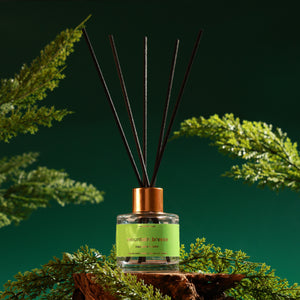
 Mountain Breeze₹849The arrival moment is a difference between two concentrations separated by a doorway, and a difference needs both halves. Nearly everybody works on the inside half and forgets the outside one. A shut door does two things at once: it lets the room accumulate, and it keeps the corridor bare so there is something to accumulate relative to. In a 100–150 sq ft bedroom that is a genuinely small volume, so a passive source reaches a clearly perceptible level without help. Open the door and you have quietly asked the same bottle to fragrance three times the volume and have thrown away the contrast in the process. If your bedroom door stands open all day, that single habit is doing more damage to the effect than any product choice on this page.
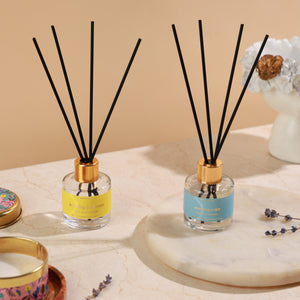
 Garden Bloom₹799This is the counter-intuitive one, and it is the advice people most often ignore before writing back a month later. If you want a door to mean something, the space in front of it has to smell of less than the space behind it. Running your bedroom scent in the passage, the living room and the bathroom as well produces a home that is pleasantly and uniformly fragranced — a perfectly good outcome, but a different one, and it deletes the moment you asked for. Worse, a home that smells identical in every room stops registering as a smell at all within a week, because there is never a change to report. If you want fragrance elsewhere, make it another register entirely, so that each doorway is a small event rather than a continuation.
 Sukoon₹1,899Once you accept that the effect belongs to arrivals, the useful question becomes what the room is doing in the hours before you get to it. A reed handles this for free by never stopping — it has been emitting into a shut room all day, so the concentration at six in the evening is the same as it was at noon, and you arrive to meet it. That is the reed’s quiet advantage on this specific page, and it is worth naming. What a reed cannot do is give you a peak on cue. If you want the room to be at its highest level at the hour you walk in, you need a device with a schedule: Sukoon at ₹1,899, or waterless nebulising with Safar at ₹3,999 with its three speeds and 1/2/3-hour auto-off.
What makes a scent a signature rather than just a smell
There is a second half to your question that is easy to skip past, and it is the more interesting one. You did not ask for a strong bedroom. You asked for a signature, and a signature is a recognition effect rather than an intensity one. What makes a hotel’s scent feel like an identity is not that it is powerful; it is that it is the same one, at the same level, for years, so that a returning guest gets a flash of the place before they have consciously identified anything. You can have that at home for ₹749, and the only cost is discipline. Pick one composition and keep it for a year. Do not rotate seasonally, do not have four bottles on the go, do not switch because a new one looked interesting. Consistency is the luxury signal, and it is almost free.
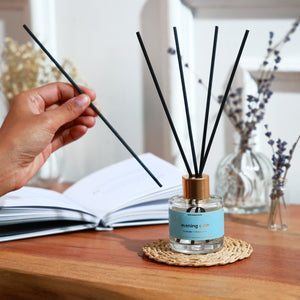
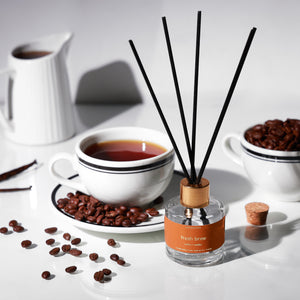
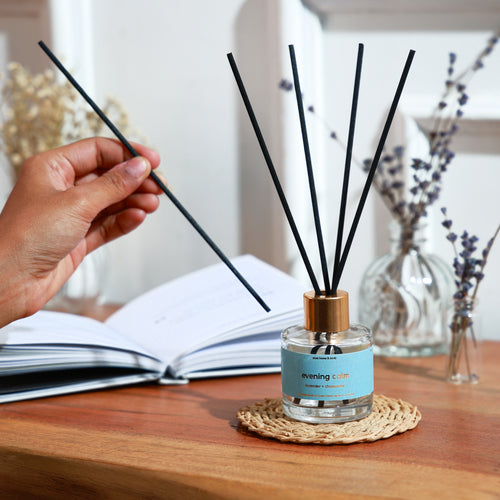
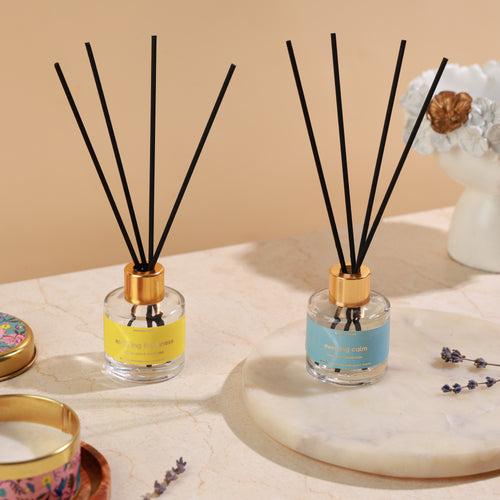
Choose it for durability rather than for impact, because you are choosing something you will meet several hundred times. In our range, the softest things are the ones that survive that test best: Evening Calm at 8.9 on the SOSA strength scale, Kashmir lavender with real chamomile and a soft musk drydown, and Mountain Breeze at 9.4, which is our deepest woody and yet reads as cool outdoor air rather than as timber. Fresh Brew at 9.5 is the deepest thing we make and a superb bedroom signature for the right person, but it is a warm gourmand and it is the least neutral choice in the range. The scale is not a quality ranking — it measures perceived intensity in a room, and it exists precisely so that somebody buying for a small sealed bedroom can choose deliberately downwards.
The last piece is the one people never think of as part of a signature: put the bottle where you will be, not where the door is. A reed’s concentration is highest at the source and falls with distance, so the fragrant zone should include the bed, the reading chair and the wardrobe you stand at, rather than a shelf by the entrance. And keep it off the threshold itself for a practical reason — a doorway is the most turbulent point in a home, repeatedly stripped by the door opening and then hit at close range, which gives you a worse first impression and a shorter bottle. A metre or so inside, at roughly chest height, out of the direct draught of a door or a split AC, is the placement that does the most for the least.
| Mechanism | How it works | The door moment | Can it be scheduled? | Price |
|---|---|---|---|---|
| Free — the door and the approach ★ | Shut the bedroom, leave the corridor unscented, dose for the room, place the bottle inside and out of the draught | The largest single improvement available, and the one nearly everybody skips | — | ₹0 |
| Passive capillary — reed diffuser | Oil climbs six fibre reeds and evaporates. No power, no air moved | Good, because it has been filling a shut room all day and you arrive to meet it. A zone rather than a fragranced room | No. It cannot be switched on or off — the one real design limitation | ₹749–₹849 |
| Ultrasonic water mist — Sukoon | A piezo plate shatters oil diluted in water into a visible wet mist, and moves air | Strong and even — 270–320 sq ft, 16–18 hours on low, well over any bedroom | Yes, by running it in windows. Costs dilution, refilling and added humidity | ₹1,899 |
| Waterless cold-air nebulising — Safar | Pressurised air shatters undiluted oil into a dry micro-mist. No water, no white dust | The hotel mechanism at personal scale. No published room-coverage figure | Yes — 3 speeds and a 1/2/3-hour auto-off, then it stops and needs recharging | ₹3,999 |
| The honest gap: the mechanism that suits a bedroom door moment best is waterless nebulising, and SOSA’s only bedroom-scale waterless device is Safar, which is named and sold as a car and travel diffuser and carries no published room coverage. Above it, Vaayu ₹11,999 is rated to 1000 m³ — roughly 2,000–3,000 sq ft — and in a 120 sq ft bedroom nine-tenths of it is wasted. There is nothing between them, and that is our gap rather than your mistake. | ||||
Softest · Evening Calm₹799Shop → 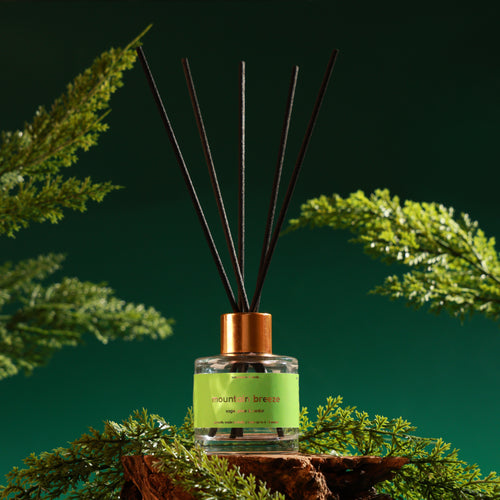 Cool and dry · Mountain Breeze₹849Shop →
  If you want a clock · Sukoon₹1,899Shop →
Being fair to the reed, which on this page is genuinely the right product
On a great many pages in this series I end up explaining why a passive diffuser cannot do something. This is not one of them. For a bedroom signature met on arrival, a reed diffuser is close to the ideal instrument, and I would rather say so than perform reluctance in order to sell a machine. It runs continuously without being asked, which means the shut room has been quietly accumulating all day and is at its level when you get there. It is silent, which in a bedroom matters more than in any other room in the house. It uses no power, so nothing hums at three in the morning and nothing has to be remembered. It costs roughly ₹13 to ₹15 a day. And it looks like a glass object on a bedside table rather than an appliance, which is the honest reason a great many people would not put a machine in a bedroom at any price.
It also happens to be the format best suited to the thing that makes a signature work, which is sameness. A reed at four reeds today is at four reeds in six weeks; there is no setting to drift, no schedule to fall out of, no tank to run dry unnoticed. The only maintenance is flipping the reeds every three to five days, which re-wets the dry upper length and restores projection without opening a new bottle — and a useful trick for this page specifically is to flip on the morning of a day you know you will be out, so the restored lift is waiting for you when you come back rather than being spent while you sit in the room adapting to it.
Two honest limits to hold alongside that. The first is the one I have already made much of: a reed cannot be switched off, and it cannot be timed. If your requirement is genuinely “at its strongest at 7pm and quiet at 3am”, no reed does that and no number of reeds will. The second is scale. A 50ml is specified for up to about 150 sq ft and a 130ml above that, so a 50ml in a large or open-plan bedroom will read as weak while performing precisely to specification — that is a sizing question, not a strength one, and the answer is the larger bottle rather than a different mechanism.
What to buy, in order — and the rung that does not exist
The first two rows cost nothing and they are genuinely first rather than a preamble before the products. The last row is the gap in our own range, said plainly, because a reader who wants a scheduled, waterless, bedroom-sized machine is describing a product we do not make.
| Do this | What it is | When it is the right answer | Price |
|---|---|---|---|
| 1. Close the door and strip the corridor ★ | Keep the bedroom shut during the day, keep the approach unscented or in a different register, and place the bottle a metre inside the room out of the draught rather than on the threshold | First, always. It builds the step the moment depends on, and it is free | ₹0 |
| 2. Dose for the room, not for drama | 50ml for up to ~150 sq ft, 130ml above it. Four reeds as a starting point, six for full projection, three for a soft bedside level and roughly double the life. Flip every 3–5 days, ideally on a day you will be out | Second, always. Over-dosing is what people mean by “cloying”, and under-dosing is what they mean by “weak”. Both are free to correct | ₹0 |
| 3. One reed, kept for a year | Passive capillary. Evening Calm 8.9 is the softest we make and the easiest to meet several hundred times; Mountain Breeze 9.4 is cool and dry; Fresh Brew 9.5 is the deepest and the least neutral | When you want a signature rather than a strong room. Silent, unpowered, refillable, about ₹13–₹15 a day | ₹749–₹849 |
| 4. Sukoon — if you want the peak on cue | Ultrasonic water mist. 500ml, 270–320 sq ft, 16–18 hours on low, three 15ml Hotel Collection scents included. Run it in a window before you get home | When the requirement is genuinely a scheduled peak. Accept dilution, refilling, added humidity and possible white mineral dust in hard water | ₹1,899 |
| 5. Safar — undiluted, and no added water | Waterless cold-air nebulising. 20ml, 2000 mAh Type-C, up to 10 hours continuous or ~30 intermittent, 3 speeds, 1/2/3-hour auto-off, 6.9 cm. Named and sold as a car and travel diffuser, with bedside and hotel room among its stated uses | When adding humidity is the objection and you want the hotel mechanism itself. No published room-coverage figure; personal scenting, and it needs recharging | ₹3,999 |
| Not for one bedroom: Vaayu | 1000 m³ — roughly 2,000–3,000 sq ft — 400ml lasting about 90+ days, Bluetooth scheduling in 1h/4h/8h/24h windows, under 38 dB | No. In a 120 sq ft bedroom nine-tenths of it is wasted. It earns its price on a whole floor, an open-plan living-dining, a villa, a clinic or a reception | ₹11,999 |
| The honest gap | No mid-sized waterless bedroom nebuliser exists at SOSA. Nothing sits between Safar at personal scale and Vaayu at building scale. Megh ₹3,499 is not the answer either — about 215 sq ft, less than the ₹1,899 Sukoon, and a runtime and humidity machine | Said plainly. If what you want is a scheduled, waterless, bedroom-sized machine, we do not make one and I would rather you knew before you started looking | — |
Versailles
I put the limitation in the first paragraph of this page rather than burying it near the FAQs, and I want to explain why. If I let you buy your way toward an effect that receptors will not permit, you will spend twice and then decide that home fragrance is a swindle. You adapt to your own bedroom within minutes. Everybody does. The people who write to me convinced their diffuser has stopped working are almost always describing themselves rather than the bottle, and the ones who have already gone from three reeds to six to a machine have usually built a room that guests find heavy and that they themselves still cannot detect.
So I would rather give you the two free moves, because between them they do more than any purchase. Shut the bedroom door during the day. Leave the corridor outside it unscented, or scent it with something else entirely. That is the whole architecture of the moment you described: a low side and a high side with a doorway in the middle, met by a nose that has been outdoors. Then choose a composition you can meet several hundred times without tiring of it, and keep it for a year. Consistency is what turns a smell into a signature, and it is the cheapest luxury in this entire category.
If after all that you still want the room to peak at the hour you walk in, that is a real requirement and a reed genuinely cannot meet it — a reed cannot be switched on or off, and that is its one honest design limitation. Buy a machine for the clock rather than for the smell. Know that Sukoon puts water into the air, that Safar is named and sold as a car diffuser with no published room coverage, and that the large machine above it is built for a whole floor rather than a bedroom. That middle rung does not exist in our range, and it is ours to own rather than yours to work around. Everything is composed in Pune, and part of every order funds a girl’s classroom through Nanhi Kali.
Frequently asked questions
- How hotels do it in seconds — threshold concentration and a scent held constant for years.
- The “wow, your home smells amazing” effect — one scent, one room, ventilate before.
- Guests noticing before they sit down — placement inside the entrance, out of the draught.
- An arrival moment at the bedroom door — the same threshold, built for guests rather than for you.
- Nice once you sit inside, but no immediate impact — the concentration gradient explained.
- Reed, spray or active diffusion — three shapes over time, honestly compared.
- Why you notice a lobby and not your own home — adaptation in full, and the fifteen-minute test.
- Arrival effect vs continuous background — two setups in tension, and how to choose.
- Stronger fragrance or better diffusion? — the pillar, and the one free exception.
- Brand: the SOSA founder story.
Facts verified August 2026: Three diffusion mechanisms are described — passive capillary (reed diffusers), ultrasonic water mist (Boond ₹899, 300ml, up to ~150 sq ft, ~6 hours, USB, night light; Sukoon ₹1,899, 500ml, 270–320 sq ft, 16–18 hours on low, three 15ml Hotel Collection scents included; Megh ₹3,499, 6L tank, ~100 hours runtime, ~215 sq ft, which is less coverage than Sukoon and never a coverage upgrade) and waterless cold-air nebulising (Safar ₹3,999, 20ml bottle, 2000 mAh Type-C battery, up to 10 hours continuous or around 30 hours intermittent, 3 speeds, 1/2/3-hour auto-off timer, 6.9 cm, named and sold as a car and travel diffuser with car, handbag, desk, bedside and hotel room among its stated uses, no published room-coverage figure; Vaayu ₹11,999, coverage up to 1000 m³ or roughly 2,000–3,000 sq ft, 400ml refillable tank lasting up to about 90+ days, Bluetooth app and onboard buttons, 1h/4h/8h/24h run windows, adjustable intensity, key-lock, under 38 dB, freestanding or wall/HVAC mount, 5W, CE, RoHS, SGS). SOSA reed diffusers: five scents, 50ml ₹749–₹849 lasting 6–8 weeks and suiting rooms up to ~150 sq ft, 130ml ₹1,249–₹1,349 lasting 14–18 weeks and suiting above 150 sq ft, six fibre reeds included and flipped every 3–5 days, six reeds for full projection and three for a soft bedside level, about ₹13–₹15 a day, heat-stable CCT carrier rather than DPG, alcohol-free, phthalate-free, paraben-free, IFRA-compliant, 0 ppm formaldehyde, refillable glass bottle, climate-tested at 45°C and 85% RH, composed in Pune. SOSA strength scale: Evening Calm 8.9 (softest), Garden Bloom 8.9, Morning Freshness 9.0, Mountain Breeze 9.4, Fresh Brew 9.5 (deepest). Duos are two 50ml bottles at ₹1,498–₹1,598; 130ml duos ₹2,498–₹2,598; refills 300ml ₹2,399 and 500ml ₹3,499, oil only and never a first purchase. Hotel Collection fragrance oils are water-based and ultrasonic-only at 15ml ₹299 (a refill), 100ml ₹999, 300ml ₹1,799 and a pack of seven at ₹1,799; they cannot be used in reed diffusers and reed oil cannot be used in ultrasonic machines, so no hotel-inspired reed diffuser exists. Free shipping above ₹499. A portion of every order supports girl-child education through Nanhi Kali. SOSA is an independent Indian fragrance house; the Hotel Collection scents referenced here are SOSA’s own interpretations inspired by the world’s finest hotels, and SOSA is not affiliated with, endorsed by or a supplier to any hotel brand. Prices subject to change — see the live product pages.