



Reproducible — 1. Consistency: one scent, unchanged, for years. Free.
2. Dryness: a hotel scent arrives as a dry mist, not a damp one. Waterless cold-air nebulising throws undiluted oil; ultrasonic water mist throws oil diluted in water and adds humidity. That difference is much of what you perceived as clean.
3. A single signature: one register in the space, not four competing stories.
4. Scheduled intensity: the same level at the same hours, rather than a bottle that runs at whatever rate the day allows.
What you probably own: a reed diffuser — passive capillary diffusion, oil climbing six fibre reeds and evaporating with no air being moved. It makes a fragrant zone, not a fragranced room, and it is unbeatable on silence, zero maintenance and about ₹13–₹15 a day.
The honest gap: Sukoon ₹1,899 covers 270–320 sq ft but uses water. Safar ₹3,999 is dry and undiluted but is named and sold as a car and travel diffuser with no published room-coverage figure. Between it and the 2,000–3,000 sq ft Vaayu ₹11,999 there is no mid-sized waterless bedroom nebuliser at SOSA. SOSA is independent and not affiliated with any hotel brand.
2. Commit to one scent and keep it. A hotel runs a single fragrance, in the same places, at the same level, for years. Homes do the opposite: an agarbatti in the morning, a floor cleaner at eleven, a candle at the weekend, a diffuser somewhere and dinner at eight. None of those is wrong, and together they make a home smell busy. Busy is the true opposite of that hotel room. Choosing one register and living with it is the single largest free improvement available.
3. Get the dose right, which usually means downwards. The commonest thing people do after a good hotel stay is add. Six reeds in a small sealed bedroom is frequently too many. What gets described as cloying is almost always over-dosing rather than the composition — any fragrance at too high a concentration flattens into one sweet or sharp impression, which is exactly what people mean by air freshener. Three reeds instead of six roughly doubles the life of the bottle and very often improves the room.
4. Understand dry versus damp, because it is most of what you perceived as clean. Waterless cold-air nebulising shatters undiluted oil into a dry mist. Ultrasonic throws the same oil diluted in water as a visible wet mist, which adds humidity and, in hard-water cities, can leave a fine white mineral dust. Same oil, different payload per droplet, and a noticeably different feeling in the room. Neither is wrong; they are different trades.
5. Then choose the mechanism honestly. Keep the reed if you want silence, no power and nothing to maintain, and accept a fragrant zone rather than an even room. Buy Sukoon at ₹1,899 for genuine 270–320 sq ft coverage with water. Buy Safar at ₹3,999 for the dry, undiluted principle at personal scale — it is named and sold as a car and travel diffuser, with bedside and hotel room among its stated uses, and SOSA publishes no room-coverage figure for it.
Alcohol-free, phthalate-free, paraben-free, IFRA-compliant, 0 ppm formaldehyde. Free shipping above ₹499, and a portion of every order supports girl-child education through Nanhi Kali.

The four things about that room you can actually reproduce
A hotel room is not a fragrance achievement so much as a control achievement. The scent in it is usually light — often it is carry-over from corridors and public areas rather than anything released in the room itself, which is why guests so rarely find a diffuser when they go looking. What makes it read as designed is that everything around it is held steady. Below are the three controls worth copying, and after them the section on the fourth, which is dryness, and which almost nobody names.
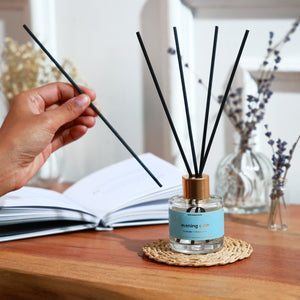
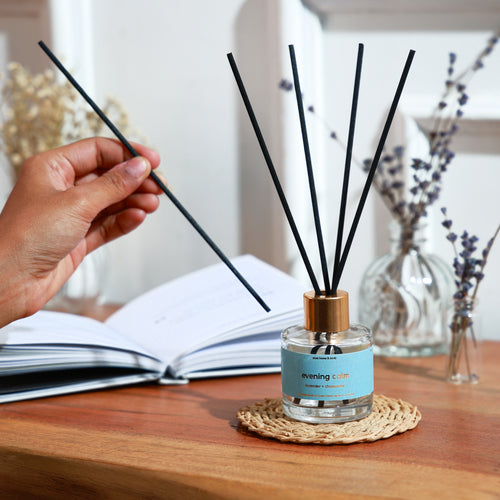
 Evening Calm₹799The hotel you remember has been running that scent since before you first stayed there, and will still be running it when you go back. It does not change seasonally, does not add a second one for interest, and does not run something different in the rooms from the corridors. That refusal to be interesting is most of what reads as luxury, and it is the one component that costs nothing whatsoever. At home, the equivalent is buying one bottle rather than three and finishing it. If you want the softest option to live with for a long stretch, Evening Calm at 8.9 on the SOSA strength scale is the gentlest thing we make, and gentle is what survives repetition. Deep and dramatic is exciting in week one and tiring by week five, which is precisely why hotels do not choose it.
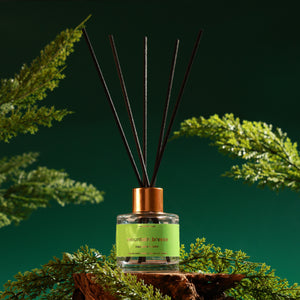
 Mountain Breeze₹849This is different from consistency and it is the one people miss. Consistency is about time; singularity is about the same moment. In that hotel room there was one fragrance idea and nothing arguing with it. In a bedroom at home there is usually a diffuser, a wardrobe sachet, a laundry detergent, a hand wash, whatever came through the door from the kitchen, and sometimes a candle from a birthday. The result is not unpleasant — it is illegible, and legibility is what you are remembering. The cheapest version of this fix is to make the bedroom the one room that carries a single deliberate register, and to let the rest of the flat be as busy as ordinary life makes it. Sequencing beats blending: if incense owns your morning, let the diffuser own the hours after it clears rather than trying to run both.
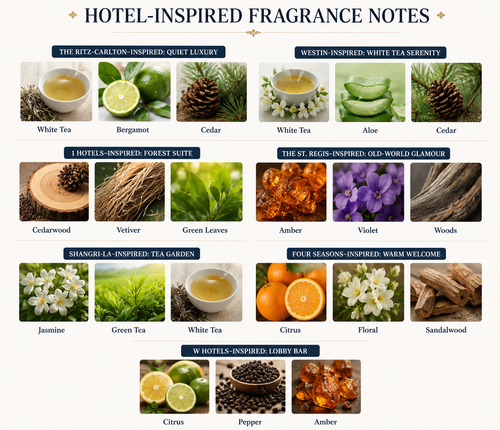
 Hotel Collection₹999A hotel decides how much fragrance enters a space and when. A reed diffuser cannot: its rate is set by the room’s temperature, humidity and airflow, it runs at whatever level those allow, and it cannot be switched off. That is the reed’s one genuine design limitation and pretending otherwise costs trust. Machines give the control back. Sukoon runs on demand for 16–18 hours on low. Safar has three speeds and a 1, 2 or 3-hour auto-off, which means it is not a set-and-forget always-on device and does need recharging — worth knowing before you buy it as a maintenance-free answer. Vaayu has app scheduling with 1h, 4h, 8h and 24h windows, chosen days and adjustable intensity — and is rated to 1000 m³, so it belongs to a floor rather than a bedroom.
Why dryness is the part nobody names, and why it changes the feeling
Ask somebody to describe a good hotel room and the words that come back are clean, cool, dry, quiet, uncluttered. Notice that three of those five are not about fragrance at all — they are about the state of the air. A dry room and a damp room carrying the identical oil do not read as the same fragrance, and this is the most under-discussed thing in home scenting in India, where for several months of the year the outdoor air is close to saturated.
Two separate mechanisms are in play. The first is what the diffuser itself puts into the room. An ultrasonic machine works by shattering a mixture of water and oil into a visible wet mist, so every droplet is mostly water — that is why the output adds humidity, and why in hard-water cities it can leave a fine white mineral deposit on nearby surfaces. A waterless cold-air nebuliser uses pressurised air to shatter undiluted oil into a dry micro-mist, so the payload per droplet is entirely fragrance and nothing wet enters the room at all. Why does undiluted oil smell stronger than the same oil in a water diffuser? Because it is not competing with water. Same composition, different carrier, and a genuinely different impression of the room. This is the technology hotels actually use, and it is the honest reason their scenting reads as dry rather than misted.
The second mechanism is the room’s own air, and here the hotel had an advantage you can partly copy. A hotel room runs its air conditioning more or less continuously in a closed, well-sealed volume. That does two useful things at once: it recirculates air within the room, which distributes fragrance far more evenly than still air ever will, and it dries that air, which speeds evaporation. Better distribution and a shorter bottle life in the same season — a genuine trade rather than a free win. If your bedroom has an AC and you close the door for your occupied hours, you already own most of that advantage. Do not, however, place a reed diffuser directly in the blast, which strips the lightest materials within days and leaves you with the base.
| Mechanism | What enters the room | Reach | Control | Price |
|---|---|---|---|---|
| Passive capillary — the reed diffuser | Vapour only, from six wetted fibre reeds. Nothing wet, nothing moved | A fragrant zone around the bottle | None — it cannot be switched off, and it also never needs switching on | ₹749–₹1,349 |
| Ultrasonic water mist — Boond, Sukoon, Megh | A visible wet mist of oil diluted in water. Adds humidity; possible white mineral dust in hard-water cities | Sukoon 270–320 sq ft · Boond up to ~150 · Megh only ~215 | On demand; Sukoon runs 16–18 hours on low, so refilling is not a daily chore | ₹899 / ₹1,899 / ₹3,499 |
| Waterless cold-air nebulising — Safar, Vaayu | A dry micro-mist of undiluted oil. No water, no heat, no added humidity, no white dust | Safar: personal scale, no published room-coverage figure. Vaayu: 1000 m³, roughly 2,000–3,000 sq ft | Safar 3 speeds and 1/2/3-hour auto-off, needs recharging. Vaayu app scheduling, 1h/4h/8h/24h windows | ₹3,999 / ₹11,999 |
| The honest gap: Safar is named and sold as a car and travel diffuser, so buy it knowing that, and Vaayu at 2,000–3,000 sq ft is the wrong purchase for one bedroom. Between them SOSA has no mid-sized waterless bedroom nebuliser — which is why a reader who wants hotel dryness in one room genuinely has to choose between accepting water and accepting a personal-scale device. | ||||
Setting up the bedroom itself, before you buy anything
Close the door for your occupied hours. Concentration in a room is what enters minus what leaves, and what leaves is air exchange — an open window, a gap under a door, an exhaust fan, a balcony on a high floor where wind speed is considerably greater than at street level. A bedroom that ventilates all day is not a home-fragrance environment during those hours; it becomes one the moment it closes. This is why the same bottle reads completely differently at three in the afternoon and at eleven at night, and why closing a door is the most effective free thing available to you.
Place for the person, not for the shelf. A reed diffuser has no fan and borrows whatever air the room is already moving, so concentration peaks at the bottle and falls away with distance. If yours is on a corner console and you spend your evenings four metres away in bed, you have put the fragrant part of the room where nobody stands. Move it towards the bedside. It will not fragrance the whole room — nothing passive will — but it puts you inside the part that is fragrant, which is usually the actual request. Keep it out of direct sun and out of the AC blast for the same reason: both strip the lightest materials fastest.
Then take the reading honestly. Leave for fifteen minutes and walk back in, or ask somebody who has just come up from the street. You are adapted to your own bedroom in a way you can do nothing about; a visitor is a better instrument than you are. A surprising number of people who write to me after a holiday describing their room as dead are told by the next guest that it smells lovely — at which point the correct purchase is nothing, and the correct action is to stop measuring with the one nose in the household that cannot.
What to buy, in order — and the rung that does not exist
In the order I would run it, cheapest first, because the free rows genuinely resolve this for a share of readers. The final row is the gap in our own range, stated because it is the reason there is no single automatic answer for a bedroom that wants hotel dryness.
| Do this | What it is | When it is the right answer | Price |
|---|---|---|---|
| 1. One scent, right dose, closed door ★ | Commit to a single register; three reeds rather than six in a small sealed bedroom; bottle moved to the bedside and out of the AC blast; door closed for occupied hours; fifteen-minute test before judging | First, always. Consistency and singularity are two of the four reproducible things and both are free | ₹0 |
| 2. The scent you will keep for a year | A single reed diffuser — 50ml up to ~150 sq ft over 6–8 weeks, 130ml above that over 14–18. Evening Calm at 8.9 is the softest and the easiest to live with over months | When you want the hotel’s consistency rather than its coverage. Silent, unplugged, nothing to fill or charge, about ₹13–₹15 a day | ₹749–₹1,349 |
| 3. Room coverage, water accepted | Sukoon — 500ml, 270–320 sq ft, 16–18 hours on low, three 15ml Hotel Collection scents included | The best-value real answer for a bedroom. You accept dilution, added humidity, refilling and possible mineral dust in a hard-water city | ₹1,899 |
| 4. Dry and undiluted, personal scale | Safar — waterless cold-air nebulising, 20ml bottle, 2000 mAh Type-C, up to 10 hours continuous or around 30 intermittent, 3 speeds, 1/2/3-hour auto-off, 6.9 cm. Named and sold as a car and travel diffuser, with bedside and hotel room among its stated uses | When dryness is the thing you actually loved and water is the deal-breaker. No published room-coverage figure — personal scenting, not room scenting | ₹3,999 |
| Never for this: Megh | 6L tank, around 100 hours of runtime, about 215 sq ft | Less coverage than the ₹1,899 Sukoon, and more humidity, not less. A runtime and humidity machine | ₹3,499 |
| The honest gap | No mid-sized waterless bedroom nebuliser exists at SOSA — nothing between Safar and Vaayu ₹11,999, rated to 1000 m³ or roughly 2,000–3,000 sq ft and the wrong purchase for one bedroom. Vaayu earns its price on a whole floor, an open-plan living-dining, a villa, a clinic, a salon or a reception | Said plainly, because it is why “hotel dryness in one bedroom” is a trade-off rather than a product | — |
Versailles
The letters that begin “I loved the smell of my hotel room” are my favourite ones to answer and the ones I am most careful with, because there is a version of this reply that is patronising and I never want to write it. Nobody is being silly for wanting their bedroom to feel like that. It is a completely reasonable thing to want, and a good deal of it is achievable.
What I have learned from answering enough of them is that the achievable part is smaller than people expect and cheaper than they fear. Cheaper, because two of the four reproducible things — committing to one scent and keeping the room legible — cost nothing at all and are the two nobody does. Smaller, because a holiday is a state you were in, not a product you encountered, and I would rather say that plainly than let somebody spend ₹12,000 chasing it.
I will also defend the reed here, since this is a page where it is easy to make it sound second-best. It is our core product, and there is no machine I would put on a bedside table for its looks. It makes no sound, it has no plug and no battery, it cannot be forgotten and it cannot be left on, it asks for four minutes of attention every three to five days, and it costs about ₹13 to ₹15 a day. What it will not do is even out a room or run to a schedule. If those two are what you brought back from your holiday, buy the mechanism that does them and keep the reed for the room where silence matters more. Everything is composed in Pune, and part of every order funds a girl’s classroom through Nanhi Kali.
Frequently asked questions
- My house smells boring after the hotel — novelty, adaptation and the practical ladder.
- The resort you could smell on arrival — scale and scheduling.
- Why a ₹1,000 reed feels nothing like a hotel — the ceiling is the mechanism, not the budget.
- A signature smell for your home — one scent, one year, one or two places.
- Making coming home feel like a hotel — the scheduling answer.
- That hotel smell every evening — reasoning from your occupied hours.
- A resort feeling in a normal Indian apartment — humidity and open windows, named.
- You do not need a luxury home — presence is mechanism and consistency.
- What to buy first — the family pillar, cheapest honest option first.
- Brand: the SOSA founder story.
Facts verified August 2026: Three diffusion mechanisms are described — passive capillary (reed diffusers), ultrasonic water mist (Boond ₹899, 300ml, up to ~150 sq ft, ~6 hours, USB, night light; Sukoon ₹1,899, 500ml, 270–320 sq ft, 16–18 hours on low, three 15ml Hotel Collection scents included; Megh ₹3,499, 6L tank, ~100 hours runtime, ~215 sq ft, which is less coverage than Sukoon) and waterless cold-air nebulising (Safar ₹3,999, 20ml bottle, 2000 mAh Type-C battery, up to 10 hours continuous or around 30 hours intermittent, 3 speeds, 1/2/3-hour auto-off timer, 6.9 cm, named and sold as a car and travel diffuser with car, handbag, desk, bedside and hotel room among its stated uses, and no published room-coverage figure; Vaayu ₹11,999, coverage up to 1000 m³ or roughly 2,000–3,000 sq ft, 400ml refillable tank lasting up to about 90+ days, Bluetooth app and onboard buttons, 1h/4h/8h/24h run windows, adjustable intensity, key-lock, under 38 dB, freestanding or wall/HVAC mount, 5W, CE, RoHS, SGS). SOSA reed diffusers: five scents, 50ml ₹749–₹849 lasting 6–8 weeks and suiting rooms up to ~150 sq ft, 130ml ₹1,249–₹1,349 lasting 14–18 weeks and suiting above 150 sq ft, six fibre reeds included and flipped every 3–5 days, about ₹13–₹15 a day, heat-stable CCT carrier rather than DPG, alcohol-free, phthalate-free, paraben-free, IFRA-compliant, 0 ppm formaldehyde, refillable glass bottle, climate-tested at 45°C and 85% RH, composed in Pune. SOSA strength scale: Evening Calm 8.9, Garden Bloom 8.9, Morning Freshness 9.0, Mountain Breeze 9.4, Fresh Brew 9.5. Duos are two 50ml bottles at ₹1,498–₹1,598; 130ml duos ₹2,498–₹2,598; refills 300ml ₹2,399 and 500ml ₹3,499, oil only and never a first purchase. Hotel Collection fragrance oils are water-based and ultrasonic-only at 15ml ₹299 (a refill), 100ml ₹999, 300ml ₹1,799 and a pack of seven at ₹1,799; they cannot be used in reed diffusers and reed oil cannot be used in ultrasonic machines, so no hotel-inspired reed diffuser exists. Fragrance does not remove a smell — source, then ventilation, then fragrance. Free shipping above ₹499. A portion of every order supports girl-child education through Nanhi Kali. SOSA is an independent Indian fragrance house; the Hotel Collection scents referenced here are SOSA’s own interpretations inspired by the world’s finest hotels, and SOSA is not affiliated with, endorsed by or a supplier to any hotel brand. Prices subject to change — see the live product pages.