
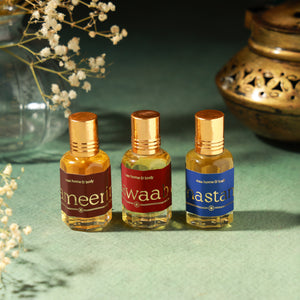
- The direct answer
- Why real sandalwood reads differently from synthetic amberwood
- The three decisions a woody-perfume lover actually needs to make
- Matching your woody craving to the right SOSA attar
- How much to put on, and how often
- What to buy first, and what to add later
- A note from Sonal
- Questions from woody-perfume lovers
2. Most designer 'woody' sprays are built on synthetic amberwood, not sandalwood. Molecules like the ones perfumers reach for to give a spray a clean, diffusive woody base are engineered for exactly that job — projection and consistency in an alcohol formula — and they smell like an idea of wood rather than the material itself.
3. Real Mysore sandalwood oil has a density synthetic amberwood doesn't attempt. It's creamy at the edges but genuinely dry at the centre, faintly milky, and it sits closer to the skin than a spray's wood accord ever does — the honest way to describe the difference is texture, not quality.
4. This isn't a case against the spray you already own. A synthetic amberwood base does its job well in an alcohol formula, and nothing here argues it's a lesser choice — it's simply solving a different problem than an oil built on the actual raw material is.
5. A 3 ml roll-on is the right-sized way to find out. ₹399 is a low-risk way to put real sandalwood on skin next to whatever spray you already reach for, rather than committing to a larger bottle on the strength of a note list alone.
If woody is the family you already trust yourself in, Nawaab is where that trust finds its most literal version — a wood you can smell as wood, not as a clever impression of one.

Why real sandalwood reads differently from synthetic amberwood
A great deal of what the perfume industry calls 'woody' today isn't built from wood at all. Synthetic amberwood molecules — the family of materials a perfumer reaches for to give a spray its dry, ambery-wood base — are chosen precisely because they're clean, stable in alcohol, and diffusive in a way few natural materials manage on their own. They do that job extremely well, which is exactly why almost every modern woody fragrance, from mass designer to niche, leans on them. None of this is a flaw in the perfume you already wear; it's simply what the format and the budget usually call for.
Real Mysore sandalwood oil is solving a different problem, because it isn't trying to project across a room — it's sitting on skin. The oil itself is dense, faintly milky, warm rather than sharp, and genuinely dry at its centre in a way that has very little sweetness hiding underneath it. Where a synthetic amberwood base tends to smell consistent from the first minute to the last, sandalwood oil moves — it warms against skin temperature, it thins and deepens over the hours, and it never quite smells the same twice on the same person. That's not an upgrade in the abstract; it's a different kind of material behaving the way natural materials behave.
Nawaab doesn't try to out-project a spray, and it shouldn't be judged as if that were the contest. What it offers instead is proximity — a wood note close enough to smell as an actual material rather than an impression of one, built around Kashmir saffron for dryness and a white royal oud that keeps the whole thing clean rather than dark. A woody-perfume lover who already knows the difference between 'ambery-wood spray' and 'the smell of a cedar box' is exactly the reader who will notice that difference fastest.
The three decisions a woody-perfume lover actually needs to make
 Nawaab₹399The honest test is whether real sandalwood reads the way you expect wood to read on your own skin — that's a ₹399 question, not a ₹1,199 one, and it should stay that size until you know the answer.
Matching your woody craving to the right SOSA attar
Not every woody taste wants the same wood. This lines up the specific craving against the attar that actually answers it, honestly, inside a four-attar range.
| If what you love is… | The attar | Why it fits | What's genuinely different from a spray |
| A dry, mineral wood with real depth | Nawaab | Mysore sandalwood and Kashmir saffron, with white royal oud keeping it clean rather than dark | The sandalwood is an actual oil, not a synthetic accord built to resemble one |
| Wood softened by rose and warm spice | Ameeri | Indian sandalwood wrapped in Taif rose and Persian saffron, with soft oudh underneath | The same sandalwood family as Nawaab, carried in a rounder, warmer register |
| Wood alongside jasmine, not saffron | Mastani | Night-blooming jasmine and Damask rose sit over oudh, for a floral-forward take on the same dark-wood family | Closer to a floral-oud reading than a purely woody one — worth knowing before buying on the word 'oudh' alone |
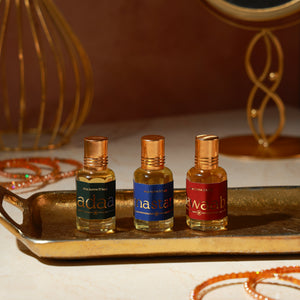
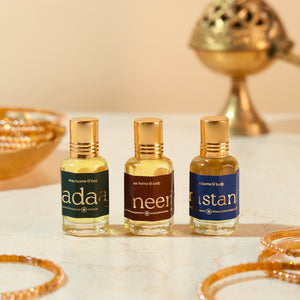
| You genuinely don't know yet which register you want | The Attar Trio | Ameeri, Nawaab and Mastani, one of each, so the comparison happens on your own skin rather than on a note list | Costs less than buying three single bottles separately, at ₹1,055 |
| A cool, citrus-forward wood — Adaa's bergamot and cardamom lean here, not into sandalwood | Worth reading as this cluster's fresh-perfume answer rather than its woody one, since its depth comes from green cardamom and jasmine sambac rather than wood at all |
Nawaab · dry, mineral, real sandalwood₹399Shop → 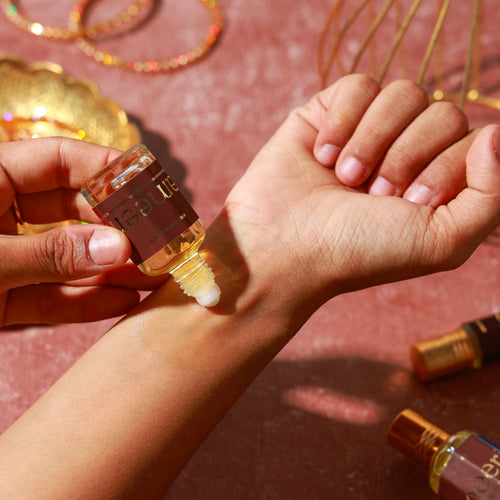 Ameeri · the same wood, warmed by rose₹385Shop →
 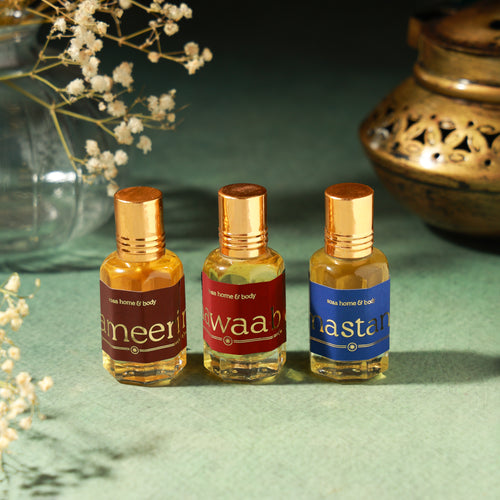 The trio · compare all three on skin₹1,055Shop →
How much to put on, and how often
Never judge Nawaab against a spray by how far it carries across a room in the first five minutes — an oil isn't trying to win that contest, and doing so misreads what the format is actually for.
Sometimes the honest move is applying it to two or three pulse points rather than one, particularly on a first wear, simply because that's how you learn where sandalwood's density actually sits on your own skin rather than on a note list.
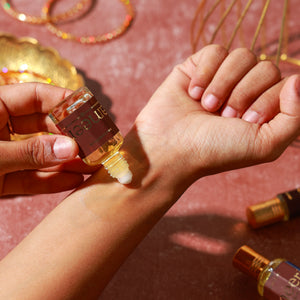
Usually, one light pass at the wrist and one at the inner elbow, from a 3 ml roll-on, is enough to spend a full day finding out whether real sandalwood is the material you thought it would be — no more is needed for a genuine first test.
What to buy first, and what to add later
Matched to how sure you already are about the register you want, and how much of the range you're ready to compare at once.
| Route | Best for | Why | What it costs |
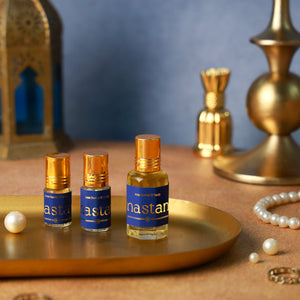
| Nawaab, 3 ml | A first, honest test of real sandalwood against a familiar synthetic-amberwood spray | Low-risk way to learn whether the material itself is what you were after | ₹399 |
| Nawaab, 6 ml or 12 ml | Once the 3 ml has confirmed the register | The same dry, mineral sandalwood-and-saffron profile, sized for daily wear rather than a trial | ₹699 / ₹1,199 |
| Ameeri, 3 ml | A woody taste that also wants rose and warmth | The same sandalwood family, carried by Taif rose and Persian saffron instead of staying dry | ₹385 |
| The Attar Trio | Genuinely undecided between a dry, a rosy and a jasmine-forward woody-oud register | Ameeri, Nawaab and Mastani in one order, cheaper than three single bottles | ₹1,055 |
| Adaa, 3 ml | Only if the 'woody' you actually love turns out to be closer to fresh bergamot and green cardamom than to sandalwood | Worth trying if Nawaab's density surprises you in the wrong direction | ₹379 |
Woody is the easiest match I make in this whole range, and I want to be honest about why: Nawaab isn't a clever reinterpretation of a woody perfume, it's simply built from the material most woody perfumes are only alluding to. When someone tells me they love woody fragrances, I don't have to bridge a gap the way I do for a vanilla or an aquatic lover — the gap barely exists.
What I do want people to understand before they buy is that real sandalwood oil is a different kind of material, not a stronger dose of the same one. It doesn't throw the way a spray does, and it shouldn't be judged against a spray's projection — it changes over hours in a way a synthetic accord, built for consistency, deliberately doesn't.
I trained to work with both worlds, synthetic and natural, and I'd never tell someone their synthetic-amberwood spray is the lesser choice — it's doing a job an oil was never built to do. What I will say is that if wood is the family you trust your own nose in, you owe it to that nose to smell the actual material at least once, and a 3 ml Nawaab is the cheapest, lowest-stakes way to do that.
Questions from woody-perfume lovers
- Which Perfume Oil Should I Try If Sandalwood Is My Favourite Perfume Note? — how Nawaab and Ameeri carry the same wood two different ways.
- I Love Dry Woody Perfumes but Hate Oud — Which Attar Would Suit Me? — the honest answer for a wood lover who's specifically wary of oud.
- Should a Woody-Perfume Lover Start With Sandalwood, Vetiver or Oud Attar? — where this range's wood sits against the broader woody-perfume map.
- Which SOSA Attar Should a Woody-Fragrance Lover Try? — this series's short, direct wrap-up for the same reader.
- Brand: the SOSA founder story.
SOSA attars & prices (verified September 2026): All four are alcohol-free roll-on attars in 3 ml, 6 ml and 12 ml. Adaa (bergamot, green cardamom, jasmine sambac, white musk) ₹379 · ₹669 · ₹1,149. Ameeri (Taif rose, Indian sandalwood, Persian saffron, soft oudh) ₹385 · ₹679 · ₹1,165. Mastani (night-blooming jasmine, Damask rose, oudh) ₹389 · ₹685 · ₹1,179. Nawaab (white royal oud, Mysore sandalwood, Kashmir saffron) ₹399 · ₹699 · ₹1,199. The Ameeri + Nawaab + Mastani trio is ₹1,055 · ₹1,859 · ₹3,189. Prices are the live store prices at the time of writing.