


What follows from it: stop buying for strength and buy for control. A device you can run during the closed hours will outperform a stronger device running all day into a ventilated room, and it will cost you less oil to do it.
The buy: Sukoon ₹1,899 — 270–320 sq ft, 500ml tank, 16–18 hours on low, three 15ml Hotel Collection scents included. It dilutes oil in water and adds humidity, which is a serious objection on the coast and a much smaller one in Pune’s drier inland air. That is a genuine, city-specific reason this page lands differently from the Mumbai ones.
The reed’s one real design limitation, stated plainly: a reed diffuser cannot be switched off. Capillary flow has no valve — as long as oil and reeds are in contact it runs, including through every hour your window is open. That is the honest argument against it for your specific day, and it is the only page in this set where I would say so.
The honest gap: if you want control and no water, the only SOSA answer is Safar ₹3,999 — named and sold as a car and travel diffuser, with no published room-coverage figure — because between it and Vaayu at 1000 m³ there is no mid-sized waterless bedroom nebuliser in the range.
2. Therefore buy control, not strength. This is the single most useful reframing on the page. A machine you run for four closed hours produces a far higher concentration in those hours than a passive source running twenty-four hours into a ventilated room, and it uses less oil doing it. Sukoon at ₹1,899 is the honest answer: 270–320 sq ft of published coverage from a 500ml tank, 16–18 hours on low, and off completely when you leave the window open.
3. In Pune, the water in an ultrasonic machine is a much smaller objection than it is on the coast. All three of ours — Boond, Sukoon, Megh — dilute the oil in water and add humidity, because the mist is water carrying fragrance. In a saturated coastal bedroom that is disqualifying. In drier inland air it is a mild side effect, which means the cheapest real room coverage in the range is open to you. Your city has genuinely changed the answer.
4. Understand what you are giving up by not choosing a reed, because it is real. A reed diffuser cannot be switched off. There is no valve on capillary flow: as long as oil and reeds are in contact, it runs, into an open window as happily as into a sealed room. That is the format’s one genuine design limitation and this page is where it bites hardest. Everything else about it — silent, no power, no charging, no filling, no schedule, roughly ₹13–₹15 a day, looks like an object rather than an appliance — remains true and remains excellent.
5. Then use the transition rather than fighting it. Shut the window and the door forty-five minutes before you want the room to feel like something, and run the machine into that closed volume. A sealed bedroom reaches a perceptible concentration far faster than an open-plan floor ever will, and the contrast with the ventilated afternoon is itself part of what you notice — you come to it un-adapted, which is most of what a hotel corridor is doing to you.
Free shipping above ₹499, and a portion of every order supports girl-child education through Nanhi Kali.

What an open window actually does to a fragranced room
Fragrance molecules do not travel through a home under their own power in any useful sense. They go where the air goes — which is a wonderful thing when the air is circulating inside a closed room and a fatal one when the air is on its way out of a window. Every source in this cluster, passive or powered, is adding molecules to a volume of air. What decides whether you perceive them is not how many are added but how many are present at once, and the second number is governed by how often the room replaces its air. That is why the same diffuser is unremarkable at three in the afternoon and obvious at nine at night.
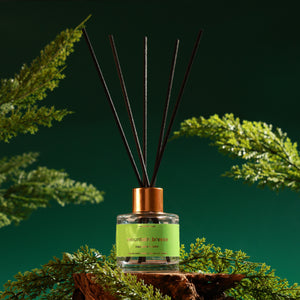
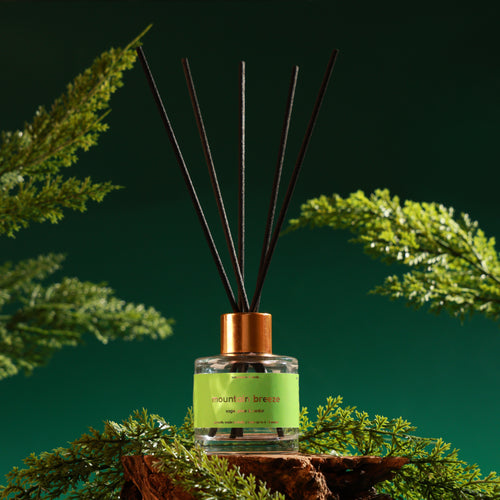
 Mountain Breeze₹849A home with the windows open all day is not a home-fragrance environment during those hours. It becomes one the moment they close. That sentence sounds like a criticism and it is not — cross-ventilation is a good way to live in Pune, and I would not ask anybody to seal a bedroom for the sake of a diffuser. It simply means the money is best spent on the other part of the day. Nothing you can buy competes with a breeze, because the breeze is not diluting the fragrance, it is removing it. And note that height matters here in a way people rarely consider: wind speed increases with elevation, so a high-floor balcony door is a far more aggressive exchange than a second-floor window, and the same setup will behave quite differently in two flats in the same building.
 Sukoon₹1,899Two separate advantages, and both are real. First, drier air carries fragrance molecules more readily than saturated air does, so once the room is closed, what you release actually travels — projection is longer here than on the coast and the composition keeps its shape rather than sitting heavy and close. Second, and more usefully for the purchase decision: the standard objection to ultrasonic diffusers is that they add moisture, and that objection is far weaker inland. On a Mumbai page I spend three paragraphs ruling the entire ultrasonic category out. Here I am recommending it, for the same physical reason, applied to different air.
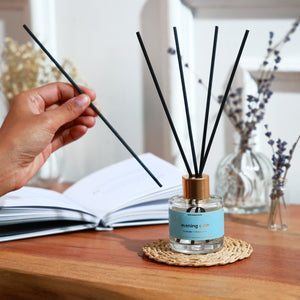
 Evening Calm₹799A reed diffuser holds nothing back. Every millilitre in the bottle leaves through the reeds into the room, which is a point in its favour — there is no reservoir being withheld from you and nothing degrading unused. But it means the only real waste in a passive diffuser is oil evaporating into a room nobody is in, or into air that is leaving, and your open-window afternoon is precisely that situation for six or eight hours a day. This is not an argument that reeds are bad. It is an argument that a reed belongs in the rooms of your flat that stay closed, and that the bedroom you ventilate wants something with a switch.
Buying for the closed hours, in practice
The practical version of everything above is a small routine rather than a bigger product. Close the window and the door about forty-five minutes before you want the room to feel like something — before you come up for the evening, before guests arrive, before you go to bed. Run the machine into that sealed volume. A closed bedroom reaches a perceptible concentration far faster than an open-plan floor, because the volume is small and the air is not being replaced, and that is the one respect in which your bedroom beats a hotel lobby outright: a lobby needs a commercial machine to hold a level in an enormous volume with doors opening constantly, and you need almost nothing to hold a level in a shut room.
The second half of the routine is about your nose rather than the room. You will have spent the afternoon in ventilated air, which means you arrive at the closed room un-adapted, and un-adaptation is a large part of what people are actually describing when they talk about the hotel effect. Olfactory receptors stop reporting an unchanging stimulus within minutes, which is why you cannot smell your own home and can smell everybody else’s. Your open-window day, irritating as it is for building concentration, is quietly giving you the best possible conditions for noticing the room when you return to it. That is worth arranging deliberately rather than resenting.
And one caution about how not to solve this. The instinct when a room feels weak is to raise the dose — more reeds, a higher setting, a second device. In a room being ventilated that mostly raises your oil consumption, and in the closed hours it produces a concentration high enough to flatten the composition into a single sharp or sweet impression, which is what people mean when they say something smells like an air freshener. The same oil at a lower dose reads as layered because the nose has room to resolve the separate materials. Control beats volume here in both directions: it gives you more when the room is shut and nothing when it is open.
| Option | Mechanism | Can it be switched off? | Published coverage | Water and humidity | Price |
|---|---|---|---|---|---|
| Reed diffuser | Passive capillary, six fibre reeds | No. Capillary flow has no valve — the reed’s one real design limitation | 50ml up to ~150 sq ft, 130ml above — as a zone, not a filled room | None. Adds nothing but fragrance | ₹749–₹849 |
| Boond | Ultrasonic water mist | Yes, on/off over USB | Up to ~150 sq ft, 300ml, about 6 hours | Adds humidity — a small objection in Pune | ₹899 |
| Sukoon ★ | Ultrasonic water mist, three 15ml Hotel Collection scents included | Yes — on demand, 16–18 hours on low when you want it | 270–320 sq ft from a 500ml tank — the only figure in the range that matches a real bedroom | Adds humidity, dilutes oil in water, needs filling | ₹1,899 |
| Megh | Ultrasonic water mist, six-litre tank | Yes, and it will run about 100 hours unattended | Only ~215 sq ft — less than Sukoon. Never a coverage upgrade | The most humidity of anything we make | ₹3,499 |
| Safar | Waterless cold-air nebulising, undiluted oil | Yes — 3 speeds and a 1, 2 or 3-hour auto-off, cordless on 2000 mAh Type-C | None published. Personal and small-space scenting; named and sold as a car and travel diffuser | None at all | ₹3,999 |
| Vaayu | Waterless cold-air nebulising, 400ml tank | Yes, app scheduling with 1h/4h/8h/24h windows | Up to 1000 m³, roughly 2,000–3,000 sq ft — wrong for one bedroom | None | ₹11,999 |
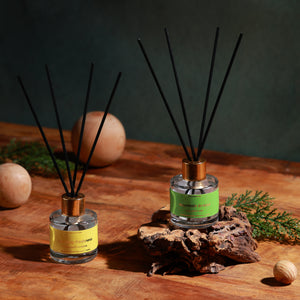
On demand · Sukoon₹1,899Shop →  The oils · Hotel Collection₹999Shop →
 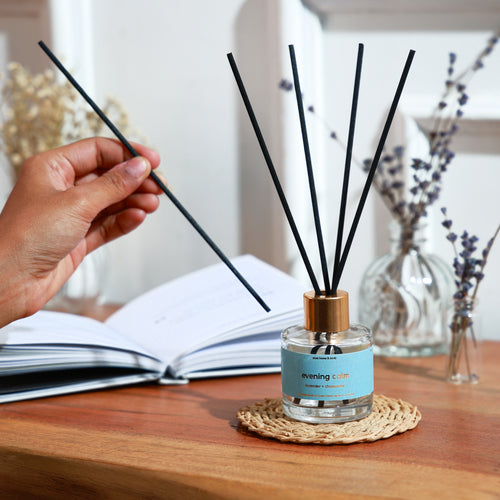 For a closed room · Evening Calm₹799Shop →
Where the reed still belongs in your flat, and it is not nowhere
I have been harder on the reed on this page than on any other in the city set, and it is worth being precise about why, because the criticism is narrow. The only thing a reed cannot do for you is stop. Everything else it does better than any machine on this page: it is silent — not quiet, silent, with no pump, no piezo hum, no fan and no click when a timer fires. It needs no power point, no charging cable, no tank and no schedule. It never surges and never cycles, so within its zone it produces the steadiest output of any format there is. It costs roughly ₹13–₹15 a day. And it looks like a glass bottle with sticks in it rather than a small appliance with a light on it, which matters in a bedroom.
So put one where the door stays shut. Most Pune flats have at least one room that is not being cross-ventilated all day — a study, a guest room, a bathroom, the landing. A bathroom in particular is one of the best-value placements we know of, though for the opposite reason to the one people assume: it is small, so two or three reeds in 50 sq ft can make a 50ml bottle last close to three months. That is efficiency, not deodorising, and I should say plainly that no fragrance removes an odour — the order is always source, then ventilation, then fragrance.
If you would rather have one product than two, and you want it in the bedroom, the reed can still work provided you accept what you are buying: a fragrant zone within about a metre and a half of the bottle during the closed hours, and effectively nothing while the window is open. Use all six fibre reeds for full projection, flip them every three to five days, and keep the bottle out of the direct draught from the window, which will strip it faster without giving you anything in return. Choose a composition with some structure to it rather than a fragile citrus if it is going to be sitting in moving air — Mountain Breeze at 9.4 or Fresh Brew at 9.5 hold their shape better in a ventilated room than something built on light top notes.
What to buy for an open-window bedroom — and the gap
Free first, then the machine that can be switched off, then the waterless option for anybody who wants control without moisture. The last row names the hole in our range, which on this page affects only the readers who want both control and no water at all.
| Step | What it is | When it is the right answer | Price |
|---|---|---|---|
| 1. Close the window and door 45 minutes before you want the room ★ | A sealed bedroom reaches a perceptible concentration far faster than a ventilated one, and you arrive at it un-adapted | Always first, and it settles this question for a surprising number of people. Free | ₹0 |
| 2. Sukoon ★ | 270–320 sq ft, 500ml tank, 16–18 hours on low, three 15ml Hotel Collection scents included, and an off switch | The recommendation for a Pune bedroom. Water and added humidity are a far smaller objection in drier inland air than on the coast | ₹1,899 |
| 3. Boond | 300ml, up to ~150 sq ft, about 6 hours, USB, night light | If the bedroom is genuinely small and you want the cheapest machine with a switch | ₹899 |
| 4. A reed, in a room that stays shut | 50ml up to ~150 sq ft lasting 6–8 weeks, six fibre reeds, flipped every 3–5 days, about ₹13–₹15 a day | Study, guest room, bathroom, landing — anywhere the air is not being replaced all day. Silent, unpowered, no maintenance | ₹749–₹1,349 |
| 5. Safar | Undiluted oil, waterless, cordless on 2000 mAh Type-C, 3 speeds, 1/2/3-hour auto-off, 20ml bottle, 6.9 cm | If you want control and refuse water. Named and sold as a car and travel diffuser; no published room coverage | ₹3,999 |
| The honest gap | A mid-sized waterless nebuliser built for one bedroom — which SOSA does not make. Safar has no published room coverage; Vaayu at ₹11,999 is rated to 2,000–3,000 sq ft and is the wrong purchase for one room. Megh at ₹3,499 covers less than the ₹1,899 Sukoon | Stated plainly, because a reader who wants both control and no water has nowhere good to go in this range | — |
Versailles
Everything SOSA makes is composed in Pune, so I have spent a great many working days in exactly the conditions you are describing: windows open, air moving through the flat, and the reasonable expectation that a fragrance should still register. It will not, during those hours, and I would rather tell you that than sell you something stronger to test the theory.
What surprises people is how good the other half of the day is here. Once a Pune bedroom is shut, the drier air carries fragrance further than coastal air does, so the same bottle that feels close and heavy in a Mumbai flat opens out. You do not need much. What you need is a switch, and that is the whole reason Sukoon at ₹1,899 is my answer here when it is not my answer on the pages about coastal humidity. Same machine, same water, different air, different verdict. If a page tells you the city matters and then recommends the same product everywhere, the city did not matter.
I will also say the thing that is inconvenient for us. A reed diffuser cannot be turned off, and for six or eight hours a day your bedroom is effectively outdoors. That is our best-selling product and it is the wrong shape for this one room in your flat — though it is the right shape for the study, the guest room and the bathroom, where nobody is opening anything. Everything is composed here in Pune, and part of every order funds a girl’s classroom through Nanhi Kali.
Frequently asked questions
- A Mumbai bedroom without a humidifier — where the water objection is disqualifying rather than mild.
- A small Mumbai apartment — small volume as an advantage.
- A Pune 2BHK at the end of the day — same city, and the constraint is arrival rather than ventilation.
- A Bengaluru work-from-home bedroom — ten occupied hours, and why the answer is less.
- A closed AC bedroom in Gurgaon — the exact opposite of your room, and the easiest in the series.
- Delhi without candles or incense — what the exclusions leave.
- Humid Chennai: passive or active? — why saturated air argues for moved air.
- Hyderabad, large open living spaces — the one city page where Vaayu is right.
- A humid Kolkata flat — ventilation and damp before mechanism.
- Brand: the SOSA founder story.
Facts verified August 2026: Passive capillary — SOSA reed diffusers, five scents, 50ml ₹749–₹849 for rooms up to ~150 sq ft lasting 6–8 weeks, 130ml ₹1,249–₹1,349 above 150 sq ft lasting 14–18 weeks, six fibre reeds included (six for full projection, three for a soft bedside level and roughly double the life), flipped every 3–5 days, about ₹13–₹15 a day, heat-stable CCT carrier, alcohol-free, phthalate-free, paraben-free, IFRA-compliant, 0 ppm formaldehyde, refillable glass, tested at 45°C and 85% RH, composed in Pune; strength scale Evening Calm 8.9, Garden Bloom 8.9, Morning Freshness 9.0, Mountain Breeze 9.4, Fresh Brew 9.5; duos from ₹1,498; refills 300ml ₹2,399 and 500ml ₹3,499, oil only and never a first purchase. Ultrasonic water mist — Boond ₹899 (300ml, up to ~150 sq ft, ~6 hours, USB, night light), Sukoon ₹1,899 (500ml, 270–320 sq ft, 16–18 hours on low, three 15ml Hotel Collection scents included), Megh ₹3,499 (6L tank, ~100 hours, ~215 sq ft — less than Sukoon, and never a coverage upgrade); all three dilute oil in water and add humidity. Waterless cold-air nebulising — Safar ₹3,999 (20ml bottle, 2000 mAh Type-C, up to 10 hours continuous or around 30 hours intermittent per charge, 3 speeds, 1/2/3-hour auto-off, 6.9 cm, named and sold as a car and travel diffuser with bedside and hotel room among its stated uses, no published room-coverage figure) and Vaayu ₹11,999 (up to 1000 m³ or roughly 2,000–3,000 sq ft, 400ml tank lasting up to about 90+ days, Bluetooth app plus onboard buttons, 1h/4h/8h/24h run windows, choice of days, adjustable intensity, key-lock, under 38 dB, freestanding or wall/HVAC mount, 5W, CE, RoHS, SGS). Between Safar and Vaayu there is no mid-sized waterless bedroom nebuliser in the SOSA range. Hotel Collection oils are water-based and ultrasonic-only — 15ml ₹299 (a refill), 100ml ₹999, 300ml ₹1,799, pack of 7 ₹1,799 — and cannot be used in reed diffusers or waterless nebulisers, nor reed oil in ultrasonic machines; there is no hotel-inspired reed diffuser. No health, air-quality, allergy or antimicrobial claims are made, and fragrance does not remove a smell: source, ventilation, then fragrance. Free shipping above ₹499. A portion of every order supports girl-child education through Nanhi Kali. SOSA is an independent Indian fragrance house; the Hotel Collection scents referenced here are SOSA’s own interpretations inspired by the world’s finest hotels, and SOSA is not affiliated with, endorsed by or a supplier to any hotel brand. Prices subject to change — see the live product pages.