
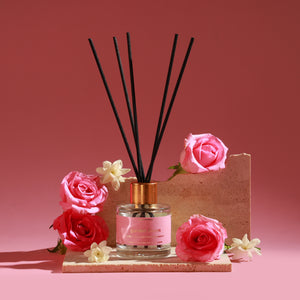



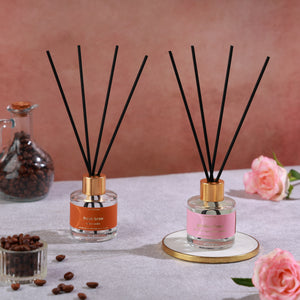
The stratification: warm air rises and carries fragrance vapour upward, so the most concentrated layer in a tall room sits near the ceiling, well above nose height.
The fix: more evaporating surface, placed lower and in more than one location — full six reeds, at seated height, in two spots rather than one.
2. Because warm air rises, and takes the fragrance with it. Room air is never uniform. Warmer air is less dense and rises, and evaporating fragrance vapour travels with it. In a normal-height room this hardly matters, because there is not far to go and everything mixes. In a tall room the warmest, most scented layer collects against the ceiling and sits there. Your fragrance is not gone; it is above your head. This is why standing on a stool in a high-ceilinged hall sometimes reveals a scent you could not detect from the sofa.
3. Because old buildings with high ceilings usually leak. The two go together. Buildings designed with tall rooms were designed for air movement: door ventilators, tall timber windows, deep sills, generous shutters. Even shut, they exchange air with the outside far more freely than a modern gasketed flat. That higher background air-change rate is comfortable and healthy, and it also carries your fragrance away steadily.
4. So the effective coverage of any diffuser drops. A six-reed SOSA reed diffuser is rated for a room up to roughly 150 sq ft, and that figure assumes a normal ceiling and a normally sealed room. In a 150 sq ft room with a 12 ft ceiling and old timber windows, treat that as covering meaningfully less. This is not a defect in the product; it is the same product in twice the physics.
5. And the answer is surface and position, not strength. A reed diffuser has exactly one output control: how much reed surface is exposed to the air. Six reeds instead of four is a fifty per cent increase in evaporating surface and it costs nothing. Two bottles at opposite ends of a long room beat one bottle in the middle, because you are creating two zones of usable concentration rather than one that fails at the edges. And putting the bottle at nose height rather than on a high shelf puts the scent where a person is.
Made in India, composed by an ISIPCA Versailles-trained perfumer — and a portion of every order supports girl-child education through Nanhi Kali.
Why square feet is the wrong unit for fragrance
Square feet became the standard unit for diffuser coverage for a practical reason: everyone knows the area of their flat and almost nobody knows its volume. It works well enough because most modern housing is built to a fairly consistent floor-to-ceiling height, so area is a reliable proxy for volume. The moment your ceiling is unusual, the proxy breaks. Older buildings — 1930s to 1970s apartment blocks, converted bungalows, homes with clerestory windows, anything with a mezzanine or a double-height living area — are exactly the case where the shortcut fails, and they are also the homes where people most often conclude that home fragrance simply does not work for them.
The second half of the explanation is that concentration in a room is not a fixed pool but a balance. The reeds add molecules at a steady rate set by evaporation. The room removes them at a rate set by air exchange, by adsorption onto surfaces and fabric, and by simple dispersal into whatever volume is available. What you smell is the level where those two rates meet. A tall old room raises the removal side twice — more volume to disperse into, and more air leakage to carry it out — while leaving the supply side exactly where it was. Understanding it as a balance rather than a quantity is also what tells you the useful fix: you cannot make a bottle stronger, but you can add more evaporating surface, and you can stop trying to fill the whole volume and instead build a usable concentration in the part of it where people actually are.
Volume, height and leakage — the three losses
 Six reeds130ml ₹1,249Work out your actual volume once and the whole question resolves. Measure the room, measure floor to ceiling, multiply. A 12 by 14 ft living room at 9 ft is about 1,500 cubic feet; the same room at 12 ft 6 in is over 2,000. If a bottle at six reeds gives you a satisfying level in the first, it will read noticeably thinner in the second, and no amount of reed-flipping changes that. The honest answer in a large tall room is more than one source. Two 50ml bottles at ₹749 in different corners of a long room will out-perform a single 130ml sitting in the middle of it, even though the single bottle holds more liquid — because coverage is about where the surface is, not how much is in reserve.
Symptom to cause in a tall room
High ceilings explain a lot of "the fragrance is too weak" complaints, but not all of them. Work through the rows and confirm before you spend anything.
| What you notice | Most likely cause | How to confirm it | What actually fixes it |
|---|---|---|---|
| Strong at the bottle, nothing three steps away ★ | Volume — the room is too large a body of air for one source | Measure length × width × ceiling height and compare with about 1,350 cubic feet | All six reeds, and a second bottle at the other end of the room |
| Noticeable when standing, absent when seated | Vertical stratification — warm air carrying vapour to the ceiling | Stand on a stool in the middle of the room and compare with sofa height | Move the bottle down to a console or side table, near where people sit |
| Fine in the bedroom, invisible in the hall of the same flat | Different volumes and different door habits, not a different bottle | Swap the two bottles for a week and see if the effect follows the room | Dose per room: four reeds in a closed bedroom, six plus a second point in the hall |
| Scent lasts an hour after flipping the reeds, then fades | A flip gives a burst; steady state is set by evaporating surface, not by agitation | Note the time from a flip to the fade — a short peak means you are chasing it | Stop flipping often. Add reed surface or a second bottle instead |
| Bottle empties normally but the room never smells of it | Reeds clogged, or the flat is leaking air faster than the source can charge it | Look at the exposed reed length — dull, sticky or dark means spent | Replace the reeds; close the ventilated route between the room and the stair |
| Persistent musty or earthy note under everything, in an old block | Damp in the structure — a building matter, not a fragrance one | Torch the base of external walls and the ceiling corners for tide lines or growth | Find the moisture, repair it, remove any growth. Adding scent here achieves nothing. |
| If none of these fit: measure the volume before buying anything else. Most people who conclude that home fragrance "does not work" in an old flat are running a single four-reed bottle in something close to two thousand cubic feet of leaky air. | |||
Reeds · always-on roomsFrom ₹749Shop →  Sukoon · when you want a switch₹1,899Shop →
  Hotel Collection · the scentFrom ₹299Shop →
How to dose a tall room
Start by using everything the box gives you. Six fibre reeds come with every bottle, and a tall room is precisely where all six belong. Four reeds is a bedroom setting for a normal-height, normally-sealed room; using four in a 12 ft-ceilinged hall and concluding the product is weak is a very common and completely avoidable mistake. Beyond that, reed count has a ceiling of its own — you cannot get more than six reeds' worth of surface out of one bottle neck. Once you are at six and still want more, the next step is a second source, not a longer flipping routine.
Then place for people rather than for symmetry. A tall room is not one uniform space; it is a set of zones with a large empty volume above them. Scent the zones. In a long living room that means one bottle near the seating and one near the entrance to the room, at side-table height, on internal walls, away from windows and out of any draught line. In a big hall with a dining area, one at the console by the door and one on the sideboard. The goal is that a person crossing the room passes through two pockets of usable concentration rather than standing in one thin average. Two 50ml bottles at ₹749 in the right two places genuinely outperform a single 130ml in the wrong one.
Then consider whether the machine is the better tool for the biggest room. Reeds are passive: output is capped by evaporation from a fixed surface, which is why very large volumes defeat them. The Sukoon at ₹1,899 is active — it disperses a water-based fragrance as a cool mist and covers roughly 270 to 320 sq ft, with 3 to 6 drops of the Hotel Collection from ₹299 per tank. In a tall old living room, running it for forty minutes before people arrive puts far more fragrance into the air than any passive source can, and then you switch it off. My usual recommendation for a large old flat is both: reeds holding a permanent low background in the entrance, the passage and the bedroom, and the Sukoon doing the heavy lifting in the one big room when it matters. Do not put reed oil in the machine — the two liquids are not interchangeable.
The order that works
The free steps still come first even here, because a tall room that smells closed is not a dosage problem. Once it is neutral, dose for volume rather than for floor area.
| Step | What to do | When | Cost |
|---|---|---|---|
| 1. Remove the source | Deal with any source first — old built-in storage, damp at wall bases, wet traps in a rarely-used bathroom | Before anything else | ₹0 |
| 2. Move the air | Use the ventilators and tall windows the building gave you; ten minutes of genuine cross-flow, twice a day | Daily, five to ten minutes | ₹0 |
| 3. Deal with what holds it | Wash and air the large textiles — curtains in a tall room are enormous and are rarely cleaned | Weekly to monthly | ₹0 |
| 4. Then the always-on layer ★ | A SOSA reed diffuser — a permanent background: all six reeds, at seated height, and two points in any room over ~1,800 cubic feet | 50ml 6-8 weeks · 130ml 14-18 | from ₹749 |
| 5. Or the on-demand layer | Sukoon with a Hotel Collection scent — the heavy lifting in a big tall living room — run it forty minutes before people arrive, then switch it off | Run it when you want it | ₹1,899 |
Versailles
This is the question I most often get wrong-footed by, because the person asking it usually assumes the fragrance is at fault and I have to explain that their ceiling is. Coverage in square feet is a convenient lie that everyone in this industry tells, including me — it is on my own packaging. It is accurate for the flats most people live in and it quietly stops being accurate the moment the ceiling goes over about ten feet. If you live in an old building with tall rooms, mentally reduce every coverage figure you read, from any brand.
What I would not do is sell you a bigger bottle as the answer, because bottle size is a supply of liquid, not a rate of delivery. A 130ml and a 50ml with six reeds each evaporate at the same rate in the same room; the 130ml simply runs for longer. If your room is under-scented, more liquid in one bottle changes nothing about how it smells today. What changes it is more evaporating surface in more places, or an active machine. Buy the 130ml because you would rather reorder every four months than every two, which is a perfectly good reason.
And I would gently argue against fighting the room. Tall old rooms are wonderful and part of what makes them wonderful is that they are airy — the same property that dilutes your diffuser. Rather than trying to fill thousands of cubic feet evenly, build two or three good pockets: the entrance, where the first impression happens; the seating area, where people spend hours; the bedroom, where the door is shut anyway. That is how hotels do it in high lobbies too, and it reads as intentional rather than as a struggle. A portion of every order funds a girl's classroom through Nanhi Kali.
Frequently asked questions
- Same diffuser, strong in one room, weak in another — volume, airflow and placement.
- Old flat versus new flat — why the materials change the smell.
- Old large flat vs modern compact high-rise — two different strategies.
- Does strong cross-ventilation weaken a reed diffuser? — the honest answer, and the placement fix.
- Brand: the SOSA founder story.
SOSA products & prices (verified August 2026): Hotel Collection water-based ultrasonic diffuser fragrance 15ml ₹299 · 100ml ₹999 · 300ml ₹1,799 · Pack of 7 (15ml, all fragrances) ₹1,799; refills 100ml from ₹999. Seven scents: The Ritz-Carlton-inspired (white tea · bergamot · cedar), Westin-inspired (white tea · aloe · cedar), 1 Hotels-inspired (cedarwood · vetiver · green leaves), The St. Regis-inspired (amber · violet · woods), Shangri-La-inspired (jasmine · green tea · white tea), Four Seasons-inspired (citrus · floral · sandalwood), W Hotels-inspired (citrus · pepper · amber). Diffusers: Boond 300ml ₹899 · Sukoon 500ml ₹1,899 · Megh 6L ₹3,499. Water-based, phthalate-free, composed to IFRA standards for home diffusion; 3–6 drops per tank. Made in India, Pune. The Hotel Collection scents are SOSA's own interpretations inspired by the world's finest hotels; all hotel names are trademarks of their respective owners and are used only to describe the scent style — SOSA is an independent Indian fragrance house, not affiliated with or endorsed by any hotel brand. Prices and availability subject to change — see the live product pages.