
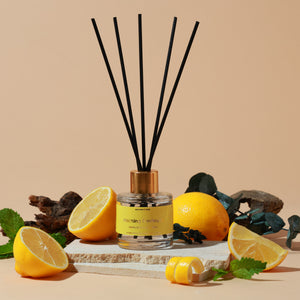
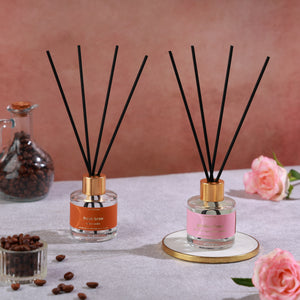
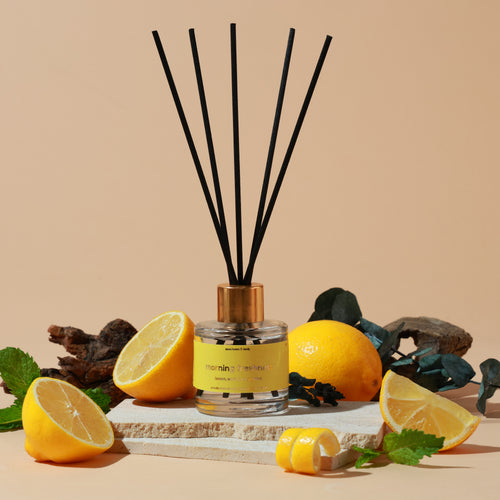
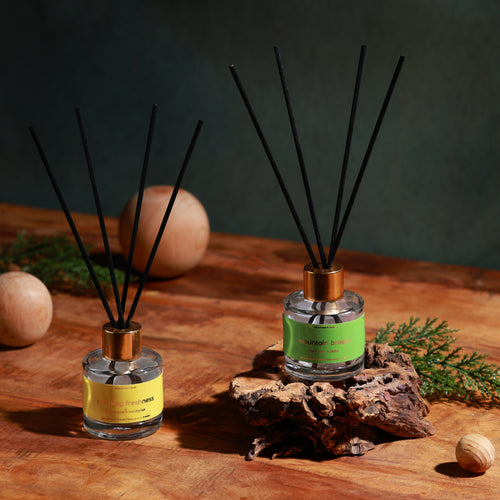
The fragrance, once drying is faster: Morning Freshness ₹749 for 50ml — cold-pressed Malabar lemon, peppermint, eucalyptus globulus. Bright citrus is the register that reads as dry air against a heavy monsoon room.
Where it goes: the living room you actually sit in, not beside the drying rack. Fragrance next to wet fabric is the fastest way to make a room smell of both.
The honest gap: SOSA sells nothing that removes moisture from your air, and no reed in this range is a "fresh laundry" or clean-linen accord. If the smell in your head is line-dried cotton, none of our five scents is it, and I would rather say so on the first screen.
2. Space the clothes before you do anything else. Garments touching each other dry at the speed of the slowest, wettest one. A rack loaded so that air cannot pass between the items is the single commonest reason a load takes two days instead of one. Fewer things on the rack, drying in two batches, beats one dense rack every time.
3. Put a fan on the rack, not on the room. This is the highest-value thing in this entire article and it costs nothing you do not already own. Moving air across wet fabric is what actually removes water from it. A ceiling fan on low above the rack, or a table fan pointed along the line of clothes, changes drying time in a way no fragrance decision can.
4. Separate the drying from the sitting. Dry in one place, close the door on it if you can, and open whatever is openable there — even in rain, a small opening on the sheltered side moves more air than a sealed room does. The room you occupy should not be the room the water is evaporating into.
5. Only now, fragrance — and in the living room, not at the rack. Morning Freshness at ₹749 is where I would start: cold-pressed Malabar lemon over peppermint on a eucalyptus globulus base, which is bright enough to read as dry air in a heavy room. Three reeds first, six only if the room genuinely swallows it.
Alcohol-free, phthalate-free, IFRA-compliant, composed in Pune. A portion of every order supports girl-child education through Nanhi Kali.
The three steps, in the order they actually work
Almost every article you will find on this subject starts at the end. It suggests a scent, then mentions ventilation as an afterthought, and the reader tries the scent first because that is the part you can buy. I would rather run it the right way round, because the first two steps are free and they do most of the work, and because a reader who is told the truth about the laundry has some reason to believe what I say afterwards about the diffuser.
 Morning Freshness₹749Adding a pleasant smell to an unpleasant one produces a mixture, not a cancellation, and the mixture is frequently worse than either, because the brain now has two things to track instead of one. That is not modesty about our own product; it is how the nose works. So a reed diffuser is not the answer to damp. It is the answer to a room that is already drying properly and still feels like the inside of a monsoon — grey, closed, a bit heavy. Morning Freshness gives that room a bright, dry-reading top note at nose height, continuously, with no switch and nothing to fill. It changes how the room feels. It does not change how much water is in it.
Why a Mumbai flat is the hard case, and what changes about the fragrance
Every city dries laundry indoors during rain. Mumbai is the difficult version because the outside air is already close to saturated, which removes the escape route the rest of the sequence depends on. In a dry-season Delhi flat, opening a window genuinely takes moisture away with the air. In a Mumbai July, the air arriving through that window is carrying a great deal of water of its own, so ventilation is doing less of the drying and air movement across the fabric is doing correspondingly more. That is precisely why I keep pushing the fan rather than the window. The window is not useless — exchanging air still helps, and it matters for the odour as much as the moisture — but the fan is the lever with the most travel in it.
The same saturation changes the fragrance behaviour, and this is worth knowing before you decide the diffuser is faulty. Saturated air carries fragrance molecules less readily, so projection shortens and the scent hangs closer to the bottle than it did in a dry month. People read this as weakness and add reeds. The better move is to move the bottle into the room's natural airflow path — near a doorway rather than in a far corner — so the room's own circulation distributes it. In monsoon, relocation beats dosage almost every time, and it is free.
There is one more monsoon-specific detail on our side of the equation. Reed diffusers are largely designed in and for European climates, and most of them ship with rattan reeds — a natural cane with irregular internal channels that wicks unevenly in high humidity and tends to go dry-sticked at one end. Every SOSA bottle ships with six fibre reeds instead, which are more porous and more consistent, and the reason that decision exists at all is the Indian monsoon rather than anything more glamorous. The oil sits on a heat-stable CCT carrier rather than DPG, and the range is tested through a 45°C heat soak and 85% relative humidity, which is the condition this page is actually about.
| Step | What it changes | What it does not do | Cost |
|---|---|---|---|
| 1. Space and batch the clothes | Cuts drying time sharply — the wettest fold stops setting the pace for the whole rack | Nothing about the air already in the room | Free |
| 2. Fan aimed along the rack | Continuously replaces the saturated air against each garment; the single largest lever here | Does not remove moisture from the flat, only from the fabric | Free, if you own a fan |
| 3. Close the drying room, open what it has | Stops the water load reaching the room you sit in, and exchanges some of it outward | Less effective in saturated monsoon air than in a dry month — say so honestly | Free |
| 4. Reed diffuser in the living room | Gives the room you occupy a continuous bright top note at nose height, with no switch and no filling | Removes nothing. Layered over damp it produces scented damp | ₹749–₹1,349 |
| An ultrasonic machine in a damp flat | Fast, controllable, fills a room in minutes when the room is dry | Adds water vapour to the air — which in this specific situation is an argument against it | ₹899–₹1,899 |
Bright · Morning Freshness₹749Shop → 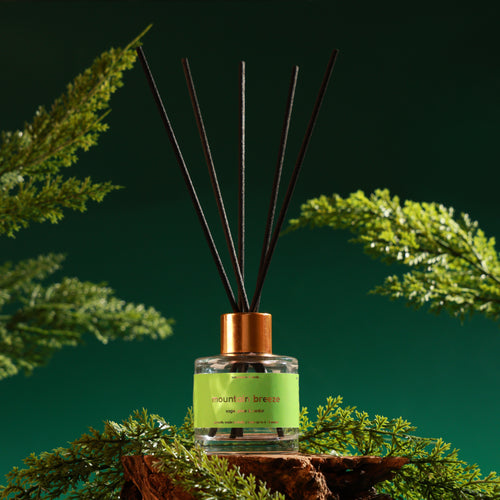 Dry green · Mountain Breeze₹849Shop →
 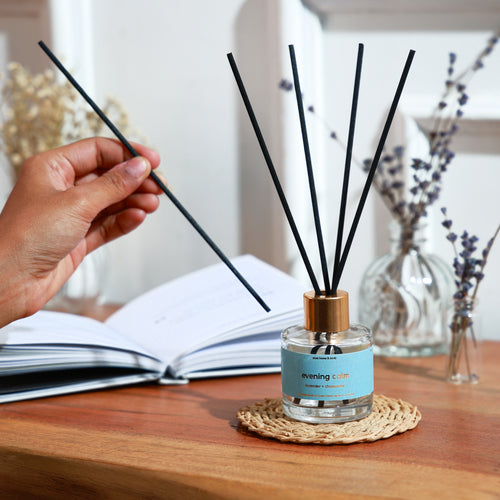 Soft · Evening Calm₹799Shop →
Where the diffuser goes in a damp flat, and how much of it to use
Not beside the drying rack. I say that first because it is the instinct, and it is the one placement guaranteed to disappoint: a reed sitting in the wettest air in the flat is both wasting its projection into a room nobody is sitting in and putting a citrus layer directly on top of the exact note you are trying to get away from. Fragrance the rooms you occupy, not the room the problem lives in. The living room, at or slightly below nose height, out of the direct draught of the fan but somewhere the room's air genuinely travels — a console near a doorway is usually better than a corner shelf, and in monsoon that difference is larger than usual.
Then dose. In this family I would start every reader at three reeds rather than six, and the reason is physical rather than aesthetic. Heavy, humid air keeps a fragrance close to the bottle and close to you, so the same 50ml that reads as pleasant in a dry February can read as thick in an August living room. Three reeds gives a soft, background level and roughly doubles how long the bottle lasts; six is full projection and belongs in a large open-plan room. If somebody in your home describes the diffuser as cloying, they are almost always describing a dose rather than a composition, and the fix is to pull two reeds out and wait a day. It costs nothing and it is the adjustment nearly nobody makes before deciding they dislike a scent.
One more thing that sounds like a technicality and is not. You will stop noticing your own diffuser within minutes of being in the room — olfactory receptors adapt to an unchanging stimulus very quickly, which is why you can smell every other house but your own. During monsoon this produces a specific false conclusion: the flat smells damp when you walk in from outside, you assume the diffuser has stopped working, and you buy a stronger one. What has actually happened is that you are un-adapted on arrival and reading the room accurately for about ninety seconds. The damp you smell at the door is real and is telling you about drying time. The diffuser you cannot smell after five minutes is working normally.
What to buy, in what order — and the two things I would not buy
If your drying is still slow, buy nothing from this page yet. Sort the rack and the fan, live with it for a week, and come back. If the load is drying overnight and the flat still feels closed and grey in the evening, that is a genuine fragrance situation and the list below is how I would spend on it. The last row is the honest gap, and on this family it matters more than usual, because the smell many people are chasing when they dry indoors is line-dried cotton — and we do not make it.
| Buy | What it is | When it is the right answer | Price |
|---|---|---|---|
| 1. Morning Freshness 50ml ★ | Malabar lemon, peppermint, eucalyptus globulus — bright, 9.0 | The living room, once drying is sorted. Three reeds to start | ₹749 |
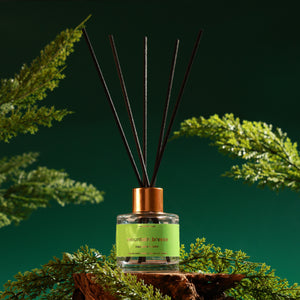
| 2. Mountain Breeze 50ml | Himalayan pine, sage, Indian cedar — dry and resinous, 9.4 | If citrus reads as too sharp to you, or for a study where you want the room to feel drier rather than brighter | ₹849 |
| 3. Morning Freshness 130ml | The same composition sized for above 150 sq ft, 14–18 weeks | An open-plan living-and-dining end, which is most Mumbai flats above 700 sq ft | ₹1,249 |
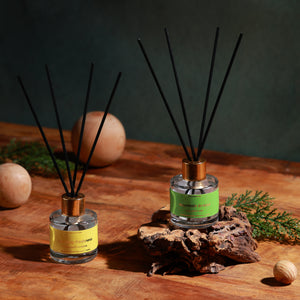
| 4. Fresh & Grounded duo | Bright plus dry green, two 50ml bottles | If you are treating a flat rather than a room — citrus in the living room, cedar in the bedroom | ₹1,548 |
| Not this: Fresh Brew or a candle at the rack | Fresh Brew is our warmest gourmand at 9.5 and stacks onto heavy air rather than contrasting with it. And a lit candle near drying fabric is not advice we give — fragrance oil is flammable and wet clothes move in a draught | Named so you do not find out the expensive way | — |
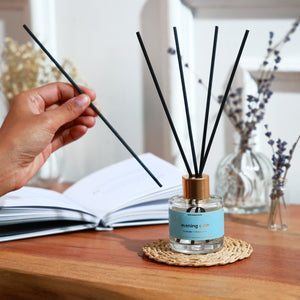
| The honest gap: no clean-linen reed, and nothing that removes moisture | There is no "fresh laundry", cotton or aquatic accord in the SOSA reed line, and SOSA sells no dehumidifier, air purifier or odour eliminator | If line-dried cotton is the smell you want, none of the five is it. The nearest honest answers are Morning Freshness for brightness and Evening Calm for soft clean skin | ₹749 / ₹799 |
Versailles
This is the question I am least comfortable answering commercially, because the honest answer begins with a fan and ends with us. Somebody writes in July saying the flat smells closed and the clothes are on a rack in the hall, and the useful reply is not a scent recommendation. It is: move the rack, space the clothes, point a fan at them. If I skip that and go straight to a bottle, the bottle underperforms, and quite rightly.
What I do know something about is the second half. A monsoon room is heavy — the air is carrying water, fragrance does not travel as far, and everything reads warmer and closer than it does in January. That is why I steer people towards Morning Freshness in these months rather than anything sweet. And it is why the eucalyptus base under that lemon matters: a plain citrus reed would be lovely for a fortnight and finished long before the rain is, and a fragrance you have to replace three times in one wet season is not a solution to anything.
The dose is the last thing, and the thing I would most like people to take away. Three reeds, not six, for the first week. Heavy air makes everything read stronger, and I would rather you found the bottle a little quiet and added a reed than found it thick and decided you disliked the fragrance. Everything is composed in Pune, and a part of every order funds a girl's classroom through Nanhi Kali.
Frequently asked questions
- Why the house smells damp when clothes dry indoors — the mechanism on its own, with nothing to buy.
- Laundry in the spare bedroom — a closed room with wet fabric is the worst case, and where the fragrance should go instead.
- What to fix before adding fragrance and the 1BHK with no choice — sequencing when the options are limited.
- Fresh without becoming too perfumed — the dose question, answered properly.
- The best fresh fragrance for a Mumbai flat and citrus, green or floral when it feels damp.
- Reed diffuser vs Sukoon in monsoon — why an ultrasonic machine is the harder argument in a damp flat.
- A small flat through weeks of continuous rain — the whole system in one place.
- Brand: the SOSA founder story.
SOSA reed diffusers — facts verified August 2026: Five scents, all alcohol-free, on a heat-stable CCT (caprylic/capric triglyceride) base rather than DPG, phthalate-free, paraben-free, IFRA-compliant, 0 ppm formaldehyde, six fibre reeds in a refillable glass bottle, composed and made in Pune, India. Morning Freshness (Malabar lemon · peppermint · eucalyptus globulus) 50ml ₹749 · 130ml ₹1,249 · 9.0 on the SOSA strength scale; the eucalyptus globulus base slows lemon evaporation three to four times, giving 6–8 weeks rather than the usual 10–14 day citrus fade. Evening Calm 50ml ₹799 · 130ml ₹1,299 · 8.9, the softest in the range. Garden Bloom 50ml ₹799 · 130ml ₹1,299 · 8.9. Mountain Breeze (Himalayan pine · sage · Indian cedar) 50ml ₹849 · 130ml ₹1,349 · 9.4. Fresh Brew 50ml ₹849 · 130ml ₹1,349 · 9.5, the deepest in the range. 50ml suits rooms up to about 150 sq ft and runs 6–8 weeks; 130ml suits above that and runs 14–18 weeks. Six reeds is full projection, three is a soft level and roughly doubles bottle life. Duos: Day & Night ₹1,498, Fresh & Grounded ₹1,548, Warmth & Bloom ₹1,598. Refills 300ml ₹2,399 · 500ml ₹3,499, oil only and not a first purchase. Machines: Boond ₹899 (300ml, up to about 150 sq ft), Sukoon ₹1,899 (500ml, 270–320 sq ft, 16–18 hours on low), Megh ₹3,499 (six-litre tank and around 100 hours of runtime but only about 215 sq ft of coverage, which is less than the Sukoon — a runtime machine, never a coverage upgrade). Reed oil and the water-based Hotel Collection are separate physical systems and are not interchangeable in either direction; there is no hotel-inspired reed diffuser. The reed line contains no oud, sandalwood, vetiver, amber, aquatic or clean-linen accord. Climate-tested through 45°C heat and 85% RH monsoon humidity. Free shipping above ₹499. SOSA is an independent Indian fragrance house and is not affiliated with or endorsed by any hotel brand. Prices subject to change — see the live product pages.