
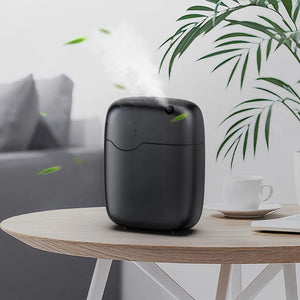




The three identicals: the state of the entrance, the light and temperature you walk into, and the smell. All three can be standardised by a host; none of them require renovation.
Why scent is the cheap one: a reed diffuser at ₹749–₹849 holds a constant for six to eight weeks unattended; a Vaayu at ₹11,999 holds one across up to 1000m³ for 90+ days per 400ml fill, on a schedule, with a key-lock.
The boundary: this is an argument about how arriving feels. It is not a claim about ratings, reviews, bookings or rates, and nobody can honestly make one.
2. Make the entrance the most disciplined square metre in the property. Clear surface, one considered object, nothing of yours stored there, no shoe rack in the sightline, and a light that comes on. This is where the guest's judgement is cheapest to influence and most often wasted.
3. Hold one fragrance and never change it. A signature is a discipline rather than a product: one scent, in the same register, at the same intensity, across every turnover. Guests who return recognise it before they recognise the door number. Guests who do not return simply experience a property that seems to have been thought about.
4. Choose a format that survives your worst turnover. The Sunday changeover with two hours between guests is the one that decides whether your standard is real. Anything that has to be remembered will eventually not be. Reeds need nothing at handover; a Vaayu runs 90+ days on a 400ml fill and can be scheduled from a phone, with a key-lock so a guest cannot alter it.
5. Spend on the invisible before the decorative. Mattress, blackout, water pressure, linen. Scent belongs in the same category as those — it is felt rather than photographed — but it is the least expensive entry on that list by a wide margin.
6. Keep the claim honest. A consistent arrival is a better arrival. Nobody can promise you that it changes a rating, a review score, a booking rate or a nightly price, because there is no data for that, and I would treat any brand that says otherwise with suspicion.
Our fragrances are composed in small batches in Pune, the machines are made in India, and a portion of every order supports girl-child education through Nanhi Kali.

Part one — the three things a host can genuinely make identical
There is a version of this advice that involves buying nicer things, and it is not wrong, but it is slow and expensive and most hosts have already done as much of it as they can afford. The faster route is to notice that what separates a good hotel arrival from a good flat arrival is almost never the objects. It is that the hotel produces the same arrival several thousand times and the flat produces a slightly different one every time. Three variables account for most of that gap, and all three are within a host's control without spending on furniture.
 Sukoon₹1,899 · timersWalking into a hot, dark flat at nine in the evening undoes a great deal of expensive furniture. Walking into a cool, softly lit one flatters furniture that cost very little. Neither of those is about taste; both are about whether someone set them before the guest arrived. Where you have remote-controlled air conditioning or a smart plug, this is a scheduling job. Where you do not, it is a line on the housekeeper's checklist with a specific setting written on it — not "put the AC on" but the number. The same logic then extends to scent, which is simply a third environmental variable that can be set in advance and left alone. A machine with 1h, 4h, 8h and 24h timers belongs in this category rather than in the decorative one.
Part two — hotel standard against host standard, item by item
This is the comparison I find most useful when a host tells me they want the property to feel more premium. The left column is what a hotel does; the right columns are what the equivalent is in a let property, what it costs, and how much of a turnover it eats. Almost nothing on this list is expensive. Nearly all of it is a discipline.
| The standard | How a hotel holds it | The host-scale version | One-off cost | Minutes per turnover |
|---|---|---|---|---|
| A constant lobby scent ★ | Ducted or freestanding nebulisers on a schedule | One Vaayu on the common floor, or reeds at the entry | ₹749 – ₹11,999 | Zero to one |
| A cleared, lit entrance | A bell desk and a design that has no storage in it | One surface, one object, no host storage, light on | Free | Two |
| Room at a set temperature | Central plant and a room-ready standard | A written AC setting, or a smart plug on a timer | Free to ₹1,500 | One |
| Identical linen presentation | A laundry contract and one folding standard | One set of photographs pinned to the linen cupboard | Free | Already in the clean |
| Nothing of the operator on display | Back-of-house exists as a separate building | One lockable cupboard for host possessions | Cost of a lock | Zero |
| A scent a guest cannot switch off | Plant rooms guests never enter | Key-lock on the machine, or a passive reed bottle | Included on the Vaayu | Zero |
| The honest caveat: this table describes how an arrival is experienced, not how a listing performs. There is no evidence — ours or anyone's — that scenting or standardising a property raises a rating, a review score, occupancy, a booking rate or a nightly price, and we will not imply otherwise. Consistency is worth doing because inconsistency is visible to guests. That is the entire argument. | ||||
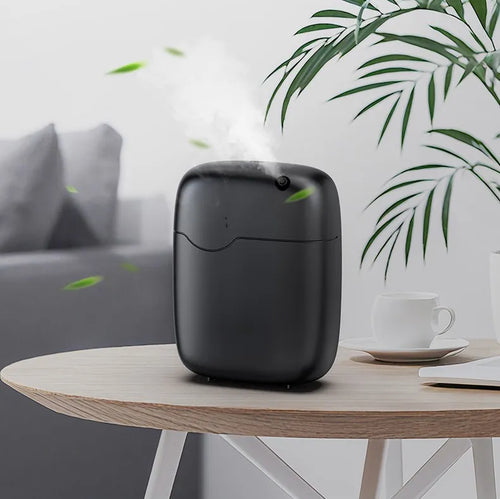 Vaayu · whole floor, scheduled₹11,999Shop →
  Sukoon · one room, timers₹1,899Shop →
 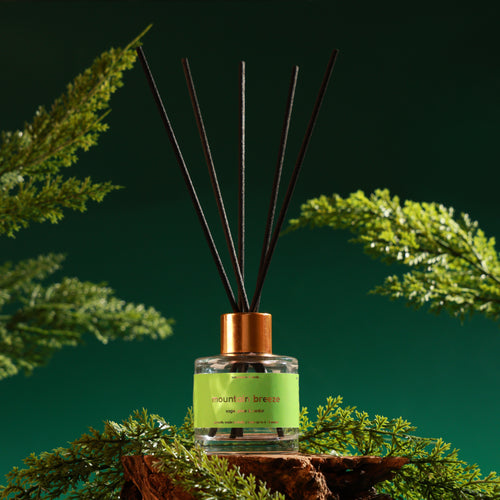 Mountain Breeze · passive constantfrom ₹849Shop →
Part three — when consistency is the wrong goal, and what to do instead
I should be honest about where this argument stops working. The first case is a property whose appeal is that it is not a hotel. A farm stay, a hundred-year-old family house, a cottage full of somebody's books — these listings are chosen precisely because they are particular, and standardising them towards a lobby register strips out the reason people booked. The correct move in a property like that is not to abandon consistency but to point it at the property's own character: hold one scent that agrees with wood, damp stone, old textile and rain, rather than one that agrees with marble. Mountain Breeze, with real Himalayan pine over sage and Indian cedar, sits far better in that kind of building than anything from a lobby palette.
The second case is a host who cannot actually guarantee the standard. This is the one I would ask you to be most truthful with yourself about. If you manage remotely through a rotating set of cleaners, if turnovers are handled by whoever is free, or if you have three listings and one set of hands, then committing to a standard you will meet six times out of ten is worse than committing to a simpler one you will meet every time. In that situation choose the format with the fewest failure modes rather than the best output: a passive reed diffuser that nobody has to start, or a machine that runs on its own schedule for 90+ days and locks against interference. Do not choose a candle, a spray or anything requiring a person to be standing in the property at the right hour.
The third case is a property where the money is needed elsewhere and this is a distraction. If your reviews mention the mattress, the hot water, the wifi or the noise, a ₹11,999 scent machine is not the next purchase; it is a way of avoiding the next purchase. Scent belongs near the end of the list, applied to a property that already works. And a fourth, smaller case: if your connected space is genuinely small — a studio, a compact 1BHK, one room with a bathroom off it — then holding a signature costs ₹749 and not ₹11,999. A single reed bottle in the entry is the whole solution at that size, and a cold-air machine specified up to 1000m³ would simply be too much apparatus for the volume of air involved.
Part four — the consistency budget, by what it survives
The useful way to compare formats for a let property is not by how good they smell. It is by what happens on the worst turnover you will have this year: two hours between guests, a cleaner who is late, and you three hundred kilometres away. Sort the options by that, and the ranking changes considerably.
| Format | How it holds a standard | What makes it fail | Guest can interfere? | Price |
|---|---|---|---|---|
| Vaayu waterless machine ★ | Scheduled 1h/4h/8h/24h across up to 1000m³, 90+ days a fill | Running out of the 400ml supplied, with no refill sold yet | No — key-lock | ₹11,999 |
| Sukoon ultrasonic | One room, 270–320 sq ft, remote with steady/2H/4H | A water tank nobody refilled between stays | Yes — it has buttons and a remote | ₹1,899 |
| Reed diffuser at the entry | Constant, unattended, six to eight weeks on a 50ml | Nobody flipped the reeds; a draught stripped them early | Only by moving the bottle | ₹749–₹849 |
| Boond ultrasonic | ~150 sq ft, ~6 hours a fill, USB powered | Six hours does not cover an arrival window reliably | Yes | ₹899 |
| Megh 6L ultrasonic | ~100 hours of runtime from one fill | Covers only ~215 sq ft — less than the Sukoon | Yes | ₹3,499 · runtime, not coverage |
| Candles and sprays | They do not hold a standard; they mark an occasion | Require a person present at the right hour; open flame in a let property | Entirely | Not recommended for turnovers |
Versailles
I spent a stretch of my training in France walking into hotels for a living, and the thing that surprised me was how ordinary most of the good ones were up close. The lobbies were not full of expensive objects. They were full of decisions that had been made once and then never revisited — where the light fell, what the air felt like, what the room smelled of at four in the afternoon and again at eleven at night.
That is a discipline, and it transfers to a two-bedroom flat in Bandra almost perfectly. What does not transfer is the budget, which is why I keep pushing hosts towards the three variables that cost nothing to standardise. If you get the entrance, the environment and the smell to be the same every time, you have bought most of the effect for a few thousand rupees.
One last thing, said plainly because it matters more than the rest of this page: do not buy fragrance expecting it to move your numbers. It will not, as far as anyone can honestly demonstrate. Buy it because you would like the first thirty seconds of somebody's holiday to feel considered. Everything we make is composed in Pune, the machines are made in India, and a portion of every order funds a girl's classroom through Nanhi Kali.
Frequently asked questions
- How to make your Airbnb smell amazing when guests walk in — the ninety-second window in full.
- What should guests smell on entry? — neutral, scented, masked, and which is worst.
- The best entrance fragrance and keeping the property fresh between stays.
- The complete arrival scenting guide — the whole cluster in one place.
- Brand: the SOSA founder story.
SOSA Vaayu specifications (verified from the live product page, August 2026): ₹11,999 (the product page displays a rounded ₹12,000). Waterless cold-air nebulisation — pressurised air atomises undiluted fragrance oil into a dry nano-mist; no water, no heat, residue-free. Coverage up to 1000m³, about 2,000–3,000 sq ft. 400ml refillable tank, 90+ days per fill at a mid intensity setting. Bluetooth app plus onboard buttons, 1h / 4h / 8h / 24h timers, adjustable mist intensity, auto-stop and key-lock. Under 38 dB. DC 12V / 1A, 5W. 165 × 80.5 × 215 mm, 0.9 kg, black or white. Freestanding or wall / HVAC mount. CE, RoHS and SGS certified. Ships with four SOSA Hotel Collection fragrances at 100ml each (400ml in total) in one of three combos chosen at checkout. SOSA does not currently sell a separate Vaayu refill oil; the 400ml supplied in the box is the fragrance available at the time of writing, and buyers who need long-term supply should confirm current refill availability with SOSA before purchasing. The cold-air oil supplied with the Vaayu is a different product from the water-based Hotel Collection sold for ultrasonic machines (15ml ₹299 · 100ml ₹999 · 300ml ₹1,799), which must not be used in a Vaayu despite sharing scent names. Other SOSA machines: Boond 300ml ₹899 (~150 sq ft) · Sukoon 500ml ₹1,899 (270–320 sq ft) · Megh 6L ₹3,499 (~215 sq ft — a runtime and humidity machine, not a coverage upgrade) · Aangan ₹25,999 (~8,000–10,000 sq ft) · Meenar ₹38,500 (12,000–18,000 sq ft) · Safar car diffuser ₹3,999. Reed diffusers 50ml ₹749–₹849 (6–8 weeks) · 130ml ₹1,249–₹1,349 (14–18 weeks) · duo sets ₹1,498–₹1,598 · oil-only refills 300ml ₹2,399 / 500ml ₹3,499. Runtime, consumption and coverage figures are manufacturer specifications and vary with intensity setting, run hours, ceiling height, ventilation and season; any per-month or per-day figure in this guide is arithmetic on those specifications, not a measurement. Electricity costs vary by state tariff. No claim is made that scenting affects ratings, reviews, bookings, occupancy, revenue, health, mood or air quality. Free shipping above ₹499. A portion of every order supports girl-child education through Nanhi Kali. Prices subject to change — see the live product pages.