

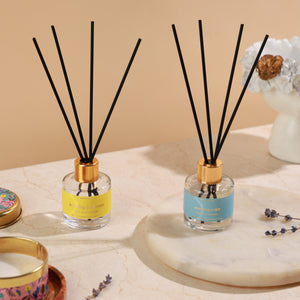

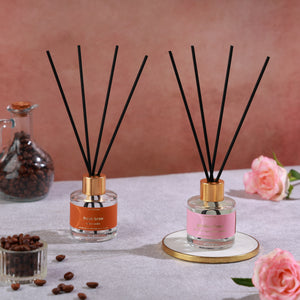

Which size: both 130ml, six reeds each. This is the one occasion where six reeds is correct rather than excessive — people arrive with a fresh nose.
The total: ₹1,299 + ₹1,349 = ₹2,648, and both bottles are still running fourteen weeks later.
When: in position forty-eight hours before, not on the morning.
2. Set them up forty-eight hours early. This is the single instruction most likely to change the result. A reed diffuser is not a spray; the fragrance climbs the porous core of each reed by capillary action and only evaporates from the saturated portion. Two days is roughly what it takes for six reeds to wet through and reach a steady throw. Unboxed on the day, a new bottle is at a fraction of its working strength, and people conclude they should have bought more when what they should have done is bought earlier.
3. Use all six reeds — this is the one time that is right. Six reeds is a hall setting, and a function is a hall event. Guests arrive from outside with an unadapted nose, cross the threshold once, and form their whole impression in that first breath. A bedroom setting of three or four reeds is calibrated for someone who lives there. Put six in both bottles for the week of the function, and pull two out afterwards if the living room feels loud on an ordinary Tuesday.
4. Buy nothing for the kitchen, the bedrooms, the corridor or the balcony. The kitchen is running at full output that day and a passive bottle cannot compete with a working hob; we would never claim it removes what is in the air there. The bedrooms are coat rooms for the evening. A corridor is crossed in about four seconds. The balcony is outdoors. That is four purchases avoided, roughly ₹3,000 to ₹3,500 kept, and the evening is not measurably different.
5. The guest bathroom is the only arguable third — and it is not a function purchase. It is the one space besides the entrance that every guest enters alone and notices. But a 50ml at ₹749 bought for Saturday is a permanent improvement bought in a panic. If you want it, buy it — but buy it next month as a normal purchase, not as part of a function list, because that way you will still be running it in November.
Made in India, composed by an ISIPCA Versailles-trained perfumer — and a portion of every order supports girl-child education through Nanhi Kali.
Where guests actually stand — and why that is only two places
A family function moves people through a flat in a pattern that has almost nothing in common with how the flat is normally used. Everybody arrives through the same door within about ninety minutes, everybody puts their shoes in the same two square feet, and then everybody sits in one room and stays there. The kitchen is staff-only that evening. The bedrooms hold coats and handbags and are entered twice. The corridor is a place people are in for four seconds at a time. Fragrance is worth buying where somebody is standing still with an unadapted nose, and on the evening of a function that describes precisely two locations.
The entrance earns its bottle for a reason that has nothing to do with area. It is usually the smallest space in the flat — twenty-five or thirty square feet — and it is the only one every single guest passes through with a nose that has just come in from a stairwell or a lift. Olfactory adaptation is essentially complete within about twenty minutes, so a guest can only ever form a first impression once, and they form it in your entrance. The room they sit in earns its bottle for the opposite reason: it is the largest volume in the flat and it is where they will be for three hours, so it needs a bottle simply to have any presence at all in that much air. Everything between those two points is transit, and transit spaces are measured in seconds of occupancy, not in square feet.
The three decisions before a function
 Two bottles₹2,648The pattern we see before every festival is a reader buying one bottle per room — five or six of them, somewhere near ₹7,000, for a single evening. Four of those bottles go into rooms that will hold coats or be closed. They do not evaporate faster because there is a party on; they simply sit there, and in March they are still two-thirds full in a bedroom nobody sits in. Two bottles is not a compromise version of six. It is the correct number, because the fifth and sixth are placed where there is no nose to receive them.
Space by space — what a function actually needs
The pattern of a function evening, room by room, with what each space is worth. Four of these rows come to ₹0, and that is the point of the table.
| Space | What it needs | How many | Cost |
|---|---|---|---|
| The entrance or foyer ★ | One 130ml on six reeds — every guest passes through it once, with an unadapted nose | One | ₹1,299 |
| The room guests sit in | One 130ml on six reeds — the largest volume and three hours of occupancy | One | ₹1,349 |
| The kitchen, on the day of the function | Nothing. A working hob outruns any passive source, and we make no claim that fragrance removes what is in that air | None | ₹0 |
| Bedrooms being used for coats and bags | Nothing. Entered twice, for about thirty seconds each time | None | ₹0 |
| The corridor between rooms | Nothing. Four seconds of occupancy per crossing, and it borrows from the rooms at either end anyway | None | ₹0 |
| The guest bathroom | Genuinely worth having — but as a permanent purchase next month, not as part of a function list | None today, one 50ml later | ₹749, later |
| A note on all of the above: reed diffuser coverage figures assume a closed room with still air. On the evening of a function the front door opens forty times, every window is likely open and there are thirty people in the flat raising the temperature — so both bottles will read lighter than they did on the quiet Thursday you set them up. That is not a reason to buy a third bottle. It is a reason to set them up on Thursday. | |||
One room · the unitFrom ₹749Shop → 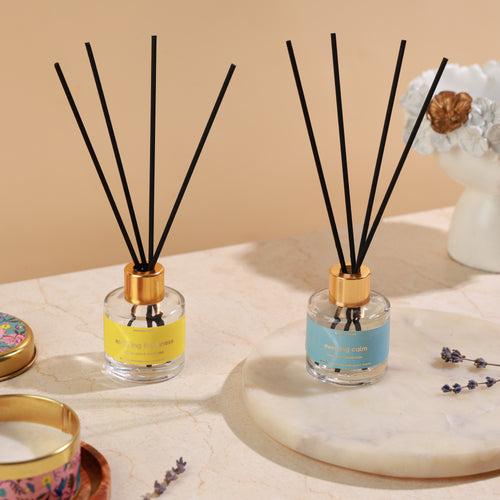 Two rooms · better value₹1,498Shop →
  Large room · a switch₹1,899Shop →
Timing, reeds and where the two bottles actually go
Work backwards from the function by forty-eight hours. For a Saturday evening, both bottles come out of their boxes on Thursday morning and go straight into position — not onto a shelf to be moved later, because a bottle that is carried across the flat on Saturday afternoon has been saturating in the wrong room. Put all six reeds in on Thursday. On Friday evening, flip every reed end for end: the saturated end comes into the air and the throw lifts appreciably, and by Saturday it has settled into a steady state rather than a spike. Do not flip on Saturday. A last-hour flip peaks about twenty minutes later, which is usually while you are still arranging chairs.
Then placement, which is worth more than a third bottle. At the entrance, put the bottle at about waist to chest height on a console or shoe cabinet, on the side away from the door swing — a bottle directly in the draught of a door opening forty times will empty faster and push everything into the stairwell. In the sitting room, place it near the doorway rather than in the far corner, because that is where the air moves and where guests cross a threshold. Keep both off polished wood and away from anything a sleeve can catch: reed oil marks a finish permanently. Stand each on a tray or coaster, and keep them out of reach of children, which at a family function is not a small consideration.
Then stop, and reassess in week two rather than on the day. If the flat feels quiet on Saturday afternoon, remember that you have been living in it for forty-eight hours and your nose finished registering the fragrance somewhere in the first twenty minutes of Thursday. Step outside for half an hour and judge the first breath on returning, or ask the first person who arrives. If it is genuinely faint at the doorway, the fix on the day is to move the bottle nearer the door and away from the fan — not to send someone out for a third bottle. After the function, pull two reeds out of the sitting-room bottle. It will run to eighteen weeks instead of fourteen, and the room will be pitched for a family rather than for thirty guests. When it does run out, a 300ml refill at ₹2,399 fills a 130ml roughly twice, which covers the next two functions as well.
What to buy
The function list is two lines. The rest of this table exists so you can see what the other options are for, and can decide against them deliberately rather than by accident at eleven at night.
| Buy | What it covers | Lasts | Price |
|---|---|---|---|
| One 50ml | A single reed diffuser — the guest bathroom — worth buying, but next month as a permanent purchase, not for one evening | 6–8 weeks | from ₹749 |
| One 130ml ★ | The value size — the entrance and the sitting room — one each, six reeds, in position forty-eight hours ahead | 14–18 weeks | from ₹1,249 |
| The duo | Day & Night duo — both function positions in one order if you would rather not choose scents separately | 6–8 weeks each | ₹1,498 |
| Sukoon | 500ml ultrasonic — a sitting room past about 200 sq ft where you want it strong for one evening and off the rest of the week | Runs when you switch it on | ₹1,899 |
| 300ml refill | The running cost — the second function and the third — one refill covers a 130ml roughly twice over | Roughly 2 × 130ml fills | ₹2,399 |
Versailles
Every year in the fortnight before Diwali somebody writes to ask whether six bottles is enough for a function. It is far more than enough, and it is the wrong shape of purchase. Thirty guests will stand in two places all evening. The bottle you put in the second bedroom will be discovered, still nearly full, when you clear out that room in the spring.
What I would rather you spent the effort on is the calendar. Set both bottles up on Thursday for a Saturday. I have watched people open a box an hour before guests arrive, decide the fragrance is weak, and go out to buy more — when all that was wrong was that the reeds had been wet for fifty minutes. Two days, six reeds, one flip on Friday evening. That is the whole method.
And be a little careful about strength on a night with food. A function is not the moment for the biggest scent you own in the room where the meal is served; the fragrance should be the thing somebody notices at the door and then forgets. Two bottles, ₹2,648, and both of them still working at the next function in three months. A portion of every order funds a girl's classroom through Nanhi Kali.
Frequently asked questions
- What to buy if guests visit once a month — occasion, not habit.
- Does a corridor count as a room? — seconds of occupancy.
- How much to buy as a housewarming gift — the giving version.
- The complete sizing and quantity guide — every home type, three builds.
- Brand: the SOSA founder story.
SOSA products & prices (verified August 2026): Hotel Collection water-based ultrasonic diffuser fragrance 15ml ₹299 · 100ml ₹999 · 300ml ₹1,799 · Pack of 7 (15ml, all fragrances) ₹1,799; refills 100ml from ₹999. Seven scents: The Ritz-Carlton-inspired (white tea · bergamot · cedar), Westin-inspired (white tea · aloe · cedar), 1 Hotels-inspired (cedarwood · vetiver · green leaves), The St. Regis-inspired (amber · violet · woods), Shangri-La-inspired (jasmine · green tea · white tea), Four Seasons-inspired (citrus · floral · sandalwood), W Hotels-inspired (citrus · pepper · amber). Diffusers: Boond 300ml ₹899 · Sukoon 500ml ₹1,899 · Megh 6L ₹3,499. Water-based, phthalate-free, composed to IFRA standards for home diffusion; 3–6 drops per tank. Made in India, Pune. The Hotel Collection scents are SOSA's own interpretations inspired by the world's finest hotels; all hotel names are trademarks of their respective owners and are used only to describe the scent style — SOSA is an independent Indian fragrance house, not affiliated with or endorsed by any hotel brand. Prices and availability subject to change — see the live product pages.