


One scent or several? One Hotel Collection scent at ₹299, run faithfully. A rotating shelf of bottles is the opposite of minimalism.
Large open-plan space? Still one — but a Vaayu at ₹11,999 that covers the whole floor from a single hidden unit.
2. One scent. A single Hotel Collection note (₹299) run consistently is what a room remembers — a shelf of half-used bottles is clutter you can smell.
3. One decision about running it. Passive base, or on-off evening lift. Choose the rhythm; do not layer three.
4. One upgrade path. If the space is genuinely open-plan, replace the small unit with one Vaayu (₹11,999) rather than adding more small ones.
5. One habit. Air the room first; scent flatters clean air and covers nothing.
And a portion of every order supports girl-child education through Nanhi Kali.
Why one product, done well, beats three done vaguely
Minimalism is not the absence of things; it is the absence of surplus things. A well-edited living room does not have fewer functions than a cluttered one — it has the same functions, delivered by fewer, better objects. Fragrance obeys the identical logic. The instinct, when people decide to scent a room, is to hedge: a reed here, a plug-in there, a candle for the weekend, a spray for emergencies. Four weak signals that never agree with one another. What you smell, walking in, is not a considered scent but an argument.
One product run properly does what four cannot: it establishes a single, coherent identity for the room. The nose reads consistency as quality. A living room that smells faintly but unmistakably of one clean note — every day, in the same place, at the same gentle level — reads as deliberate and expensive, in exactly the way a single good armchair reads as more considered than three cheap ones. A Boond at ₹799 with one Hotel Collection scent at ₹299 gives you that single signal for the price of the impulse candles you would otherwise accumulate.
There is a maintenance argument too, and minimalists feel it keenly. Every product you add is another thing to top up, switch, replace or hide. One unit is one decision, made once. That is why I never tell a minimalist client to build a “system” — a system is a maximalist idea. I tell them to choose the one object that fits their room and their rhythm, and then to stop.
What actually counts as “one product”
A fair question follows: does a reed and a machine count as one, or two? My rule is simple. A passive base note plus one active unit is still, in spirit, a single considered setup — because they do different jobs and never compete. The reed is the floor: a quiet constant that means the room never smells of nothing while you are out. The machine is the ceiling: an on-off lift you raise for the evening. What breaks minimalism is not two complementary pieces; it is two competing ones — two scents, two machines fighting for the same air.
| Setup | Products | Verdict |
|---|---|---|
| Reed only | 1 passive | Purest; ideal for small closed rooms |
| Boond + one scent | 1 unit | The recommended minimalist default |
| Reed base + Boond lift | 1 + 1, non-competing | Still minimalist — two jobs, one identity |
| Reed + plug-in + candle + spray | 4 competing | The mistake — four weak, clashing signals |
 Hotel Collection · one note₹299Shop → Boond · the one unit₹799Shop →
 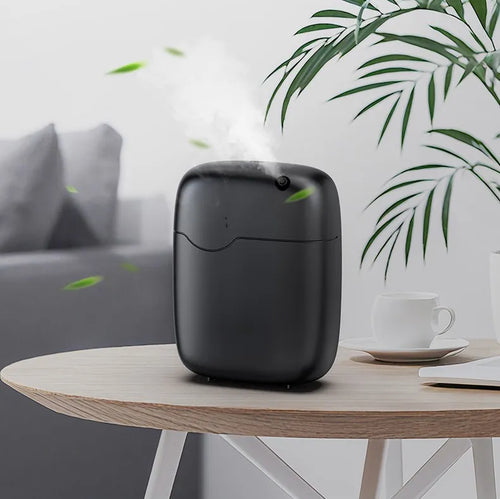 Vaayu · one unit, big room₹11,999Shop →
When the room is large — the answer is still one
The one situation that tempts a minimalist into buying more is scale. An open-plan living-dining, or a double-height volume, defeats a single small unit — and the reflex is to scatter reeds and plug-ins until the far corner smells of something. That is precisely the wrong move: you end up with the clutter of many weak sources and still no even scent. The minimalist answer to a big room is not more products; it is one bigger one. A single waterless Vaayu at ₹11,999 nebulises a fine, dry scent across up to roughly 1000 cubic metres from one hidden unit, on an app and a timer, so the whole floor smells identical with nothing on display.
So the count never really changes. A small room needs one small unit; a large room needs one large unit. What a minimalist living room never needs is a collection. If you are weighing a discreet ultrasonic against a waterless machine for exactly this reason, the companion piece on where to hide a diffuser in a minimalist interior covers concealment, and the complete minimalist guide ties the whole approach together.
The SOSA minimalist edit
One unit sized to your room, one note you love, and nothing else. Here is the whole edit, from the barest reed to the single machine that handles a large open floor.
| Product | Best for | Why it works | Price |
|---|---|---|---|
| SOSA reed diffuser | The barest, passive setup | One object, no power, no switch, no upkeep | see the collection |
| Boond | One normal minimalist room | A single compact unit that does everything | ₹799 |
| Sukoon + Hotel Collection | A slightly larger single room | Holds one note across the room all evening | ₹1,799 + ₹299 |
| Megh | Long, unattended runs | 6L tank; set one scent and leave it | ₹3,499 |
| SOSA Vaayu ★ | One unit for a large / open-plan floor | Waterless, app + timer; even throw, hidden | ₹11,999 |
| Hotel Collection refills | Keeping the one note running | Low, predictable cost for a single scent | from ₹999 |
Versailles
People assume a perfumer’s home smells of a hundred things. Mine smells of one, most weeks — a soft woody note in a single unit by the window. I could run more. I don’t, because I know what a room does with too many voices: it stops being able to say anything.
The discipline you already used editing your living room is the whole skill here. Choose once, choose well, then stop. A single considered scent is worth more than a drawer of samples, the same way one good chair is worth more than three you tolerate.
So buy one thing that fits your room, run one note you love, and let the restraint do the talking. A portion of what you spend gives a girl a classroom through Nanhi Kali — one clear thing, done well, on both counts.
Frequently asked questions
- Where to hide a diffuser in a minimalist interior — keeping the one unit out of sight.
- The complete minimalist living-room fragrance guide — the whole approach in one place.
- Hotel Collection — SOSA’s interpretations of the world’s finest hotel scents, from ₹299.
- Brand: the SOSA founder story.
Facts verified August 2026: A single scent run consistently is judged more coherent than several run together, and adding products past the point of coverage reduces, rather than improves, perceived quality. The effect of ambient scent is real but moderate, and no fragrance improves unclean or unventilated air. SOSA systems and prices as stated: Boond ₹799, Sukoon ₹1,799, Megh ₹3,499, Vaayu ₹11,999, Hotel Collection scents from ₹299, refills from ₹999; reed diffuser pricing and sizes are shown on the collection page. The Hotel Collection scents are SOSA’s own interpretations inspired by the world’s finest hotels; SOSA is an independent Indian fragrance house, not affiliated with or endorsed by any hotel brand. Prices subject to change.