Founder Diaries · Clinics & Medical Centres · Shared Waiting Areas
By Sonal Sahani · ISIPCA Versailles 11 min read Updated September 2026
This page is one clinic, done in full, with the arithmetic on the page rather than behind it. Forty seats in a waiting hall of 1,250 square feet with a 3.1 metre ceiling, a registration bay, an entrance lobby and a corridor between departments — about 634 cubic metres of public envelope inside a floor plate of 4,200 square feet. The brochure figure would have suggested two machines. The volume that is actually scented needs one, running at about two-thirds of its rating, which is exactly where a machine should sit. What follows is that sum in public, the single setting the hall runs at, and the refill maths: a 400ml tank at about seventy-five days is four visits a year per unit, which is a line procurement can model in ten minutes.
Quick answers — read this first
The sum: m³ = (sq ft ÷ 10.76) × ceiling height in metres. Waiting hall 1,250 sq ft at 3.1 m ≈ 360 m³ · registration bay 350 sq ft ≈ 101 m³ · entrance and lift lobby 220 sq ft ≈ 63 m³ · inter-departmental corridor 380 sq ft ≈ 110 m³.
Total public envelope ≈ 634 m³.What comes out of the sum: 2,000 sq ft of consultation cabins, procedure and dressing rooms, sample collection, the laboratory, dispensing and sterile stores — about 576 m³, and about 48 per cent of the floor plate. Those doors are shut and those rooms are fragrance-free.
The machine: one
Vaayu at ₹11,999, rated to 1000 m³, running at roughly two-thirds. One intensity setting, locked. Opening hours only.
The refills: 400ml to about 75 running days — four refill visits a year per unit, against roughly three hundred tank events a year for a water-based machine.
The short answer
Short answer: work out the public volume rather than the floor area, and buy for that. A 40-seat hall of 1,250 sq ft at 3.1 m is about 360 m³, and the whole public envelope around it comes to about 634 m³.
One Vaayu at ₹11,999, rated to 1000 m³, covers it at roughly two-thirds of its ceiling — which is the right place for a machine to run.
The configuration: one unit, wall-mounted at the edge of the seating bank and away from the consultation corridor, on the Westin-inspired White Tea Serenity, at one intensity set in the first week and then key-locked. Scheduled to the opening hours through the app, with the 8h onboard timer as the fallback. Nobody adjusts it when the hall fills.
The running cost: a 400ml tank lasts about seventy-five running days, so four refill visits a year per unit — a quarterly line rather than a daily task. The machine arrives with four hotel-inspired fragrances. The
Aangan at ₹25,999 is the wrong purchase at this volume. Free shipping above ₹499.
Straight answer
How should a 40-seat waiting area with constant footfall actually be scented?
1. Measure the volume, not the floor area, and only the volume you will scent. Cubic metres equal square feet divided by 10.76, multiplied by the ceiling height in metres. The 40-seat hall in this example is 1,250 sq ft at 3.1 m, which is about 360 m³.
2. Add the rest of the public envelope, because it is one connected volume. Registration bay 350 sq ft ≈ 101 m³, entrance and lift lobby 220 sq ft ≈ 63 m³, inter-departmental corridor 380 sq ft ≈ 110 m³. Total about 634 m³.
3. Take the clinical rooms out entirely. Eight consultation cabins, a procedure room, a dressing room, sample collection, the laboratory, dispensing and sterile stores come to about 2,000 sq ft — roughly 576 m³ and about forty-eight per cent of a 4,200 sq ft floor plate. Those doors are shut and those rooms are fragrance-free. Count the volumes a door closes, not the square feet on the brochure.
4. One machine. The
Vaayu at ₹11,999 is rated to 1000 m³, so 634 m³ puts it at about two-thirds of its ceiling — comfortable, quiet and with headroom for a hot Monday. The
Aangan at ₹25,999 is for 3,000 m³ and buying it here would be overselling.
5. One setting, and constant footfall does not change it. Set the intensity in the first week by walking in cold before the hall fills, then key-lock it. A door cycling several hundred times a day is answered by a steady low output, not by chasing the losses.
6. Four refills a year. 400ml lasts about seventy-five running days on a clinic's opening hours, which is roughly a quarter if you close on Sundays. Four visits a year per unit, on a calendar reminder rather than a daily routine. And before any of it: if the hall smells of anything in particular, that is information about a source — find it and fix it rather than covering it.
A portion of every order supports girl-child education through Nanhi Kali.
TL;DR: work in cubic metres and only for the volumes you scent: a 1,250 sq ft hall at 3.1 m is about 360 m³, and the whole public envelope around it about 634 m³ against a floor plate that would have read as 1,210. One
Vaayu at ₹11,999 rated to 1000 m³ covers it at two-thirds, on one locked setting, with a 400ml tank lasting about seventy-five days — four refill visits a year.
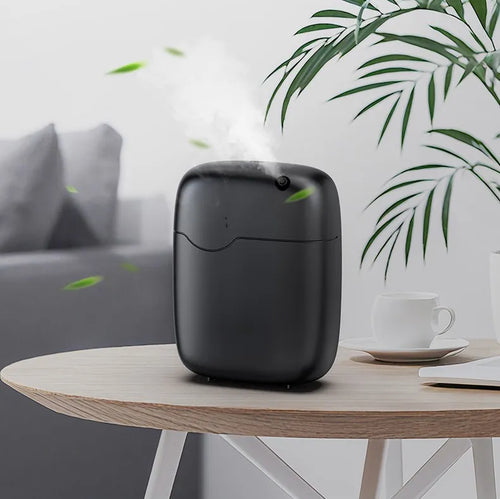
634 cubic metres against a machine rated for a thousand
SOSA Vaayu · up to 1000 m³ ₹11,999
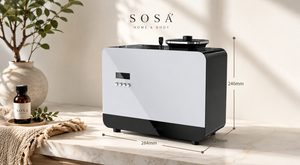
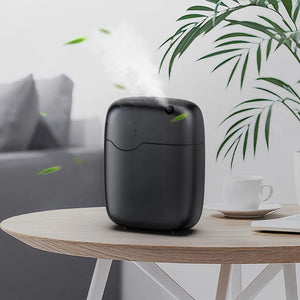
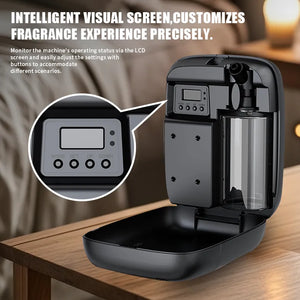
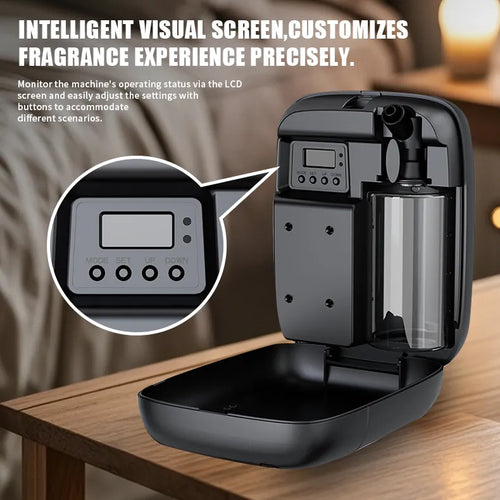
Coverage up to 1000 m³, roughly 2,000–3,000 sq ft, from a 400ml tank lasting about seventy-five days on a clinic's opening hours. The forty-seat hall in this page comes to about 360 m³, and the whole public envelope it sits in — hall, registration bay, entrance and the corridor between departments — comes to about 634. One machine, running at roughly two-thirds of its rated ceiling, which is exactly where a machine should sit. The 4,200 sq ft on the floor plan would have read as 1,210 m³ and sold somebody two. Count the volumes a door closes. Bluetooth app plus 1h/4h/8h/24h onboard timers, adjustable intensity, auto-stop, key-lock, under 38 dB, 0.9 kg, wall or HVAC mountable, four hotel-inspired fragrances supplied.
The arithmetic, done in public
Almost every over-purchase I have seen in this sector comes from the same place: somebody took the floor area off the lease, divided it by a coverage figure on a brochure, and bought accordingly. That method will sell a 4,200 square foot polyclinic two machines, and 4,200 square feet at a 3.1 metre ceiling is about 1,210 cubic metres, so the sum even looks right. It is wrong because it counts rooms that will never be scented and whose doors are shut all day. The honest method takes about fifteen minutes with a floor plan and a calculator, and in most clinics it removes forty to sixty per cent of the plan area before you get to a product. Here is the whole of it for one real-shaped facility, so you can do the same to yours.
1
THE SUM
Four volumes that add up, and one that does not belong in the total
Start with the hall itself, because it is the number the question asks about. Forty seats in a waiting area of 1,250 square feet with a 3.1 metre ceiling: 1,250 divided by 10.76 is about 116 square metres, times 3.1 is about 360 cubic metres. Then the volumes it is continuous with, because air does not stop at the edge of a seating plan and a scenting calculation has to follow the air rather than the furniture. The registration and reception bay at 350 square feet is about 101 cubic metres. The entrance and lift lobby at 220 square feet is about 63. The inter-departmental corridor at 380 square feet is about 110. Add them: roughly 634 cubic metres of connected public envelope, which is the number you are actually buying a machine for. Now the part that makes this a clinic sum rather than a hotel one. The same floor plate is 4,200 square feet, so about 2,000 square feet of it — eight consultation cabins, a procedure room, a dressing room, the sample-collection room, the laboratory, dispensing and the sterile store — is roughly 576 cubic metres that comes out of the total entirely. Not reduced. Removed. Those rooms are fragrance-free and their doors are shut, and 576 plus 634 is 1,210, which is the brochure figure and the reason the brochure method oversells. Forty-eight per cent of that floor plate is not in the calculation, which is exactly the forty to sixty per cent I see in most multi-speciality plans, and it is the difference between one machine and two.
Do this to your own plan before you take a quotation from anybody: colour the fragrance-free rooms on a printed floor plan, total only what is left, multiply by the ceiling height in metres and divide by 10.76. Then compare that number with a coverage rating rather than with your lease area.
2
THE MACHINE
634 against 1,000, and why headroom is the point
With 634 cubic metres established, the machine choice takes about a minute.
The Vaayu at ₹11,999 is rated to 1000 m³, roughly 2,000 to 3,000 square feet, so this facility runs one unit at about sixty-three per cent of its ceiling. That is not underuse and it is not a wasted specification; it is the right place for a machine to sit, for the same reason that nobody specifies a chiller at a hundred per cent of design load. A machine at two-thirds runs at a lower intensity setting, which means a flatter and more even field across the seating bank, less variation between the chair nearest the unit and the one furthest from it, and headroom for the days a hall behaves badly — a hot Monday, a festival week, a health-check camp that doubles the footfall for a fortnight. A machine sized to exactly its volume has nowhere to go on those days, and the instinct then is to turn it up permanently, which is how a waiting hall ends up with a level somebody can name.
The Aangan at ₹25,999 is the wrong purchase here and I will say so rather than take the larger order: it covers up to 3,000 m³ and connects to HVAC, which is a double-height atrium, a whole-floor air-handling tie-in or a genuinely large integrated centre. At 634 cubic metres it is more than four times the volume required. The thing that moves a facility from the first machine to the second is not seat count or square footage; it is the volume left after every fragrance-free room has come out, and a six-metre ceiling is the one variable that changes it quickly.
A 3,000 sq ft clinic worked through and
whether one machine can cover a clinic take the sizing question further.
3
THE REFILLS
400ml, seventy-five days, and four visits a year
Then the number procurement actually cares about, which is not the purchase price.
A 400ml tank runs for about seventy-five days on a clinic's opening hours. For an eight-to-eight facility closed on Sundays, seventy-five running days is about twelve and a half weeks — a quarter — which makes it four refill visits a year per unit. That is a calendar reminder, a quarterly line in a maintenance schedule and a single consumable to keep in a store cupboard. It is not a task, and the difference between a task and a reminder is the whole of whether a scenting system is still working eighteen months after it was installed. The contrast with a water-based machine is arithmetic rather than opinion: an ultrasonic consumes 30 to 50 millilitres of water an hour, so across a twelve-hour clinic day a 500ml tank is a daily refill, which is roughly three hundred filling events a year, plus three hundred empty-rinse-dry events if the tank is being looked after properly, which in a healthcare building it must be.
Four events a year against six hundred is the real argument for a waterless machine in a clinic, and it is a housekeeping argument rather than a clinical one. I am not going to describe it as infection control, because it is not. On the money: ₹11,999 spread across three years is about ₹4,000 a year, which across forty seats is ₹100 per seat per year, or roughly thirty-three paise per seat per day in a clinic open about three hundred days. The machine ships with four hotel-inspired fragrances, so the first stretch of running is covered; for refill oil pricing, check the live product page rather than a number on a blog.
The full-year cost of scenting a medical centre sets it out properly.
The same facility as a table, so you can substitute your own figures into it. The top block is what you buy for. The middle block is what comes out of the sum entirely. The bottom line is the brochure figure and the reason it is misleading.
A 40-seat polyclinic, in cubic metres
What goes into the coverage sum, and what comes out of it
| Space |
Floor area |
Ceiling |
Volume |
In the sum? |
| Waiting hall · 40 seats ★ |
1,250 sq ft |
3.1 m |
≈ 360 m³ |
Yes — this is the room |
| Registration and reception bay |
350 sq ft |
3.1 m |
≈ 101 m³ |
Yes — continuous with the hall |
| Entrance and lift lobby |
220 sq ft |
3.1 m |
≈ 63 m³ |
Yes — the arrival volume |
| Inter-departmental corridor |
380 sq ft |
3.1 m |
≈ 110 m³ |
Yes — public circulation |
| Public envelope total |
2,200 sq ft |
3.1 m |
≈ 634 m³ |
One Vaayu, at about two-thirds of its rating |
| Eight consultation cabins, procedure, dressing, sample collection, laboratory, dispensing, sterile store |
≈ 2,000 sq ft |
3.1 m |
≈ 576 m³ |
No — fragrance-free, doors shut, removed entirely |
| The whole floor plate, as a brochure would count it |
4,200 sq ft |
3.1 m |
≈ 1,210 m³ |
This is the number that sells two machines |
Shop this guide
The 40-seat setup, in three products
The SOSA principle
Forty-eight per cent of that floor plate is not in the calculation at all. Count the volumes a door closes, not the square feet on the lease.
Which is the difference between 634 cubic metres and 1,210, and therefore between one machine and two. Selling one where you expected to buy two is the point rather than a loss.
One setting, four refills, and what it costs a year
Start with what constant footfall actually does to a hall, because it changes the operating instruction and not the machine. Forty seats with a turnover of roughly a hundred and ten patients a day, most of them with somebody accompanying them, means an entrance door cycling several hundred times between eight and eight. Every cycle exchanges a share of the entrance volume with the street, and on a busy Monday the hall is effectively being ventilated by its own front door. The instinct that follows is to compensate — to run a higher intensity because so much is being lost — and it is the wrong instinct, because the losses are not steady. They come in bursts around the peaks, and a level set to cover the bursts is a level that is far too high for the twenty minutes after each one, which is when a patient is most likely to notice it and ask reception what it is. A steady low output across twelve hours produces a flatter experienced level than any attempt to chase the losses, and it uses less fragrance. So: set the intensity once in the first week by walking in cold each morning before the hall fills, with somebody who does not work in the building, then key-lock it and write the number into the standard operating procedure. Schedule it in the app to the opening hours with the 8h onboard timer as the fallback, and let it stop with the last appointment. The midday rule applies here more than anywhere in the cluster: nobody turns it up because the hall got busy. A full hall is an occupancy and air-change question and that is its own page.
Then the placement, briefly, because the sizing is what this page is for and the siting page covers the geometry properly. In a 40-seat hall the unit goes at the edge of the seating bank rather than inside it, three to four metres in from the entrance so the door does not throw the output straight back out, two to two and a half metres off the floor because a cold-air mist falls rather than rises, clear of the direct throw of a supply grille, and on the side of the room furthest from the consultation corridor. The Vaayu wall mount is worth the fitting cost at this seat count for a reason that is nothing to do with performance: a hall with a hundred and ten patients a day in it contains a great many people you have never met, a fair number of them children, and a machine at reach height is a machine that will be touched. The key-lock deals with the rest. At 0.9 kg and 165 × 80.5 × 215 mm the bracket is a small job. And the test that matters is done from the other end: stand in the open doorway of the nearest consultation cabin or sample-collection room with the machine running, and if anything registers there, move the unit rather than turning it down. Those rooms are fragrance-free, along with procedure and treatment rooms, dressing rooms, the laboratory, dispensing, sterile stores, imaging, oncology day-care and paediatric clinical areas, and that boundary holds regardless of how good the coverage arithmetic looks.
Then the year, as a procurement line. One Vaayu at ₹11,999, four refill visits a year at about seventy-five running days per 400ml tank, one intensity setting and one scent — the Westin-inspired White Tea Serenity, the lightest of the seven, or the Ritz-Carlton-inspired Quiet Luxury a step more present if the hall feels large at the far end. The machine arrives with four hotel-inspired fragrances, it takes its own undiluted oil rather than the water-based Hotel Collection bottles, and it draws DC 12V at 5W, which is a rounding error on a clinic's electricity bill. Amortised over three years the hardware is about ₹4,000 a year, or roughly a hundred rupees per seat per year. Against that, the comparison worth making is not with another diffuser but with the alternatives a clinic actually considers: a morning spray, which is a twenty-minute product that has gone before the ten o'clock queue arrives and which SOSA does not make in any case, since the sprays in the range are car perfumes; an alcohol-free reed diffuser from ₹749, which takes 24 to 72 hours to establish and is barely noticed past about a metre, so a 40-seat hall never receives it; an ultrasonic Sukoon at ₹1,899 or Megh at ₹3,499, which hold standing water and want a daily empty-rinse-dry from a named person; and candles, which are not appropriate in a healthcare facility at all because an open flame is a fire-safety and insurance matter. And the standing boundary: none of this does anything to a patient. A diffuser is not an air purifier, it does not clean or disinfect anything, and fragrance in a clinic is housekeeping and presentation. If the hall smells of something in particular, that is information about a source, and the answer is to find it and fix it rather than to cover it.
A machine running at two-thirds of its rating gives you a flatter field and somewhere to go on a bad Monday. A machine sized exactly to its volume has nowhere to go, and gets turned up permanently.
— Sonal Sahani, SOSA
The SOSA edit
The whole purchase for this facility, in order, with the annual figures a procurement lead will ask for. The second row is the machine this clinic should not buy, and the last row is the product SOSA does not make at all.
The SOSA edit
A 40-seat waiting area, in buying order
| Buy |
What it is |
The figures |
Cost |
| 1. The volume sum, on your own plan ★ |
Fragrance-free rooms coloured out, the rest totalled, multiplied by ceiling height and divided by 10.76 |
634 m³ here against a 1,210 m³ floor plate. Forty-eight per cent removed before any product is chosen |
₹0 |
| 2. One Vaayu for the public envelope |
Waterless, no standing water, rated to 1000 m³, 400ml tank, app and 1h/4h/8h/24h timers, under 38 dB, key-lock, auto-stop, 0.9 kg |
634 of 1000 m³ is about 63 per cent. One unit, one oil, one locked setting |
₹11,999 |
| 3. Vaayu wall mount |
The same machine fixed at two to two and a half metres, out of reach of a hall with a hundred and ten patients a day in it |
A bracket and an hour. It also puts the output above the seated head line, which is where it should be |
Fitting only |
| 4. Refills, quarterly |
400ml lasting about seventy-five running days on a clinic's opening hours |
Four visits a year per unit, against roughly six hundred tank events a year for a water-based machine |
See the product page |
| Not this machine here: Aangan
|
Up to 3,000 m³, 800ml reservoir, HVAC-connected or standalone, under 42 dB |
More than four times the volume this facility has. Right for an atrium or a whole floor; overselling at 634 m³ |
₹25,999 |
| Not made by SOSA: a room spray |
The sprays in the range are car perfumes, formulated for about three cubic metres of hot moving air |
A morning spray is a twenty-minute product. It has gone before the first peak arrives at a hall this size |
— |
Honest notes for buyers: fragrance in a medical facility is housekeeping and presentation, never treatment. Nothing on this page claims that a fragrance reduces anxiety, aids recovery, improves sleep, cleans or disinfects air, or has any clinical effect whatsoever, because it does not and a diffuser is not an air purifier. Scenting belongs to the entrance, reception, shared waiting areas, inter-departmental corridors and administrative rooms. Consultation and examination rooms, treatment and procedure rooms, day-care surgery, dressing rooms, blood- and sample-collection rooms, laboratories, pharmacy dispensing, sterile stores, imaging rooms, oncology day-care and paediatric clinical areas should be left fragrance-free. A persistent smell is information about a dry drain trap, a bin, a soiled-linen route or an air-conditioning drain pan: find it and fix it rather than covering it. On the machines: the
Vaayu at ₹11,999 is waterless cold-air nebulisation with no standing water tank, covering up to 1000m³ or roughly 2,000–3,000 sq ft, with a 400ml tank lasting about 75 days, Bluetooth app control, 1h/4h/8h/24h timers, under-38dB running, auto-stop and a key-lock for public areas. The
Aangan at ₹25,999 covers up to 3,000m³ and connects to HVAC for a whole floor or an atrium. The ultrasonic
Sukoon,
Boond and
Megh are water-based, hold standing water and add 30–50 ml of water an hour to the air, which makes them suitable for a single administrative cabin with a named person emptying and drying the tank daily, and unsuitable for public clinical property. An alcohol-free
reed diffuser needs 24–72 hours to establish and suits a small lobby rather than a large waiting hall. Candles are not appropriate in a healthcare facility because an open flame is a fire-safety matter. SOSA does not make a room spray. The Hotel Collection scents are SOSA's own interpretations inspired by the world's finest hotels; SOSA is an independent Indian fragrance house, not affiliated with or endorsed by any hotel brand. A portion of every order supports girl-child education through Nanhi Kali.
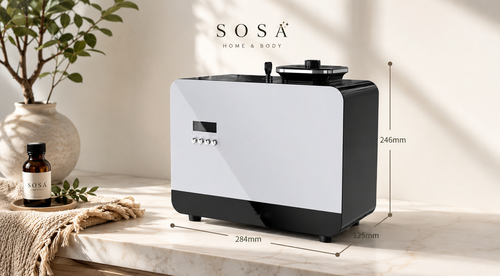
The machine this particular clinic should not buy
SOSA Aangan · HVAC or standalone ₹25,999
Up to 3,000 m³, roughly 8,000 to 10,000 sq ft, an 800ml reservoir, a metal body, programmable schedules and under 42 dB. For a 634 m³ public envelope this is the wrong purchase and I would rather print that here than explain it in an email afterwards. It is the machine for a double-height atrium, a whole-floor AHU tie-in or a genuinely large integrated centre, and recommending it to a forty-seat polyclinic is overselling. The number that moves a facility from one to the other is not the seat count and not the square footage on the brochure. It is the volume left over once every fragrance-free room has been taken out of the sum, and a double height ceiling is the one thing that changes it fast.
A note from Sonal
I keep a note of every clinic I have talked out of a second machine, partly because it amuses me and partly because the pattern in it is so consistent. In every single case the facility had done the sum on the square footage from the lease, and in every single case more than forty per cent of that area was rooms with a closed door and a standing instruction that nothing goes into the air in them. A 4,200 square foot polyclinic is a 2,200 square foot scenting job. That is not a technicality; it is the central fact of specifying anything for a medical building, and it is the reason I would rather teach the arithmetic on a public page than quote on a floor plan.
The forty-seat hall in this page is a real shape and the numbers are real numbers, and what I find satisfying about it is how undramatic the answer turns out to be. One machine at two-thirds of its rating, one scent nobody can name, one setting nobody touches, and four reminders a year in somebody's calendar. That is the whole system. A clinic does not need a scenting strategy. It needs a public envelope that smells of nothing in particular for twelve hours a day, a clinical half that smells of nothing at all, and a housekeeping routine that finds a dry drain trap before a patient does. Everything else is somebody trying to sell you a second box.
Everything is made and supported from Pune, and a part of every order funds girl-child education through Nanhi Kali. You get a space that smells like somewhere looked after; a girl gets a classroom. That equation has always felt right to me.
Frequently asked questions
How many diffusers does a 40-seat clinic waiting area need?
One, in almost every case. A 1,250 sq ft hall at a 3.1 m ceiling is about 360 m³, and the whole public envelope around it — registration, entrance lobby and inter-departmental corridor — comes to about 634 m³. The
Vaayu at ₹11,999 is rated to 1000 m³, so one unit runs at roughly two-thirds of its ceiling.
How do I work out the cubic metres for my own waiting area?
Cubic metres equal floor area in square feet divided by 10.76, multiplied by the ceiling height in metres. Count only the volumes you will actually scent: consultation cabins, procedure and dressing rooms, sample collection, the laboratory, dispensing, sterile stores, imaging and oncology day-care are fragrance-free with their doors shut and come out of the sum entirely.
How often does a Vaayu need refilling in a busy clinic?
A 400ml tank lasts about seventy-five running days on a clinic's opening hours, which for an eight-to-eight facility closed on Sundays is roughly a quarter. That is four refill visits a year per unit — a calendar reminder rather than a daily task, and the machine arrives with four hotel-inspired fragrances.
Should we run the machine harder because the footfall is constant?
No. The losses from a door cycling several hundred times a day come in bursts around the peaks, and a level set to cover the bursts is far too high in the quiet twenty minutes after each one. A steady low output gives a flatter experienced level and uses less fragrance. Set it once in the first week, then key-lock it.
Would the Aangan be a better choice for a hall this size?
No, and buying it here would be overselling. The
Aangan at ₹25,999 covers up to 3,000 m³ and connects to HVAC, which suits a double-height atrium, a whole-floor tie-in or a genuinely large integrated centre. At 634 m³ it is more than four times what this facility needs.
A 3,000 sq ft clinic worked through shows where the line sits.
Forty seats, one machine, four reminders a year
634 cubic metres, not 4,200 square feet — count what a door closes
The Vaayu is ₹11,999: waterless cold-air nebulisation with no standing water tank, coverage up to 1000 m³ or roughly 2,000–3,000 sq ft, a 400ml refillable tank lasting about seventy-five days per fill, Bluetooth app control with 1h/4h/8h/24h timers, adjustable intensity, under 38 dB, DC 12V at 5W, 0.9 kg and 165 × 80.5 × 215 mm, freestanding, wall or HVAC mounted, auto-stop and key-lock, supplied with four hotel-inspired fragrances. The Aangan at ₹25,999 covers up to 3,000 m³ for an atrium or a whole floor. Free shipping above ₹499, and a portion of every order supports girl-child education through Nanhi Kali.
See the Vaayu · ₹11,999 Compare the Aangan · ₹25,999
Continue the read
More from SOSA
Editorial standards & sources
About this guide: Written by Sonal Sahani, ISIPCA Versailles-trained founder and perfumer at SOSA Home & Body, working a single 40-seat polyclinic waiting area through in public: the cubic-metre arithmetic for a 1,250 sq ft hall at a 3.1 metre ceiling, the connected public envelope totalled at about 634 m³ against a 4,200 sq ft floor plate, the forty-eight per cent of plan area removed because those rooms are fragrance-free with their doors shut, one machine at two-thirds of its rating, and the refill maths at 400ml to about seventy-five days.
Facts verified August 2026: Product facts used in this guide. SOSA Vaayu ₹11,999: waterless cold-air nebulising diffuser, atomises undiluted fragrance oil to a dry residue-free nano-mist with no water reservoir, coverage up to 1000m³ (approximately 2,000–3,000 sq ft), 400ml refillable tank lasting up to about 75 days per fill, Bluetooth app plus onboard control, 1h/4h/8h/24h timer scheduling, adjustable intensity, under 38 dB, DC 12V/1A at 5W, 165 × 80.5 × 215 mm and 0.9 kg, freestanding or wall or HVAC mounted, auto-stop and key-lock, CE, RoHS and SGS certified, supplied with four hotel-inspired fragrances. SOSA Aangan ₹25,999: HVAC-connected or standalone commercial nebulising diffuser, coverage up to 3,000m³ (roughly 8,000–10,000 sq ft), 800ml reservoir, metal body, programmable schedules, under 42 dB. Ultrasonic machines are water-based, hold standing water and consume 30–50 ml of water an hour: Sukoon ₹1,899 (500ml, 270–320 sq ft, 16–18 hours on low, 3–6 drops per tank, steady/2H/4H timers, three 15ml Hotel Collection scents included), Boond ₹899 (300ml), Megh ₹3,499 (6 litres). Hotel Collection water-based fragrance 15ml ₹299, 100ml ₹999, 300ml ₹1,799, Pack of 7 at 15ml ₹1,799 against ₹2,093 bought singly; the Vaayu and Aangan take their own undiluted oil rather than these water-based bottles. Alcohol-free reed diffusers from ₹749, requiring 24–72 hours to reach their working level. Free shipping above ₹499. Coverage arithmetic: cubic metres equal floor area in square feet divided by 10.76 and multiplied by ceiling height in metres, counting only the volumes that are actually scented. This guide makes no medical, therapeutic or clinical claim of any kind for fragrance: a diffuser does not purify, disinfect or clean air, and does not treat, calm or affect any patient or condition. Fragrance is housekeeping and presentation. Clinical areas should be left fragrance-free, and a persistent odour should be traced to its source and corrected rather than covered. SOSA is not affiliated with or endorsed by any hotel brand. Prices subject to change — see the live product pages.