
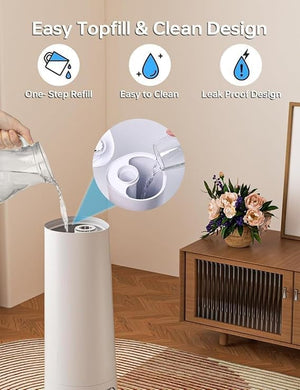



2. Brief clinical staff and the front desk before any patient encounters it. The people working in the space every day should never learn about a new fragrance the same way a patient does — tell them first, and tell them what it's for.
3. Run a two-week trial with that named owner responsible throughout. A trial with no clear owner drifts — nobody adjusts it when it needs adjusting, and nobody notices if it's wrong.
4. Ask staff for their read before asking patients or anyone outside the practice. Staff spend entire days in the space and will notice drift or discomfort long before an outside opinion would.
5. Stop immediately if a partner or senior clinician objects. A divided practice should not be running a scent — an objection from anyone with a stake in the clinic's direction is a reason to stop, not a reason to persuade them.
Vaayu's app control means the named owner can adjust or switch off the setting entirely on their own, without needing to involve anyone else in the room.

Why ownership decides whether a first rollout works
A staged technical rollout — one zone, a low setting, a two-week review — is necessary but not sufficient. Every step in it assumes somebody is actually watching: adjusting the level if it drifts, noticing if a patient reacts, knowing where the off switch is. Without a named person doing that watching, the technical plan is just a schedule nobody follows.
Clinics are not single-owner businesses in the way a shop or a cafe is. A practice manager, a front desk lead and one or more clinicians may all have a view on whether ambient scent belongs in the space at all — and unlike a retail fit-out, a divided view here isn't a minor disagreement, it's a reason not to proceed.
This page is not about which diffuser to buy. It's about the internal decision that has to happen before that purchase means anything: who is responsible, who has been told, and who has to agree before the trial starts.
The three decisions that determine whether a first rollout survives internally
 Sukoon₹1,899Pick the individual — practice manager, front desk lead, or a clinician — who will own the setting for the full two weeks: adjusting it, watching for problems, and holding the authority to switch it off.
Comparing rollouts by who is actually responsible
Two rollouts can use identical equipment and still succeed or fail depending on whether anyone specific owns the setting.
| Setup | Named owner | Staff briefed first | What it costs |
| Fragrance switched on with no discussion beforehand | No — nobody is responsible | No — staff learn about it the same way patients do | ₹749–₹11,999 |
| One staff member asked to 'keep an eye on it' informally | Unclear — no real authority to adjust or stop it | Partially | ₹749–₹11,999 |
| A named owner, staff briefed, but no internal sign-off sought | Yes | Yes | ₹749–₹11,999 |
| A named owner, staff briefed first, and every partner or senior clinician's view sought before starting | Yes — with authority to adjust or stop it | Yes, and internal agreement confirmed | ₹749–₹11,999 depending on equipment |
| The equipment cost is nearly identical across all four rows — what actually separates a trial that survives from one that doesn't is who owns it and who was asked first. | |||
 Vaayu · app control for a single named owner₹11,999Shop → Sukoon · a simpler trial for a small practice₹1,899Shop →
 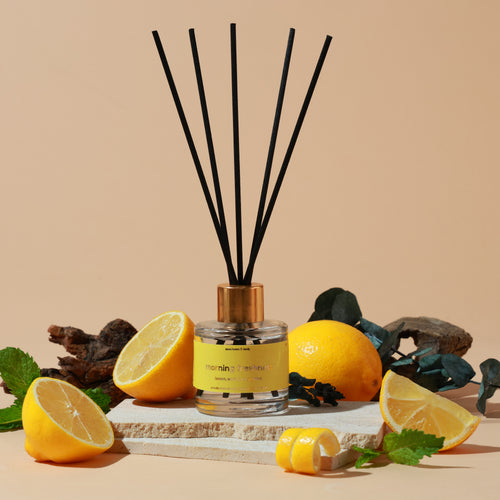 Morning Freshness · the lowest-commitment starting register₹749Shop →
Running the internal side of a first trial
Before any equipment is chosen, name the person who will own the setting for the full two weeks — someone with the standing to adjust the level, notice a problem, and switch it off without checking with anyone else first.
Brief clinical staff and the front desk together, plainly: what's being trialled, why, for how long, and who to tell if something feels off. This should happen before a single patient encounters the fragrance, not after.
Ask every partner or senior clinician for their view before the trial begins, not after it's already running. If any of them objects, stop — a divided practice is not a safe place to be running a scent, however good the technical plan behind it is.
What to buy for a first, internally-owned trial, by size
The equipment matters less here than usual — sizing still follows premises, but every option below assumes one named person is running it.
| Route | Premises | Why | What it costs |
| Vaayu, app-controlled, one named owner | 750 sq ft and above, any practice with more than one decision-maker | App control means the named owner can adjust or switch off from their own phone, without depending on anyone else being present | ₹11,999 |
| Vaayu, onboard buttons only, one named owner | A practice preferring physical controls over an app | Still gives one person sole, immediate control of the setting | ₹11,999 |
| Sukoon ultrasonic, manual dial, one named owner | 300–750 sq ft, a small partnership | Simple enough that ownership doesn't require any technical comfort with an app | ₹1,899 |
| Reed diffuser, one cabin, solo practitioner | Under 300 sq ft, a solo doctor with no partners to consult | The owner and the decision-maker are the same person by default | ₹749–₹849 |
| Aangan, HVAC-integrated, one named facilities owner | Above roughly 3,000 sq ft, a larger multi-partner practice | A larger rollout still needs one accountable owner, even where several partners were consulted first | ₹25,999 |
I ask every clinic the same first question, before we've discussed a single product: who is going to own this? Not who approved the budget — who will actually adjust the level, notice if something's off, and switch it off if it needs switching off.
The clinics where a first trial goes badly are almost never the ones with the wrong diffuser. They're the ones where a fragrance appeared in the waiting room and nobody on the clinical side had been told, let alone asked.
If a partner or a senior clinician tells me they're not comfortable with it, I tell the practice to stop, not to negotiate. A scent running against one clinician's judgement in their own practice was never going to be a good idea, whatever the trial data eventually said.
Questions clinics ask about the internal side of a first rollout
- What is the most conservative way to introduce ambient scent into a medical clinic? — the technical side of the same rollout this page's ownership question sits alongside.
- How do I handle ambient fragrance if some patients are sensitive to strong scents? — the protocol the named owner is responsible for running once the trial is live.
- Should my architect or interior designer plan scent diffuser placement while designing my clinic? — the earliest point at which an ownership decision can be made.
- Is professional scenting worth it for a solo doctor, or only for large clinics? — how the ownership question simplifies for a single-decision-maker practice.
- Brand: the SOSA founder story.
SOSA products & prices (verified September 2026): Reed diffusers 50ml ₹749–₹849 (to 150 sq ft, 6–8 weeks at six reeds) · 130ml ₹1,249–₹1,349 (above 150 sq ft, 14–18 weeks) · reed refill 300ml ₹2,399. Ultrasonic: Boond ₹899 (~150 sq ft) · Sukoon ₹1,899 (270–320 sq ft, ships with three 15ml Hotel Collection fragrances) · Megh ₹3,499 (6L tank, ~100 hrs runtime, ~215 sq ft — a runtime machine, not a coverage upgrade). Waterless cold-air: Safar ₹3,999 (no published coverage figure) · Vaayu ₹11,999 (up to 1000 m³, roughly 2,000–3,000 sq ft; 400ml tank lasting about 90+ days; app and onboard control, 1h/4h/8h/24h run windows, adjustable intensity, key-lock, under 38 dB, freestanding or wall/HVAC mount, 5W, CE/RoHS/SGS) · Aangan ₹25,999 (8,000–10,000 sq ft). Hotel Collection water-based fragrance 15ml ₹299 · 100ml ₹999 · 300ml ₹1,799 is for ultrasonic machines; reed oil and Hotel Collection are not interchangeable. Reed diffusers are alcohol-free, phthalate-free, paraben-free, IFRA-compliant and low VOC, handmade in small batches in Pune. Every purchase funds a girl's education through Nanhi Kali. Prices and availability subject to change — see the live product pages.