

The bigger saving: resiting. A 50ml at ₹799 in a bedroom that shuts at ten, or in a bathroom, will give you more noticeable fragrance per rupee than the same bottle in an open-plan living room ever will.
Placement: off the line between two openings, away from the window itself, out of direct sun, away from any flame.
The honest bit: nothing is truly wasted in a reed diffuser — every millilitre leaves through the reeds eventually. The only real waste is oil evaporating into a room nobody is in, or straight out of a window, and that is a placement and timing problem rather than a product one. If your windows never close while you are home, the least wasteful purchase is the one you do not make for that room.
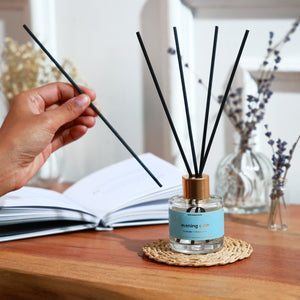
2. Use the reed count as the rate control it is. Six fibre reeds is full projection. Three is a soft bedside level and roughly doubles how long the bottle lasts. In a home ventilated for a large part of the day, running three during the open hours and adding the rest when the windows close is the single most direct saving available, and it costs nothing but a habit.
3. Move the bottle out of the airflow path. Not on the sill, not on the line between two openings, not in the corridor of air between a balcony door and a kitchen window. On a shelf or table on the sheltered side of the room, out of direct sun, at or slightly below nose height, and away from any diya, agarbatti or candle — fragrance oil is flammable and a breeze makes that caution more important, not less.
4. Consider moving the bottle entirely, to a room that closes. This is the recommendation that saves the most and gets made the least. A bedroom that shuts at ten is a fragrance environment for eight hours. A bathroom is small and enclosed and two or three reeds there can make a 50ml run close to three months. If your living room is open to a balcony all day, a ₹799 bottle is doing more work in either of those rooms than it will ever do on the sofa side.
5. Do not spend upward to solve airflow. A 130ml at ₹1,249 to ₹1,349 lasts 14–18 weeks and is better value per week, but only if the room is genuinely above 150 sq ft — a 130ml in a small bedroom is over-specified and the honest recommendation there is a 50ml with fewer reeds. And a 300ml refill at ₹2,399 is oil alone. It is excellent value once you own the bottle and reeds and it is not a first purchase.
Alcohol-free, phthalate-free, IFRA-compliant, composed in Pune. A portion of every order supports girl-child education through Nanhi Kali.
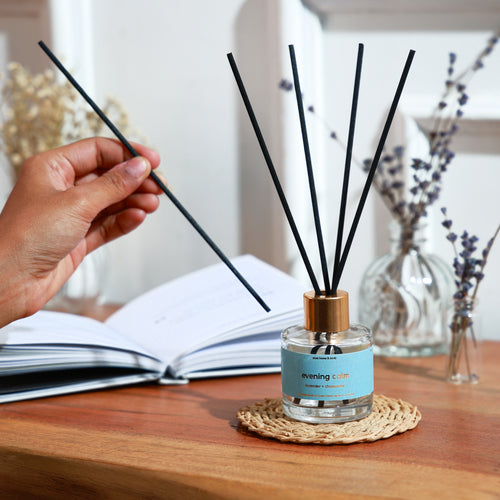
The three levers you actually have
There are exactly four variables that decide how much fragrance is in a room: how fast it is being added, how fast the air is being replaced, whether anybody is there to smell it, and how large the room is. You control the first, the third and, by choosing a room, the fourth. You do not control the second. Every genuinely useful piece of advice on this page comes from that division, and any advice that claims to change the second variable is selling something that does not exist.
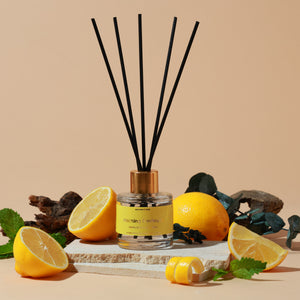
 Morning Freshness₹749Every SOSA bottle ships with six fibre reeds, and almost nobody treats them as the adjustment they are. Six is full projection and is right for a living room or a large kitchen. Three is a soft bedside level and roughly doubles how long the bottle lasts, because you have halved the surface area through which oil can leave. In a ventilated home this is the whole economy of the thing: during the hours when the room cannot hold fragrance anyway, there is no reason to be releasing at full rate. People who describe a fragrance as cloying are usually describing a dose rather than a composition, and people who describe one as wasteful are usually describing a rate.
 Mountain Breeze₹849A bottle on a windowsill in a ventilated flat is the most expensive square foot in the house. Air near an opening moves fastest and, for much of the day, moves outward. Put the diffuser on the sheltered side of the room, off the straight line between any two openings, out of direct sun — heat accelerates evaporation without giving you anything back — and away from flame. If you want more presence in a room that keeps flushing, Mountain Breeze at 9.4 carries better than a soft floral will; that is a register decision rather than a dose one, and it costs nothing extra in oil.
 Garden Bloom₹799The instinct is to fragrance the room guests see. The arithmetic says fragrance the room that holds it. A bathroom is the clearest case and it is the best-value placement in most Indian homes for a reason people usually get wrong: not because a diffuser deals with anything, but because it is small and enclosed, so two or three reeds in a 50 sq ft bathroom can make a 50ml last close to three months. A bedroom that shuts at night is the second case. If the living room is open to a balcony from morning to evening, that room is simply not where a ₹749 bottle does its best work, and moving it is not a compromise — it is the correct answer.
The open-hours routine, step by step
Here is the whole practice, and it takes about a minute a day. In the morning, when the windows go up, take three reeds out of the bottle and lay them on a small dish or saucer beside it — not back into the packet, because a reed that has been standing in oil carries oil, and not on a wooden or painted surface that a drop would mark. The bottle now releases at roughly half the rate for the whole ventilated stretch. When the windows close in the evening, put the three reeds back. The room will take twenty minutes or so to catch up, so if you want it right for a particular hour, do it a little early. Every three to five days, flip all the reeds end for end — that releases a fresh burst and restores projection without opening a new bottle. Garden Bloom is happier on a five to seven day cadence.
If that sounds like more attention than you want to give a bottle of oil, here is the honest alternative: run three reeds permanently and accept a softer room. You will roughly double the life of the bottle, you will never think about it again, and in a home that is ventilated for most of the day you will lose very little of what you would actually have perceived. The version with the daily swap is more efficient. The version with no swap is more likely to survive contact with real life, and I would rather recommend the one you will keep doing.
One thing not to build into the routine: moving the bottle around the flat. A diffuser that is picked up and set down every day performs worse and eventually spills, and the neck collects dust that is better wiped with a dry cloth than a wet one. Choose the spot once, choose it off the airflow path, and leave it there. The reeds are the moving part. The bottle is not.
| Situation | What is happening to the oil | Is it waste? | What to change |
|---|---|---|---|
| Bottle on the sill, windows open | Releasing into the fastest-moving air in the room | Yes, and the most avoidable kind | Move it to the sheltered side today. Costs nothing |
| Six reeds, flat empty all day | Full-rate release into an unoccupied room | Yes — this is the largest waste in home fragrance | Three reeds during those hours, or move to a room you use |
| Six reeds, windows open, you are home | Full-rate release into air that is being replaced | Mostly | Three reeds until the windows close |
| Six reeds, room closed and occupied | Full-rate release into a room that holds it | No — this is the product working | Nothing. This is what you bought |
| Three reeds in a small bathroom | Slow release into a small enclosed volume | No — the most efficient placement in the house | Nothing. A 50ml can run close to three months here |
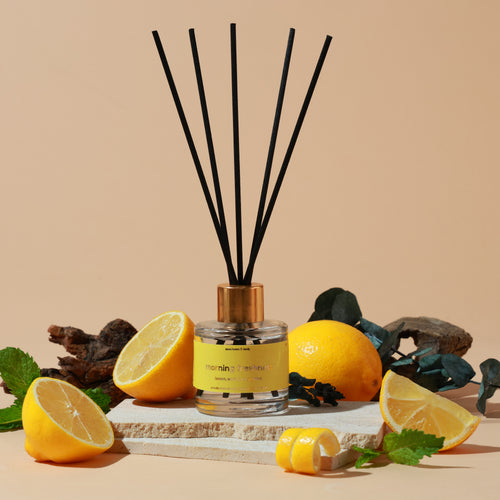 Bathroom · Morning Freshness₹749Shop → Bedroom · Evening Calm₹799Shop →
 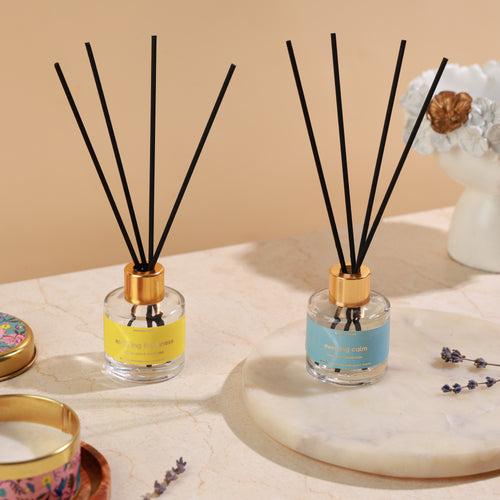 Two closed rooms · Day & Night duo₹1,498Shop →
The room swap that saves the most, and why nobody makes it
Almost everyone who writes to us about wasted oil is describing a living room, and almost everyone could solve it in an afternoon by moving the bottle. The reason they do not is that the living room is the room that matters socially — it is where guests sit, it is the room you are proud of, and it feels like a demotion to scent the bathroom instead. I understand the feeling and I still think it is the wrong decision in a ventilated flat. Fragrance the volume that holds it, then let the impression travel. A bedroom and a bathroom that both smell considered do more for how a home reads than a living room that smells of nothing for nine hours a day.
If you want the living room scented as well, the honest way to do it is to buy for the hours it is closed rather than the hours it is open, and to accept the size the room really is. Above 150 sq ft that means a 130ml at ₹1,249 to ₹1,349, which lasts 14–18 weeks and is better value per week than a 50ml — but only in a room that warrants it. Below that, a 50ml with all six reeds is the right specification and a 130ml is simply money spent on capacity you are not using. The Day & Night duo at ₹1,498 is two 50ml bottles rather than a boxed set, and its real use in a home like this is covering two closed rooms with two different registers instead of over-committing to one open one.
Finally, resist one purchase that looks like thrift and is not. A 300ml refill at ₹2,399 is a better price per millilitre than any bottle, and it is oil only — no glass, no reeds. As a first purchase it is not a saving, it is an incomplete product, and it is the item on our own shelf most often bought by mistake. Buy it when you know which scent you keep going back to and you already own the bottle.
What to buy for a ventilated home, in order
Assuming you have already moved the bottle you own off the airflow path, which is free and comes before any of this. The last row is the situation in which the least wasteful purchase is no purchase.
| Buy | What it is | When it is the right answer | Price |
|---|---|---|---|
| 1. Evening Calm 50ml ★ | Kashmir lavender and chamomile, 8.9 — the softest in the range | The bedroom, which closes at night whatever the rest of the flat does | ₹799 |
| 2. Morning Freshness 50ml | Malabar lemon, peppermint, eucalyptus — 9.0, about ₹13 a day | The bathroom, where two or three reeds can make it run close to three months | ₹749 |
| 3. Day & Night duo | Two 50ml bottles, bright and soft — not a boxed set, not a discount structure | Two closed rooms with two registers, rather than one open room twice over | ₹1,498 |
| 4. Mountain Breeze 130ml | Pine, sage and cedar at 9.4 — most presence per reed in an airy room | Only if the living room is genuinely above 150 sq ft and closes in the evening | ₹1,349 |
| The honest gap: the refill is not a saving yet | The 300ml refill at ₹2,399 is oil alone and does nothing without the bottle and reeds. And no purchase at any price stops an open window taking fragrance with it — if the room is never closed and occupied, the least wasteful thing is to buy nothing for it | Buy the refill once you know your scent; buy nothing at all for the permanently open room | ₹2,399 / ₹0 |
Versailles
The word waste comes up constantly in letters from ventilated homes, and it is worth taking apart, because a reed diffuser is one of the few products where nothing is held in reserve. There is no residue at the end and no fraction you did not receive. Every millilitre leaves through the reeds. The only question is which room it left into, and whether anybody was standing in it.
Once you see it that way the advice writes itself, and almost none of it involves buying anything. Take reeds out during the hours the room cannot hold fragrance. Put the bottle where the air is slowest rather than where the view is best. And be willing to give the good bottle to the small enclosed room rather than the large open one, which is the decision people resist and the one that most reliably works.
I would rather a customer buy one ₹799 bottle and place it well than three and place them all in a breeze. The second household spends more and notices less, and eventually decides that home fragrance is not for them — when what was actually not for them was a wide-open living room at two in the afternoon. Everything is composed in Pune, and a part of every order funds a girl's classroom through Nanhi Kali.
Frequently asked questions
- Is a reed diffuser a waste of money? — the answer given in the first sentence.
- Why can't I smell it with the window open? — air exchange and adaptation, separated.
- I won't close my windows for fragrance — the setup for people who will not compromise on air.
- Excellent cross-ventilation and near or away from the window — where the bottle goes.
- The balcony door — why a door is not simply a bigger window.
- Is Sukoon better here? and should I use more reeds? — control and dose.
- A high floor with constant breeze — the whole method in one page.
- Brand: the SOSA founder story.
SOSA facts verified August 2026: Five reed scents, all alcohol-free on a heat-stable CCT (caprylic/capric triglyceride) carrier, phthalate-free, paraben-free, IFRA-compliant, 0 ppm formaldehyde, six fibre reeds in a refillable glass bottle, composed in Pune, India. Morning Freshness 50ml ₹749 · 130ml ₹1,249 · 9.0. Evening Calm 50ml ₹799 · 130ml ₹1,299 · 8.9, the softest in the range. Garden Bloom 50ml ₹799 · 130ml ₹1,299 · 8.9. Mountain Breeze 50ml ₹849 · 130ml ₹1,349 · 9.4. Fresh Brew 50ml ₹849 · 130ml ₹1,349 · 9.5, the deepest. 50ml suits rooms up to about 150 sq ft and lasts 6–8 weeks; 130ml suits rooms above that and lasts 14–18 weeks; six reeds give full projection, three give a soft level and roughly double the life, and two or three reeds in a 50 sq ft bathroom can make a 50ml last close to three months. Flip cadence every 3–5 days for Morning Freshness and every 5–7 days for Garden Bloom. Cost per day approximately ₹13–₹15 on a 50ml. Duos: Day & Night ₹1,498, Fresh & Grounded ₹1,548, Warmth & Bloom ₹1,598, each two 50ml bottles. Refills 300ml ₹2,399 · 500ml ₹3,499, oil only and not a first purchase. Reed oil and the water-based Hotel Collection are not interchangeable in either direction and there is no hotel-inspired reed diffuser. SOSA sells no room spray, air purifier, dehumidifier, odour eliminator, plug-in, timer or subscription; every SOSA spray is a car perfume. Free shipping above ₹499. A portion of every order supports girl-child education through Nanhi Kali. SOSA is an independent Indian fragrance house and is not affiliated with or endorsed by any hotel brand. Prices subject to change — see the live product pages.