
 Garden Bloom ₹799
 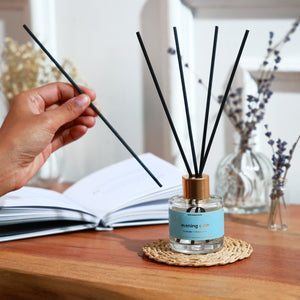 Evening Calm ₹799
 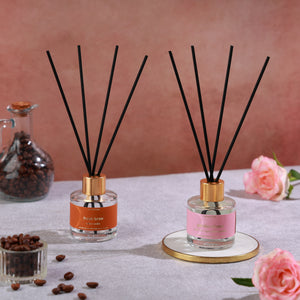 Warmth & Bloom duo ₹1,598
 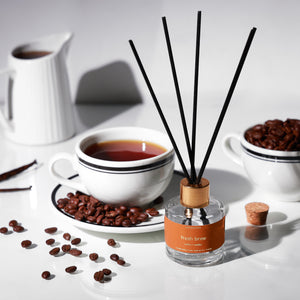 Fresh Brew ₹849
  Morning Freshness ₹749
Do not correct for your own nose. Adding reeds because you cannot smell it is how homes end up too strong for everyone else — nine reeds also runs a 50ml down in about five weeks instead of eight.
Silence is not evidence. Most people never mention a smell at all. No comment means no data, not an empty room.
Ask at the door, not after dinner, and ask a question that does not lead — by the end of an evening your visitor has adapted too.
2. Their reading is better than yours, and you should act on theirs. No prior exposure, arriving from different air, and no expectation about what they are supposed to notice.
3. An unprompted comment is the gold standard. If someone mentions it before you have said a word, the level in that room is right and there is nothing to fix.
4. Ask at the door, not at the end of the evening. Your visitor adapts too, over an evening in the same room. The first minutes are when their nose is worth anything.
5. Do not lead the witness. "Doesn't the flat smell lovely?" gets you agreement, not information. "Did you notice anything when you came in?" gets you a reading.
6. Silence proves nothing. Most people never comment on how a home smells. Absence of a remark is absence of data, not evidence of an empty room.
7. Do not correct for your own nose. Adding reeds because you cannot smell it is the commonest route to a flat that is too much for everybody else — and nine reeds runs a 50ml down in roughly five weeks instead of eight.
Everything is composed and handmade in small batches in Pune, tested through 45°C summer heat and 85% monsoon humidity, and a portion of every order supports girl-child education through Nanhi Kali.

Part one — why an arriving nose is the better instrument
It is worth being precise about why a visitor reads your home better than you do, because the reasons also tell you how to use them. Three separate advantages stack in their favour, and none of them is about having a better sense of smell.
 Evening Calm₹799 · 50mlYou paid for the bottle, you know which shelf it is on, and you have a view about whether it is working. That makes every test you run on yourself a test with an interested party holding the clipboard, usually at the exact moment you already suspect the answer. A visitor has none of that: they are taking their shoes off and thinking about the traffic. Which is precisely why an unprompted comment is worth ten answers to a question you asked. The moment you say "can you smell anything?", you have told them there is something to find, and most people will oblige you. If you must ask, ask something flat and open — "did you notice anything when you came in?" — and ask it early, before an evening in the same room has adapted them too.
Part two — whose nose proves what
Six witnesses to the same room, ranked by how much their reading is worth. The columns are deliberately about evidence rather than about strength.
| Whose nose | How that nose arrives at your room | What their reading can prove | What it cannot |
|---|---|---|---|
| A first-time visitor, arriving from outside ★ | From a street, a lift, another building — a real change | That the room is scented, and roughly at what level | How much oil is left, or what other rooms are like |
| A friend who comes every week | From outside, but into a home they half know | Whether anything has changed since last time | An absolute reading — they have adapted a little too |
| Someone who lives with you | From the next room, in the same clothes, in the same air | Very little. Roughly as adapted as you are | Almost anything useful about the level |
| You, arriving at your own doorway from outside | A genuine arrival, but into a familiar background | Whether the room reads at all — usable | A neutral judgement; you know what you are looking for |
| You, sitting in the room testing on purpose | No arrival at all | Nothing. This is the reading that causes overbuying | Any conclusion whatsoever about the bottle |
| Someone who stands at the open door but never comes in | A single breath of your entrance only | What the doorway zone is like, which is worth knowing | Anything about the rooms behind it |
| The honest caveat: nobody's nose tells you how much oil is left, so pair any of these with the calendar — 6–8 weeks on a 50ml, 14–18 on a 130ml — and the wet line on a lifted reed. Silence from a visitor is not a reading in either direction; most people do not mention smells at all, and some are being polite. Nothing here removes adaptation on demand, and no technique is offered as doing so. A reed diffuser adds a fragrance alongside whatever is already in your air; it removes, neutralises and purifies nothing, so a visitor noticing something you dislike is a source-and-ventilation problem, not a fragrance one. | |||
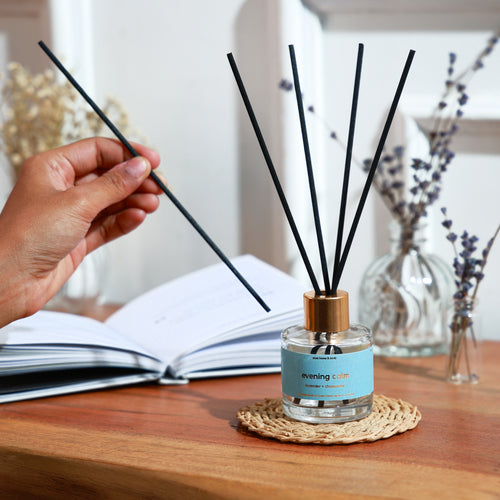 Evening Calm · if a visitor found the flat too much₹799Shop →
 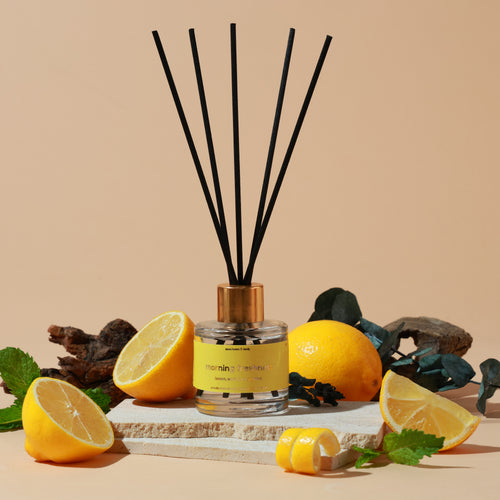 Morning Freshness · the least polarising in the range₹749Shop →
 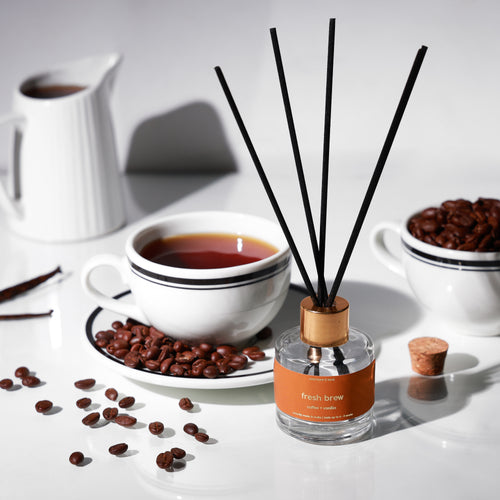 Fresh Brew · the fullest, for a room nobody notices₹849Shop →
Part three — the over-correction trap, and what this page is not about
There is a predictable path from this question to an unpleasant flat. You cannot smell it, so you add two reeds. A week later you cannot smell it, so you add two more. Then a second bottle in the same room, then a stronger composition. Your own experience never improves, because you adapt to each new level in turn — but everybody walking through the door is now meeting a room you would not have chosen. Reed count costs bottle life roughly in proportion: nine reeds runs a 50ml down in about five weeks instead of eight, ten in four or five. So over-correcting is paid for twice, in weeks and in other people's comfort. If a visitor says they could smell your flat from the landing, take two reeds out — and keep them clean and dry, because replacement reeds are not sold separately.
The opposite error is reading silence as absence. Most people say nothing about how a home smells, in the same way most people say nothing about the paint. Politeness accounts for some of it and simple inattention for most. So "nobody has ever mentioned it" is not evidence that your room is unscented — it is no evidence at all, and the fix is to ask one neutral question at the door rather than to add reeds in silence. And there is one visitor whose comment overrides everything else: somebody who finds the room uncomfortable. Some people are genuinely sensitive to high floral intensity, and the answer for them is less fragrance rather than a different one. Take reeds out, or move the bottle to another room for the evening. Both are free, both work, and neither requires you to decide who is right.
Two last things about what this page is not. It is not a page about getting compliments, and I would not write one. I make no claim about how your home will be perceived, whether anyone will mention it, or what a room with a reed diffuser in it says about you. What I can describe is what the product does: it adds a scent alongside whatever is already in your air, at a low constant level, for 6–8 weeks on a 50ml or 14–18 on a 130ml. It removes nothing and cleans nothing. If a visitor notices a smell you would rather they had not, fragrance is not the tool — find the source, ventilate or extract, then think about scent. And if what you want is a room that reads at a chosen moment, that is a Sukoon at ₹1,899, bought for control rather than strength; it adds moisture, since it works by aerosolising water, and takes only the water-based Hotel Collection.
Part four — what the visitor said, and what to do about it
Seven things people say, and what each is worth. Five cost nothing to act on.
| What the visitor actually said | What it means about the bottle | What to change | Spend |
|---|---|---|---|
| "What is that? Your flat smells lovely" — unprompted ★ | The level is right and the bottle is working | Nothing at all. Flip the six reeds weekly | ₹0 |
| "I could smell it from the landing" | Working hard — probably too much for that space | Take two reeds out; keep them clean and dry | ₹0 |
| "Lovely, but a bit much in here" | Right product, wrong intensity for a small room | Three or four reeds, or move it to a larger room | ₹0 |
| "I noticed it coming in, but not now" | Perfectly normal — they have adapted too | Nothing. A level does that to every nose | ₹0 |
| Nobody has mentioned anything, and you never asked | No data in either direction | Ask one neutral question at the door | ₹0 |
| "I can't smell anything" — and the bottle is past its range | Genuinely spent, and now confirmed by a second nose | 300ml oil refill, or a new bottle if reeds have darkened | ₹2,399 · or ₹749 |
| "I can't smell anything" — and the bottle is well inside its range | The room, not the bottle: too large, too open, too draughty | Reposition first; then a second source elsewhere | ₹0, then ₹749–₹849 |
Versailles
In evaluation you never trust a single nose, and never the one that has been living with the trial. You bring somebody in cold and watch their face before they speak. That is the whole method, and it translates directly to a flat: the person taking their shoes off in your doorway is running the exact test a perfumer would pay for.
I learned the over-correction lesson in my own home. There was a season when I kept nudging the bedroom bottle up — an extra reed here, a fuller composition there — because I could not read it any more. A friend stayed the weekend and said, very kindly, that the room was a lot. She was right. I had spent weeks calibrating a room to the one nose in the building that could not measure it.
So the discipline I would pass on is small and free. Ask one flat question at the door, then say nothing. Believe the answer even when it contradicts your own experience, particularly when it contradicts your own experience. And if nobody says anything at all, that is not a verdict — it is just people being people. Made in small batches in Pune, and a part of every order funds a girl's classroom through Nanhi Kali.
Frequently asked questions
- Weak bottle or adapted nose? — the four-check diagnostic, with the visitor as check four.
- Why you smell it entering but not sitting — the same mechanism, on your own nose.
- How long before it settles? and why you notice it again after being out.
- When to stop tuning reeds and buy a Sukoon — control, never strength.
- Brand: the SOSA founder story.
SOSA range, specifications and prices used in this guide (verified from the live store, 27 August 2026): Reed diffusers — alcohol-free, phthalate-free, paraben-free and IFRA-compliant compositions on a heat-stable coconut-derived (CCT) carrier, low-VOC, in a refillable glass bottle with six fibre reeds; flip weekly. 50ml lasts 6–8 weeks and 130ml lasts 14–18 weeks; there is no 100ml reed diffuser size. Morning Freshness (Malabar lemon · peppermint · Nilgiri eucalyptus) 50ml ₹749 · 130ml ₹1,249; Garden Bloom (British rose · night-blooming jasmine) ₹799 · ₹1,299; Evening Calm (Kashmir lavender · chamomile) ₹799 · ₹1,299; Fresh Brew (Coorg coffee · Kerala vanilla) ₹849 · ₹1,349; Mountain Breeze (Himalayan pine · sage · Indian cedar) ₹849 · ₹1,349. Duo sets ₹1,498–₹1,598 for 2 × 50ml and ₹2,498–₹2,598 for 2 × 130ml. Oil-only refills 300ml ₹2,399 · 500ml ₹3,499 — the glass vessel and reeds are not included, and replacement reeds are not sold as a separate product. Machines: Boond 300ml ₹899 (~150 sq ft, about 6 hours a fill) · Sukoon 500ml ₹1,899 (270–320 sq ft, 16–18 hours on low, three 15ml fragrances included) · Megh 6L ₹3,499 (~215 sq ft — a runtime and humidity machine that covers less than a Sukoon, never a coverage upgrade) · waterless Vaayu ₹11,999 · Safar ₹3,999 (a car and travel product) · Aangan ₹25,999 · Meenar ₹38,500. The water-based Hotel Collection for ultrasonic machines (15ml ₹299 · 100ml ₹999 · 300ml ₹1,799 · pack of seven 15ml ₹1,799) cannot be used in a reed bottle or a Vaayu. Below ₹749: jar candles ₹379, Sandalwood or Smoked Oudh candle ₹449, wax melts ₹474 (a burner is required and not included), mugs ₹474, bubble and taper candles ₹569, Amber Rose candle ₹599, ceramic trinket dish and candle two-pack ₹664. A reed diffuser adds fragrance to a room. It does not clean, purify or filter air, remove or neutralise cooking, damp or smoke smells, reduce humidity, or change how anyone feels. A reed diffuser adds no moisture to the air; ultrasonic machines work by aerosolising water and therefore do. A persistent musty smell indicates moisture that needs finding and drying, and SOSA sells no dehumidifier or air purifier. Ventilate or extract first; add fragrance second. Evaporation rate rises with warmth and falls with humidity, and airflow carries scent away from the bottle — so performance varies with season, ventilation, ceiling height and room use; longevity figures are typical ranges, not guarantees. Not noticing a constant fragrance is ordinary olfactory adaptation; the reliable checks are leaving the room and returning, or asking someone who has just arrived. Strength figures are positions on SOSA’s own internal scale, not an industry standard. Fragrance oil is flammable — keep bottles away from open flame and out of direct sunlight, and out of reach of children and pets. Composed and handmade in small batches in Pune, India; tested through 45°C summer heat and 85% monsoon humidity. Free shipping above ₹499. A portion of every order supports girl-child education through Nanhi Kali. Prices subject to change — see the live product pages.