



Woody: the best-behaved family in a room. Low volatility, holds a level for hours, reads as expensive and coexists with an open door.
Floral: the highest-risk family at a viewing, because floral preference is strongly personal. A wrong floral is the one a buyer will actively dislike.
Gourmand or sweet: wrong at every price point. It reads as domestic and cheap in a formal space. There is nothing sweet in the seven Hotel Collection scents.
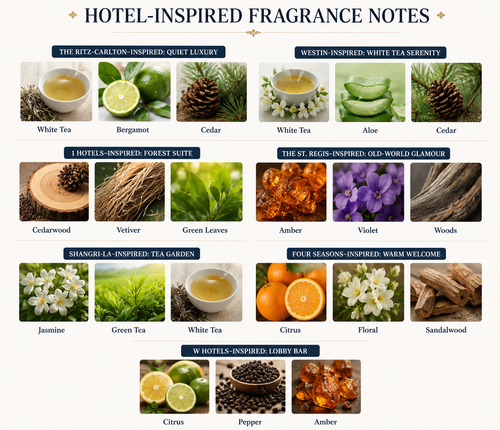
Hotel-like: not a family but a strategy — composed a level under, for a stranger passing through. That is precisely the brief a property viewing has, and the answer is a woody-fresh accord composed that way: the Ritz-Carlton-inspired Quiet Luxury, white tea, bergamot and cedar.
2. Woody is the best-behaved family in a room. Cedar, vetiver and sandalwood are heavy, slow, low-volatility materials. They reach a level and hold it for hours, they survive a door opening, and they read as considered rather than as scented.
3. Fresh and citrus is the safest to like and the fastest to leave. The materials that make a fragrance read as fresh are the lightest in perfumery. They are pleasant to almost everybody and they are gone from an unattended room in under an hour, which is why they work only with the machine still running.
4. Floral is the highest-risk family at a viewing, and it is not close. Floral preference is intensely personal and often tied to a memory. A wrong floral is not ignored, it is disliked, and dislike is the one outcome you are paying to avoid.
5. Sweet and gourmand is wrong at every price. It reads as domestic, as confectionery and as inexpensive in a formal space, whatever the materials cost. There is nothing sweet in the seven Hotel Collection scents, which on this page is a convenience rather than a limitation.
6. So the answer is woody-fresh, composed the hotel way and run low. The Ritz-Carlton-inspired Quiet Luxury — white tea, bergamot and cedar — on the Vaayu at ₹11,999, from two hours out, at a level nobody in the property would be able to describe.
A portion of every order supports girl-child education through Nanhi Kali.
Why the four words are not four of the same thing
The reason this question is hard to answer cleanly is that it mixes two different kinds of category. Fresh, woody and floral tell you what a fragrance is made of. Hotel-like tells you how it was written — and specifically, how much of itself it was allowed to be. A hotel scent can be woody, or fresh, or in a few unfortunate cases floral. What makes it a hotel scent is that the perfumer built it for somebody who did not choose it, will not be asked about it, and may be walking through the same space four times a day for a week. That is a brief almost nobody in retail perfumery ever writes to, and it happens to be, almost exactly, the brief a property viewing hands you.
The families, assessed for a viewing
Each register judged for one job only — a stranger in a property they are considering buying, for forty minutes, with a door that opens. The third column is behaviour over that duration rather than first impression, and the fourth is what it costs you when the choice goes wrong, which is the column that actually decides the ranking. Two of the six I would not run at a viewing at all.
| Family | Typical materials | Behaviour over a forty-minute viewing | What it costs when it fails | At a viewing |
|---|---|---|---|---|
| Woody-fresh, hotel-composed ★ | Cedar and vetiver under white tea and restrained bergamot | Arrives quickly on the light top, then holds a flat level on the wood base for hours. Survives a door opening | Almost nothing. Its failure mode is going unnoticed, which is also its objective | The answer. Ritz-Carlton-inspired or 1 Hotels-inspired, run low |
| Woody, on its own | Cedarwood, vetiver, sandalwood | The best-behaved family in a room. Low volatility, slow dispersal, no drift towards sweetness as it settles | At a high dose it can read as severe or slightly masculine, which narrows the room rather than dividing it | Yes, and it is what the answer above is built on |
| Fresh and citrus | Bergamot, lemon, green leaf, aldehydes | The most volatile materials in perfumery. Bright immediately, thin by minute twenty-five, and prone to oxidising flat | Little dislike, but you paid for a scent that is not there when the offer conversation happens | Only as the top of a composition, with the machine still running |
| Floral | Jasmine, tuberose, rose, soft white florals | Frequently accumulates rather than plateauing, so it is more present at minute forty than at minute one | Active dislike. Floral preference is autobiographical, and a wrong floral becomes a topic | No. The highest-risk family with an unknown buyer |
| Amber and plush | Amber, violet, polished woods | Slow, heavy and long. Settles low and stays well after the machine has stopped | Reads as deliberate. Correct for a formal evening viewing, heavy at eleven in the morning | Occasionally, in a large formal room after dark, run very low |
| Gourmand and sweet | Vanilla, caramel, tonka, ripe fruit, praline | Accumulates, and turns confectionery in a large volume rather than holding a clean line | It reads as inexpensive whatever it cost, and as domestic in a space that should feel formal | No, at any price. Nothing sweet is made in the SOSA diffuser range |
Default · Ritz-Carlton-inspiredfrom ₹299Shop → Driest · 1 Hotels-inspiredfrom ₹299Shop → 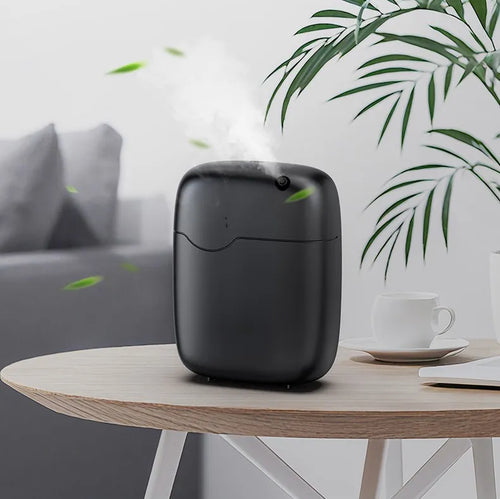 Holds the level · Vaayu₹11,999Shop →
Composing a level under, and how that is actually run
Turning all of that into a setting is simpler than the theory suggests, and it starts with an instruction that sounds like false modesty and is not. Whatever intensity you were going to use, use the one below it — and then judge from outside the property rather than inside it. The composition has already been pitched under by the perfumer; running it hard puts it back where it was designed not to be, and a hotel-style woody-fresh at a high output stops being hotel-like and starts being a scented flat. On the Vaayu that means the lowest usable setting, started two hours before the appointment on the 4h timer, with the machine sited at waist height or above at the edge of the entrance zone rather than in a doorway or the path of a vent. The reason this particular family tolerates a low setting so well is the base: cedar and vetiver hold a flat, even level for hours at very low concentration, which is precisely what a citrus-led composition cannot do. If you have ever run a fresh scent for a viewing and found it strong at the door and absent in the third room, that was not a dosing error — it was a volatility gradient, and no amount of turning it up will fix it, because turning it up makes the top louder without making the tail longer. The correct fix is a composition with a heavier base, run lower. That is the whole practical content of this page.
Then two adjustments worth knowing, because the answer is not identical in every property. The first is temperature. Warmth accelerates evaporation, so an unshaded flat at thirty-one degrees in May makes every top note louder and every base note relatively quieter — the same bottle at the same setting reads brighter, thinner and shorter than it did in December. In a hot property, or one where the air-conditioning has only just been switched on, the driest and least top-heavy option is the safer one, which is why the 1 Hotels-inspired Forest Suite is the standing recommendation for a warm flat, a ground floor, or a property where the kitchen has no door. In a cool, well-conditioned apartment the Ritz-Carlton-inspired has more room to work and is the better default. The second is the size of the volume, which changes which family survives rather than only how much you use. In a small flat under about 1,200 sq ft the lightest of the seven, the Westin-inspired White Tea Serenity, is genuinely sufficient and reads as fresher air rather than as fragrance. In a large volume the same bottle simply disappears, and the instinct to compensate by raising the output produces a strong patch near the machine and nothing at the far end. Change the bottle rather than the setting: a heavier base distributes better at low output than a light one does at high output, every time. If you own the machine and one bottle, own the woody one.
Then the constraints and the honest part. The families this page rules out are not ruled out because we do not make them — although in the case of sweet, we genuinely do not, and there is nothing gourmand anywhere in the seven Hotel Collection scents. They are ruled out because of what they do in a property being sold to a stranger. If you personally love a tuberose, run it in your own home, where you have chosen it and where the only nose involved is yours. The reed diffuser line from ₹749 has its own alcohol-free scents including florals, and it is a reasonable thing to own for a house you live in, though it needs 24 to 72 hours to reach its working level, which makes it the wrong instrument for a viewing on Saturday and a sensible one for a listing shown over months. Candles from ₹379 scent a room in fifteen to twenty minutes and must be attended and put out, so they belong in an occupied property and never in one standing empty between appointments. The Sukoon at ₹1,899, Boond at ₹899 and Megh at ₹3,499 are water-based ultrasonics adding 30 to 50 millilitres of water an hour, which is fine in an occupied room and wrong in a closed listing in monsoon. And the limit that sits over all of it: none of this is a way of dealing with a property that smells of something it should not. No family, however well-behaved, is a treatment for damp, a drain, smoke damage or anything with a physical cause. Those are material facts about a property. Find them, fix them or disclose them, and choose a fragrance family for a listing that is genuinely sound. I would also say plainly that nothing on this page claims a fragrance family affects a price, an offer or a time on market. It affects how a room feels for the hour somebody is standing in it, which is presentation, and presentation is worth doing properly.
The SOSA edit
The families translated into actual bottles, in the order I would buy them for a portfolio of viewings. The last two rows are the ones to leave out of a listing, and one of them is a register the range deliberately does not contain at all.
| Buy | Family and notes | Why it is in this position | Price |
|---|---|---|---|
| 1. Ritz-Carlton-inspired · Quiet Luxury ★ | Woody-fresh, hotel-composed. White tea, bergamot and cedar | The default for any viewing. A fresh top for arrival on a wood base that holds a level for the whole visit | from ₹299 |
| 2. 1 Hotels-inspired · Forest Suite | Woody, taken further. Cedarwood, vetiver and green leaves | The driest of the seven. For warm properties, ground floors and any flat where the kitchen has no door | from ₹299 |
| 3. Westin-inspired · White Tea Serenity | Fresh-clean at the light end. White tea, aloe and cedar | Flats under about 1,200 sq ft, where it reads as better air rather than as a fragrance. Lost in a large volume | from ₹299 |
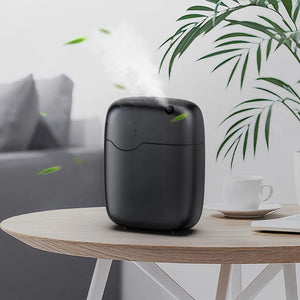
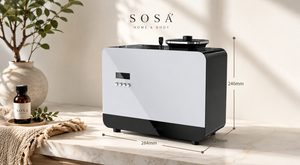
| 4. SOSA Vaayu | The machine, not a family — waterless, up to 1000 m³, timers, app, key-lock, 0.9 kg | Because a fresh top only survives with the machine still running, and a timed level is the point of all this | ₹11,999 |
| 5. Pack of 7 at 15ml | All seven, including the two florals and the plush amber | Only if you want to judge the families by nose rather than by argument. ₹1,799 against ₹2,093 singly, saving ₹294 | ₹1,799 |
| Leave out: florals and anything sweet | Jasmine-led and soft-floral compositions; and gourmand, which the diffuser range does not contain at all | Floral is the family a buyer actively dislikes rather than ignores. Sweet reads as inexpensive in a formal space at every price | — |
Versailles
I have spent a fair part of my working life on the problem this page describes, and the thing I find hardest to explain to people is that a good viewing fragrance is deliberately a less interesting fragrance. When a composition is written for a lobby or a corridor, the brief the perfumer is handed is essentially a list of things not to do. Do not be memorable. Do not be nameable. Do not be strongest at the entrance. Do not have a personality somebody could disagree with. What comes out the other end of that process is a scent that seems almost disappointing on a blotter and is completely right in a room, and it takes most people one property to believe it. It certainly took me longer than one when I started.
The families themselves I would put like this, in the plainest way I can. Woods are the only family that behaves properly in a large volume over a long period, because the materials are heavy and slow and do not change character as they settle. Citrus is loved by everybody and gone by the time it matters. Florals are where taste becomes autobiography, and you cannot know a stranger's autobiography. Sweetness I will not make for a diffuser at all, and that is a choice rather than a gap. So the answer is woods with something fresh over them, written under, run low, and started early enough that nobody meets it climbing. That is not a fashionable answer. It is the one I would want if somebody were showing my house.
Everything is made and supported from Pune, and a part of every order funds girl-child education through Nanhi Kali. You get a space that smells like somewhere considered; a girl gets a classroom. That equation has always felt right to me.
Frequently asked questions
- The best fragrance for showing a premium home to buyers — the seven ranked for a viewing.
- What fragrance makes an expensive apartment feel more premium — why some registers read as expensive.
- Can a home smell too strong during a luxury viewing — the level, and how people get it wrong.
- The safest fragrance strategy when you do not know a buyer's preferences — the group pillar.
- Brand: the SOSA founder story.
Facts verified August 2026: Product facts used in this guide. SOSA Vaayu ₹11,999: waterless cold-air nebulising diffuser, atomises undiluted fragrance oil to a dry residue-free nano-mist, coverage up to 1000m³ (approximately 2,000–3,000 sq ft), 400ml refillable tank lasting up to about 75 days per fill, Bluetooth app plus onboard control, 1h/4h/8h/24h timer scheduling, adjustable intensity, under 38 dB, DC 12V/1A at 5W, 165 × 80.5 × 215 mm and 0.9 kg, freestanding or wall/HVAC mounted, auto-stop and key-lock, CE, RoHS and SGS certified, supplied with four hotel-inspired fragrances. SOSA Aangan ₹25,999: HVAC-connected or standalone commercial nebulising diffuser, coverage up to 3,000m³ (roughly 8,000–10,000 sq ft), 800ml reservoir, metal body, programmable schedules, under 42 dB. Ultrasonic machines are water-based and consume 30–50 ml of water an hour: Sukoon ₹1,899 (500ml, 270–320 sq ft, 16–18 hours on low, 3–6 drops per tank, steady/2H/4H timers, three 15ml Hotel Collection scents included), Boond ₹899 (300ml), Megh ₹3,499 (6 litres). Hotel Collection water-based fragrance 15ml ₹299, 100ml ₹999, 300ml ₹1,799, Pack of 7 at 15ml ₹1,799 against ₹2,093 bought singly; the Vaayu and Aangan take their own undiluted oil rather than these water-based bottles. Reed diffusers (separate alcohol-free line) from ₹749, requiring 24–72 hours to reach their working level. Scented candles from ₹379, scenting a room in roughly 15–20 minutes but requiring attendance. Free shipping above ₹499. Timings: a nebulising diffuser reaches a working level within minutes and a stated viewing level well inside two hours. This guide makes no claim that fragrance affects a property's price, offer level or time on market; it is presentation, in the same category as photography, styling and lighting. Fragrance must never be used to conceal a material defect. SOSA is not affiliated with or endorsed by any hotel brand. Prices subject to change — see the live product pages.