



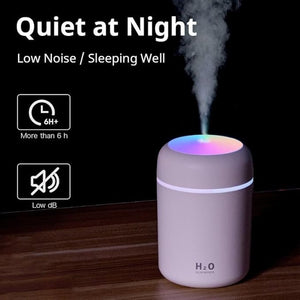
Why it is usually fine in an AC room: a split unit condenses several litres of water out of the same room over a night. A 2H run on low puts back 60 to 100 millilitres. The machine removing water is working in thousands of millilitres and the machine adding it is working in tens.
When it is the wrong machine, plainly: a room that already feels clammy; a monsoon flat you are drying out; a basement or ground-floor room with seepage; any wall or window where condensation is already forming. Do not run it in those.
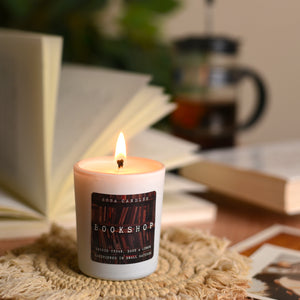
What to use instead: a candle from ₹379 or a reed diffuser from ₹749. Neither adds any water to the air at all.
2. In a normal air-conditioned room, that number is small against what the AC is doing. A split unit condenses several litres of water out of the room's air over a hot night and sends it down the pipe outside your wall. A two-hour run on low puts back 60 to 100 millilitres. One machine is working in thousands of millilitres and the other in tens.
3. Which is why it is often pleasant rather than merely tolerable. The most common complaint about a sealed air-conditioned bedroom is a dry throat at seven in the morning, and a small amount of moisture returned to a room that is being aggressively dried is a comfort rather than a problem.
4. And now the four rooms where it is the wrong machine and I will say so. A room that already feels clammy. A monsoon flat you are actively trying to dry out. A basement or a ground-floor room with seepage. Anywhere condensation already forms on a wall, a window or the cold side of a cupboard. Do not put a cool-mist machine into any of those, whatever it costs and whoever is selling it.
5. In those rooms, buy a candle at ₹379 or a reed diffuser from ₹749 instead. Neither adds a drop of water to the air. That is the honest recommendation on this page and it points at the cheapest products on it rather than the dearest, which is how you can tell it is honest.
A portion of every order supports girl-child education through Nanhi Kali.

The arithmetic, in millilitres and litres
This question deserves numbers rather than adjectives, and the numbers are easy to get hold of because both machines publish them, one on its box and the other through the pipe on your wall. The thing people get wrong is not the direction of the effect — of course a mist machine adds moisture — but the size of it relative to the appliance already running in the same room. Once you put the two figures beside each other the answer stops being a matter of opinion, and so does the list of rooms where the answer changes.
Room by room: run it, run it low, or do not run it
Six rooms, and what I would actually say to each of them if you wrote to ask. The first row is the case this page is mostly about and the answer there is yes. The last three rows are the ones where the answer is no, and where the correct product costs a fraction of the machine you were considering.
| The room | Should you run a cool-mist ultrasonic | Why | What I would buy instead |
|---|---|---|---|
| A normal air-conditioned bedroom, dry walls ★ | Yes — on low, on the 2H timer, three drops | The AC removes litres over a night and the diffuser returns tens of millilitres. The dryness is the bigger complaint of the two | Nothing. This is the machine's best room |
| An AC room where you wake with a dry throat | Yes, and this is the case it genuinely helps with | Eight hours of dehumidification in a sealed room takes the humidity lower than most people would choose. A small steady return is a comfort | Nothing, but run it on 2H rather than all night |
| A study or office with the AC on all day | Yes, on low, but stop it when you leave the room | There is no case for misting an empty room, and the auto shut-off and timers exist for exactly this | Nothing — use the 2H or 4H timer |
| A monsoon flat you are trying to dry out | No | Indoor humidity commonly runs 80–95 per cent in those months and growth accelerates above about 60. Adding water is working against yourself | A candle from ₹379 or a reed from ₹749 — no water added |
| A basement or ground-floor room with seepage | No | Moisture is arriving through the structure continuously. This is a repair, not a fragrance decision, and no machine should be adding to it | A reed diffuser, after the wall is dealt with |
| Any room where condensation already forms | No, and stop if it appears after you start | Condensation means the air in that room is already at its limit. Nothing should be adding moisture to it | A candle — and find where the water is coming from |
Sukoon · low, 2H timer₹1,899Shop →  Candle · no water added₹379Shop →
  Reeds · no water addedfrom ₹749Shop →
Low, timed, and a metre from anything
Start with the settings, because almost every complaint about dampness from a diffuser comes from running it the way the box makes possible rather than the way the room needs. Low, not high. High is roughly double the water for exactly the same fragrance, since the dose is three to six drops per tank either way and the drops are scenting the mist rather than the water — so high buys you moisture you did not want and no extra scent that you did. Then the timer. The Sukoon has steady, 2H and 4H settings and an auto shut-off, and in a bedroom I would use 2H at bedtime and let the room hold the level afterwards, rather than running the machine for eight hours beside a sleeping person. A 2H run on low is 60 to 100 millilitres; a full night on high is close to half a litre, and that is a genuinely different proposition in a sealed room. Three drops rather than four in an air-conditioned room, because cool, dry, undisturbed air carries a composition better than warm moving air does. And run the tank down rather than topping it up endlessly — standing water in a warm room is its own small problem, and a tank that is emptied, rinsed and refilled with fresh water every couple of days is a machine that never develops a smell of its own. Rinse it properly when you change scent, and never put raw essential or carrier oils into it: they clog the 2.4MHz plate and there is no fixing that afterwards.
Then placement, which is where the actual moisture damage happens if it happens at all. Keep the machine at least half a metre and preferably a metre clear of walls, and never stand it against one. Cool mist falls, spreads along the surface it lands on and does not evaporate as readily as people assume, so a diffuser tucked into a corner is depositing water onto two walls and the floor between them. Off wooden furniture, or on a tray or a coaster if it must be on wood, because a fine mist settling on an unsealed surface night after night will mark it. Away from electronics entirely: not on the desk beside a laptop, not on top of a television unit, not next to a router or a music system, and not on the shelf above any of them, since anything that falls goes downwards. Away from soft furnishings and paper — curtains, a made bed, an upholstered chair, a stack of books — because textiles and paper are the two materials in an Indian home that hold damp longest and smell of it soonest. Waist height or above, at the edge of the room, out of the direct path of the air-conditioning vent and out of the arc of a ceiling fan, and on a surface you are happy to wipe. Wipe under and around it once a week; if the cloth comes away genuinely wet rather than faintly damp, move the machine, drop to a shorter timer, or both. That weekly wipe is the whole of the maintenance, and it is also the honest test of whether the room is coping.
Then the constraints and the principle. The Hotel Collection is water-based and belongs in an ultrasonic machine only — it runs in the Sukoon at ₹1,899, the Boond at ₹899 and the Megh at ₹3,499, and it does not go into a reed diffuser, which is a separate alcohol-free line with its own five scents, nor into the waterless Vaayu at ₹11,999, which takes its own undiluted oil and covers up to 1000m³. If the room you are asking about is one of the four this page has said no to, the Vaayu is not the loophole either — it is a different machine at a different scale, and the point in a damp room is that you should be removing moisture and finding its source rather than shopping. Buy the 15ml at ₹299 before the 300ml 300ml refill at ₹1,799, and remember that within a fortnight you will stop being able to smell whatever you have chosen while every visitor still receives it — the instinct to add drops when a scent seems to fade is the most reliably wrong instinct in this category, and in a machine that is also adding water, adding drops is not even the mechanism you were reaching for. And the principle the whole cluster runs on: find the source, change the air, deal with the moisture, and only then decide what the room should smell like. On a page about a machine that adds water, that order is not a slogan. It is the specification.
The SOSA edit
In buying order for somebody deciding whether to put a mist machine into an air-conditioned room. The last two rows are the products for the rooms where the answer to the title question is no, and they cost less than a fifth of the machine above them, which is as it should be.
| Buy | What it is | When it earns its place | Price |
|---|---|---|---|
| 1. Check the room first ★ | Back of the hand on the bedlinen, a look at the window at seven in the morning, a look behind the cupboard | Before anything is ordered. If anything is already wet that should not be, none of the rows below apply | ₹0 |
| 2. Sukoon or Boond | 500ml, 270–320 sq ft, 16–18h on low at 30–50 ml/h, steady, 2H and 4H timers, auto shut-off, three 15ml scents included; or 300ml for a smaller room | In a dry air-conditioned room, on low, on the 2H timer. The timers are the reason this is the right machine rather than a cheaper one | ₹1,899 / ₹899 |
| 3. Hotel Collection 15ml | Seven water-based scents at three to six drops per tank; three drops in a cooled room | With the machine. High output does not buy more scent, only more water, so the setting matters more than the dose | ₹299 |
| 4. Bookshop candle 80g | Hand-poured in Pune, roughly 15–18 hours of burn, scent in the room in 15–20 minutes | Any room this page has said no to. It adds no water, and it is the fastest fragrance in the range. Must be attended and put out | ₹379 |
| 5. A reed diffuser | Alcohol-free, its own five scents, no electricity and no water, 24–72 hours to establish and then months at one level | A damp room after it has been dried, or any room where nobody will tend a machine. The right buy for a habit, the wrong one for tonight | from ₹749 |
| Not the answer: a bigger machine | The Megh at ₹3,499 and the waterless Vaayu at ₹11,999 are for larger spaces, not for wet ones | Printed because people ask. If a room is damp, the answer is not a different diffuser. It is finding the water | — |
Versailles
I get this question by email more often than any other technical one, and it is nearly always asked apologetically, as though wanting to know whether an appliance will make a wall wet were an unreasonable thing to ask a shop. It is an entirely reasonable thing to ask, the answer is yes it adds water, and the useful part is the size of the number rather than the fact of it. Thirty to fifty millilitres an hour against several litres a night going down an air conditioner's drain pipe is not a close contest, which is why in a normal cooled bedroom I will tell you to go ahead, use the low setting and the 2H timer, and stop worrying about it.
But I am not willing to give that answer to somebody standing in a ground-floor room in Mumbai in July with a wall that has gone dark near the skirting. That person should buy a candle at ₹379 or a reed at ₹749, and spend the rest of the money on finding out where the water is coming in. I would rather write the sentence that costs me the sale than have somebody discover in September that the nice machine I sold them was quietly on the wrong side of the argument. The whole of this cluster is built on the idea that you deal with the cause and then scent the room, and a page about a machine that adds water to the air is the place where that idea either means something or does not.
Everything is made and supported from Pune, and a part of every order funds girl-child education through Nanhi Kali. You get a home that smells like somewhere you chose; a girl gets a classroom. That equation has always felt right to me.
Frequently asked questions
- Why a room feels fresh with the fan on and stale with the AC on — where the dryness this page adds water back to comes from.
- Why a room smells of vinegar or old socks with the AC running — the smells a diffuser must never be asked to cover.
- Why a guest room smells musty even though it is perfectly clean — the room where a reed beats any machine.
- Why your air-conditioned room smells stale, and what actually fixes it — the complete guide to this group.
- Brand: the SOSA founder story.
Facts verified August 2026: Diagnostic facts used in this guide: a closed room accumulates what it cannot exchange, so cross-ventilation needs two openings rather than one; a drain's U-bend water seal evaporates in roughly two to four weeks of disuse and then admits sewer gas, which is corrected by pouring water down the drain; microbial growth in fabric and on surfaces accelerates above about 60% relative humidity, and Indian monsoon indoor humidity commonly runs 80–95%, which is the one situation where ventilating on a wet day can import moisture rather than remove it; an air-conditioner's cold, wet evaporator coil and filter grow biofilm that is blown into the room on start-up; textiles adsorb cooking aerosol and body oils and re-release them for weeks; and olfactory adaptation makes a constant household smell undetectable to its residents within about a fortnight while visitors still perceive it. Timings: a scented candle scents a normal room in roughly 15–20 minutes, a Sukoon ultrasonic diffuser reaches a steady level in about 20 minutes from cold, and a reed diffuser needs roughly 24–72 hours. SOSA products and prices: Sukoon 500ml ₹1,899 (270–320 sq ft, 16–18h on low, 9–12h high, 30–50 ml/h, 2.4MHz cool mist, remote, steady/2H/4H timers, BPA-free, auto shut-off, includes three 15ml Hotel Collection scents of your choice); Boond 300ml ₹899; Megh 6-litre ₹3,499; waterless Vaayu ₹11,999 (up to 1000m³); Aangan ₹25,999. Hotel Collection water-based fragrance 15ml ₹299, 100ml ₹999, 300ml ₹1,799, Pack of 7 at 15ml ₹1,799; dose 3–6 drops per tank. Reed diffusers (separate alcohol-free line): Morning Freshness from ₹749, Garden Bloom and Evening Calm from ₹799, Fresh Brew and Mountain Breeze from ₹849; 130ml from ₹1,249; duos from ₹1,498; 300ml refills ₹2,399. Scented candles: Bookshop 80g ₹379, Amber Rose 130g ₹599 and 220g ₹799, Smoked Oudh 130g ₹449, ceramic jar candles ₹949, Pure Calm wax melt set ₹854. Free shipping above ₹499. SOSA does not make a room or linen spray for the home. The Hotel Collection scents are SOSA's own interpretations; SOSA is not affiliated with or endorsed by any hotel brand. Prices subject to change — see the live product pages.