
The one case where reuse is fine: same fragrance, or two fragrances that genuinely share a note, on reeds under about two months old.
The three cases where it is not: crossing from a heavy composition to a light one, crossing between unrelated families, and reusing reeds that were already near the end of their life.
Reeds are not sold separately by SOSA. A new bottle arrives with six fresh fibre reeds; plain reeds from a craft supplier work too. Refresh every few months regardless.
2. The single case where reuse works cleanly is same-scent refilling. Take the reeds out, fill to the neck, put them back, flip once so both ends are coated. If those reeds are under a couple of months old and still supple, you have lost nothing at all.
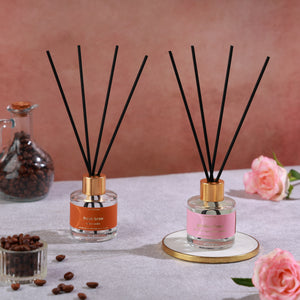
3. The second acceptable case is two fragrances that share a note. Mountain Breeze and Morning Freshness meet on green eucalyptus; Fresh Brew and Garden Bloom meet on warmth and soft musk. A shared note gives the ghost somewhere to hide.
4. Never cross from heavy to light. Coffee and vanilla residue under Malabar lemon and peppermint is the worst swap in the range — the citrus is simply outgunned, and you will spend a fortnight wondering why a bright fragrance smells stale.
5. Never reuse reeds that are near the end of their life. If the fibre is dark and tacky and a flip no longer lifts the room, the reeds have two faults, not one: they ghost and they do not wick. New oil through them is money spent twice.
6. Do not wash reeds to reset them. The residue is inside the capillary structure, and anything you soak them in stays there too. Reeds are a consumable, not a cleanable component.
7. We do not sell replacement reeds separately, and that is a genuine gap. Six fresh fibre reeds arrive with every new bottle; plain undyed reeds from a craft or packaging supplier are a reasonable in-between; our guidance is to refresh every few months anyway.
Composed and handmade in small batches in Pune, and a portion of every order supports girl-child education through Nanhi Kali.
Part one — what ghosting actually is
Perfumery divides materials by how readily they leave a surface. Top notes go first and fast; heart notes hold the middle; base notes are chosen precisely because they refuse to go anywhere quickly, which is what gives a fragrance its persistence. A reed diffuser sorts a composition along exactly that axis, and keeps the wrong half. Everything that made the old fragrance last is still in the fibre when you pull the reeds out, and it is still capable of doing the job it was designed for. Three things follow from that, and together they explain every disappointing swap I have ever been written to about.
 Fresh Brew₹849 · 9.5/10Two fragrances in the same air have to meet somewhere. When they share a material — the green eucalyptus that Mountain Breeze and Morning Freshness hold in common, or the warmth and soft musk that link Fresh Brew and Garden Bloom — the ear of the nose reads them as one thing with two moods. When they share nothing, you get a seam: two smells sitting side by side, neither resolving, and a general impression of untidiness. Ghosting on a reed is that same collision, except one of the two fragrances is invisible, so instead of blaming the pairing you blame the new bottle.
Part two — which swaps survive a set of used reeds
This table assumes reeds under about two months old that are still supple and wicking freely. If the fibre is dark and tacky, no pairing on this table is worth attempting — that is a reed-replacement question rather than a fragrance one. Strength positions quoted are on SOSA's own internal scale at six reeds, not an industry standard.
| Moving from | Moving to | Do they share anything | Ghosting risk | Verdict on reusing the reeds |
|---|---|---|---|---|
| Morning Freshness ★ | Mountain Breeze | Yes — green eucalyptus | Low, and the residue is light | Reuse is genuinely fine |
| Garden Bloom | Fresh Brew | Yes — warmth and soft musk | Low to moderate; you are moving heavier | Acceptable, expect a muddled first week |
| Mountain Breeze | Morning Freshness | Yes — green eucalyptus | Moderate; cedar residue is persistent | Workable but not ideal — fresh reeds are better |
| Fresh Brew | Garden Bloom | Yes — warmth and soft musk | Moderate to high; coffee dominates rose | Use fresh reeds |
| Evening Calm | Morning Freshness | No shared material | High — lavender under citrus reads stale | Use fresh reeds |
| Fresh Brew | Morning Freshness | No shared material | Highest in the range | Never reuse. This is the swap people regret |
| The honest caveat: SOSA does not sell replacement reeds as a separate product, so "use fresh reeds" means either the six fibre reeds that arrive with a new bottle or plain undyed reeds from a craft or packaging supplier. Our refill is oil only. It is a real gap in the range and it is why, if you want two fragrances, I would rather sell you a duo set from ₹1,548 than encourage swapping in one vessel. | ||||
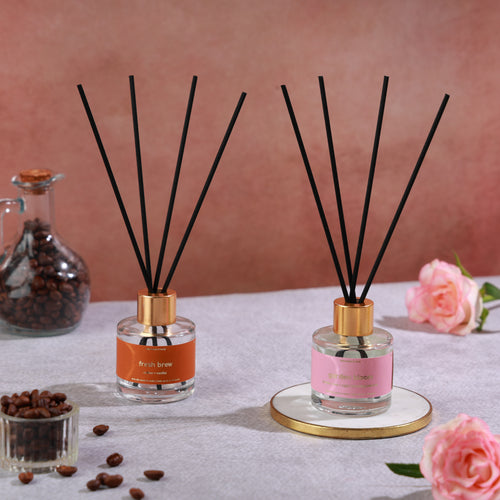 Warmth & Bloom · they share a note₹1,598Shop →
 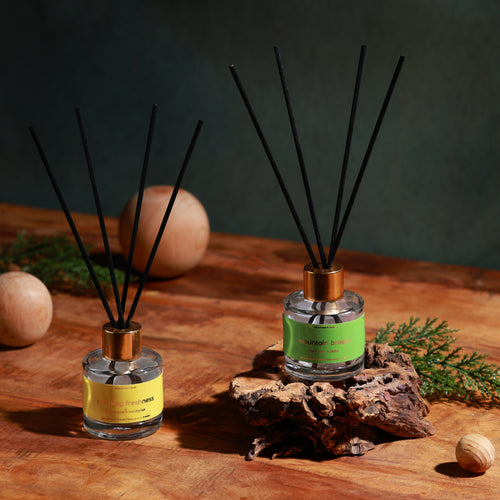 Fresh & Grounded · eucalyptus in common₹1,548Shop →
 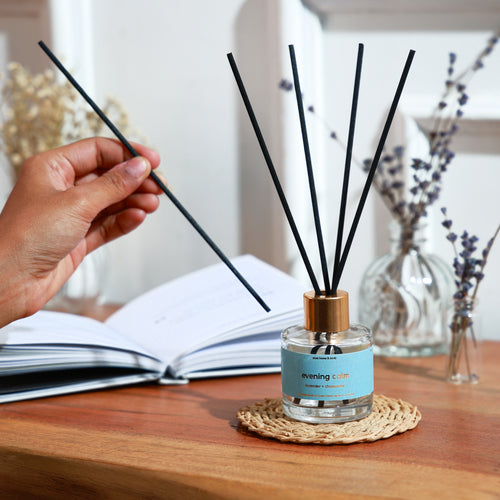 Evening Calm · its own bottlefrom ₹799Shop →
Part three — how long a ghost lasts, and why people misread it
The honest figure is weeks. A reed's residue does not release on a schedule you can wait out over a weekend, because the materials involved were chosen for persistence — that is the entire point of a base note. In my own testing, a set of six reeds moved from a warm gourmand composition into a bright citrus one reads noticeably contaminated for the first ten days to a fortnight, reads faintly muddled through the third and fourth weeks, and is only genuinely clean when the reeds themselves are approaching the point of needing replacement anyway. By the time the ghost has gone, so has most of the reed's useful life, which is the practical argument against ever bothering.
What makes this expensive is the misreading. A person who swaps fragrances on old reeds does not usually think "ghost". They think the new fragrance is weak, or cheap, or nothing like the description — and then they act on that belief. I have had customers move from Fresh Brew to Morning Freshness on used reeds, decide the citrus was disappointing, and add three more reeds to compensate — which increases the ghost as much as the new fragrance, empties the bottle in four to five weeks instead of six to eight, and confirms the wrong diagnosis. Olfactory adaptation compounds it: your nose stops reporting a constant within minutes and adapts hardest at home, so the one part of the smell you stop noticing is the part that is genuinely there all the time.
There is one situation where I actively recommend reusing reeds, and it is not a compromise: refilling with the same fragrance. The 300ml refill at ₹2,399 is oil only by design — you keep your own glass vessel and your own reeds — and if those reeds are young, supple and still wicking, putting the same composition back through them is exactly right. The residue in the fibre is that composition's base, so it adds nothing foreign. Remove the reeds, pour to the neck, return them and flip once so both ends are coated. What I would ask you not to do is treat that same permission as covering a change of scent. It does not.
Part four — the four scenarios, and what to do in each
Almost every question I receive about reusing reeds is one of these four. Find yours, and note that only the first one ends with "carry on".
| Your scenario | Age of the reeds | Reuse them? | What happens if you do | What I would do instead |
|---|---|---|---|---|
| Refilling with the same scent ★ | Under about two months, still supple | Yes — this is what the oil-only refill assumes | Nothing bad; the residue is the same composition's base | Carry on. Flip once after filling |
| Swapping to a scent that shares a note | Under about two months | Acceptable, with a muddled first week or two | A soft overlap rather than a seam | Reuse if you must; fresh reeds if you can |
| Swapping between unrelated families | Any age | No | Two to four weeks of a third smell nobody composed | Fresh reeds, or a second bottle and keep both |
| Reeds dark, stiff and tacky | Several months or more | No — twice over | Ghosting and a reed that no longer wicks | Refresh the reeds first, then decide about scent |
| You simply want both fragrances | Irrelevant | Do not swap at all | Every swap costs you a fortnight of clarity | A duo set from ₹1,498, or two 50ml bottles |
Versailles
At Versailles we were taught to smell on clean blotters, one material at a time, and to be almost superstitious about contamination — a blotter used twice is a blotter that has told you a lie. It took me embarrassingly long to notice that a reed diffuser is a blotter that has been used continuously for eight weeks, and that we routinely ask it to tell the truth about a new fragrance afterwards.
The first time I understood how strong the effect is, I had swapped a lavender bottle for a citrus one at home and spent four days convinced I had mis-composed the citrus. I had not. I had left the lavender in the reeds. When I put the same oil onto fresh fibre in the next room it was exactly what I had signed off in the lab, and the two rooms smelled like two different products.
So my honest advice runs against a sale in one direction and towards one in another. Do not buy a refill in a different scent expecting it to work on old reeds. Do buy a refill in your existing scent — it is oil only, roughly half the per-millilitre price of a bottle, and reusing your own reeds there is entirely correct. And if you want two fragrances in a home, keep two bottles rather than one bottle and a swap. Everything is composed and handmade in small batches in Pune, and a part of every order funds a girl's classroom through Nanhi Kali.
Frequently asked questions
- Should you use new reeds when refilling? — the ₹2,399 question, answered properly.
- When do reeds need replacing? — the five signs, in the order they appear.
- Why are my reeds turning dark? and can they become clogged? — the two conditions that rule out reuse.
- The complete reed replacement guide — this page and the eight around it, in one place.
- Brand: the SOSA founder story.
SOSA reed diffuser range & prices (verified August 2026): alcohol-free, phthalate-free, paraben-free and IFRA-compliant compositions on a heat-stable coconut-derived (CCT) carrier, low-VOC, supplied in a refillable glass bottle with six fibre reeds; 50ml lasts 6–8 weeks and 130ml lasts 14–18 weeks. Morning Freshness (Malabar lemon · peppermint · Nilgiri eucalyptus) 50ml ₹749 · 130ml ₹1,249 · 9.0/10; Garden Bloom (British rose · night-blooming jasmine) 50ml ₹799 · 130ml ₹1,299 · 8.9/10; Evening Calm (Kashmir lavender · chamomile) 50ml ₹799 · 130ml ₹1,299 · 8.9/10; Fresh Brew (Coorg coffee · Kerala vanilla) 50ml ₹849 · 130ml ₹1,349 · 9.5/10; Mountain Breeze (Himalayan pine · sage · Indian cedar) 50ml ₹849 · 130ml ₹1,349 · 9.4/10. Reed diffuser refills are oil only — you reuse your own vessel and reeds: 300ml ₹2,399 (roughly 8–11 months) · 500ml ₹3,499 (roughly 14–18 months), about ₹7–8 per ml against ₹15–17 per ml for a 50ml bottle. Duo sets ₹1,498–₹1,598 for 2 × 50ml and ₹2,498–₹2,598 for 2 × 130ml. Strength figures are positions on SOSA’s own internal strength scale, not an industry standard. Replacement reeds are not sold as a separate SKU; SOSA guidance is to refresh reeds every few months. The reed line is separate from the water-based Hotel Collection for ultrasonic machines (15ml ₹299 · 100ml ₹999 · 300ml ₹1,799) and the two are not interchangeable. Diffusers: Boond 300ml ₹899 · Sukoon 500ml ₹1,899 · Megh 6L ₹3,499 · waterless Vaayu ₹11,999. Composed and handmade in small batches in Pune, India; tested through 45°C summer heat and 85% monsoon humidity. Free shipping above ₹499. A portion of every order supports girl-child education through Nanhi Kali. Prices subject to change — see the live product pages.