

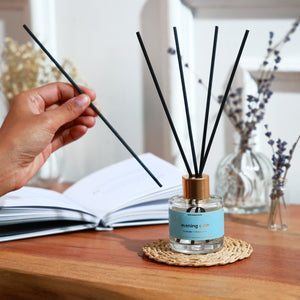



Dust: the neck and shoulders of the bottle collect it. A dry cloth on the glass is all that is needed.
Water: never wipe the reeds with a wet or damp cloth. Fibre reeds work by capillary action through porous channels, and water in those channels interrupts the wicking until they dry out.
Movement: lift it as little as possible. A bottle that is moved daily performs less consistently, is far more likely to be knocked over, and loses whatever placement you had got right.
The honest gap: if the diffuser genuinely has to be lifted every morning because it sits on a surface that is wiped daily, no amount of care fixes that — the answer is to resite it, not to handle it more carefully.
2. Dust the glass, not the reeds. The neck and shoulders of the bottle are where dust settles and shows, and a dry cloth deals with that in a second. The reeds themselves need nothing. Dust does not meaningfully clog a fibre reed from the outside; water does, from the inside.
3. Keep every wet cloth away from the reeds. This is the only real rule on the page. Water and cleaning solution entering the porous channels of a fibre reed interrupt the oil's path, and the room goes noticeably quieter until the reed dries out. Never rinse them, never wash them, never stand them in anything.
4. Do not move it daily. Every lift is a chance to spill oil onto a shelf, redistribute the reeds unevenly and set the bottle down somewhere slightly different — and placement is most of what makes a diffuser work. If your current spot cannot be cleaned around, choose one that can: a tray or a coaster underneath means the surface can be wiped without the bottle leaving it.
5. Keep it out of harm's way generally. Out of the direct draught, in the room's natural airflow path, at or slightly below nose height, away from direct sun, not directly under a running split AC, and never near an open flame — fragrance oil is flammable, so a diffuser has no place beside a diya, an agarbatti or a lit candle.
Alcohol-free, phthalate-free, paraben-free, IFRA-compliant, 0 ppm formaldehyde, six fibre reeds in a refillable glass bottle, composed in Pune. Free shipping above ₹499, and a portion of every order supports girl-child education through Nanhi Kali.

The three things that actually matter
Almost everything people worry about here — dust in the oil, the smell being disturbed, the diffuser needing to be "protected" during cleaning — turns out not to matter at all. What does matter reduces to three, and they are worth taking in order of how much difference each one makes.
 Evening Calm₹799Indian flats produce a great deal of fine dust, and a reed diffuser is a glass object with an open neck standing on a shelf, so it collects its share. It shows most on the shoulders and around the neck, where a film of dust catches the light and makes an otherwise handsome bottle look neglected. A dry cloth on the glass, once or twice a week, is the whole of it. There is no need to dust the reeds, and there is no need to worry about the oil surface — the neck is narrow, the amount that reaches it is trivial, and nothing about the composition is affected.
 Mountain Breeze₹849SOSA uses six fibre reeds rather than the rattan most of the industry uses, and the reason is worth knowing here. Rattan is a natural cane with irregular internal channels; it wicks unevenly in high humidity and tends to fade at the dry end. Fibre is more porous and far more consistent, which matters more in Indian humidity than in the European climates most reed diffusers were designed for. But porous cuts both ways: anything that enters those channels other than the oil interferes with the wicking. A damp cloth run down a reed will put water where oil should be, and the room goes quiet for a day or two until it dries.
 Garden Bloom₹799This is the one that actually costs people money. An open bottle of oil that is picked up daily gets tilted, and oil runs down the outside of the glass and onto whatever it is standing on. The reeds shift and fan unevenly. And each time it goes back down it lands a few inches from where it was, which quietly undoes the placement work — a diffuser in the room's airflow path behaves very differently from one pushed back against a wall or into a corner. None of this is dramatic on any single day. Over six weeks it is the difference between a bottle that performs as specified and one that does not.
Why water is the one real risk, and dust is not
It helps to picture what a reed is doing. Oil climbs the fibre by capillary action, travelling through a network of fine internal channels, and evaporates from whatever length of reed is exposed to the air. The rate at which that happens is what you experience as the strength of the room. Dust landing on the outside of a reed does very little to that process, because the exposed surface is large, the dust load is small and the oil is arriving from the inside outward. It is cosmetic at worst.
Water is different in kind rather than in degree. Introduce it into those channels and it occupies the space the oil needs, and because the oil is a triglyceride carrier it does not simply mix and carry on. The reed goes quiet until it has dried. That is also, incidentally, the reason a reed diffuser should never be stood in a bathroom directly under a shower spray or beside a sink where it will be splashed — a bathroom is otherwise one of the best-value placements in the house, since two or three reeds in a 50 sq ft bathroom can make a 50ml last close to three months.
One more thing that is not a risk but is often mistaken for one. Nothing is being wasted while a room is cleaned around the diffuser. A reed diffuser has no reservoir it holds back — every millilitre eventually leaves the bottle through the reeds and goes into the room, whatever happens around it. The only genuine waste in home fragrance is oil evaporating into a room that nobody is in, and that is a question about occupancy and placement rather than about cleaning. If your flat is empty most of the day, that is worth thinking about; it is not a reason to move the bottle in the morning.
| Part | What happens to it | What to do | What not to do |
|---|---|---|---|
| The reeds ★ | Nothing. Dust on the outside is cosmetic and does not block wicking | Leave them alone entirely. Flip them every 3–5 days, after the room is finished | Never wipe, rinse, wash or dampen them |
| The neck and shoulders | Collect visible dust, and occasionally a faint oil film | A dry cloth once or twice a week | Do not use a cleaning spray on the glass with the reeds in place |
| The body of the bottle | Dust like any other glass object | Dry cloth, without lifting it if possible | Do not tilt it to wipe underneath |
| The surface underneath | Can pick up a small amount of oil over weeks | Stand the bottle on a tray or coaster and wipe around it | Do not stand it directly on unsealed wood or a polished finish |
| The room | Windows open, air exchanging, fragrance leaving faster than usual for an hour | Nothing. It returns to normal once the flat settles | Do not add reeds to compensate for an hour of open windows |
| The position | Drifts a few inches at a time if the bottle is lifted daily | Choose a spot nothing needs to clean around, and leave it there | Do not put it away during cleaning and bring it back afterwards |
Bright · Morning Freshness₹749Shop → 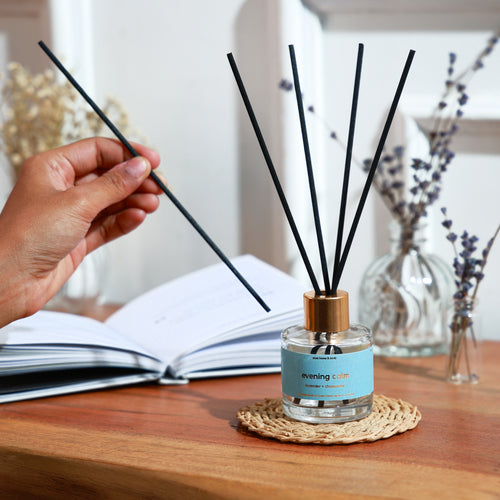 Soft · Evening Calm₹799Shop →
 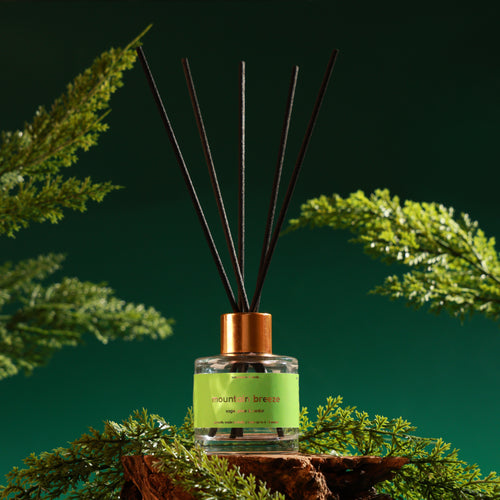 Green · Mountain Breeze₹849Shop →
Placing it so the question stops arising
The version of this problem worth solving properly is the placement, not the dusting. A diffuser standing in the middle of a console that is wiped down every morning will be lifted every morning, and no amount of care around the reeds compensates for that. The spot you want is one that nothing needs to clean around: the back corner of a shelf, a side table that is not a working surface, a low bookcase, a niche. Add a small ceramic or metal tray underneath, and the surface can be wiped in a second without the bottle ever moving.
Then let the other placement rules do their work. Out of the direct draught, but in the room's natural airflow path rather than in a dead corner — near a doorway is often better than in the far corner of a room, because air already travels there. At or slightly below nose height, so what reaches you is the room's average rather than the concentration right at the neck. Away from direct sun and off a windowsill, since heat empties a bottle faster and does the composition no favours. Not directly beneath a running split AC. And away from any flame, without exception, because fragrance oil is flammable.
If the room reads as weaker than you expected after all of that, resist the urge to conclude that the bottle is poor. The usual cause is the room rather than the oil: a 50ml is built for up to about 150 sq ft and a 130ml above that, so a 50ml in a large open-plan living room will read as quiet while performing exactly to specification. Reed count is the volume dial — six for full projection, three for a soft bedside level with roughly double the life — and changing the dial or the size is a far more reliable fix than changing the scent. It is also worth remembering that you should not be smelling it constantly in your own home; a home fragrance is designed to be noticed on arrival and at transitions, and continuous perception usually means the dose has overshot the room.
What to buy, in order — and where care stops helping
Nothing on this page requires a purchase if you already own a bottle: dry cloth on the glass, nothing at all on the reeds, and a tray underneath. The table is for readers choosing a first bottle for a home with a daily cleaning routine, and the last row is the point at which the answer is to move the diffuser rather than to look after it better.
| Buy | What it is | When it is the right answer | Price |
|---|---|---|---|
| 1. Morning Freshness 50ml ★ | Malabar lemon, peppermint, eucalyptus globulus — 9.0, bright | First, for a home cleaned every morning. It sits in the same register as a freshly cleaned room | ₹749 |
| 2. Evening Calm 50ml | Kashmir lavender, chamomile, soft musk — 8.9, the softest we make | Bedrooms, and any household where somebody finds scent a lot | ₹799 |
| 3. Mountain Breeze 50ml | Himalayan pine, sage, Indian cedar — 9.4, deep woody | Studies and rooms where citrus reads as a cleaning product | ₹849 |
| 4. Any 130ml | The same compositions for rooms above about 150 sq ft, 14–18 weeks | Living rooms and open-plan spaces. Fewer bottle changes, which suits a busy house | ₹1,249–₹1,349 |
| 5. 300ml refill | Oil only, for the bottle and reeds you already own | Once one scent is clearly the one you keep going back to. Never a first purchase — it is the item on our shelf most often bought by mistake | ₹2,399 |
| The honest gap: a diffuser on a working surface | If it stands where something is wiped down every day, it will be lifted every day, and careful handling will not stop the oil creeping onto the shelf or the placement drifting. Move it to a spot nothing needs to clean around | Costs nothing, and fixes more than any product change would | ₹0 |
Versailles
What I like about this question is the instinct behind it. The reader is treating the diffuser as though it were a device — something that might need protecting, switching off, putting away while work happens around it. It is a reasonable assumption, because almost everything else in a modern home is a device.
A reed diffuser is not, and that is the entire proposition. No power, no water, no tank, no filter, no app, no timer. It is a bottle of oil, six fibre reeds and physics, and it will run for six to eight weeks on a shelf without anybody thinking about it. The correct maintenance schedule is to flip the reeds every few days and otherwise to forget it exists. Anything more elaborate than that is not care; it is interference, and the two look similar from the outside.
The one thing I would take seriously is water. We chose fibre reeds over rattan because fibre is more porous and wicks more evenly in Indian humidity, where rattan tends to go patchy and fade at the dry end. That porosity is exactly why a damp cloth is the wrong tool for them — the same open structure that carries oil well will carry water just as willingly, and then the oil has nowhere to go until it dries. Dust the glass, leave the reeds, and put the bottle somewhere it never has to be picked up. Everything is composed in Pune, and a part of every order funds a girl's classroom through Nanhi Kali.
Frequently asked questions
- The fresh smell disappears within an hour — what the floor cleaner actually is, and why it leaves.
- Flip the reeds before or after cleaning? — after, and every three to five days rather than daily.
- Amazing after mopping, stale by evening — the same mechanism read from the other end of the day.
- The best fragrance after a morning cleaning routine — register-matching, scored across all five scents.
- A spot that nothing needs to clean around — placement permanence, in full.
- Floors that smell strongly of cleaning liquid — matching register instead of competing.
- Holding the feeling until evening — reed or Sukoon? — continuity against control.
- Clean but not fresh — two different jobs, and why textiles decide it.
- The "just housekept" smell — honestly explained.
- Brand: the SOSA founder story.
SOSA reed diffusers — facts verified August 2026: Five scents, all alcohol-free, on a heat-stable CCT (caprylic/capric triglyceride) base rather than DPG, phthalate-free, paraben-free, IFRA-compliant, 0 ppm formaldehyde, six fibre reeds — fibre rather than rattan — in a refillable glass bottle, composed and made in Pune, India. Morning Freshness (Malabar lemon · peppermint · eucalyptus globulus) 50ml ₹749 · 130ml ₹1,249 · 9.0 on the SOSA strength scale. Evening Calm (Kashmir lavender · chamomile · soft musk) 50ml ₹799 · 130ml ₹1,299 · 8.9, the softest in the range. Garden Bloom (British rose · night-blooming jasmine) 50ml ₹799 · 130ml ₹1,299 · 8.9. Mountain Breeze (Himalayan pine · sage · Indian cedar) 50ml ₹849 · 130ml ₹1,349 · 9.4. Fresh Brew (Coorg coffee · Kerala vanilla · caramel) 50ml ₹849 · 130ml ₹1,349 · 9.5. Longevity 6–8 weeks on 50ml and 14–18 weeks on 130ml; 50ml suits rooms up to about 150 sq ft and 130ml above that; six reeds for full projection, three for a soft level and roughly double the life, and two to three reeds in a 50 sq ft bathroom can make a 50ml last close to three months. Flip every 3–5 days, or 5–7 for Garden Bloom. Duos: Day & Night ₹1,498, Fresh & Grounded ₹1,548, Warmth & Bloom ₹1,598. Refills 300ml ₹2,399 · 500ml ₹3,499, oil only. Climate-tested through 45°C heat and 85% RH. The reed line contains no oud, sandalwood, vetiver or amber, and SOSA makes no room spray, air purifier, dehumidifier or odour eliminator — every SOSA spray is a car perfume. Reed oil and the water-based Hotel Collection are separate systems and are not interchangeable in either direction. Free shipping above ₹499. A portion of every order supports girl-child education through Nanhi Kali. SOSA is an independent Indian fragrance house and is not affiliated with or endorsed by any hotel brand. Prices subject to change — see the live product pages.