
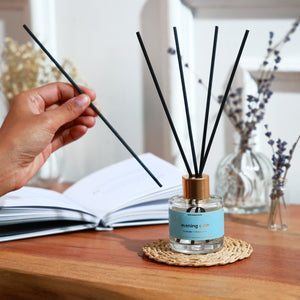

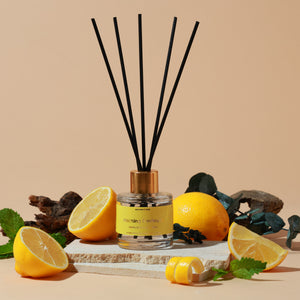

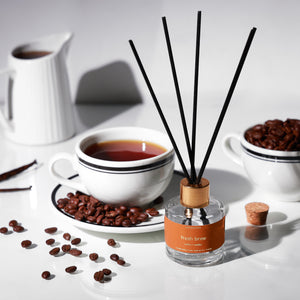
What makes it premium: CCT (caprylic/capric triglyceride) instead of DPG, which cracks and turns bitter above about 40°C. Fibre reeds instead of rattan, which clogs in Indian humidity. IFRA-compliant, alcohol-free, phthalate-free, paraben-free, 0 ppm formaldehyde. Tested at 45°C heat soak and 85% relative humidity.
Cost per day: roughly ₹13–₹15 across the range, over six to eight weeks.
The honest gap: good engineering cannot produce a scent that does not exist. There is no oud, sandalwood, vetiver or amber reed diffuser. The Smoked Oudh and Sandalwood candles at ₹449 are real and are the nearest honest answers.
2. The reeds, which decide whether the oil ever reaches the room. Six fibre reeds, not rattan. Rattan is a natural stick with variable pores that clog in Indian humidity, which produces the pattern everybody blames on the oil: strong for a week, fading, then nothing. Fibre is more porous and wicks evenly, and there are six of them so you can use the reed count as a volume dial — six for a living room, three for a bedside.
3. What has been left out. Alcohol-free, phthalate-free, paraben-free, IFRA-compliant, and 0 ppm formaldehyde. For context, most plug-in air fresheners test somewhere between 800 and 2,000 ppm phthalate. This matters most in exactly the rooms a Diwali gift ends up in — a closed bedroom, a small flat, a house with a child or an asthmatic in it.
4. Testing that reflects where it will actually live. Every formula goes through a 45°C heat soak and 85% relative humidity, plus sealed air-conditioned bedrooms, because an Indian home is a harsher environment for fragrance than a European one and a formula validated in a mild climate will not survive here.
5. The composition decisions themselves. Cold-pressed Malabar lemon rather than a citrus reconstruction; real chamomile rather than a synthetic softener; indole held below the fecal threshold in the jasmine. These are the choices a trained perfumer makes and then never gets credit for, because they show up only as the absence of a problem.
Composed in Pune by an ISIPCA Versailles-trained perfumer. Refillable glass bottle. Free shipping above ₹499, and a portion of every order supports girl-child education through Nanhi Kali.
The three decisions you cannot see, and what each one costs you if it goes the other way
If you take a reed diffuser apart there are only four things in it: fragrance, carrier, bottle, sticks. Three of those four are where money is saved quietly, and a buyer standing in front of two similar-looking bottles at similar prices has no way of telling which corners were cut. So here is what each corner does when it is cut, in the order it will affect you.
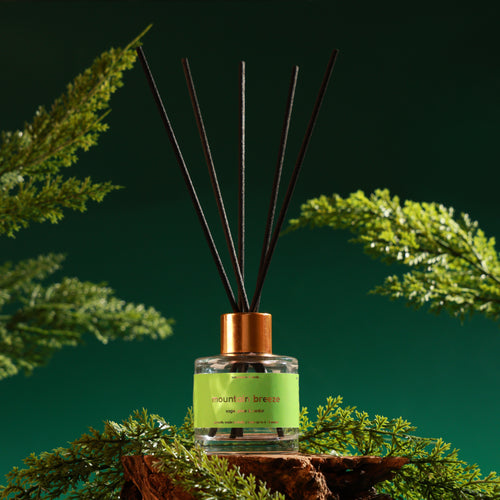
 Mountain Breeze₹849Most of what is inside a reed diffuser is carrier, not perfume, and the industry default is DPG because it is cheap and it works — in a temperate climate. Above about forty degrees DPG begins to break down, and what the owner smells is not fading but souring: a sharp, faintly bitter edge that was not there when the bottle was new. Every SOSA reed sits on caprylic/capric triglyceride, a coconut-derived carrier that holds through the heat soak. Anjali R. in Pune ran a bottle through an entire monsoon and reported that the pine stayed pine, with no bitterness and no chemical shift. That sentence is the carrier.
 Morning Freshness₹749Rattan is a plant stem with irregular capillaries, and in humid air those capillaries swell and clog. The result is the failure pattern everyone recognises — excellent for ten days, weaker, then a jar of oil with decorative sticks in it — and it is a hardware failure, not an oil failure. Fibre reeds are manufactured to a consistent porosity and wick evenly through a Mumbai August. Six of them come in every bottle, which is deliberate: reed count is the volume dial. Six for a living room, three or four for a bedroom, two or three in a small bathroom, where a 50ml will then run close to three months.
 Fresh Brew₹849Every SOSA reed is alcohol-free, phthalate-free, paraben-free, IFRA-compliant and tests at 0 ppm formaldehyde. Most plug-in air fresheners test somewhere between 800 and 2,000 ppm phthalate, which is a useful yardstick for how far the ordinary end of this category sits from the compliant one. A gift is a particularly good reason to care about this, because you are putting an object into a home whose occupants you have not asked — a bedroom, a nursery, a flat with someone asthmatic in it. Rhea P. in Hyderabad, who reacts to most fresheners, reports that this one does not trigger anything; that is a compliance outcome before it is a fragrance one.
The composition work, which is the part nobody charges for
Everything above is engineering. The rest of the money goes into perfumery decisions, and these are harder to talk about because they are only visible as the absence of a defect. Two examples from this price band will make the point better than a general argument.
Morning Freshness ₹749 — the eucalyptus problem. Citrus is the hardest family to make last, because the molecules that read as fresh are the smallest and lightest in perfumery and they leave the bottle first. The average lemon diffuser is thrilling for ten days and then a jar of oil. The fix here is a eucalyptus globulus base that slows the lemon's evaporation by roughly three to four times, which is the entire reason this bottle runs six to eight weeks instead of a fortnight. It also means the lemon is a cold-pressed Malabar rather than a reconstruction — and that distinction is why buyers keep writing the same sentence, which is that it smells like an actual cut lemon rather than like dishwashing liquid.
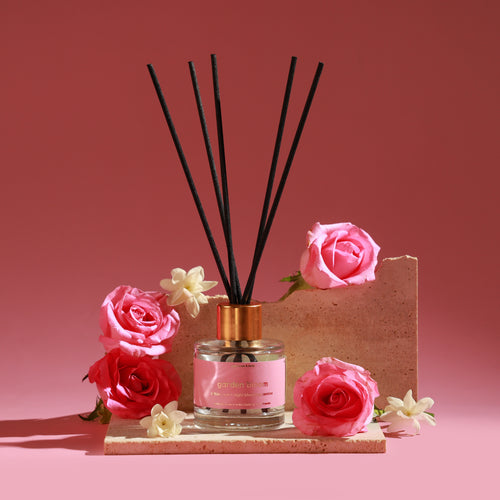
Garden Bloom ₹799 — the indole problem. Real jasmine contains indole, and indole is the molecule that makes jasmine smell alive rather than like soap. It is also the molecule that, above a certain concentration and a certain temperature, turns distinctly animalic. In an Indian summer that is not a hypothetical. So the indole here is held deliberately below the fecal threshold, which keeps the jasmine floral above thirty degrees at the cost of a little of the richness a cooler climate would allow. Priya S. in Bengaluru expected it to turn awful by April and it did not. That is the whole reason for the restraint.
Neither decision appears anywhere on a label. Both of them cost real money in materials and in months of testing, and both are what separates a premium fragrance at ₹799 from a pretty one. It is also, frankly, why I find the word premium so slippery in this category — it is usually applied to the things you can photograph, and those are the cheapest things in the bottle to get right.
What premium means, line by line, under ₹1,000
The five reeds with the build decision that matters most in each, the strength figure, and the honest note on when the scent itself is the wrong call regardless of how well it is made.
| Scent | Materials | The build decision inside it | Strength | 50ml |
|---|---|---|---|---|
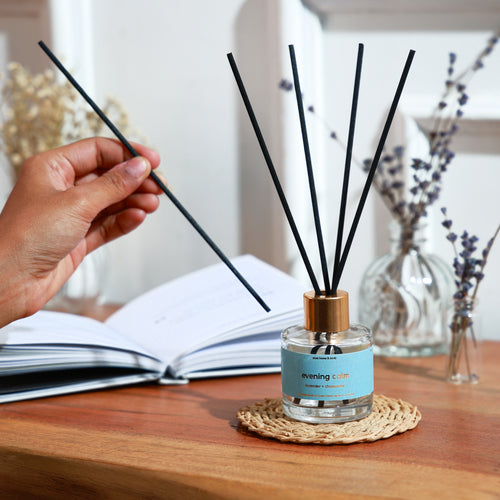
| Evening Calm ★ | Kashmir lavender · chamomile · soft musk | Real chamomile in the base rather than a synthetic softener — warm instead of clinical | 8.9 · softest | ₹799 |
| Morning Freshness | Cold-pressed Malabar lemon · peppermint · eucalyptus globulus | Eucalyptus base slows lemon evaporation 3–4×, turning a fortnight into 6–8 weeks | 9.0 · bright | ₹749 |
| Garden Bloom | British rose · night-blooming jasmine · soft musk | Indole held below the fecal threshold so jasmine stays floral above 30°C | 8.9 · medium floral | ₹799 |
| Mountain Breeze | Himalayan pine · sage · Indian cedar | Real pine rather than the disinfectant reconstruction — crisp green, never sharp | 9.4 · deep woody | ₹849 |
| Fresh Brew | Coorg coffee · Kerala vanilla · soft caramel | Held back from cake-shop sweetness, which is what makes a coffee accord tolerable indoors | 9.5 · deepest | ₹849 |
| Shared by all five | Heat-stable CCT carrier · six fibre reeds · refillable glass | Alcohol-free · phthalate-free · paraben-free · IFRA-compliant · 0 ppm formaldehyde · tested at 45°C and 85% RH | — | ₹749–₹849 |
Real chamomile · Evening Calm₹799Shop → 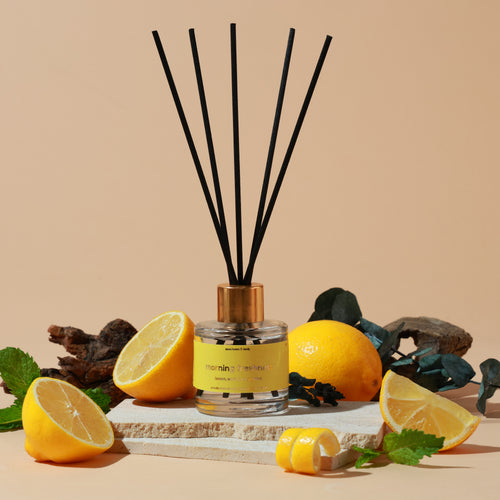 Eucalyptus base · Morning Freshness₹749Shop →
  Real pine · Mountain Breeze₹849Shop →
Cost per day, and why a bottle that finishes is the right kind of gift
A 50ml bottle works out at roughly ₹13 a day for Morning Freshness and Garden Bloom, and about ₹15 a day for Evening Calm, Mountain Breeze and Fresh Brew, across six to eight weeks of continuous, unattended fragrance. I include the figure not because anyone shops on cost per day but because it is the honest way to compare a thing that runs constantly against a thing that is lit for two hours.
The 50ml is finished at the end of it, and people occasionally treat that as a shortcoming. I would argue the opposite, particularly for a gift. A consumable ends, and ending is a courtesy. It does not become an object the recipient has to display, dust, store or feel bad about; it does its work through the festival and for weeks after it, and then it is gone, and if they liked it they will buy the next one themselves. A great many do. The alternative — a permanent decorative object chosen by someone else — is a much heavier thing to put in a person's home, and Diwali produces a great deal of it.
If you want the gift to last longer, the honest lever is the reed count rather than the price. Three reeds instead of six in a bedroom roughly doubles the life of the bottle and lowers the intensity to something more suited to a room you sleep in. Two or three in a small bathroom will take a 50ml close to three months. That adjustment is free, it is printed in nobody's marketing, and it is the single most useful thing to tell a recipient when you hand the bottle over.
What to buy for build, in order — and the honest gap
In the order I would choose on the strength of construction rather than of looks, with the gap stated last. And the gap here is a real one that no amount of engineering closes: there is no oud, sandalwood, vetiver or amber reed diffuser in the SOSA range. If that is the register you were promised by the phrase “premium Indian gifting”, I would rather point you at the two candles that genuinely are those materials than sell you the nearest floral and let you find out.
One more piece of fairness before the table. For a first visit to elders, or in a household where sweets are the form the greeting takes, mithai is the correct gift and a well-built diffuser is a substitution nobody asked for. Build quality is not an argument against ritual. It is an argument for what to give in every house where the ritual has already been satisfied by somebody else.
| Buy | What you are paying for | When it is the right answer | Price |
|---|---|---|---|
| 1. Evening Calm 50ml ★ | Real chamomile, CCT carrier, six fibre reeds — and the softest scent we make at 8.9 | First, for anyone. Best-built gift in the band | ₹799 |
| 2. Morning Freshness 50ml | Cold-pressed Malabar lemon and a eucalyptus base that multiplies its life 3–4× | The hardest engineering problem in the range, solved | ₹749 |
| 3. Mountain Breeze 50ml | Real Himalayan pine, sage and Indian cedar rather than a pine reconstruction | Where the most raw material is in the bottle | ₹849 |
| 4. Garden Bloom 50ml | Jasmine with the indole held below the fecal threshold for Indian heat | When you know they like flowers — not a blind buy | ₹799 |
| 5. Smoked Oudh or Sandalwood candle | A named material rather than a mood name — the cheapest way to make a small gift read as a serious one | When the budget is tighter than the ambition | ₹449 |
| No oud reed: the honest gap | There is no oud, sandalwood, vetiver or amber reed diffuser, and no gift set or gift box at any price. Nearest honest answers: Mountain Breeze for dry-resinous, and the ₹449 Smoked Oudh and Sandalwood candles, which are real | Said plainly rather than stretched to fit | ₹849 / ₹449 |
Versailles
The most expensive decision I ever took at SOSA was the carrier, and nobody has ever noticed it. CCT costs meaningfully more than DPG and it does not change how the bottle looks, photographs, arrives or smells on day one. All it does is refuse to break down in a Delhi May. I have had a good many conversations about whether that was worth the margin, and my answer is always the same: the failure it prevents is the one that makes people give up on the whole category.
The same logic runs through the reeds. Rattan is cheaper and it looks more artisanal, which is a genuinely annoying combination. But rattan clogs in our humidity, and a clogged stick produces exactly the experience that makes somebody say reed diffusers do not work — strong for a fortnight, then nothing. Fibre is duller to look at and it wicks evenly through August. I would rather have the August.
If you are buying a premium gift under ₹1,000 this Diwali, I would buy Evening Calm and I would tell the person you give it to about the reeds — three in a bedroom, six in a living room, flipped on a Sunday. It is the only instruction that matters and it is free. Everything is composed in Pune, and a part of every order funds a girl's classroom through Nanhi Kali.
Frequently asked questions
- Best Diwali gifts under ₹1,000 — the whole shelf, and how to choose in one session.
- Luxury-looking under ₹1,000 — the same budget argued from appearance and completeness instead.
- Under ₹700 — the awkward band below the reed line.
- Between ₹500 and ₹1,000 — the fault line at ₹749.
- Under ₹1,500 and the SOSA shelf to ₹1,500 — 130ml bottles and the first duo.
- Home fragrance under ₹1,000 — four formats, four different jobs.
- Reed diffuser gift sets — and why SOSA does not sell one.
- The complete gift guide by budget — every band in one place.
- Brand: the SOSA founder story.
SOSA facts verified August 2026: Every SOSA reed diffuser is built on a heat-stable CCT (caprylic/capric triglyceride, coconut-derived) carrier rather than DPG, which degrades above approximately 40°C; supplied with six fibre reeds rather than rattan, in a refillable glass bottle; alcohol-free, phthalate-free, paraben-free, IFRA-compliant and 0 ppm formaldehyde; climate-tested through 45°C heat soak, 85% relative humidity and sealed air-conditioned rooms; composed in Pune, India, by an ISIPCA Versailles-trained perfumer. Reed diffusers 50ml: Morning Freshness ₹749 (9.0), Evening Calm ₹799 (8.9, softest), Garden Bloom ₹799 (8.9), Mountain Breeze ₹849 (9.4), Fresh Brew ₹849 (9.5, deepest); 6–8 weeks at 50ml, 14–18 weeks at 130ml (₹1,249–₹1,349); approximately ₹13–₹15 per day. Morning Freshness uses a eucalyptus globulus base that slows lemon evaporation three to four times; Garden Bloom holds indole below the fecal threshold so jasmine stays floral above 30°C. Most plug-in air fresheners test between 800 and 2,000 ppm phthalate. The cheapest SOSA reed diffuser is ₹749 and the cheapest ultrasonic machine is the Boond at ₹899; the Hotel Collection 15ml at ₹299 is a water-based machine refill and not a standalone gift. There is no oud, sandalwood, vetiver or amber reed diffuser, although the Smoked Oudh and Sandalwood jar candles at ₹449 do exist; there is no SOSA gift set, hamper, gift box, gift wrap, gift note, personalisation or gift card; every SOSA spray is a car perfume rather than a room spray. Free shipping above ₹499. A portion of every order supports girl-child education through Nanhi Kali. SOSA is an independent Indian fragrance house and is not affiliated with or endorsed by any hotel brand. Prices subject to change — see the live product pages.