


The five signs, in the order they appear: dark fibre, a wet line that stops climbing, a flip that no longer helps, a dusty crust at the neck, and fragrance that reads flat and base-heavy.
Free moves come first, always: flip all six, move the bottle into gentle passing air out of sun and draught, close the room for an hour, then judge. Replacing reeds is the move you make after those, not before.
We do not sell reeds separately. The refill is oil only. Fresh fibre comes with every new bottle from ₹749, and plain undyed reeds from a craft supplier work in between.
2. Learn the sixty-second check. Gloves on, tray under the bottle. Look at the wet line — the boundary between oil-soaked and dry fibre. Roll the exposed end between two fingers. Hold a reed a few inches from your nose. High line, supple fibre, recognisable fragrance is healthy. Low line, stiff and tacky fibre, a flat base-heavy smell is spent.
3. Spend the free moves before you spend money. Flip all six reeds; move the bottle into gentle incidental traffic near a doorway at waist-to-chest height, out of direct sun and several feet from an AC vent or fan; close the room for an hour and walk back in. A good share of "my reeds have died" messages are answered by one of those three.
4. Treat the flip as the decisive test. A healthy set lifts the room within hours and settles by evening. If twenty-four hours after flipping all six nothing has changed, the fibre is the problem and no amount of oil will fix it.
5. Never pour a refill through spent reeds. This is the most expensive version of the mistake — ₹2,399 of perfectly good oil arriving through a closed path, then blamed on the fragrance.
6. Use fresh fibre whenever you change fragrance, regardless of reed age, because the old composition's base will ghost the new one for two to four weeks.
7. Keep the glass. The vessel is designed to be reused indefinitely; wash it and dry it thoroughly between fills. It is the reeds that are consumable, not the bottle.
8. The honest gap: we do not sell replacement reeds. A new bottle arrives with six fresh fibre reeds — 50ml from ₹749, 130ml from ₹1,249 — and plain undyed reeds from a craft or packaging supplier are a perfectly reasonable in-between. I would rather write that sentence than pretend the refill covers it.
Composed and handmade in small batches in Pune, and a portion of every order supports girl-child education through Nanhi Kali.
Part one — the principle behind all nine guides
There is one idea underneath every article in this sub-cluster, and if you take nothing else from this page, take this. A reed diffuser is two systems: a payload and a delivery mechanism. The payload is the oil, and it behaves exactly as you expect — it goes down, you replace it. The delivery mechanism is six pieces of fibre, and it degrades silently, on a different clock, with no gauge and no warning light. The whole difficulty of owning one of these is that the visible part is the part that does not fail, and the failing part looks fine from across the room. Three consequences follow, and they explain almost everything people write to me about.
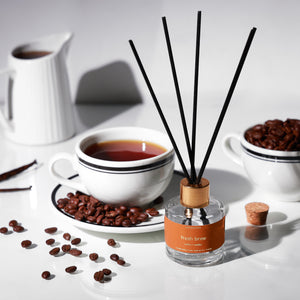
 Fresh Brew₹849 · 9.5/10A 50ml at six reeds is designed to give up roughly six to eight millilitres a week — a drop that is hard to see in the first fortnight and obvious by week four. When the reeds narrow, that drop stops, and the bottle appears to be heading for five or six months rather than seven weeks. It feels like good fortune. It is the opposite: you have paid for oil that is now ageing in the glass rather than arriving in the room, and top notes are the first casualty because they are lost to time rather than delivered to the air. Olfactory adaptation hides the rest — your nose stops reporting a constant within minutes and adapts hardest at home, so the decline and your own habituation are indistinguishable from the inside. A visitor who has just walked in from outside is a far better instrument than you are.
Part two — every symptom in this sub-cluster, decoded
Nine articles, one table. Find the sentence that matches what you would say out loud about your bottle, read across, and note the column that matters most: whether the answer is the reeds or something free. Timings assume six fibre reeds in an ordinary Indian room, and strength positions referenced anywhere on this page are on SOSA's own internal scale at six reeds rather than an industry standard.
| What you would say | Where to look | Most likely cause | The free move first | Reeds, oil or neither |
|---|---|---|---|---|
| "A flip does not help any more" ★ | Room, 24 hours after flipping all six | Capillary path lined with residue | Flip all six, wait a full day | Reeds — this is the decisive test |
| "The reeds have gone dark" | The exposed end, and a gloved pinch | Even amber is normal; tacky is spent | Nothing, if it is even and supple | Neither, unless it is sticky |
| "They have stopped absorbing oil" | The wet line on a lifted reed | Residue, dust, humidity or cold-thickened oil | Flip; warm the room; check immersion | Reeds, once a flip changes nothing |
| "Oil is not travelling up the reeds" | Immersion depth and the crowding at the neck | Too little immersion, or too many reeds jammed in | Top up to the neck; thin the count to six | Neither — usually mechanical |
| "They are dry at the top" | The gap between the wet line and the tip | Evaporation outrunning the climb in a hot dry room | Move out of sun and draught | Neither — often entirely normal |
| "There is a crust where they meet the glass" | The neck of the bottle | Dust bound into heavy residue | Wipe the neck at every refill | Reeds |
| "The new fragrance smells wrong" | What was in the bottle before | Ghosting from the previous composition's base | None — this one cannot be flipped away | Reeds, regardless of their age |
| "The refill is weaker than the bottle" | The age of the reeds you poured it through | New oil, old fibre | Flip, then run the pinch test | Reeds — the oil is identical |
| "It lasts for ever but I cannot smell it" | The oil level, marked with tape for a week | A stalled bottle, or a cold sealed still room | Flip; ask a visitor; close the room an hour | Reeds, unless a visitor smells it plainly |
| The honest caveat: in every row above where the answer is "reeds", SOSA cannot sell you the fix directly. We do not stock replacement reeds as a separate product and our refills are oil only. Fresh fibre comes with a new bottle — 50ml from ₹749, 130ml from ₹1,249 — or from a craft or packaging supplier selling plain undyed reeds. This is a real gap in the range, and naming it is more useful to you than stretching the nearest product to cover it. | ||||
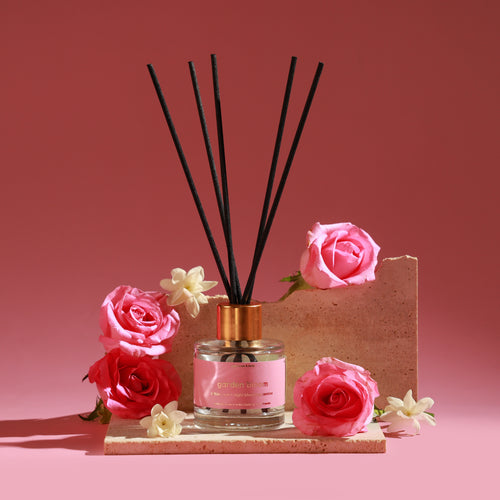 Garden Bloom · six fresh reedsfrom ₹799Shop →
  300ml refill · oil only₹2,399Shop →
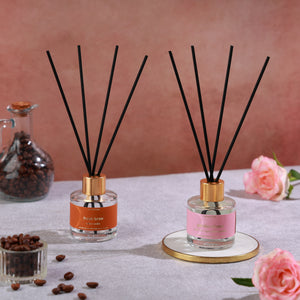
  Warmth & Bloom duo · twelve reeds₹1,598Shop →
Part three — the free ladder, and why it comes first
Nothing on this page should be read as an invitation to replace reeds at the first sign of quiet, because a badly placed bottle and a spent one produce identical complaints and only one of them costs money to fix. The ladder is the same in every guide in this cluster and it takes about an hour and a half of elapsed time, almost none of it yours. Step one: the fifteen-minute doorway test. Leave the room entirely, do something else for a quarter of an hour, then walk back in through the doorway and notice the first two seconds. Your nose reports change, not constancy, and this is the cheapest way to give it a change to report.
Step two: flip all six reeds, gloves on. Not three, not the ones facing you — all six, so a fresh surface meets the air on every one. Step three: move the bottle. Gentle incidental traffic near a doorway or walkway, waist to chest height, clear space around it, out of direct sunlight, several feet from an AC vent or a fan. Both of the airflow failure modes are common and they are opposites: dead air behind a sofa or inside an alcove means the fragrance never distributes, while a draught strips the reeds, empties the bottle weeks early and leaves the room smelling of nothing. Step four: close the room for an hour and then come back in. Only after all four should you conclude the reeds are the problem — and if you have flipped and the room lifted for a few hours, they are not.
There is one addition to the ladder specific to reed condition, and it is the pinch. Lift a reed, roll the exposed end gently between gloved fingers, and compare what you feel with what a new reed feels like — supple, faintly oily, no resistance. A spent reed is stiff and slightly tacky, sometimes with a dull band where it met the neck of the bottle. That tactile difference is more reliable than colour and much more reliable than your nose, and it is the single test I would teach somebody if I were only allowed one. It also costs nothing, which keeps it in the right half of the ladder.
Part four — reeds through an Indian year
Reed life is not a single number because the Indian year is not a single climate, and the same six fibre reeds in the same flat will age at three different rates across twelve months. Summer is the fastest. Heat thins the oil, raises evaporation and accelerates the oxidation that darkens fibre, so a bottle on a west-facing shelf through a 45°C May can run its reeds through most of their useful life in one season while emptying weeks ahead of schedule. Our compositions sit on a heat-stable coconut-derived CCT base precisely so they hold their shape rather than turning acrid at those temperatures — phthalate solvents push fragrance hard off a reed in week one and go sour by week six — but a stable oil does not protect fibre from the residue it deposits.
The monsoon is the other extreme and behaves differently. Humid air slows evaporation from the exposed end, so the bottle appears to last well; meanwhile dust in the air is heavier and stickier, and a rattan reed would be swelling shut. Fibre carries on wicking, which is the entire reason we specify it — but the residue that accumulates during a humid month binds dust into a crust at the neck more readily than at any other time of year. If you refresh reeds once a year and want to choose the moment, choose the fortnight after the monsoon ends. That is the point at which a set has taken the most punishment and the coming months will reward fresh fibre most visibly.
Winter, in the northern half of the country, produces the quietest complaint of all: nothing appears to be happening. Cold thickens the oil, the climb slows, the level barely falls and the room reads faint. This is the one case where a static bottle is genuinely normal and replacing reeds would be a waste — the fibre is fine, the physics has simply slowed. Check the wet line, flip weekly, and be patient. And through every season the reed count sets the pace: ten reeds means ten surfaces collecting residue in the same air, which brings the whole schedule forward while taking a 50ml from six to eight weeks down to roughly four or five.
Part five — the replacement calendar
A working schedule rather than a rule, because the honest answer to "how often" is "it depends", and the things it depends on are all knowable. Start from the row that matches your setup and adjust from there. Every interval below assumes you are flipping weekly with gloves; a bottle that is never flipped ages its fibre unevenly and will reach the end sooner.
| Your setup | Reed count | Refresh interval | Why it sits there | What to watch for |
|---|---|---|---|---|
| Bedroom, cool, sealed, low traffic ★ | Four to six | The long end of a few months | Little dust, slow evaporation, gentle load | A wet line that stops climbing |
| Living room, ordinary traffic | Six | Every few months | The calibrated setting; steady, predictable wear | A flip that produces less each time |
| Entryway or hallway, door opening often | Six | Slightly sooner than a living room | More air exchange and more street dust | Speckling near the tips |
| Hosting configuration, run hot | Nine to ten | Distinctly sooner | More exposed surface accumulating in the same air | Bottle life dropping to 4–5 weeks on a 50ml |
| Kitchen, well away from live cooking | Six | Sooner again | Cooking aerosol settles into an oily surface | A greasy film and a crust at the neck |
| Anywhere, immediately after a monsoon | Any | Refresh now regardless of the calendar | Humidity plus heavy dust is the worst combination | Stiffness, and a dull band at the neck |
| Changing fragrance | Any | Immediately, whatever the age | The old base ghosts the new composition for weeks | A new bottle that smells "off" rather than weak |
| The honest caveat: these intervals are SOSA's own working guidance from in-house testing and customer correspondence, not laboratory measurement, and they will move with your ceiling height, ventilation, dust load and season. They also assume fibre reeds. If you are running rattan from another brand, expect the monsoon row to arrive far more abruptly — swelling cane can stop wicking within days rather than weeks. | ||||
Part six — sourcing, cost, and the gap I have not closed
Which brings us to the part of this guide that is uncomfortable to write. Everything above concludes, repeatedly, that the answer is fresh fibre — and fresh fibre is the one thing SOSA does not sell. The refill is oil only by design, because reusing your own glass vessel is genuinely better for you and for the amount of packaging in the world, and because oil alone comes in at roughly ₹7–8 per millilitre against ₹15–17 for a 50ml bottle. That design assumes serviceable reeds, and we have not yet produced the small packet of six reeds that would complete it. Here is the whole picture, with prices, and with what I would actually do in each case.
| What you need | Where it comes from | Price | The honest note |
|---|---|---|---|
| Fresh reeds and fresh oil together ★ | A new 50ml bottle — six fibre reeds, glass, 6–8 weeks of oil | From ₹749 | The simplest reset, and the cheapest way to buy our fibre |
| Fresh reeds and a long run of oil | A 130ml bottle — six fibre reeds and 14–18 weeks | From ₹1,249 | Size buys duration, never volume. Same projection at six reeds |
| Reeds only, between bottles | Plain undyed reeds from a craft or packaging supplier | Not sold by SOSA | The gap. Prefer fibre over rattan for Indian humidity |
| Oil only, into healthy reeds | 300ml refill — about 8–11 months | ₹2,399 | Roughly ₹8 per ml, up to about 55% less than bottles |
| Oil for a year and a half | 500ml refill — about 14–18 months | ₹3,499 | Nearer ₹7 per ml. Plan two reed refreshes across its life |
| Two fragrances, two sets of reeds | A duo set — 2 × 50ml or 2 × 130ml | ₹1,498–₹1,598 · ₹2,498–₹2,598 | Avoids ghosting entirely; pair scents that share a note |
| Scent on demand, not constantly | A Sukoon ultrasonic machine, 270–320 sq ft | ₹1,899 | A different tool, not an upgrade. Never put reed oil in it |
Versailles
When I look at the questions that come into this inbox, the reed-condition ones are the saddest, because they are almost always people who have spent more money than they needed to. Somebody buys a bottle, loves it, refills it, refills it again, and two years later writes to ask whether the formula has changed. It has not changed. They have run three bottles of oil through one set of reeds, and the fibre gave up somewhere in the middle of the second.
The reason that happens is partly mine. We designed a refill that assumes you have working reeds and then never gave you a way to buy working reeds. I have been asked for a packet of six more often than for any other product we do not make, and every time I have to write the same paragraph: the refill is oil, a bottle brings six, a craft supplier will sell you plain ones. It is not a satisfying answer and I do not intend to keep giving it for ever.
What I can do meanwhile is tell you the truth about the format. A reed diffuser is constant, passive and deliberately low — no fan, no heat, no switch — and it is at its best as a background a room simply has. It will not surge on demand; if that is what you want, a Sukoon at ₹1,899 is the honest answer, and most homes end up running both. Whichever you choose, change the part that wears out. Everything we make is composed and handmade in small batches in Pune, and a part of every order funds a girl's classroom through Nanhi Kali.
Frequently asked questions
- When do reeds need replacing? and how often? — the five signs, and the schedule.
- Stopped absorbing oil and oil not travelling up the reeds — the material side and the mechanical side.
- Dry at the top and turning dark — two appearances that are usually normal.
- Can reeds become clogged? — the humidity mechanism, and why fibre beats rattan here.
- Reusing reeds with a new fragrance and new reeds when refilling — ghosting, and the ₹2,399 mistake.
- Brand: the SOSA founder story.
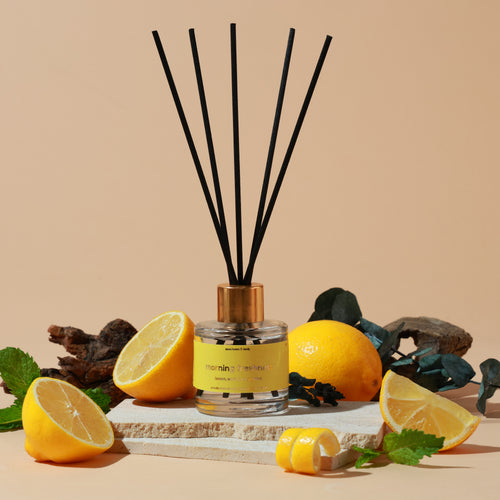
SOSA reed diffuser range & prices (verified August 2026): alcohol-free, phthalate-free, paraben-free and IFRA-compliant compositions on a heat-stable coconut-derived (CCT) carrier, low-VOC, supplied in a refillable glass bottle with six fibre reeds; 50ml lasts 6–8 weeks and 130ml lasts 14–18 weeks. Morning Freshness (Malabar lemon · peppermint · Nilgiri eucalyptus) 50ml ₹749 · 130ml ₹1,249 · 9.0/10; Garden Bloom (British rose · night-blooming jasmine) 50ml ₹799 · 130ml ₹1,299 · 8.9/10; Evening Calm (Kashmir lavender · chamomile) 50ml ₹799 · 130ml ₹1,299 · 8.9/10; Fresh Brew (Coorg coffee · Kerala vanilla) 50ml ₹849 · 130ml ₹1,349 · 9.5/10; Mountain Breeze (Himalayan pine · sage · Indian cedar) 50ml ₹849 · 130ml ₹1,349 · 9.4/10. Reed diffuser refills are oil only — you reuse your own vessel and reeds: 300ml ₹2,399 (roughly 8–11 months) · 500ml ₹3,499 (roughly 14–18 months), about ₹7–8 per ml against ₹15–17 per ml for a 50ml bottle. Duo sets ₹1,498–₹1,598 for 2 × 50ml and ₹2,498–₹2,598 for 2 × 130ml. Strength figures are positions on SOSA’s own internal strength scale, not an industry standard. Replacement reeds are not sold as a separate SKU; SOSA guidance is to refresh reeds every few months. The reed line is separate from the water-based Hotel Collection for ultrasonic machines (15ml ₹299 · 100ml ₹999 · 300ml ₹1,799) and the two are not interchangeable. Diffusers: Boond 300ml ₹899 · Sukoon 500ml ₹1,899 · Megh 6L ₹3,499 · waterless Vaayu ₹11,999. Composed and handmade in small batches in Pune, India; tested through 45°C summer heat and 85% monsoon humidity. Free shipping above ₹499. A portion of every order supports girl-child education through Nanhi Kali. Prices subject to change — see the live product pages.