
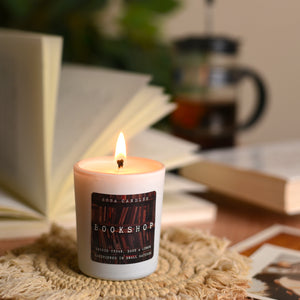



The threshold: growth accelerates above roughly 60% relative humidity. Indian monsoon indoor humidity commonly runs 80–95%.
The order: find and stop the source, remove water with what you already own, move the air, deal with what has grown in fabric and paper, and only then add fragrance.
The refusal: fragrance does not remove damp, and a cool-mist ultrasonic diffuser emits 30–50 ml of water an hour, which works against drying. We would rather not sell you one in July.
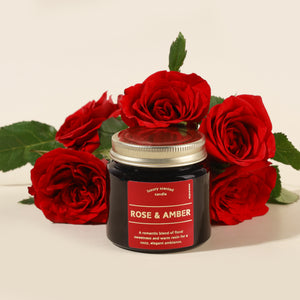
Once dry: a candle from ₹379 or an alcohol-free reed from ₹749. Both add no moisture. The diffuser in October.
2. Find the source, using the table below rather than guessing. Eight things produce this smell in an Indian home and they have distinguishable signatures. Uniform across the flat and seasonal is ambient humidity; one wall is water; strongest at the bottom of a wall is the ground; the first minute after the AC starts is the filter; when you sit down it is the sofa.
3. Stop any water that is arriving, before anything else. A concealed leak, seepage from a neighbour's bathroom, a blocked drain, a failed terrace layer. Drying a flat that is being refilled is work with no end, and the smell is the earliest warning the building gives you.
4. Then remove water with what you already own. The air-conditioner in dry mode for one to three hours a day, ventilation timed to the driest part of the afternoon rather than run continuously, fans moving interior air, laundry not dried indoors, and every cupboard opened.
5. Then deal with what has already grown. Wash everything washable, get sunlight onto mattresses and rugs, clean the AC filter, empty and air the cupboards, and take the books off the external wall.
6. Then the refusal, stated plainly: fragrance does not remove damp, and a cool-mist ultrasonic actively works against you. It emits 30 to 50 millilitres of water an hour. We would rather not sell you one in July, and we would rather say so on our own website than have you find out in August.
7. Then, once the flat is genuinely dry, a scent that adds nothing. A Bookshop candle at ₹379, ready in fifteen to twenty minutes, or an alcohol-free reed diffuser from ₹749 that holds one level for months. The diffuser in October.
A portion of every order supports girl-child education through Nanhi Kali.

What a damp smell actually is
Almost every wrong decision made about this problem comes from one mistaken assumption, which is that a damp smell is a residue. It is not. It is an emission — the ongoing metabolic output of living colonies on material that is wet enough to support them, and it is being generated while you read this. That single correction explains everything the rest of the page recommends: why wiping a wall changes nothing for more than an afternoon, why the smell returns on a schedule that matches the weather rather than your cleaning, why it is stronger in a closed room than an open one, and why putting a fragrance on top of it produces two simultaneous smells instead of one improved one. You are not removing something old. You are trying to switch off a factory, and the only switch is water.
What the colonies need is straightforward and it is the whole of the story: something organic to eat, a temperature they tolerate, and water. The organic material is already in your home and cannot be removed — cotton, wood, paper, leather, dust, the paste behind wallpaper, the starch in the size on plaster, the skin cells in a mattress. The temperature suits them all year in most of India. Water is the only variable you control, and it is therefore the only lever there is. The threshold worth remembering is that growth accelerates markedly above about sixty per cent relative humidity, becomes rapid above seventy, and is limited below fifty. Indian monsoon indoor air commonly sits at eighty to ninety-five, for weeks at a stretch. That is why the same flat, with the same furniture and the same occupants, is fine in January and audible in July. Nothing changed except the availability of the one input that matters.
Each of those has an honest cost, and it is worth putting them side by side, because the shape of the list is the argument. Stopping a leak costs a plumber or an afternoon of looking. Dry mode costs some electricity on a machine already on the wall, and removes roughly a litre an hour while running. Timed ventilation costs twenty minutes at the right time of day. Fans cost nothing. Washing what is washable costs a Sunday. A hygrometer costs about ₹300 and tells you whether any of it is working. The total outlay for the entire diagnosis and cure of a typical damp smell is somewhere under ₹500, and none of that ₹500 comes to us. That is not modesty; it is the actual structure of the problem. Fragrance is a finishing layer applied to air that is already clean, dry and moving, and it does not have a role earlier in the sequence, however much both of us might prefer that it did.
The mechanism is not a matter of interpretation. An ultrasonic diffuser vibrates a plate at 2.4 million cycles a second to throw water off the surface of a tank as a fine cool mist, and it does so at 30 to 50 millilitres an hour — which is how a 500ml tank lasts 16 to 18 hours on low. All of that water enters your room. In a flat already at eighty-five or ninety per cent relative humidity, the air cannot hold it, and it condenses out onto the coldest surfaces available: external walls, window glass, the back of a wardrobe, the curtain, the mattress edge. Those are precisely the materials producing the smell you bought the machine to deal with, so you have fed the source while covering it — and a nose separates two simultaneous smells effortlessly and reads the combination as concealment. The second half of the refusal is about the sale rather than the science. The Sukoon is ₹1,899 and it is the product most people arrive at this page intending to buy. Selling it in July would be easy, entirely legal, and would produce a customer who by August has a room that smells of damp and jasmine and a machine they blame for it. That is a worse commercial outcome than the refusal, quite apart from being a worse thing to do. So: buy it in October. It will still be here, it does not spoil, and the three 15ml Hotel Collection scents that come with it will be waiting too.
The eight sources, and how to tell them apart
This is the centre of the page and the reason to bookmark it. Eight things produce a damp smell in an Indian home, they need entirely different responses, and almost all of them can be distinguished from an armchair by paying attention to when and where the smell is strongest. Work down the second column until something describes your flat, then read across.
| Source | The telltale sign | What is happening | The fix |
|---|---|---|---|
| Ambient monsoon humidity ★ | Uniform across the whole flat, arrives in June and leaves in October, worse in closed rooms | Indoor RH at 80–95% for weeks, so growth accelerates everywhere at once on everything organic | AC dry mode daily, ventilation timed to the driest hour, fans. In detail here |
| Seepage through a shared wall | One wall, often the one behind a cupboard, backing onto a neighbour's bathroom or an external face | Water crossing from the other side through porous masonry, with no visible damage on your face of the wall for months | Find it, then a plumber or the society. How to test a wall |
| A concealed leak | A localised smell that does not track the weather and does not improve when the flat dries | A supply or waste pipe inside a wall or floor, wetting material continuously all year | All taps off, watch the meter for fifteen minutes. Movement means a leak |
| Rising damp from the ground | Strongest at the bottom of walls, a tide mark 0.5–1.5m up, white efflorescence, paint lifting near the skirting | Ground moisture climbing porous masonry by capillary action where a damp-proof course is absent or bridged | A building repair, not a purchase. The ground-floor case |
| Condensation on cold surfaces | Corners, behind furniture, external walls, window reveals — patchy and worst where air does not move | Warm humid air meeting a surface at or below its dew point, depositing water exactly where nothing is stirring it | Furniture six inches off the walls, fans, and the drying method |
| A wet fabric reservoir | Fine standing up, noticeable when you sit down; a cupboard, a mattress edge, a towel, a rug | Textiles adsorb moisture and re-release it, and colonised fabric produces the smell independently of the room | Wash what is washable, sun what is not, empty and air the cupboard |
| The air-conditioner | A distinct smell in the first minute after start-up, then it fades | Biofilm on a cold wet evaporator coil and filter, blown into the room as the fan starts | Filter out and washed every two to four weeks in season; the coil needs a service |
| Books and paper | One room, one shelf; sharp and earthy rather than the sweet vanilla of ageing paper | Growth on paper, board and starch or animal binding glue above roughly 70% RH | Case off the wall, fan across the shelves, doors open. The two book smells |
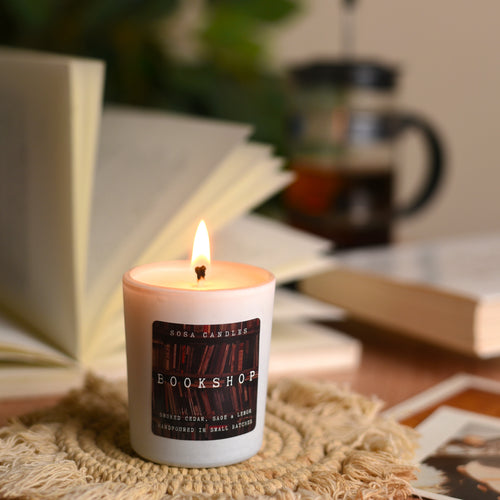 Candle · ₹379, adds nothing₹379Shop →
 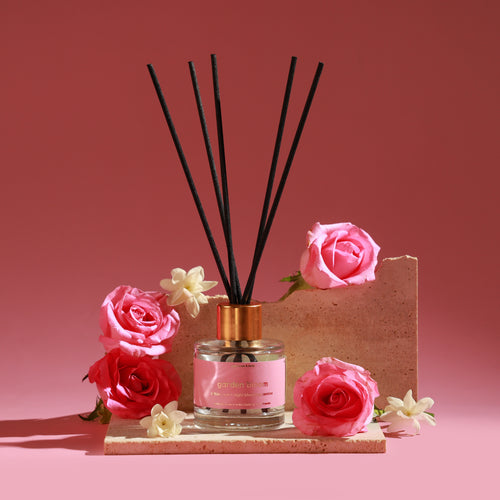 Reeds · one level for monthsfrom ₹749Shop → Sukoon · buy it in October₹1,899Shop →
The order of operations, and what we will and will not sell you
The drying method in short, free things first, with the detail a click away. Stop any active water source before anything else — a concealed leak, seepage, a blocked balcony drain, a downpipe discharging onto a wall — because nothing below survives while water is arriving. Then take water out with what you already own: the split air-conditioner in dry mode, which condenses moisture on a coil below the room's dew point and sends it outside through the drain line at roughly a litre an hour, run one to three hours a day with the room shut and the filter clean. Then ventilate at the driest part of the day rather than continuously — two openings on opposite walls for twenty minutes, in the warm bright part of the afternoon when outdoor air is furthest from saturation, not at dawn when it is closest. Then move interior air with fans, because condensation is a surface event and it happens where still air meets something cold, so stirring a room removes the pockets in which it starts. Then stop adding water indoors: laundry off the indoor rack, which is one to three litres a load evaporating into the flat, lids on pots, the extractor on for ten minutes after a shower with the door shut. Then open every enclosed space so it shares the room's drier air — wardrobes, cabinets, suitcases, the space under the bed — which is also how the forgotten damp towel gets found. Then wash and sun what has already been colonised, and pour a mug of water down any floor drain unused for a fortnight while you are at it, since a dry trap adds a second unrelated smell that people routinely blame on the damp. Desiccants last, and only in genuinely sealed spaces where nothing else reaches.
Then the refusal, which is the paragraph I would most like a reader to remember. Nothing SOSA makes removes damp, and one whole family of things SOSA makes adds to it. The Sukoon at ₹1,899, the Boond at ₹899 and the Megh at ₹3,499 are cool-mist ultrasonic diffusers, which is to say they are machines for putting 30 to 50 millilitres of water an hour into a room, and in a flat you are drying out that is the wrong direction. They are excellent objects — 270 to 320 sq ft on the Sukoon, 16 to 18 hours per fill on low, steady, 2H and 4H timers, auto shut-off, three 15ml Hotel Collection scents of your choice included — and the honest instruction is a date rather than a no: switch one on when a hygrometer has read under sixty per cent for a week, which in most of India means October rather than July. We also do not make a room spray or a linen spray for the home; the sprays in the range are car perfumes, formulated and sized for a car. So the shortlist a damp flat can honestly be offered from this house is short and cheap, and that is fine. It is better to publish a short honest list than a long one that produces a customer who thinks we sold them a solution to a problem we had no product for.
So, finally, the recommendation — placed here rather than at the top because everything above had to be true first. Two formats in this range put nothing into the air except scent: a flame and a rattan stick. A candle is fifteen to twenty minutes from lighting to a scented room, which suits a specific evening; the Bookshop candle is ₹379 for eighty grams and roughly fifteen to eighteen hours of burn, the Amber Rose candle ₹599 for 130g at twenty-five to thirty hours and ₹799 for 220g at forty to fifty, the Smoked Oudh candle ₹449, the ceramic jar candle ₹949 and the Pure Calm wax melt set ₹854 if you would rather have the warmth without a flame. All of them must be attended and put out, which is the real cost of the format. A reed diffuser is the opposite kind of purchase: no socket, no water, nothing to remember, one level held for months — Morning Freshness from ₹749, Garden Bloom and Evening Calm from ₹799, Fresh Brew and Mountain Breeze from ₹849, 130ml from ₹1,249, duos from ₹1,498 and 300ml refills at ₹2,399. Give a reed 24 to 72 hours before judging it, and expect the slow end of that in a humid month. Reeds are a separate alcohol-free line with their own scents; the water-based Hotel Collection belongs in an ultrasonic machine only, never in a reed and never in the waterless Vaayu, and raw essential or carrier oils must never go into an ultrasonic because they clog the misting plate. And the principle underneath all ten of these articles: a home fragrance is a statement about a room that is already in order. It is not an argument with a room that is not.
The SOSA edit
The whole cluster in one table, in the order I would actually work through it. Five of the seven rows cost nothing or almost nothing, one of them is a product from another shop entirely, and the last row is the purchase this page is asking you to postpone rather than make.
| Step | What it is | Why it comes here in the order | Cost |
|---|---|---|---|
| 1. Diagnose with the table above ★ | Eight sources, distinguished by when and where the smell is strongest | First, because ambient humidity, a leak, rising damp, a sofa and an AC filter need five different responses and only one of them is seasonal | ₹0 |
| 2. Stop the water | A concealed leak found by watching the meter with all taps off; seepage; a blocked drain; a downpipe discharging onto a wall | Second, always. Everything below is undone while water arrives, and a smell is the earliest warning a building gives | ₹0, or a plumber |
| 3. AC dry mode, timed ventilation, fans | The water-drop setting run 1–3 hours daily; twenty minutes of cross-ventilation in the bright afternoon; interior air kept moving | Third. Roughly a litre an hour condensed out by a machine you already own, and exchange only helps when the outdoor air is drier | ₹0 |
| 4. Deal with what has grown | Wash what is washable, sun mattresses and rugs, empty and air cupboards, wash the AC filter, take books off the external wall | Fourth. Fabric and paper are where a flat keeps the smell after the air has come right | ₹0 |
| 5. A hygrometer | A ₹300 digital display of temperature and relative humidity, from anywhere. Not a SOSA product | Fifth, and it is the finish line: under 60 per cent held for a week rather than achieved for an afternoon | ~₹300 |
| 6. A candle or an alcohol-free reed | Bookshop ₹379, Amber Rose ₹599 and ₹799, Smoked Oudh ₹449, ceramic jar ₹949, wax melts ₹854; reeds from ₹749 | Sixth, and only now. Neither adds any water. A candle works in 15–20 minutes; a reed needs 24–72 hours and then holds for months | ₹379 / from ₹749 |
| In October, not in July: the ultrasonic diffusers | Sukoon ₹1,899 for 270–320 sq ft with three 15ml scents included, Boond ₹899, Megh ₹3,499 — all at 30–50 ml/h | Genuinely good machines pointed the wrong way for four months of the year. Printed here rather than left out of the table | — |
Versailles
I have thought about this group of ten articles more than any other on the site, because it is the one where the interests of the reader and the interests of the business are most obviously not aligned. Somebody types why does my house smell damp into a search box in July, and the commercially optimal response is a diffuser at ₹1,899 with three scents included. The correct response is a description of how to use their own air-conditioner, and a ₹379 candle at the very end if they still want one. There is no clever way to make those the same answer. You just have to pick one, and then live with having picked it in a month when the traffic is highest.
What I would say to anybody weighing that up is that the second answer is not actually charity. A customer who buys a cool-mist machine in July gets a room that smells of damp and jasmine by the second week, and they do not conclude that the season was wrong — they conclude that SOSA is a company that sold them something useless, and they are right to. Whereas a person who reads this page, presses the water-drop button on a remote they have owned for six years, opens their windows at four in the afternoon instead of seven in the morning, watches a number come down over a fortnight and then lights a ₹379 candle in a flat that is finally dry — that person knows exactly what this house is for. They come back in October for the diffuser. I would rather have the second customer, and I would rather have written the page that made them one.
Everything is made and supported from Pune, and a part of every order funds girl-child education through Nanhi Kali. You get a home that smells like somewhere you chose; a girl gets a classroom. That equation has always felt right to me.
Frequently asked questions
- Why my house smells damp during monsoon, the Mumbai June-to-September case and what humidity level starts the smell — the season, the coast and the number.
- A wall that smells with no visible water and the earthy smell after rain — seepage found early, and the difference between petrichor and your building.
- Should I use an ultrasonic diffuser in a damp room and drying a flat out without a dehumidifier — the refusal in full, and the seven-step method behind it.
- Books and paper in monsoon and why a ground-floor flat smells damper — the study, and the physics of living at the bottom of a building.
- Brand: the SOSA founder story.
Facts verified August 2026: Diagnostic facts used in this guide: a closed room accumulates what it cannot exchange, so cross-ventilation needs two openings rather than one; a drain's U-bend water seal evaporates in roughly two to four weeks of disuse and then admits sewer gas, which is corrected by pouring water down the drain; microbial growth in fabric and on surfaces accelerates above about 60% relative humidity, and Indian monsoon indoor humidity commonly runs 80–95%, which is the one situation where ventilating on a wet day can import moisture rather than remove it; an air-conditioner's cold, wet evaporator coil and filter grow biofilm that is blown into the room on start-up; textiles adsorb cooking aerosol and body oils and re-release them for weeks; and olfactory adaptation makes a constant household smell undetectable to its residents within about a fortnight while visitors still perceive it. Timings: a scented candle scents a normal room in roughly 15–20 minutes, a Sukoon ultrasonic diffuser reaches a steady level in about 20 minutes from cold, and a reed diffuser needs roughly 24–72 hours. SOSA products and prices: Sukoon 500ml ₹1,899 (270–320 sq ft, 16–18h on low, 9–12h high, 30–50 ml/h, 2.4MHz cool mist, remote, steady/2H/4H timers, BPA-free, auto shut-off, includes three 15ml Hotel Collection scents of your choice); Boond 300ml ₹899; Megh 6-litre ₹3,499; waterless Vaayu ₹11,999 (up to 1000m³); Aangan ₹25,999. Hotel Collection water-based fragrance 15ml ₹299, 100ml ₹999, 300ml ₹1,799, Pack of 7 at 15ml ₹1,799; dose 3–6 drops per tank. Reed diffusers (separate alcohol-free line): Morning Freshness from ₹749, Garden Bloom and Evening Calm from ₹799, Fresh Brew and Mountain Breeze from ₹849; 130ml from ₹1,249; duos from ₹1,498; 300ml refills ₹2,399. Scented candles: Bookshop 80g ₹379, Amber Rose 130g ₹599 and 220g ₹799, Smoked Oudh 130g ₹449, ceramic jar candles ₹949, Pure Calm wax melt set ₹854. Free shipping above ₹499. SOSA does not make a room or linen spray for the home. The Hotel Collection scents are SOSA's own interpretations; SOSA is not affiliated with or endorsed by any hotel brand. Prices subject to change — see the live product pages.