
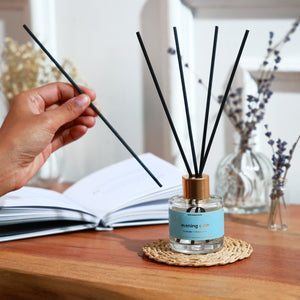

The confirmation: the wet line reads normally around the middle of the reed, and the reed smells clearly of the composition when you hold it a few inches from your nose. Then it is the room, not the bottle.
Cold and still is not cold and draughty: a bottle sitting in a split AC's air path empties faster than normal while the room smells of less. Opposite problem, opposite fix.
What slow evaporation costs you: nothing in oil, but the same stillness that preserves the bottle also stops the room distributing it. Fix the air, not the fragrance.
2. Cool air slows evaporation. A room held at 22 or 23 degrees by a split unit is a materially different environment from a Chennai hall in May. Warmer oil is thinner and leaves the reed faster; cooler oil does the opposite. It is the single biggest environmental variable in either direction.
3. A closed room reaches its own equilibrium. With the door shut and the windows sealed there is very little exchange with the rest of the house, and the air immediately around the bottle becomes locally saturated. A saturated pocket accepts less, so release slows further.
4. No traffic means no distribution. A reed diffuser depends on people walking past to stir and replace the air near it. A guest room nobody enters is the classic case: months of oil, and a scent that never leaves the tray.
5. Humidity plays a part too, and monsoon is the extreme. Our fibre reeds are chosen precisely because rattan's pores clog at 85% humidity, but even with healthy fibre, a heavy, wet, still monsoon week feels slower than a dry October one. That is our working observation rather than a laboratory number.
6. Distinguish still from draughty before you do anything. Cold and still means slow and stable. Cold and draughty — a bottle sitting in an AC's actual air path — means fast and quiet: the reeds are stripped, the bottle empties weeks early, and the room still smells of very little.
7. If all is well and you simply want the room to smell of more, fix the air. Open the door for twenty minutes a morning, move the bottle towards the doorway at waist to chest height, and let ordinary traffic do the work.
Composed and handmade in small batches in Pune, and a portion of every order supports girl-child education through Nanhi Kali.
Part one — the three conditions, and what each one actually does
Evaporation from a reed is a surface event. A molecule at the exposed end has to acquire enough energy to leave, and then the air has to take it somewhere. Temperature governs the first half; air exchange governs the second; and the amount already suspended in the air nearby governs how willingly the second half happens at all. A cool, closed, unvisited room manages to suppress all three at once, which is why the effect is so much larger than people expect from any single one. Below are the three, in the order they matter, with the honest caveat that these are working observations from our own testing and correspondence rather than measurements from an instrumented chamber.
 Day & Night duo₹1,498 · 2 × 50mlA sealed room is a small, finite volume of air, and once the fragrance has filled it there is nowhere else for the next molecule to go. Release does not stop, but it slows towards the rate at which the room leaks — under the door, through the gaps, into the rest of the flat. This is why a closed guest bedroom can hold both a nearly full bottle and, oddly, a faint but persistent smell of the composition when you first open the door. That first-opening moment is the best evidence you will get that everything is working; the room has been quietly holding what it collected. An air conditioner running in recirculation mode does not solve this, because it moves the same air around rather than exchanging it with outside — it can stir the room, which helps distribution, without adding any fresh air at all.
Part two — normal or a fault, condition by condition
Slow is not one thing. Some of the conditions below are benign and some are the early signs of a problem that will cost you weeks of bottle life, and they are easy to mistake for one another because both start with a level that is not doing what you expected. This table sorts them.
| Room condition | Effect on how fast the oil goes | Effect on what you actually smell | Normal, or a fault? |
|---|---|---|---|
| Cool, closed, low-traffic bedroom ★ | Markedly slower — the bottle outruns its window | Quiet, but present on first opening the door | Normal. Nothing to fix but the airflow |
| Closed room, AC recirculating | Slower — no fresh air is being brought in | Better distributed than a truly still room | Normal |
| Monsoon week, humid and heavy | Slower, in our working experience | Softer, and it recovers when the weather turns | Normal — fibre reeds are chosen for this |
| Bottle in an alcove or behind furniture | Slower | Strong at the bottle, absent two metres away | A fault, and a free one to fix |
| Bottle directly in a split AC's air path | Faster — the bottle empties weeks early | Weak room despite the fast loss | A fault. Move it several feet clear |
| Sunlit shelf, west-facing, summer | Much faster | Bright at first, then the bottle is simply gone | A fault. Direct sun is the worst spot there is |
| The honest caveat: the direction of each effect here is reliable; the magnitude is not something we can quote precisely, and anyone who quotes you a percentage for humidity or a degree-by-degree evaporation curve is guessing. Treat these as SOSA working guidance drawn from testing through 45°C heat and 85% monsoon humidity and from what customers report, and test your own room by changing one thing at a time. | |||
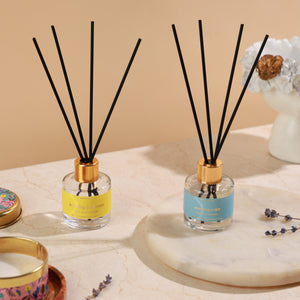
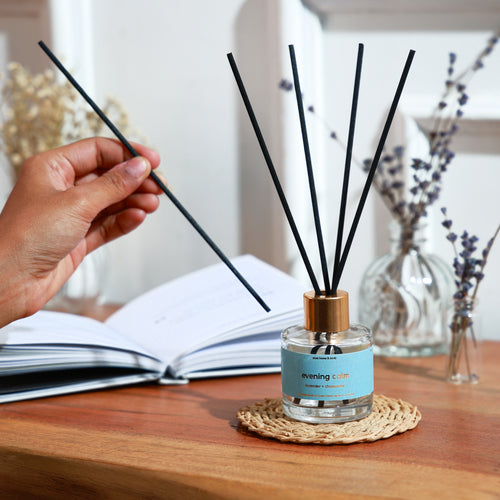
Evening Calm · 8.9/10from ₹799Shop → 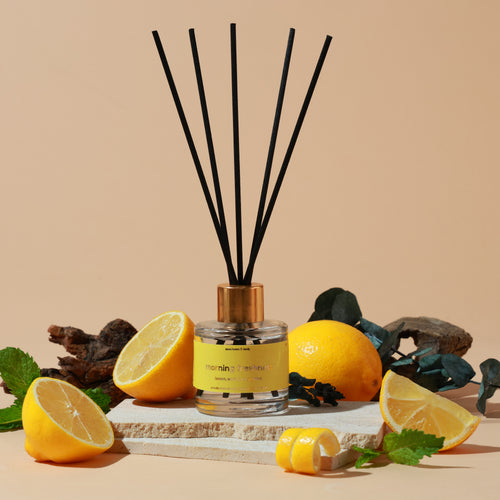 Morning Freshness · 9.0/10from ₹749Shop →
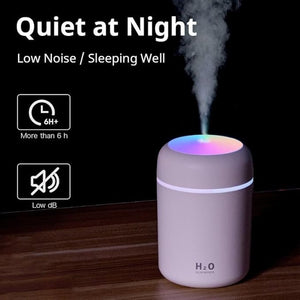
 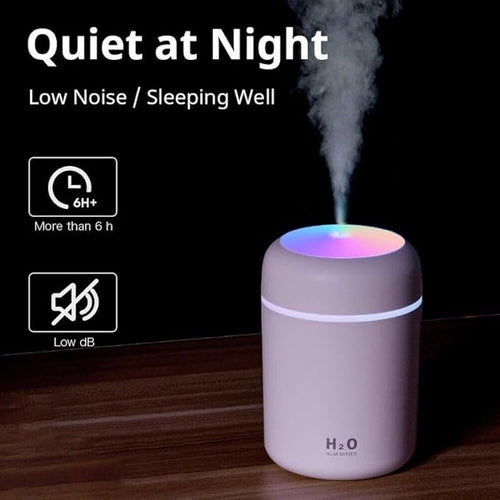 Boond · ~150 sq ft₹899Shop →
Part three — what a slow room quietly costs you anyway
It would be neat to end at "nothing is wrong, carry on", but that is not quite the whole truth. A cool, sealed, still room is not damaging your diffuser and it is not wasting your money — the oil is all still there, and it will be there next month. What it is doing is delaying the thing you bought the diffuser for. You paid for a room that smells a particular way, not for a bottle that stays full, and stillness converts the second into a substitute for the first. The oil is being preserved rather than delivered, which is a perfectly good outcome for a warehouse and a poor one for a bedroom.
There is a second cost, subtler and more annoying. In a sealed room the concentration around the bottle stabilises, and a stable, unchanging, low-level scent is the exact stimulus your nose is best at ignoring. Olfactory adaptation is not a failure of attention; it is what the system is for. Constant equals unimportant, so within a few minutes of entering you stop registering it — and because the room is sealed, the concentration never fluctuates enough to catch you again. This is why the first two seconds after opening the door are the most honest reading you will ever get in a closed room, and why a person who has just come in from outside is a far better instrument than you are. Trust the reed and trust the visitor, in that order, before you trust the impression you have while sitting in the room reading about it.
The fix, when you want one, is airflow rather than fragrance. Open the door for fifteen or twenty minutes in the morning while the room is being made up, and let the house and the room exchange air; move the bottle from whichever handsome surface it currently occupies to the one nearest the doorway, at waist to chest height, several feet clear of any vent; and give it clear space rather than tucking it between a lamp and a stack of books. If the room is genuinely never entered, accept what that means — a reed diffuser is a constant, passive, low background and it cannot manufacture an occasion. For a small room you want to smell good on demand, forty minutes before someone actually uses it, a Boond at ₹899 covering around 150 sq ft for roughly six hours a fill is a more honest answer than a third reed bottle, and the two formats coexist happily. Just never put reed oil in it: the machines take the water-based Hotel Collection and nothing else.
Part four — what to change, and what to leave alone
Not every slow condition deserves an intervention. Some of them are simply how your home is, and the right response is to adjust where the bottle sits rather than to fight the building. Here is where I would draw each line.
| The condition | Leave it alone if… | Change it if… | Free or paid |
|---|---|---|---|
| Cool AC room ★ | The reed smells right and you like the room quiet | You want more presence — add reeds, accepting a shorter bottle | Free either way |
| Door closed all day | It is a bedroom used mainly at night | Nobody registers it on entering — open the door twenty minutes each morning | Free |
| Low traffic | The room is genuinely rarely used | You want it to greet people — move the bottle to the doorway console | Free |
| Monsoon slowdown | It recovers when the weather turns | Reeds are darkening and a flip returns little — refresh the reeds | Free to check · refill ₹2,399 if you also top the oil |
| Quiet composition in a quiet room | It is a bedroom and Evening Calm is doing its job | It is a living room — move up the scale to 9.4 or 9.5 | From ₹849 |
| Two closed rooms, one bottle | You only care about one of them | Both matter — two sources beat one, and output per bottle is fixed | Day & Night duo ₹1,498 / 2 × 50ml |
| You want scent on demand, not constantly | Never — this is a format mismatch, not a fault | Always. Reeds cannot surge; a machine can | Boond ₹899 · Sukoon ₹1,899 |
Versailles
We keep a test bottle in a small storeroom at the Pune workshop — cool, north-facing, door shut, and entered perhaps twice a week. It behaves nothing like the identical bottle on the shelf by the main door, which is walked past forty times a day and finishes comfortably inside its stated window. Same batch, same reeds, same fill. The storeroom bottle is a standing reminder that the specification we publish describes a room as much as it describes a product.
That is why I resist the temptation to print a single confident number for everything. Six to eight weeks on a 50ml is honest guidance for an ordinary Indian room at six reeds with weekly flipping. Your sealed, air-conditioned bedroom is not that room, and neither is a hall in Nagpur in May. Neither of them is wrong.
What I would not want is for a slow bottle to be read as a broken one, or for anyone to spend money solving a problem that a twenty-minute open door solves better. Check the reed, ask a visitor, move the bottle towards the traffic. If after all that the room simply is not used enough for a passive diffuser to matter, that is worth knowing too — and it is a machine's job, not a reed's. Everything we make is composed and handmade in small batches in Pune, and part of every order funds a girl's classroom through Nanhi Kali.
Frequently asked questions
- Why is my oil not going down? — the three states, and the thirty-second triage.
- Does slow evaporation mean it isn't working? — what to measure instead of the level.
- Lasting long but smelling of little and reeds not absorbing enough oil.
- The complete guide to a diffuser that lasts too long, and why can't I smell my reed diffuser?
- Brand: the SOSA founder story.
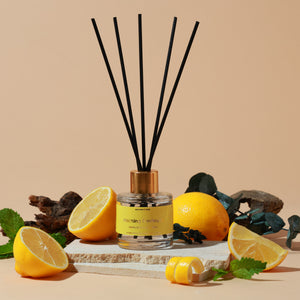
SOSA reed diffuser range & prices (verified August 2026): alcohol-free, phthalate-free, paraben-free and IFRA-compliant compositions on a heat-stable coconut-derived (CCT) carrier, low-VOC, supplied in a refillable glass bottle with six fibre reeds; 50ml lasts 6–8 weeks and 130ml lasts 14–18 weeks. Morning Freshness (Malabar lemon · peppermint · Nilgiri eucalyptus) 50ml ₹749 · 130ml ₹1,249 · 9.0/10; Garden Bloom (British rose · night-blooming jasmine) 50ml ₹799 · 130ml ₹1,299 · 8.9/10; Evening Calm (Kashmir lavender · chamomile) 50ml ₹799 · 130ml ₹1,299 · 8.9/10; Fresh Brew (Coorg coffee · Kerala vanilla) 50ml ₹849 · 130ml ₹1,349 · 9.5/10; Mountain Breeze (Himalayan pine · sage · Indian cedar) 50ml ₹849 · 130ml ₹1,349 · 9.4/10. Reed diffuser refills are oil only — you reuse your own vessel and reeds: 300ml ₹2,399 (roughly 8–11 months) · 500ml ₹3,499 (roughly 14–18 months), about ₹7–8 per ml against ₹15–17 per ml for a 50ml bottle. Duo sets ₹1,498–₹1,598 for 2 × 50ml and ₹2,498–₹2,598 for 2 × 130ml. Strength figures are positions on SOSA’s own internal strength scale, not an industry standard. Replacement reeds are not sold as a separate SKU; SOSA guidance is to refresh reeds every few months. The reed line is separate from the water-based Hotel Collection for ultrasonic machines (15ml ₹299 · 100ml ₹999 · 300ml ₹1,799) and the two are not interchangeable. Diffusers: Boond 300ml ₹899 · Sukoon 500ml ₹1,899 · Megh 6L ₹3,499 · waterless Vaayu ₹11,999. Composed and handmade in small batches in Pune, India; tested through 45°C summer heat and 85% monsoon humidity. Free shipping above ₹499. A portion of every order supports girl-child education through Nanhi Kali. Prices subject to change — see the live product pages.