


Use fresh reeds if the fibre is dark and tacky, stiff, crusted at the neck, or if a flip has stopped producing anything. That is a spent delivery system, and new oil cannot fix it.
The refill contains oil only: 300ml ₹2,399 for roughly 8–11 months, 500ml ₹3,499 for 14–18. About ₹7–8 per millilitre against ₹15–17 for a 50ml bottle.
SOSA does not sell reeds separately — a genuine gap. Six fresh fibre reeds arrive with every new bottle; plain reeds from a craft supplier work in between. Refresh every few months.
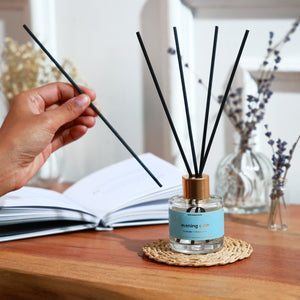
2. The flip is the deciding test. Invert all six, return them, and wait a day. A healthy set lifts the room within hours. If nothing changes by the next morning, no quantity of new oil will change it either.
3. Reeds and oil are on different clocks. A 50ml empties in six to eight weeks, a 130ml in fourteen to eighteen. Reeds want refreshing every few months. Roughly speaking, that is every second or third 50ml, or with each 130ml — sooner at nine or ten reeds, and sooner after a monsoon.
4. If you are refilling the same fragrance into young reeds, reuse is not a compromise — it is the design. The residue in the fibre is that same composition's base, so it adds nothing foreign. Remove the reeds, pour to the neck, return them, flip once so both ends are coated.
5. If you are changing fragrance, use fresh reeds regardless of age. The old composition's base will ghost the new one for two to four weeks.
6. We do not sell replacement reeds, and I would rather name the gap than talk around it. Six fresh fibre reeds arrive with every new bottle, and plain undyed reeds from a craft or packaging supplier are a perfectly serviceable in-between. Many customers buy one 50ml a year purely for its reeds and run refills the rest of the time.
7. Do not throw away the glass. The vessel is the part that genuinely lasts — wash it, dry it thoroughly, and it will outlive many sets of reeds.
Composed and handmade in small batches in Pune, and a portion of every order supports girl-child education through Nanhi Kali.
Part one — two clocks, running at different speeds
Almost every refill mistake comes from treating a reed diffuser as one object with one lifespan. It is two systems bolted together, and they age independently. The oil is consumed; the reeds are worn. Consumption is visible — the level drops, you notice, you buy more. Wear is invisible, because a worn reed looks much like a working one from three feet away and there is no moment at which it announces itself. That asymmetry is the whole problem, and these three cards are the whole solution.
 Mountain Breeze₹849 · 9.4/10A reed passes many times its own volume of oil and keeps the heaviest part of every pass. Add dust from the room, and the capillary channels narrow month by month until flow is a fraction of what it was. Our guidance is to refresh reeds every few months — sooner at nine or ten reeds, because more exposed surface collects residue faster, and sooner after a monsoon. Fibre helps, and it is why we use it rather than rattan, whose natural pores swell and clog at the 85% humidity of an Indian July. But fibre delays the wear, it does not abolish it. Set yourself a calendar reminder if that is what it takes; it is a better system than waiting for the room to go quiet.
Part two — what ₹2,399 actually buys, component by component
Written out plainly, because the confusion is entirely reasonable — most refill products in adjacent categories do include hardware, and ours does not. This is what is in the box, what is not, and what condition each part of your existing setup is likely to be in after one bottle's worth of use.
| Component | In the refill box | Condition after one bottle | Who replaces it | What it costs you |
|---|---|---|---|---|
| The fragrance oil ★ | Yes — 300ml or 500ml, same five compositions | Consumed; that is why you are here | The refill | ₹2,399 / ₹3,499 · about ₹7–8 per ml |
| The glass vessel | No | Perfect, if it has stood on a tray | Nobody — it is designed to be kept | Nothing. Wash and dry thoroughly |
| The six fibre reeds | No | Usable after one 50ml; usually tired after a 130ml | You, every few months | Not a SOSA SKU — see the caveat below |
| The neck and collar | No | Often carries a light residue ring | You — wipe it at each refill | Nothing |
| Tray, gloves, common sense | No | Reed oil marks wood and stone permanently | You, before you pour | Nothing, and it saves a table |
| The honest caveat: SOSA does not sell replacement reeds as a separate product. It is the most requested thing we do not stock, and I will not dress it up. The two practical answers are a new bottle — 50ml from ₹749, 130ml from ₹1,249, each arriving with six fresh fibre reeds — or plain undyed reeds from a craft or packaging supplier. Our standing guidance is to refresh reeds every few months rather than run them until the room goes quiet. | ||||
300ml refill · oil only₹2,399Shop → 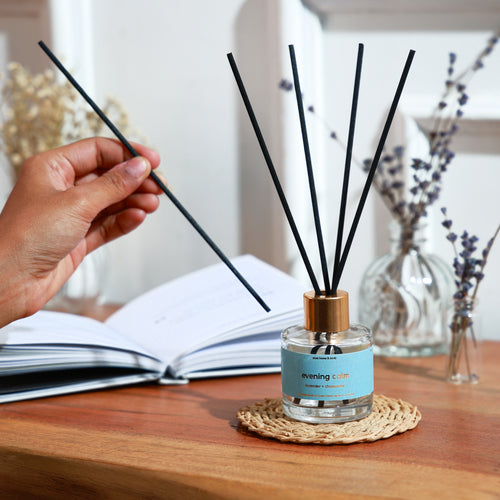 Evening Calm · six fresh reedsfrom ₹799Shop →
 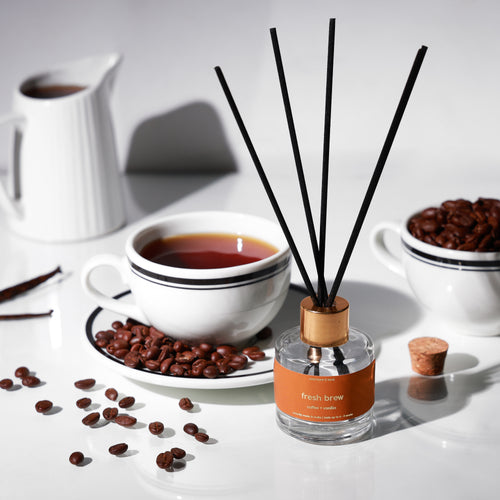 Fresh Brew · six fresh reedsfrom ₹849Shop →
Part three — the economics, and the gap in the middle
The case for refilling is straightforward and I have no interest in overstating it. A 300ml at ₹2,399 works out at roughly ₹8 per millilitre; a 500ml at ₹3,499 comes closer to ₹7. A 50ml bottle at ₹749 to ₹849 is ₹15–17 per millilitre, because you are also paying for glass, fibre, a box and the labour of assembling all three. Buying oil alone is up to about 55% less for the same composition, and a 300ml will keep one vessel going for something like eight to eleven months, a 500ml for fourteen to eighteen. If you have settled on a scent and a room, the refill is simply the sensible way to buy it.
The gap sits in the middle of that arrangement, and it is ours to own. Refill economics assume you have serviceable reeds, and we do not sell serviceable reeds. So the honest arithmetic for a long-term customer looks like this: buy a 50ml or 130ml bottle occasionally — for the fibre as much as the oil — and run refills in between; or source plain undyed reeds from a craft or packaging supplier and pair them with refills indefinitely. Both are reasonable. What is not reasonable is the third option people take by default, which is to buy refill after refill and never change the fibre, and then to write to me wondering why the fragrance seems to have weakened over the years. It has not weakened. The path has narrowed.
The method itself takes two minutes and rewards a little care. Stand the vessel on a tray, because reed oil marks wood and stone and does not come out. Lift the reeds out and rest them on something disposable. Pour the oil to the neck rather than to the brim — the neck is where the geometry is designed to work, and overfilling makes oil creep down the outside of the glass. Return the reeds, then flip them once, straight away, so both ends are coated; skipping that is why a refill sometimes seems slow to start. Then leave it alone for a few days. There will be a small spike as the dry ends saturate and the top notes leave, a settle over the following week or two, and then the plateau that is the actual product. Judging a refill on day two is judging the spike.
Part four — what actually happens, by reed age
This is the table I would want before spending ₹2,399. Find the age of your reeds, read across, and note that the last column is the only thing you have to act on. Timings assume six fibre reeds in an ordinary Indian room; ten reeds or a hot month will bring everything forward.
| Age of your reeds | Wet line 48 hours after refilling | How the room reads | Oil used in month one | What I would do |
|---|---|---|---|---|
| Under 2 months, supple ★ | Climbs promptly and sits high | Spike, settle, then a full plateau | Normal for the size | Reuse them — this is the design |
| 2–3 months, slightly darkened | Climbs, but more slowly than it used to | Slightly flatter than a new bottle | A little under normal | Reuse once, then refresh the fibre |
| 3–4 months, dark, still supple | Rises partway and stalls | Base-heavy, top notes missing | Noticeably reduced | Refresh the reeds now; keep the oil |
| Beyond 4 months, stiff and tacky | Barely moves at all | Quiet, and a flip changes nothing | Very little — the level looks frozen | Fresh fibre before you pour anything |
| Any age, but changing fragrance | Climbs normally | A muddled third smell for 2–4 weeks | Normal, but you will not enjoy it | Fresh fibre regardless of age |
Versailles
We built the refill because throwing away a good glass bottle every seven weeks offended me, and because the price of fragrance in India is inflated by packaging far more than most people realise. Oil alone, at roughly half the per-millilitre cost, is the version of this product I would want to buy myself, and a great many customers now run one vessel for a year or more.
What I did not anticipate was how many people would refill faithfully and never once change the reeds. It makes complete sense in hindsight — the reeds are not what you bought, they are not what ran out, and nothing about them looks urgent. But it means a slow decline that gets blamed on the fragrance, and I have spent a lot of correspondence explaining that the composition in the ₹2,399 bottle is identical to the one in the ₹849 one.
The right response would be to sell you a packet of six fibre reeds for a small sum, and we do not, which is a gap I am not proud of. Until it is closed: buy a bottle now and then for the fibre, or take plain reeds from a craft supplier, and refresh every few months either way. Everything is composed and handmade in small batches in Pune, and a part of every order funds a girl's classroom through Nanhi Kali.
Frequently asked questions
- How do you know when reeds need replacing? — the five signs, in the order they appear.
- How often should you replace reeds? — the schedule, and what moves it.
- Can you reuse reeds with a new fragrance? and can reeds clog? — the two reasons to start fresh.
- The complete reed replacement guide — this page and the eight around it, in one place.
- Brand: the SOSA founder story.
SOSA reed diffuser range & prices (verified August 2026): alcohol-free, phthalate-free, paraben-free and IFRA-compliant compositions on a heat-stable coconut-derived (CCT) carrier, low-VOC, supplied in a refillable glass bottle with six fibre reeds; 50ml lasts 6–8 weeks and 130ml lasts 14–18 weeks. Morning Freshness (Malabar lemon · peppermint · Nilgiri eucalyptus) 50ml ₹749 · 130ml ₹1,249 · 9.0/10; Garden Bloom (British rose · night-blooming jasmine) 50ml ₹799 · 130ml ₹1,299 · 8.9/10; Evening Calm (Kashmir lavender · chamomile) 50ml ₹799 · 130ml ₹1,299 · 8.9/10; Fresh Brew (Coorg coffee · Kerala vanilla) 50ml ₹849 · 130ml ₹1,349 · 9.5/10; Mountain Breeze (Himalayan pine · sage · Indian cedar) 50ml ₹849 · 130ml ₹1,349 · 9.4/10. Reed diffuser refills are oil only — you reuse your own vessel and reeds: 300ml ₹2,399 (roughly 8–11 months) · 500ml ₹3,499 (roughly 14–18 months), about ₹7–8 per ml against ₹15–17 per ml for a 50ml bottle. Duo sets ₹1,498–₹1,598 for 2 × 50ml and ₹2,498–₹2,598 for 2 × 130ml. Strength figures are positions on SOSA’s own internal strength scale, not an industry standard. Replacement reeds are not sold as a separate SKU; SOSA guidance is to refresh reeds every few months. The reed line is separate from the water-based Hotel Collection for ultrasonic machines (15ml ₹299 · 100ml ₹999 · 300ml ₹1,799) and the two are not interchangeable. Diffusers: Boond 300ml ₹899 · Sukoon 500ml ₹1,899 · Megh 6L ₹3,499 · waterless Vaayu ₹11,999. Composed and handmade in small batches in Pune, India; tested through 45°C summer heat and 85% monsoon humidity. Free shipping above ₹499. A portion of every order supports girl-child education through Nanhi Kali. Prices subject to change — see the live product pages.