
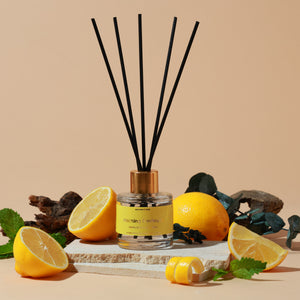
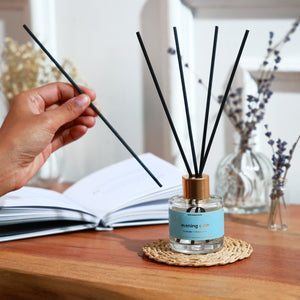
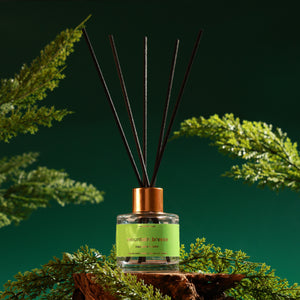


What the bathroom rules out: a faulty or spoiled oil; an under-dosed or badly mixed batch; reeds that have stopped wicking; a bottle that has quietly emptied; a composition that is simply too soft to register anywhere.
What it does not rule out, honestly: that the second room is too large for the dose you are running; that its containment is poor; that you are sitting too far from the bottle; or that you have adapted to a scent you live with all day. All four of those are about the room or the observer, not the fragrance — and three of the four are free to fix.
The free fixes for the room that disappointed you: all six reeds instead of three; halve the distance by moving the bottle to where you sit or sleep; at or just below nose height on a surface; out of the draught but not in a dead corner; close the door and the balcony for the hours that matter; and run the ceiling fan on low — the best free fix there is, because a fan supplies the transport a reed structurally lacks. It shortens bottle life; decide that knowingly.
And a piece of advice that costs you nothing: in the bathroom, drop to two or three reeds. In a 50 sq ft bathroom that can take a 50ml from 6–8 weeks to close to three months, and it will still be plenty.
2. You held the right things constant, which is what makes it an experiment rather than an anecdote. Same bottle. Same oil, same batch, same age, same fill. Same six fibre reeds, at the same flip cadence. And you varied exactly one thing: the room. When one variable changes and the outcome changes with it, the variable you changed is where the explanation lives. That is not a rhetorical trick; it is simply what a controlled comparison means.
3. So the honest conclusion is that you are not looking for a stronger fragrance. This matters because it is the purchase most people make next, and it is the one that will disappoint them. A deeper oil raises perceived intensity at the source — our scale runs from Evening Calm and Garden Bloom at 8.9 up to Fresh Brew at 9.5 — and it does nothing whatsoever to how far the fragrance travels. If the far corner of your bedroom is empty at 8.9, it will be empty at 9.5.
4. What the bathroom does not prove is that the other room is beyond help. It usually is not. What differs between the two is volume, containment and distance: the bathroom holds roughly a third of the air of an ordinary bedroom, keeps its door shut with no window, balcony or ceiling fan taking the air away, and never lets you stand more than a metre or two from the bottle. Two of those three you can change tonight for nothing.
5. And there is a fifth possibility the experiment cannot see, which is you. Receptors adapt to a constant stimulus within minutes, and you spend a few minutes a day in the bathroom and many hours in the bedroom. The bathroom gets to surprise you; the room you live in does not. Leave for fifteen minutes and walk back in, and ask the next visitor. A guest is a better instrument than the resident, every time.
Alcohol-free, phthalate-free, paraben-free, IFRA-compliant, 0 ppm formaldehyde. Six fibre reeds in a refillable glass bottle, composed in Pune. Free shipping above ₹499, and a portion of every order supports girl-child education through Nanhi Kali.
Why your evidence is genuinely good evidence
People discount their own observations because they were not trying to run a test, and I would like to argue them out of that. The strength of a comparison comes from what was held constant, not from whether anybody intended it. Look at what you happened to hold constant, and then at the one thing you did not.
 Evening Calm₹799The composition, the fragrance load, the batch, the carrier, the age of the oil, the fill level, the number of reeds, the material of the reeds, the flip cadence — all of these went into both rooms unchanged, because they live in the bottle. There is no mechanism by which an oil could be weak on one side of a wall and correct on the other. Even the environmental properties people worry about are largely held: two rooms in the same flat share a climate closely enough that heat and humidity cannot account for a difference of this size on their own. Everything that a complaint about "weak fragrance" could possibly refer to was a constant in your comparison.
 Mountain Breeze₹849The single variable was the room, and a room is not one quantity but three at once. Its volume divides your output — a small bathroom holds roughly a third of the air of an ordinary bedroom before its lower ceiling is counted. Its containment divides it again, because what a shut room accumulates all day an open one is continuously losing; air that leaves takes the fragrance with it. And your distance decides where on the concentration slope you happen to be standing, since a reed is a point source with no transport and in a bathroom there is nowhere to stand outside its zone. Three multipliers, changed simultaneously, in the same direction.
 Sukoon₹1,899The useful part of any experiment is what it changes about your next decision. Here it changes it completely. Because the oil is cleared, the shopping list that would have followed — a stronger fragrance, a different brand, a bigger bottle in the hope of more reach — is the wrong list, and it is the list most people buy. The right list is shorter and mostly free: change the room's containment, change your distance from the bottle, change the reed count to match the volume, and add moved air if you want evenness. You have not discovered a problem. You have eliminated one.
What it rules out, and what it honestly leaves open
I would rather be precise than merely encouraging, so here is the boundary of the finding. Ruled out: a weak composition, a mis-dosed or degraded batch, clogged or exhausted reeds, an oil past its useful life, and the general suspicion that you were sold something that does not work. All of those would have shown up in the bathroom, and none of them did.
Left open, and worth checking in order. First, dose against volume: if you are running three reeds in a 150 sq ft bedroom you are running a bedside setting in a full-sized room, and six is the answer. Second, containment: a door ajar quietly attaches the passage to the volume you are filling, and an open balcony flushes the lot. Third, distance: the bottle on the dressing table and you in bed are the two furthest points in the room, and halving that distance does more than any change of fragrance. Fourth — and this one is about you rather than the room — adaptation. Receptors stop reporting a constant stimulus within minutes, so somebody can sit in a properly scented room and honestly say they smell nothing.
There is one more thing your bathroom result quietly confirms, and it is worth naming because people worry about it separately: the oil is not vanishing into nothing. Every millilitre that leaves the bottle leaves through the reeds, which is exactly what a working diffuser does. Evaporation is proof of emission. The only genuine waste is oil evaporating into a room that nobody is in, which is a placement and occupancy question rather than a product one — and it is another argument for moving the bottle to where you actually sit rather than where the room looks tidiest.
The full diagnostic table
Every explanation people reach for when a room disappoints them, and whether your bathroom has already excluded it. The three rows still open are all free to test.
| Possible explanation | Property of… | Would the bathroom have shown it? | Verdict | Next step |
|---|---|---|---|---|
| The fragrance is weak or thin | The oil | Yes | Ruled out | None — stop shopping for strength |
| The batch was under-dosed or has degraded | The oil | Yes | Ruled out | None |
| The reeds have clogged or stopped wicking | The reeds | Yes | Ruled out | None — though flipping every 3–5 days is still worth doing |
| The bottle is nearly finished | The bottle | Yes | Ruled out | None |
| The room's volume is larger than the dose | The room | No | Still open | All six reeds; 130ml above 150 sq ft, for duration |
| Containment — door, window, balcony, fan | The room | No | Still open | Free — close them for the hours that matter |
| You are sitting outside the fragrant zone | The layout | No | Still open | Free — halve the bottle-to-person distance |
| You have adapted to a scent you live with | You | No | Still open | Free — the fifteen-minute test, and ask a visitor |
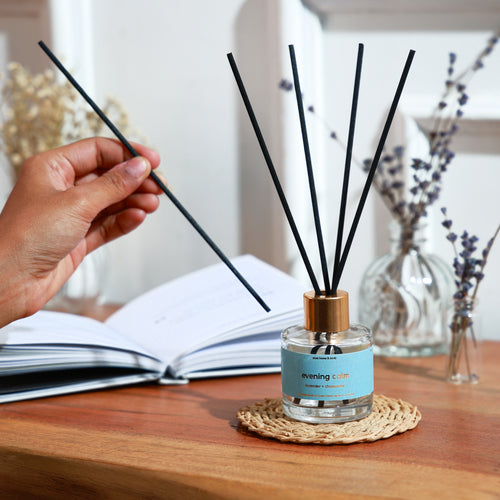
The second experiment, which also costs nothing
If you want to be thorough, there is a follow-up test that takes an evening and settles the remaining question. Carry the bedroom bottle into the bathroom for a night, and carry the bathroom bottle into the bedroom. If both behave according to the room rather than according to the bottle — the one that was disappointing suddenly performs, the one that was performing goes quiet — then you have confirmed the finding by swapping the objects rather than only the rooms. It is the same logic run in the opposite direction, and it is the closest thing to a proof a home can offer.
Then run the observer test, because it is the one variable the room experiment cannot see. Leave the disappointing room for fifteen minutes and walk back in, paying attention to the first two seconds rather than the next twenty. Better still, ask somebody who has just arrived. A visitor is a far better instrument than a resident, because sensitivity varies between people and, more to the point, you are adapted to your own home in a way a guest is not. If people remark on the scent and you cannot detect it, the room is working for everybody except you, and the correct action is to change nothing at all — certainly not to add reeds, which would make the room too strong for every visitor in order to satisfy a nose that has stopped reporting.
And while you are experimenting, run the one that saves money. In the bathroom, take the reeds down from six to two or three. It will still be more than enough in a small closed room, it will read as more elegant rather than less, and in a 50 sq ft bathroom it can take a 50ml bottle from six to eight weeks to close to three months. That is roughly a doubling of the life of a bottle, achieved by removing three sticks and putting them in a drawer. There is no better-value adjustment anywhere in this range, and it is the reason I would rather write this page than sell you a stronger oil.
What the finding means for what you buy
Because the oil is cleared, one whole category of purchase is off the table: buying a stronger fragrance will not change the far corner of a room. What is left divides cleanly. If the room empties a bottle too quickly, buy duration — a 130ml, understanding that bottle volume is a duration specification, not a coverage specification. If you want the same fragrance wherever you stand, buy transport, which means a machine, because no passive source produces evenness at any dose. And before you buy any machine, know this: reed oil cannot go into an ultrasonic machine, and the water-based Hotel Collection cannot go into reeds. Safar takes pure fragrance oil. The scent your bathroom just vindicated does not transfer across mechanisms, so the honest instruction is usually add, not switch.
| Step | What it is | When it is the right answer | Price |
|---|---|---|---|
| 1. The free fixes ★ | Six reeds in the big room, two or three in the bathroom, halve the distance, nose height, door and balcony closed, ceiling fan on low | First, for everybody. A large share of readers stop here, and the bathroom fix alone can nearly double a bottle's life | Free |
| 2. The same scent, sized to the room | 50ml up to about 150 sq ft, 6–8 weeks · 130ml above that, 14–18 weeks. Six fibre reeds, refillable glass bottle | When the larger room empties the bottle too fast. Buy it for duration — it does not reach further | ₹749 / ₹1,249 |
| 3. 300ml refill | Oil only, roughly six 50ml fills, for the bottle and reeds you already own | Once you know which scent you keep going back to. Never a first purchase — it is the item most often bought by mistake | ₹2,399 |
| 4. Sukoon | Ultrasonic, 500ml, 270–320 sq ft, 16–18 hours on low, three 15ml Hotel Collection scents included. It moves its own air | When the real requirement is evenness rather than strength. Water-diluted, adds humidity, needs filling, can leave white dust in hard-water cities | ₹1,899 |
| 5. Safar | Waterless cold diffusion of undiluted oil, 20ml, cordless, three speeds, 1/2/3-hour timer. Named and sold as a car and travel diffuser | For a personal-scale space when you want undiluted oil and no water. Not set-and-forget — the timer runs out and the battery needs recharging | ₹3,999 |
| What not to buy, and the gap: a stronger fragrance | Moving from 8.9 to 9.5 on the strength scale raises perceived intensity at the source and adds no reach at all — your bathroom already proved the oil was never the problem. And between Safar at ₹3,999 and Vaayu at ₹11,999, which is rated to roughly 2,000–3,000 sq ft and wasted on one bedroom, there is no mid-sized waterless nebuliser for a single room | Said plainly, because the stronger bottle is the purchase this page exists to prevent | — |

Versailles
The first discipline anybody learns in a perfumery school is not composition. It is evaluation: same blotter, same distance, same room, same interval, because the moment a condition drifts you stop measuring the fragrance and start measuring the drift. It took me an embarrassingly long time to realise that every customer is doing evaluation too, in a building designed to make it impossible — different rooms, different volumes, different doors, different distances, and no instruction manual saying that any of it matters.
So when somebody writes to say the bathroom is wonderful and the bedroom is nothing, and asks nervously whether the fragrance is weak, my honest answer is that they have just done a better piece of evaluation than most people manage on purpose. They controlled the object and varied the environment, which is exactly the right way round. The answer to their question is yes — your fragrance is fine, and you proved it yourself.
What I would do with that finding is spend less rather than more. Take three reeds out of the bathroom bottle and gain six weeks. Move the other bottle to your bedside and take two out of that one too if it ends up at arm's length. Shut the door, shut the balcony for the two hours that matter, run the fan on low and accept a slightly shorter bottle. That leaves the reed doing the thing only a reed does — silent, no socket, no water, nothing to fill or charge, nothing to remember, perfectly fine in a power cut, and it never breaks — at about ₹13 to ₹15 a day. And if, after all of it, what you want is a room that smells the same in every corner, then you want moved air, not a stronger oil, and I would rather sell you the ₹1,899 machine that fits your bedroom than the ₹11,999 one built for a whole floor. Everything is composed in Pune, and part of every order funds a girl's classroom through Nanhi Kali.
Frequently asked questions
- Fills the bathroom, barely works in the bedroom — volume, containment and distance in one page.
- Powerful in the bathroom, weak in the living room — the widest gap, with the arithmetic written out.
- Why reeds seem much stronger in small closed spaces — the general principle, stated plainly.
- 60 sq ft to 150 sq ft — what changed? — nothing about the product; three things about the room.
- Moving it to the bathroom makes it strong again — the same fact from the other direction.
- Does a reed need a small enclosed room to feel powerful? — to feel powerful, largely yes.
- Why the same fragrance performs differently in two rooms and bathroom vs bedroom vs living room.
- My diffuser isn't bad — is my bedroom asking more of it? — the family pillar.
- Brand: the SOSA founder story.
SOSA facts verified August 2026: Reed diffusers are supplied in 50ml and 130ml only — 50ml suits rooms up to about 150 sq ft and lasts 6–8 weeks, 130ml suits larger rooms and lasts 14–18 weeks. Two to three reeds in a 50 sq ft bathroom can make a 50ml last close to three months. Morning Freshness 50ml ₹749 / 130ml ₹1,249 · Evening Calm ₹799 / ₹1,299 · Garden Bloom ₹799 / ₹1,299 · Mountain Breeze ₹849 / ₹1,349 · Fresh Brew ₹849 / ₹1,349. Perceived-intensity scale: Evening Calm 8.9, Garden Bloom 8.9, Morning Freshness 9.0, Mountain Breeze 9.4, Fresh Brew 9.5 — a measure of intensity in the room, not of quality. Six fibre reeds in a refillable glass bottle, heat-stable CCT carrier, alcohol-free, phthalate-free, paraben-free, IFRA-compliant, 0 ppm formaldehyde, tested through 45°C heat and 85% RH, composed in Pune. Refills 300ml ₹2,399 and 500ml ₹3,499 are oil only and are never a first purchase. Machines: Boond ₹899 (300ml, up to ~150 sq ft, ~6h) · Sukoon ₹1,899 (500ml, 270–320 sq ft, 16–18h on low) · Megh ₹3,499 (6L, ~100h runtime, ~215 sq ft) · Safar ₹3,999 (waterless, 20ml, 2000 mAh, up to 10 hours continuous, three speeds, 1/2/3-hour timer — named and sold as a car and travel diffuser, with no published room-coverage figure) · Vaayu ₹11,999 (up to 1000 m³, roughly 2,000–3,000 sq ft, 400ml, under 38 dB). Reed oil and the water-based Hotel Collection are separate products and are not interchangeable; there is no hotel-inspired reed diffuser. Free shipping above ₹499. A portion of every order supports girl-child education through Nanhi Kali. SOSA is an independent Indian fragrance house; the Hotel Collection is SOSA's own interpretation inspired by the world's finest hotels, and SOSA is not affiliated with or endorsed by any hotel brand. Prices subject to change — see the live product pages.