

The ceiling: the maximum output of one bottle at six reeds is fixed by the composition. Flipping reaches it; nothing about flipping exceeds it.
What does raise the ceiling: more reeds (costs bottle life), better airflow (free), a louder composition (costs money), or a second bottle (more sources, not more oil).
The free measurement: flip all six, wait a day, then walk in from outside. That reading is the honest capacity of that bottle in that room.
2. It does nothing measurable to a bottle flipped last Sunday. There is no accumulated penalty to remove, so there is nothing to recover. If flipping on schedule produces no change, that is the system working, not failing.
3. The ceiling belongs to the composition. Fresh Brew sits at 9.5 and Evening Calm at 8.9 on SOSA's internal scale at six reeds. Flipping a bottle of Evening Calm every day will not turn it into a Fresh Brew; it is a sleep fragrance and it is meant to be quiet.
4. Reed count is the only true volume control. Six is the dose. Nine gets you an audibly fuller room and roughly five weeks instead of eight on a 50ml; ten is about four to five weeks. Reversible in ten seconds, and free.
5. Airflow decides whether any of it reaches you. A bottle in dead air can be running at full specification and still leave the sofa unscented. Near a doorway, waist to chest height, clear space, out of direct draught and out of the sun.
6. A bigger bottle is not on this list. A 130ml at ₹1,249–₹1,349 lasts 14–18 weeks against 6–8. At the same six reeds it projects the same. Size buys duration.
7. Past roughly 250–300 sq ft of connected open volume, the format is the ceiling. Two bottles at opposite ends, or an ultrasonic Sukoon at ₹1,899. Saying so is more useful than selling you a third bottle.
Composed and handmade in small batches in Pune, and a portion of every order supports girl-child education through Nanhi Kali.
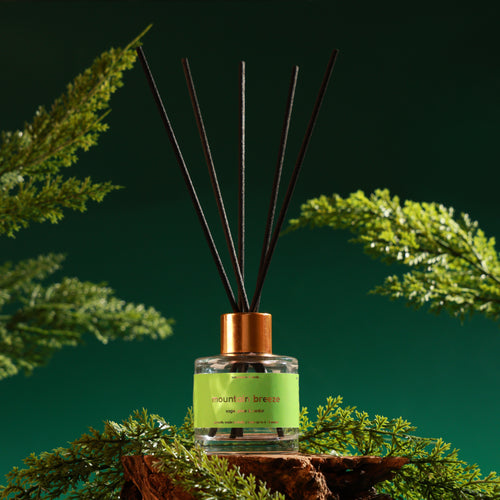
Part one — why a repair feels like a raise
The confusion here is entirely reasonable, because the experience of flipping a long-neglected bottle is genuinely dramatic. The room changes within hours. It feels like you have turned something up. What you have actually done is remove a penalty you did not know was there, and the difference between those two descriptions determines whether your next purchase is a good one.
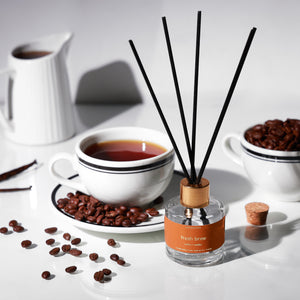
 Fresh Brew₹849 · 9.5/10Output from a reed bottle is the product of exposed reed surface, the volatility of the composition, and the rate at which air around the bottle is replaced. Change any of those and the ceiling moves; a flip changes none of them. It restores the first to full working order without adding to it. This is why the strength ratings we publish are stated at six reeds — the number is meaningless without the count it was measured at. Fresh Brew reaches 9.5 because of what is in it, not because of how it is maintained. And I should say plainly what that scale is not: it is SOSA's own internal positioning, not an industry standard, not a concentration figure, and not a ranking of quality. Evening Calm at 8.9 is not a lesser fragrance than Fresh Brew at 9.5. It is a quieter one, on purpose.
Part two — what each lever can and cannot exceed
Every intervention available to you has a ceiling of its own, and they are not the same ceiling. The table below sets them side by side so you can see where flipping sits — near the bottom for capability, at the very top for value, because it is free.
| Lever | Can it exceed the designed rate? | Its own ceiling | What reaching that ceiling costs |
|---|---|---|---|
| Flipping the reeds ★ | No — it restores, never amplifies | Specification at six reeds | Ten seconds a week and a marginal shortening of the bottle |
| Moving the bottle | No — but it decides how much of the rate reaches you | Whatever the room's air can carry from a point source | Nothing; it often extends bottle life by escaping a draught |
| Adding reeds | Yes — the only true volume control the format has | Around ten in a 50ml before the neck crowds and wicking suffers | Roughly proportional weeks: 10 reeds ≈ 4–5 weeks, not 6–8 |
| A larger bottle | No — this is the commonest wasted purchase in the category | 14–18 weeks instead of 6–8, at the same projection | ₹1,249–₹1,349, correctly spent on duration |
| A louder composition | Yes — this is where strength genuinely lives | 9.5 on our scale, at Fresh Brew | A new bottle from ₹849 and a change of character |
| A second bottle | Yes — more sources, not more oil per source | Two point sources covering an open plan properly | From ₹1,498 as a duo set, and two bottles to maintain |
| An ultrasonic Sukoon | Yes — a different format with a fan and a switch | 270–320 sq ft, 16–18 hrs on low, timers and a remote | ₹1,899, and it takes water-based Hotel Collection oil only |
| The honest caveat: the Megh at ₹3,499 is not on this table, and people ask why. It holds six litres and runs for around a hundred hours, but it covers only about 215 sq ft — less than the Sukoon. It is a runtime and humidity machine, never a coverage upgrade, and buying it to make a large room stronger is a ₹3,499 mistake. The waterless Vaayu at ₹11,999 is a commercial cold-air nebuliser running neat oil, and is frankly absurd in a flat. | |||
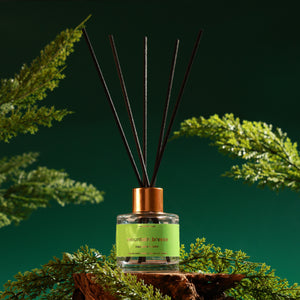
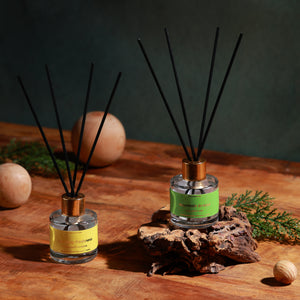
Mountain Breeze · 9.4/10from ₹849Shop → 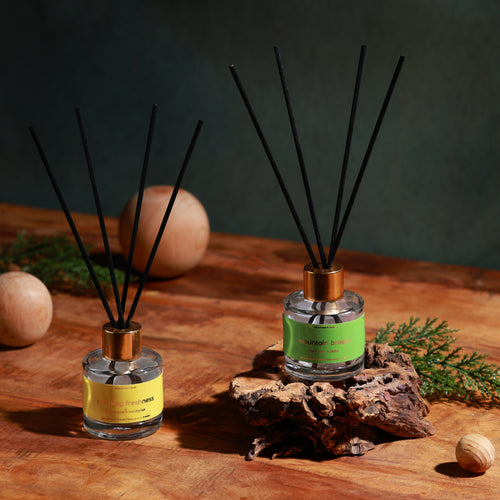 Fresh & Grounded duo₹1,548Shop →
  Sukoon · 270–320 sq ft₹1,899Shop →
Part three — how to use a flip as a free measurement
Run it as a proper test rather than an impression, because impressions in your own home are unreliable in a specific and well-understood way. Flip all six reeds on a morning when you are going out. Leave the room roughly as it normally is — same doors, same AC setting, no windows thrown open specially. Come back after at least fifteen minutes away, and take your reading in the first three seconds of walking through the door. Those three seconds are the only honest data you will get, because olfactory adaptation begins immediately and is strongest at home, where a familiar constant carries no novelty for your nose to report. If you want a second opinion, ask whoever arrives that evening before you mention the diffuser at all. Guests are better instruments than owners, every time.
Then interpret. If the room greeted you clearly and it still is not what you pictured, the question is what you were picturing — a reed diffuser is a constant, passive, deliberately low background with no fan and no switch, and many disappointments are an expectation borrowed from a spray or a plug-in. If it greeted you and then vanished by the time you reached the sofa, that is airflow rather than strength, and moving the bottle to a console near a doorway at waist-to-chest height is free. If it did not greet you at all, lift a reed and read the wet line: high and dark means saturated and stalled; barely above the oil means it is not wicking, and the reeds themselves are the problem.
Only after that measurement would I spend anything, and then in a specific order. Reeds first, because they are free and reversible: go from six to nine, accept roughly five weeks instead of eight on a 50ml, and run that for a fortnight before deciding. Composition second, if the character is wrong as well as the volume — moving from 8.9 to 9.4 or 9.5 is a genuine change and not a marginal one. A second bottle third, because output per bottle is fixed and the only way to raise the total in a space is another source; two 50ml at opposite ends of an open living-dining will always beat one 130ml in the middle. And if you are dealing with a connected open plan beyond roughly 250–300 sq ft, or you want scent on demand rather than continuously, stop buying reeds. The Sukoon at ₹1,899 is the right tool, it runs water-based Hotel Collection fragrance rather than reed oil, and most homes end up running both formats in different rooms.
Part four — spending after the measurement
Assume you have flipped, waited a day and taken an honest reading from the doorway. Here is what each result means in buying terms, cheapest first. Two of the five rows cost nothing at all.
| What the doorway test told you | The diagnosis | What to do about it | Price |
|---|---|---|---|
| Clear and pleasant on entry ★ | Working correctly; you had simply adapted to it | Nothing. Keep the weekly cadence | Free |
| Present at the door, gone at the sofa | Distribution, not strength — dead air or a draught | Console near a doorway, waist to chest, clear space, no AC blast, no sun | Free |
| Correct character, not enough of it | Reed count is below what this room wants | Nine reeds, accepting roughly 5 weeks instead of 8 on a 50ml | Free · reversible |
| Wrong character and too quiet | Composition mismatch — a sleep scent in a hosting room | Move up the scale to Mountain Breeze 9.4 or Fresh Brew 9.5 | ₹849 |
| Fine at one end of an open plan, absent at the other | One point source cannot cover two zones | Two bottles at opposite ends; pair scents that share a note | Duo from ₹1,498 |
| Everything right, space still too large | Past roughly 250–300 sq ft the format is the ceiling | Sukoon — 270–320 sq ft, timers, remote, three 15ml scents in the box | ₹1,899 |
| Working, but you want it cheaper to run hard | Nine or ten reeds is a running-cost question | Oil refill — reuse your vessel, roughly half the per-ml price | ₹2,399 · 300ml |
Versailles
The most valuable email I get is the one that says: I flipped it, I waited a day, and it is still not enough. That customer has done something rare — they have measured before they have spent. Now I can actually help them, because we are talking about a known quantity rather than a maintenance question wearing the costume of a product question. Half the time the answer costs nothing at all and involves moving a bottle four feet.
The other half, I get to say the thing I think the category says far too rarely. Sometimes the honest answer is that a reed diffuser is not the right product for what you want. If you have a 400 sq ft open living-dining and you want it to smell of something the moment guests walk in, a passive point source with no fan will never satisfy you, and I can either take your money three times or tell you once.
A ceiling is not a failure. It is a specification, and a brand that publishes its specification is a brand you can plan around. Everything we make is composed and handmade in small batches in Pune, tested through 45°C heat and 85% monsoon humidity, and a part of every order funds a girl's classroom through Nanhi Kali.
Frequently asked questions
- Should you flip reed diffuser sticks? — the residue gradient a flip exists to reverse.
- What happens after a flip — the surge, the settle and the plateau.
- Does flipping finish the oil faster? and how often should you flip?
- The complete strength guide, and the complete reed-flipping guide.
- Brand: the SOSA founder story.
SOSA reed diffuser range & prices (verified August 2026): alcohol-free, phthalate-free, paraben-free and IFRA-compliant compositions on a heat-stable coconut-derived (CCT) carrier, low-VOC, supplied in a refillable glass bottle with six fibre reeds; 50ml lasts 6–8 weeks and 130ml lasts 14–18 weeks. Morning Freshness (Malabar lemon · peppermint · Nilgiri eucalyptus) 50ml ₹749 · 130ml ₹1,249 · 9.0/10; Garden Bloom (British rose · night-blooming jasmine) 50ml ₹799 · 130ml ₹1,299 · 8.9/10; Evening Calm (Kashmir lavender · chamomile) 50ml ₹799 · 130ml ₹1,299 · 8.9/10; Fresh Brew (Coorg coffee · Kerala vanilla) 50ml ₹849 · 130ml ₹1,349 · 9.5/10; Mountain Breeze (Himalayan pine · sage · Indian cedar) 50ml ₹849 · 130ml ₹1,349 · 9.4/10. Reed diffuser refills are oil only — you reuse your own vessel and reeds: 300ml ₹2,399 (roughly 8–11 months) · 500ml ₹3,499 (roughly 14–18 months), about ₹7–8 per ml against ₹15–17 per ml for a 50ml bottle. Duo sets ₹1,498–₹1,598 for 2 × 50ml and ₹2,498–₹2,598 for 2 × 130ml. Strength figures are positions on SOSA’s own internal strength scale, not an industry standard. Replacement reeds are not sold as a separate SKU; SOSA guidance is to refresh reeds every few months. The reed line is separate from the water-based Hotel Collection for ultrasonic machines (15ml ₹299 · 100ml ₹999 · 300ml ₹1,799) and the two are not interchangeable. Diffusers: Boond 300ml ₹899 · Sukoon 500ml ₹1,899 · Megh 6L ₹3,499 · waterless Vaayu ₹11,999. Composed and handmade in small batches in Pune, India; tested through 45°C summer heat and 85% monsoon humidity. Free shipping above ₹499. A portion of every order supports girl-child education through Nanhi Kali. Prices subject to change — see the live product pages.