



If any one of them is false, that item is your next move, and it is free. Most people find two or three false the first time they read the list.
Two cases where you should stop earlier: if you want evenness across an open volume above about 150 sq ft, no reed configuration reaches it; and if you want fragrance on demand — guests in ten minutes — a passive device has no on switch and never will.
The honest gap: after the reed, the ladder is Sukoon ₹1,899, then Safar ₹3,999, which is named and sold as a car and travel diffuser, then Vaayu ₹11,999, which is built for 2,000–3,000 sq ft. Between the last two there is no mid-sized waterless machine for one bedroom, and I would rather name that than sell around it.
2. Until then, the false item is your next move and it costs nothing. This matters more than the rule itself. Most people reading this list find two or three items they have not done, and the commonest by far are the last two: the fan, and the visitor. A great many rooms are fixed at that stage for free, which is why I would rather publish the checklist than a recommendation.
3. Stop earlier in two specific cases. If what you want is evenness across an open volume — the same intensity at the bed, the desk and the door — no reed configuration achieves it, because a point source has a gradient by definition and two point sources simply make two hills with a valley between. And if you want fragrance on demand, a passive device has no on switch: it is running now, it was running while you were out, and it will be running at three in the morning.
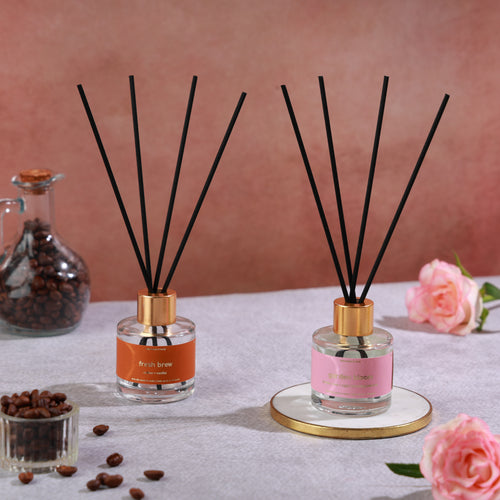
4. When you do stop, do not read it as the reed having failed. A 50ml at ₹749–₹849 running 6–8 weeks is roughly ₹13–₹15 a day for something silent that needs no power, no water, no filling, no charging and no remembering, that works straight through a power cut and never breaks. Nothing on the ladder above it can say that list. Most homes end up with both, which is the sensible outcome rather than a compromise.
5. Then buy the mechanism that matches the experience you want, and check the oil before the price. Reed oil cannot go into an ultrasonic machine, the water-based Hotel Collection cannot go into reeds, and Safar takes pure fragrance oil. Switching mechanism usually means choosing a new scent as well, and that is the single most common disappointment in this whole category.
Alcohol-free, phthalate-free, IFRA-compliant, composed in Pune. A portion of every order supports girl-child education through Nanhi Kali.
The six-point stopping rule
Work down it in order. Each item is either true or false today, and every false one is a free change with something to gain. Only when all six are true, and the room is still not what you want, have you established that the constraint is the mechanism rather than the dose. That is the moment to consider a different diffusion method — and it is a moment you can point at, which is the whole reason for writing the rule down.
One. All six reeds are in the bottle, have been for at least a week so they are fully saturated, and were flipped within the last five days. A flip restores output for a few hours; it adds no range, so it is a maintenance item rather than a fix. Two. The bottle is matched to the room: 50ml for anything up to about 150 sq ft, 130ml above that. If it is under-sized, size is your answer and it is a real one — though it buys weeks, not metres. Three. The bottle sits within about arm's reach of where you actually sit or sleep, at or just below nose height, on a surface rather than on the floor or a high shelf. Halving the distance does more than any change of scent, size or stick count.
Four. It is out of a direct draught — not on a windowsill, not beside an open balcony door, not in the AC blast — but not buried in a dead corner either, and the door has been shut for at least an hour before you judged the room. Five. You have run the room with the ceiling fan on low and the door closed, and formed your opinion in that state. This is the item most often skipped and the one most likely to change the answer, because a fan is the transport a reed structurally lacks. Six. Somebody who has just come in from outside has given you their verdict, and it agrees with yours. If it does not, they are right and you are adapted.
 Mountain Breeze₹849Six saturated reeds is full projection for a SOSA bottle, and the correct bottle for the room is the other half of the dose question. Get both right and emission is at its maximum — which is a genuinely useful thing to establish, because it removes the explanation everybody reaches for first. Note the cost, though, so you make the trade deliberately: six reeds gives 6–8 weeks from a 50ml and three gives roughly double, which is the same bottle, the same price, spread across about twice as many days.
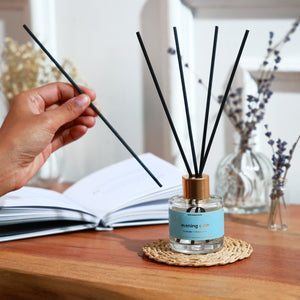
 Evening Calm₹799Distance, containment and air movement decide almost everything, and all three are free to change. An open window or balcony door does not weaken the bottle — it flushes the room, because air that leaves takes the fragrance with it. Cross-ventilation is a straight line between two openings, so keep the bottle off that line. A running AC in a closed room recirculates and distributes well while drying the air and shortening the bottle. And a ceiling fan on low, door shut, is the best free change in this entire cluster, for the same reason and on purpose.
 Garden Bloom₹799Receptors adapt to a constant stimulus within minutes: the molecules keep arriving and the brain stops reporting them. You can therefore sit in a properly scented room and truthfully say you smell nothing. Leave for fifteen minutes and walk back in; better, ask a visitor, who is a better instrument than you are. It is also worth knowing that a home fragrance you can smell continuously is usually set too strong for the room — home fragrance is meant to be noticed on arrival and at transitions, not held at a constant audible level all day.
Why a checklist rather than an adjective
Every other answer to this question comes out as a feeling — buy a machine when the reed “isn't enough”, when you want something “stronger”, when you are “serious about fragrance”. Those are not decisions, they are moods, and a mood is a poor guide to a ₹4,000 purchase. The reason a checklist works here is that all six items are about quantities the reader can actually observe: how many reeds, which bottle, how far away, what the door is doing, whether the air is moving, and what somebody else's nose reports. Get those six settled and the remaining explanation is mechanism, by elimination.
The mechanism itself is worth stating once more, because the whole rule rests on it. A reed diffuser is passive capillary diffusion: oil climbs six fibre reeds and evaporates from their surface at whatever rate temperature, humidity and airflow allow. No energy goes in and no air is moved. Vapour therefore enters the air immediately around the bottle and reaches the rest of the room only by molecular diffusion, which is far too slow to cross metres usefully, or by whatever air the room happens to be moving, which is not under the bottle's control. That is why the checklist ends with a fan and a visitor rather than a stronger oil.
And it is why bottle volume keeps disappointing people who read it as a coverage figure. It is a duration specification. A 130ml lasts 14–18 weeks against 6–8 for a 50ml, at the same reach. The clearest illustration of that is sitting in our own range and it embarrasses us slightly: Megh at ₹3,499 has a six-litre tank and about 100 hours of runtime and covers only about 215 sq ft — less than the 270–320 of the ₹1,899 Sukoon. Six litres against half a litre, and the smaller machine covers more room. Megh is a runtime and humidity machine, and it is the best proof I can offer that capacity and coverage are unrelated numbers.
The checklist as a table, with the free fix for each row
The same six items, with what each one is testing and what to do if it comes back false. The last row is the one that ends the exercise.
| Check | What it tests | If it is false, do this | Cost |
|---|---|---|---|
| 1. All six reeds in a week, flipped within five days | Whether emission is at its ceiling | Add the reeds, flip them, wait a week before judging | Free |
| 2. Bottle matched to room size | Whether the bottle is under-specified for the volume | 50ml up to about 150 sq ft, 130ml above — and remember this buys weeks, not metres | ₹749–₹1,349 |
| 3. Within arm's reach, nose height, on a surface | Whether you are inside the fragrant zone or outside it | Move it. Halving the distance beats every other single change | Free |
| 4. Out of the draught, not in a dead corner, door shut an hour | Containment, and whether the room is being flushed | Off the windowsill, out of the AC blast, off the cross-ventilation line, and shut the door | Free |
| 5. Judged with the ceiling fan on low, room closed | Whether the room has any transport at all | Turn it on low — not under the blades at speed. Best free change in the cluster; it does shorten the bottle | Free |
| 6. A visitor's verdict, collected | Whether the problem is the room or your own adaptation | Leave for fifteen minutes and walk back in, and ask somebody who has just arrived | Free |
| All six true, room still short | The constraint is mechanism, not dose | Stop adding reeds. Change method — and choose by the experience you want, not the product you first searched for | From ₹1,899 |
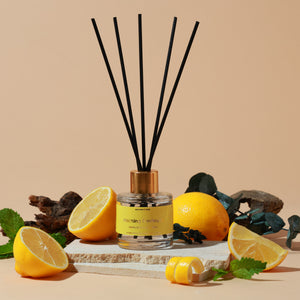
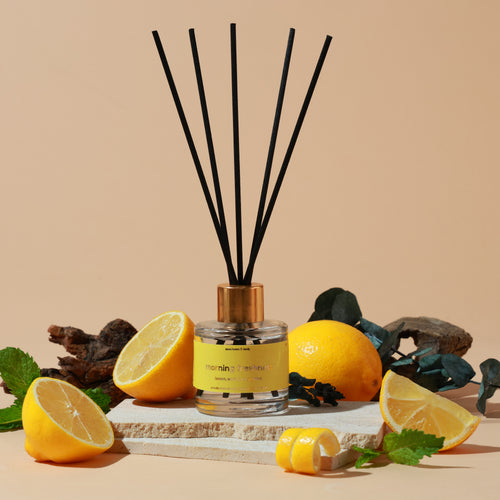
Passive · Morning Freshness₹749Shop →  Active · Sukoon 270–320 sq ft₹1,899Shop →
  Longer, not further · 300ml refill₹2,399Shop →
What to choose after you stop
Choose by the experience you want rather than by the product you first searched for. If you want this fragrance, quietly, beside you — keep the reed and run three sticks, which roughly doubles the weeks and costs you almost nothing you were enjoying. A bedside table is not a compromise placement for a point source; it is the correct use of one. If you want it to last longer rather than reach further — the 130ml for 14–18 weeks, or the 300ml refill at ₹2,399, which is roughly six 50ml fills but is oil alone and only makes sense if you already own the bottle and reeds.
If you want the room occupied, on demand — that is active diffusion, and it starts at Sukoon ₹1,899: 500ml, 270–320 sq ft, 16–18 hours on low, with three 15ml Hotel Collection scents included. It moves air, which is the entire point, and it should never be skipped on the way to something dearer. Its costs are real and I would rather you knew them: the oil is diluted in water, the output adds humidity to the room, in hard-water cities it can leave a fine white mineral dust, and it wants a socket and refilling. If you want the waterless mechanism at a personal scale — that is Safar ₹3,999, which shatters undiluted oil into a dry mist with no water, no dilution and no added humidity. It is named and sold as a car and travel diffuser, its timer runs one, two or three hours and its battery needs recharging, so it is not a set-and-forget room device and I will not present it as one.
And if you want one machine to scent a whole floor — that is Vaayu ₹11,999, up to 1000 m³, roughly 2,000–3,000 sq ft, under 38 dB, with a 400ml tank lasting up to about 90 days. For one bedroom the honest answer is no; in 120 sq ft nine-tenths of it is wasted. It earns its price on an open-plan living-dining, a large home or villa, a clinic, salon, showroom or reception. Whichever way you go, check the oil before the price: reed oil cannot go into an ultrasonic, the water-based Hotel Collection cannot go into reeds, and Safar takes pure fragrance oil. The instruction, for most people, is add rather than switch.
The ladder, in order — and the gap in it
Everything above, arranged as a purchase order. The last row is the gap in our own range, which is the thing I would most want a reader of a pillar page to leave knowing.
| Rung | What it buys | When it is right | Price |
|---|---|---|---|
| 0. The checklist ★ | Reach, containment and an accurate measurement — and roughly double the bottle life if you drop to three reeds | Always first. A large share of readers stop here, and that is the correct outcome rather than a failed sale | Free |
| 1. A reed, run properly | Silent, no power, no water, nothing to fill or charge, works in a power cut, never breaks — about ₹13–₹15 a day | Bedsides, desks, bathrooms, and anywhere the list above matters more than a metre of reach | ₹749–₹849 |
| 2. 130ml or the 300ml refill | Duration: 14–18 weeks, or roughly six 50ml fills. Not distance | When you are tired of repurchasing, and only if you already own the bottle and reeds | ₹1,249–₹2,399 |
| 3. Sukoon ultrasonic | 270–320 sq ft, 16–18h on low, three 15ml scents included — and it moves air | The first real change of mechanism, and very often the correct final answer for a bedroom | ₹1,899 |
| 4. Safar waterless | Undiluted oil, no water or added humidity, three speeds, cordless, 1/2/3-hour timer | With the disclosure: it is named and sold as a car and travel diffuser and needs recharging, so it is not set-and-forget | ₹3,999 |
| The gap, named: Vaayu ₹11,999 and Megh ₹3,499 | Vaayu is 1000 m³, roughly 2,000–3,000 sq ft — a whole-floor machine. Megh's six litres buy runtime and only about 215 sq ft, less than the ₹1,899 Sukoon | Neither is a bedroom answer. Between Safar and Vaayu we have no mid-sized waterless machine for one room — nothing here is “a Vaayu for one bedroom”, and I would rather say so than sell you the nearest thing | ₹11,999 / ₹3,499 |
Versailles
I wrote this checklist because of a pattern in our inbox that I found genuinely uncomfortable. People do not stop adding reeds when the evidence tells them to. They stop when they lose patience, and by then they have often spent three bottles establishing something the first bottle could have told them. There is no reason a customer should have to discover the ceiling of a mechanism by trial and expense. It is our job to publish where it is.
What surprises people, when they actually run the six items, is how often the answer is on the list rather than past it. Two of the six — run the fan on low, and ask somebody who has just walked in — are skipped almost universally, and between them they resolve a remarkable number of rooms. That is not a sales strategy. It is simply where the physics puts the fix, and it happens to be free.
And when you do cross the line, I would like you to cross it holding both ideas at once. A reed diffuser cannot do transport, and it can do a list of things no machine on our shelf can do: sit silently on a bedside table, ask for no socket, want no filling, need no remembering and carry on quietly through a power cut, at roughly ₹13–₹15 a day. Most people who buy a machine keep their reeds, and they are right to. The question was never which one is better. It was which one is the answer to the sentence you started with. Everything is composed in Pune, and part of every order funds a girl's classroom through Nanhi Kali.
Frequently asked questions
- Will more reed sticks reach further? — higher, not further.
- All the sticks in, and it still stays near the bottle — why the ceiling is structural.
- Projection, or just evaporation? — the deflating but honest answer.
- Five reeds to ten, and still nothing across the room — what to change instead.
- How many reeds do I actually need? — six, three, and the bathroom exception.
- Does over-reeding just finish the bottle faster? — the arithmetic, written out.
- More reeds against better diffusion — the two scored side by side.
- Every reed in the box and still not enough — a completed experiment with a useful result.
- Adding reeds for monster projection? — why no stick count produces it.
- Brand: the SOSA founder story.
SOSA facts verified August 2026: Reed diffusers in 50ml and 130ml only — Morning Freshness ₹749 / ₹1,249, Evening Calm ₹799 / ₹1,299, Garden Bloom ₹799 / ₹1,299, Mountain Breeze ₹849 / ₹1,349, Fresh Brew ₹849 / ₹1,349. 50ml suits rooms up to about 150 sq ft and lasts 6–8 weeks; 130ml suits above 150 sq ft and lasts 14–18 weeks. Six fibre reeds included rather than rattan; three reeds roughly doubles bottle life; two or three reeds in a 50 sq ft bathroom can stretch a 50ml to nearly three months; flip every 3–5 days; about ₹13–₹15 a day for a 50ml. Duos 50ml × 2: Day & Night ₹1,498, Fresh & Grounded ₹1,548, Warmth & Bloom ₹1,598. Refills 300ml ₹2,399 and 500ml ₹3,499, oil only. Alcohol-free on a heat-stable CCT carrier rather than DPG, phthalate-free, paraben-free, IFRA-compliant, 0 ppm formaldehyde, refillable glass, tested at 45°C and 85% RH, composed in Pune. Machines: Boond ₹899 (300ml, up to about 150 sq ft, about 6h, USB, night light), Sukoon ₹1,899 (500ml, 270–320 sq ft, 16–18h on low, three 15ml Hotel Collection scents included), Megh ₹3,499 (6 litres, about 100h runtime, about 215 sq ft — a runtime and humidity machine, never a coverage upgrade), Safar ₹3,999 (named and sold as a waterless car and travel perfume diffuser; 20ml, 2000 mAh, up to 10 hours continuous or about 30 intermittent per charge, three speeds, 1/2/3-hour auto-off timer, 6.9 cm), Vaayu ₹11,999 (waterless cold-air nebulising, up to 1000 m³ or roughly 2,000–3,000 sq ft, 400ml tank, up to about 90+ days, 1h/4h/8h/24h windows, under 38 dB, 5W, CE, RoHS, SGS). Between Safar and Vaayu there is no mid-sized waterless bedroom machine in the range. Hotel Collection oils are water-based and ultrasonic-only: 15ml ₹299, 100ml ₹999, 300ml ₹1,799. Reed oil and Hotel Collection oil are not interchangeable in either direction, and there is no hotel-inspired reed diffuser. Free shipping above ₹499. SOSA is an independent Indian fragrance house; the Hotel Collection is SOSA's own interpretation inspired by the world's finest hotels, and SOSA is not affiliated with or endorsed by any hotel brand. Prices subject to change — see the live product pages.