
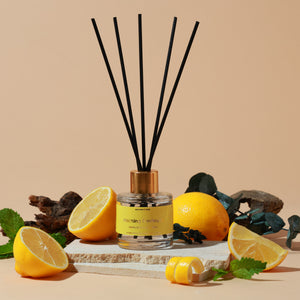
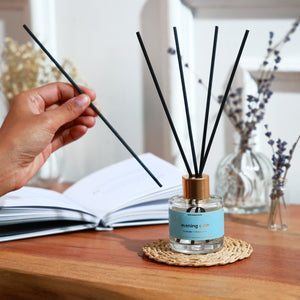
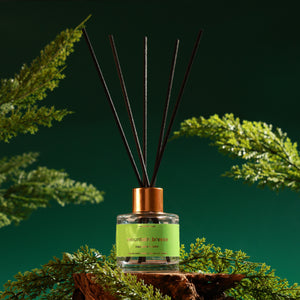

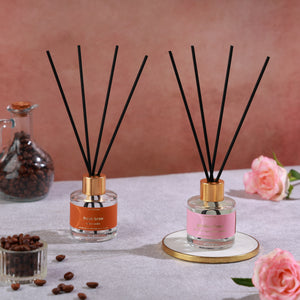
The three differences, all working the same way: volume — a small bathroom holds roughly a third of the air of an ordinary bedroom, before its lower ceiling is counted; containment — the door is shut, no window is open, there is no balcony and no ceiling fan, while a bedroom usually leaks in three directions at once; distance — in a bathroom you are never more than a metre or two from the bottle, so you stand inside the fragrant zone instead of outside it.
Free things to try in the bedroom tonight: all six reeds instead of three; move the bottle to the bedside so you halve the distance; put it at or just below nose height on a surface; keep it out of the draught but not in a dead corner; close the door and the balcony door; and run the ceiling fan on low, which is the best free fix there is, because a fan supplies the transport a reed has no way of supplying. It will shorten the life of the bottle, and most people take that trade.
A genuinely useful piece of bathroom advice: use two or three reeds there rather than six. In a 50 sq ft bathroom that can stretch a 50ml bottle to close to three months, and it is still plenty.
The honest gap: between Safar at ₹3,999 — which is named and sold as a car and travel diffuser — and Vaayu at ₹11,999, SOSA has no mid-sized waterless nebuliser built for one bedroom. If the free fixes are not enough, Sukoon at ₹1,899 is very often the right bedroom answer and should never be skipped on the way to something dearer.
2. Volume is the first difference. A 60 sq ft bathroom against a 150 sq ft bedroom is two and a half times the floor area, and bathrooms usually have the lower ceiling of the two, often with a false ceiling over the shower. Counting the height, the bedroom commonly holds around three times the air. The bottle did not get three times weaker. The room got three times larger.
3. Containment is the second, and it is the one most people never think about. A bathroom door is shut almost all the time it is in use, there is rarely a window standing open, there is no balcony and there is no ceiling fan. A bedroom leaks in three directions at once — a door left ajar to the passage, a window or a balcony door, and a fan or an air conditioner moving air out through both. Air that leaves a room takes the fragrance with it. Containment is half the equation, and in a bathroom you get it for free.
4. Distance is the third, and it is quietly the largest. A reed is a point source: concentration is highest at the bottle and falls away with distance. In a bathroom you are never more than a metre or two from it, so you are standing inside the fragrant zone the whole time you are in there. In a bedroom the bottle is usually on a chest of drawers or a dressing table and you are in bed, four or five paces away, outside the zone entirely. Halving that distance does more than any change of fragrance.
5. So fix the room before you replace the product. Six reeds instead of three. The bottle on the bedside table rather than across the room. At or just below nose height, on a surface, not on the floor and not on top of a wardrobe. Door closed, balcony door closed for the hours you want the room to smell of something. And the ceiling fan on low, which is the single most effective free change in this whole subject, because a fan supplies the transport a reed structurally lacks. It will empty the bottle a little sooner and you should know that before you switch it on.
Alcohol-free, phthalate-free, paraben-free, IFRA-compliant, 0 ppm formaldehyde. Six fibre reeds in a refillable glass bottle, composed in Pune. Free shipping above ₹499, and a portion of every order supports girl-child education through Nanhi Kali.
The three things that changed when you carried the bottle down the corridor
People expect the answer to this question to be about the fragrance, and it never is. It is about building physics, and the three factors below are not alternatives — they all changed at the same moment, in the same direction, and they multiply rather than add. That is why the difference between the two rooms feels so much larger than the difference in their floor plans. If any one of them had changed on its own you would probably have called the bedroom slightly weaker. All three at once is what makes it read as nothing at all.
 Evening Calm₹799A bathroom is one of the smallest enclosed spaces in a home, and rooms are three-dimensional rather than two, so the floor plan understates the gap. Take a 60 sq ft bathroom against a 150 sq ft bedroom: that is already two and a half times the floor area, and bathrooms usually sit under a lower or false ceiling, so the bedroom is commonly holding something like three times the air. A reed emitting exactly the same amount per hour into three times the volume produces roughly a third of the concentration, and your nose does not read a third as slightly less — it reads it as barely there. The bottle is doing precisely what it did in the bathroom. It is being asked to fill three times as much of the world.
 Mountain Breeze₹849Filling a room is not a single event that finishes; it is a balance between what is arriving and what is leaving. In a bathroom with the door shut, almost nothing leaves, so the fragrance accumulates all day and is waiting for you when you walk in. A bedroom is the opposite. The door stands ajar to a passage that is itself connected to the rest of the flat, so the effective volume is not the bedroom's at all. A window or balcony door is open for part of the day, and air that leaves takes the fragrance with it — the bottle is not weaker, the room is being flushed. A ceiling fan or an air conditioner then accelerates the whole exchange. Three separate leaks, each of which alone would be noticeable.
 Garden Bloom₹799This is the factor readers most often leave out of their own account, and it may be doing the most work. A reed is a point source with no transport — concentration is highest at the reeds and falls away continuously from there. A bathroom is so small that there is nowhere in it to stand that is outside the fragrant zone. You are within a metre or two of the bottle from the moment you shut the door. In a bedroom, the diffuser is nearly always on a dressing table or a chest of drawers and you are nearly always in bed, and those two points are the furthest apart the room allows. You have not been smelling a weaker fragrance. You have been standing outside a zone that is still exactly where you left it.
What your bathroom has already proved, and what it has not
I want to spend a paragraph on this because it is the most reassuring thing on the page and readers almost never see it themselves. You have run a controlled experiment. The bottle was the same bottle, the oil the same oil from the same batch, the reeds the same six fibre reeds, flipped on the same three-to-five-day cadence, at the same age and the same fill level. Precisely one variable was changed — the room — and the outcome changed with it. In any other context you would read that result without hesitation. The oil is intact, the reeds are wicking, the emission is correct. There is no version of a faulty bottle that performs properly in a bathroom.
What it has not proved is that your bedroom is unfixable, and this is where the news is good. Two of the three factors above are under your control for nothing. Containment costs a closed door. Distance costs the effort of moving an object two metres. Only volume is genuinely fixed, and volume is the one the reed count and the bottle size are there to answer. The commonest question I get after this one is a version of did I get a weak bottle? — and far more often than not it is the room, not the bottle. A 50ml is built for up to about 150 sq ft; put it in a 300 sq ft open-plan bedroom and it will read as weak while performing exactly to specification.
There is one more thing worth ruling out while we are being rigorous, because it costs nothing and it catches a surprising number of people. Receptors adapt to a constant stimulus within minutes: the signal keeps arriving and the brain stops forwarding it. You spend seven minutes in the bathroom and eight hours in the bedroom, which means the bathroom gets to surprise you and the bedroom does not. Leave the bedroom for a quarter of an hour and walk back in, and ask whoever arrives at your house next. A visitor is a better instrument than you are, and if guests remark on the smell in a room you cannot detect, the room is working for everyone except you.
The two rooms, side by side, on every variable that matters
This is the whole argument in one table. Read the last column: nothing in it describes the diffuser. Every row is a property of the room, and four of the six rows are things you can change this evening without spending anything.
| Variable | Typical bathroom | Typical bedroom | Effect on what you smell | Fixable? |
|---|---|---|---|---|
| Air volume | Around 60 sq ft, low or false ceiling | Around 150 sq ft, full ceiling height | Roughly three times the air to fill from the same output | Reed count and bottle size |
| Door | Shut nearly all the time | Ajar to a passage, so the real volume is larger still | Fragrance accumulates in one and drifts away in the other | Free — close it |
| Window or balcony | Rarely open, often none | Frequently open for part of the day | Air that leaves takes the fragrance with it | Free — close it for the hours that matter |
| Ceiling fan or AC | Neither | Usually both | Cuts both ways: faster distribution, faster loss | Free — and worth switching on, see below |
| Distance to you | One to two metres, always | Four or five paces from bottle to pillow | Inside the fragrant zone versus outside it — the largest single lever | Free — move the bottle |
| Time you spend still in it | Minutes — no time to adapt | Hours — receptors adapt within minutes | The bathroom gets to surprise you; the bedroom does not | Free — the fifteen-minute test |
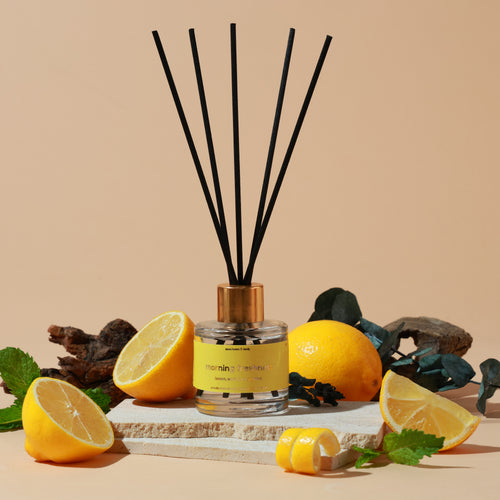
Morning Freshness · 9.0₹749Shop → 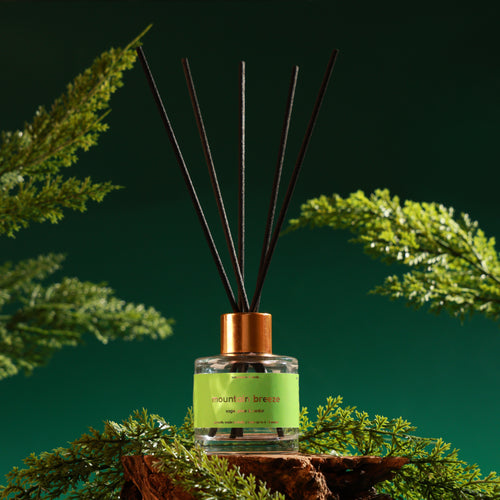 Mountain Breeze · 9.4₹849Shop →
  Sukoon · 270–320 sq ft₹1,899Shop →
Making the bedroom behave a little more like the bathroom
Every one of these is free, and I would rather hand them over than let anybody spend first. Start with the reeds, because most people never touch them: if you are running three, put all six in. Six is full projection, three is a soft bedside level that roughly doubles how long the bottle lasts, and the reed count is a genuine volume dial rather than a range dial — it will make the zone stronger, not wider. Then flip them, and know what a flip is doing: it restores output for a few hours and adds no reach whatsoever. It is a dose adjustment wearing the costume of a distribution fix.
Then move the bottle, because halving the distance between the bottle and your pillow does more than any change of fragrance. The bedside table is not a compromise placement; it is the correct use of a point source. Put it at or just below nose height on a surface — not on the floor, where the fragrance has to climb, and not on top of a wardrobe, where it sits above the air you actually breathe. If you do move it to within thirty centimetres of your head, take two reeds out; three at that range is generally better than six, and it doubles the life of the bottle into the bargain. Keep it out of a direct draught — not on a windowsill, not in the blast of a split AC — but do not overcorrect into a dead corner behind a curtain where nothing circulates at all.
Then borrow the bathroom's best feature, which is not its size but its door. Containment is half the equation and costs nothing: shut the bedroom door, and shut the balcony door for the hours you want the room to smell of something, then open everything again when you want the room aired. A home with the windows open all day is not a fragrance environment during those hours, and it becomes one the moment they close. And finally, the best free advice in this entire subject — turn the ceiling fan on low. A fan is exactly the transport a reed structurally lacks. It takes the concentrated air sitting around the reeds and mixes it through the room, which is the one thing the bottle cannot do for itself, and in a closed bedroom it is the closest a passive diffuser ever gets to behaving like a machine. It also shortens the life of the bottle, because more air across the reeds means faster evaporation. You should know that before you switch it on, and in my experience almost everybody takes the trade.
If the free fixes are not enough — what to buy, and what to skip
Suppose you have done all of it. Six reeds, bottle on the bedside, door shut, fan on low, and the bedroom is better but still not the bathroom. That is a fair place to arrive at, and the honest next step depends on which of the three factors is left over. If it is volume — a bedroom above about 150 sq ft — the answer is a bottle sized to it, remembering that bottle volume is a duration specification, not a coverage specification: 130ml buys you 14–18 weeks instead of 6–8, not extra reach. If what is left over is the wish for the room to smell the same wherever you stand, that is an evenness requirement, no passive device can meet it, and a change of mechanism is the honest answer. One warning first, because it prevents more disappointment than anything else here: reed oil cannot go into an ultrasonic machine, and the water-based Hotel Collection cannot go into reeds. Moving to a machine means finding a new scent to love. The instruction is usually add, not switch.
| Step | What it is | When it is the right answer | Price |
|---|---|---|---|
| 1. The free fixes ★ | Six reeds, bottle to the bedside, nose height, door and balcony closed, ceiling fan on low | First, for everybody. A large share of readers stop here and buy nothing | Free |
| 2. A reed sized to the bedroom | 50ml up to about 150 sq ft, 6–8 weeks · 130ml above that, 14–18 weeks. Six fibre reeds in a refillable glass bottle | When the bedroom is genuinely larger than the bottle was built for, or you simply want longer between repurchases | ₹749 / ₹1,249 |
| 3. Two or three reeds in the bathroom | Take the bathroom bottle down from six reeds to two or three — in a 50 sq ft bathroom a 50ml can then run close to three months | Always, in a small bathroom. It is the best-value adjustment in the range and it costs nothing | Free |
| 4. Sukoon | Ultrasonic, 500ml, 270–320 sq ft, 16–18 hours on low, three 15ml Hotel Collection scents included. It moves its own air | When you want the bedroom evenly fragranced on demand. Water-diluted, adds humidity, needs filling, and in hard-water cities can leave a fine white dust | ₹1,899 |
| 5. Safar | Waterless cold diffusion of undiluted oil, 20ml, cordless, three speeds, 1/2/3-hour timer. Named and sold as a car and travel diffuser | For a personal-scale space when you want undiluted oil and no water at all. Not set-and-forget — the timer runs out and the battery needs recharging | ₹3,999 |
| Skip for one bedroom: Vaayu, and the gap behind it | Vaayu is rated to 1000 m³ — roughly 2,000–3,000 sq ft — and in a 150 sq ft bedroom nine-tenths of it is wasted. Behind that sits the real gap: between Safar at ₹3,999 and Vaayu at ₹11,999 there is no mid-sized waterless bedroom nebuliser | Said plainly, because nothing in the range is "a Vaayu for one room" and pretending otherwise would sell you the wrong end of the ladder | ₹11,999 / — |
Versailles
This is my favourite question in the postbag, because the person asking it has already done the hard part and does not know it. They write to me slightly apologetically, as though the bathroom result were an embarrassment — and the bathroom result is the finding. You cannot get a fragrance to behave beautifully in one room and badly in another by owning a bad bottle. Every fault you might worry about would show up in both places.
The reason nobody sees it is that we all think of a diffuser as a thing with a strength, the way a bulb has a wattage. It is closer to a tap running into a bath. The tap has one flow rate; the level depends entirely on the size of the bath and how wide open the plug is. A bathroom is a small bath with the plug in. A bedroom with the balcony door open is a swimming pool with the plug out, and no tap is going to win that argument.
So the advice is unglamorous and mostly free. Move the bottle to where your head is. Shut the door. Use all six reeds in the big room and only two or three in the small one, where a 50ml will then stretch to nearly three months and you will have spent nothing to gain six weeks. Run the fan on low and accept the shorter bottle. And keep the reed for what it is genuinely superb at — silent, no socket, nothing to fill or charge, nothing to remember, working perfectly well in a power cut, and it never breaks — at about ₹13 to ₹15 a day, an object rather than an appliance. If after all of that you still want your bedroom to smell the same in every corner, buy the ₹1,899 machine that fits a bedroom rather than the ₹11,999 one that fits a showroom. Everything is composed in Pune, and part of every order funds a girl's classroom through Nanhi Kali.
Frequently asked questions
- Powerful in the bathroom, weak in the living room — the widest gap, with the volume arithmetic written out.
- Why reeds seem much stronger in small closed spaces — the general principle, stated plainly.
- 60 sq ft to 150 sq ft — what changed? — nothing about the product; three things about the room.
- Does the bathroom prove the fragrance isn't weak? — yes, and why that is a real result.
- Moving it to the bathroom makes it strong again — the same fact from the other direction.
- Does a reed need a small enclosed room to feel powerful? — to feel powerful, largely yes.
- Why the same fragrance performs differently in two rooms and bathroom vs bedroom vs living room.
- My diffuser isn't bad — is my bedroom asking more of it? — the family pillar.
- Brand: the SOSA founder story.
SOSA facts verified August 2026: Reed diffusers are supplied in 50ml and 130ml only — 50ml suits rooms up to about 150 sq ft and lasts 6–8 weeks, 130ml suits larger rooms and lasts 14–18 weeks. Two to three reeds in a 50 sq ft bathroom can make a 50ml last close to three months. Morning Freshness 50ml ₹749 / 130ml ₹1,249 · Evening Calm ₹799 / ₹1,299 · Garden Bloom ₹799 / ₹1,299 · Mountain Breeze ₹849 / ₹1,349 · Fresh Brew ₹849 / ₹1,349. Perceived-intensity scale: Evening Calm 8.9, Garden Bloom 8.9, Morning Freshness 9.0, Mountain Breeze 9.4, Fresh Brew 9.5 — a measure of intensity in the room, not of quality. Six fibre reeds in a refillable glass bottle, heat-stable CCT carrier, alcohol-free, phthalate-free, paraben-free, IFRA-compliant, 0 ppm formaldehyde, tested through 45°C heat and 85% RH, composed in Pune. Refills 300ml ₹2,399 and 500ml ₹3,499 are oil only and are never a first purchase. Machines: Boond ₹899 (300ml, up to ~150 sq ft, ~6h) · Sukoon ₹1,899 (500ml, 270–320 sq ft, 16–18h on low) · Megh ₹3,499 (6L, ~100h runtime, ~215 sq ft) · Safar ₹3,999 (waterless, 20ml, 2000 mAh, up to 10 hours continuous, three speeds, 1/2/3-hour timer — named and sold as a car and travel diffuser, with no published room-coverage figure) · Vaayu ₹11,999 (up to 1000 m³, roughly 2,000–3,000 sq ft, 400ml, under 38 dB). Reed oil and the water-based Hotel Collection are separate products and are not interchangeable; there is no hotel-inspired reed diffuser. Free shipping above ₹499. A portion of every order supports girl-child education through Nanhi Kali. SOSA is an independent Indian fragrance house; the Hotel Collection is SOSA's own interpretation inspired by the world's finest hotels, and SOSA is not affiliated with or endorsed by any hotel brand. Prices subject to change — see the live product pages.