

What you have proved without meaning to: the oil is intact and the reeds are wicking properly. A faulty bottle does not become powerful because it was carried down a hall. The bedroom was never a verdict on the product.
The free fixes for the bedroom, in order: close the door, fit all six reeds rather than three, halve the bottle-to-pillow distance, put it at nose height on a surface, keep it out of a draught, and run the ceiling fan on low. The fan is the best free advice on this subject because a fan is the transport a reed structurally lacks — and it will shorten the bottle's life, which you should know before you switch it on.
What will not work: a bigger bottle. A 130ml lasts 14–18 weeks against 6–8, and reaches no further. Volume is a duration specification, not a coverage one.
The honest gap: between Safar at ₹3,999 — which is named and sold as a car and travel diffuser — and Vaayu at ₹11,999, rated to 1000 m³ or roughly 2,000–3,000 sq ft, SOSA has no mid-sized waterless machine built for one bedroom. If someone tries to sell you the Vaayu for a 150 sq ft room, they are selling you nine-tenths of a machine you will never use.
2. Because the bathroom does not leak, and the bedroom does. The second term is air exchange — how quickly the fragranced air is replaced by unfragranced air. A bathroom is usually the most contained space in a flat: one door, kept shut, often no openable window and rarely a balcony or a ceiling fan. A bedroom leaks in at least three directions — a door left open onto a hall, a window on the latch, a balcony, and a ceiling fan pushing air out under the door. Air that leaves takes the fragrance with it, continuously, all evening. Your bottle was not weaker in the bedroom. The bedroom was being flushed.
3. Because you stand inside the zone in a bathroom and outside it in a bedroom. A reed produces a fragrant zone rather than a fragranced room — concentration is highest at the bottle and falls away with distance. In a bathroom you are never more than a metre or two from the shelf, so you are permanently inside the strong part of the gradient. In a bedroom the bottle is often on a dresser three or four metres from the pillow, which puts you at the thin end of the same curve. Halving that distance does more than any change of scent.
4. And because you arrive in a bathroom rather than settle in it. Walking in means crossing the gradient in a second or two, and the nose is built to report change rather than steady state. Lying in bed is a constant stimulus, and receptors adapt within minutes — you can be in a properly fragranced bedroom and accurately report smelling nothing. The test is to leave for fifteen minutes and walk back in, and better still to ask somebody else. A visitor is a far better instrument than the resident.
5. So change the room's terms before you change the product. Close the bedroom door. Fit all six reeds rather than three — six is full projection, three is a soft bedside level that roughly doubles the life. Move the bottle to within reach of the bed at roughly nose height, on a surface, not the floor and not a high shelf. Keep it out of a draught and out of the AC's blast, which strips the reeds and throws everything at one wall. Then run the ceiling fan on low, which is the single best free change available here, because a fan supplies the transport a reed does not have — at the honest cost of emptying the bottle sooner.
Alcohol-free, phthalate-free, made in Pune. A portion of every order supports girl-child education through Nanhi Kali.
What changed in the ten seconds you carried it down the hall
I like this question more than almost any other in this subject, because the reader has done something a laboratory would recognise. You held every property of the product constant — the oil, the carrier, the bottle, the reed count, the number of days since you last flipped them — and you varied exactly one thing. Then you observed a large difference. That is a controlled experiment, and its conclusion is not ambiguous: the variable that matters is the room. Here are the three ways in which it matters, in the order of how much work each one is doing.
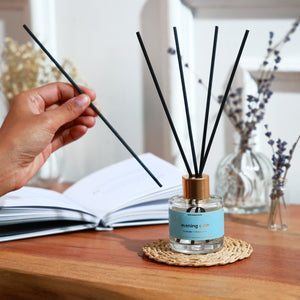
 Evening Calm₹799Emission is what leaves the bottle. Concentration is what arrives at your nose, and it is emission spread through a volume of air. A bathroom of about 50 sq ft holds in the region of a third of the air of a 150 sq ft bedroom, and the difference is usually larger than the floor plan suggests, because bathrooms tend to have the lowest ceilings in the flat and volume includes the ceiling. Nothing was added to the oil in that corridor. The same quantity of fragrance is simply being asked to occupy far less space. The bottle did not get stronger; the room got smaller, and strength is a ratio rather than a quantity.
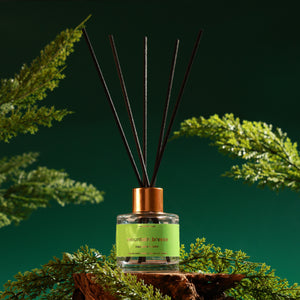
 Mountain Breeze₹849The second term in the equation is air exchange, and it is the one nobody thinks about because it is invisible. Fragrance accumulates in a room only to the extent that the room keeps the air it already has. A bathroom door stays shut by habit; most Indian bathrooms have no openable window worth the name, no balcony and no ceiling fan. A bedroom has, at minimum, a door onto a hall that is open more often than not, a window that is rarely fully closed, frequently a balcony, and a fan overhead. Each of those is a route out. An open balcony door does not weaken the bottle — it turns the room's air over, and everything dissolved in that air goes with it. This is also why a bedroom often smells strongest at night with the door shut and the AC recirculating, and faintest on an airy afternoon.
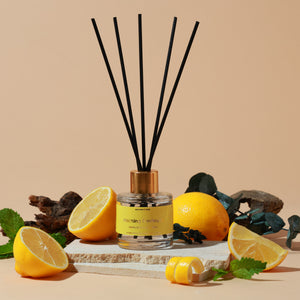
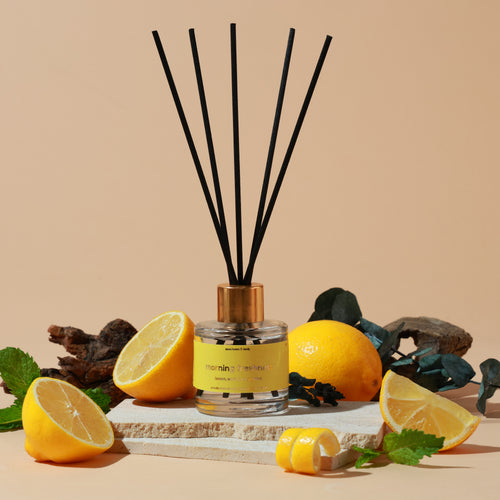
 Morning Freshness₹749A reed diffuser produces a fragrant zone, not a fragranced room, and that is the design rather than a defect — it is the price of a thing that is silent, needs no power and never has to be switched on. Concentration peaks at the reeds and falls away with distance in every direction. A bathroom is too small to let you leave that zone. You can stand anywhere in it and still be within a metre or two of the bottle, so you experience the strong end of the gradient every time you are in the room. A bedroom is large enough to have a far end, and the bed is very often at it, three or four metres from a dresser in the corner. You have not moved to a better product. You have moved to a room where the geometry keeps you standing in the best part of the old one.
Arriving in a room, and living in one
There is a fourth difference between those two rooms that has nothing to do with air at all, and it is worth separating out because it changes what you should conclude. A bathroom is a room you arrive in. You are elsewhere, you go in, you are there for a few minutes, and you leave. Every single one of those arrivals is a crossing of the gradient — from a corridor with almost nothing in the air to a small sealed box with a fragrant object in it, in the space of one step. The nose is far better at reporting change than at reporting a steady state, which is why the bathroom greets you the way it does, and why the same effect is so much weaker in a room you never leave.
A bedroom is a room you live in, and living in it means a constant stimulus. Olfactory receptors adapt to a constant stimulus within minutes: the molecules keep arriving, the brain stops passing the message on. It is entirely possible — routine, in fact — to lie in a properly fragranced bedroom and honestly report smelling nothing. So part of the gap you have noticed is physics and part of it is measurement, and it is worth separating them before you spend money on the physics. The diagnostic is to leave the bedroom for fifteen minutes and walk back in. If it greets you at the door, the bedroom is working and your nose had simply stopped mentioning it. Better still, ask somebody who does not live there. A visitor is a much better instrument than you are, because they have not spent the evening adapting to your room, and if guests remark on the scent while you cannot detect it, the product is working for everybody including you.
Two related things people are shy about asking. First, no, you are not supposed to smell it constantly — a fragrance you notice every moment you are in a room is usually set too strong for that room, and home fragrance is meant to be met on arrival and at transitions rather than worn all day. Second, the bathroom is genuinely one of the best-value placements in a home, but for the opposite reason to the one people assume. It is not that it deodorises; fragrance mixes with a smell rather than cancelling it, and the honest order is always source, then ventilation, then fragrance. It is that the room is so small that two or three reeds in a 50 sq ft bathroom can stretch a 50ml bottle to close to three months instead of 6–8 weeks. That is efficiency, and it is the reason I would not move the bottle back.
The two rooms, variable by variable
Everything in the product column is identical in both rows, because it is the same bottle. Everything in the room columns is different. This is the whole of the answer, laid out so you can see which of the differences applies to your own bedroom and which does not.
| Variable | Bathroom, ~50 sq ft | Bedroom, ~150 sq ft | Who controls it |
|---|---|---|---|
| Emission — what leaves the bottle | Unchanged. Same oil, same six reeds | Unchanged. Same oil, same six reeds | The product. And it passed |
| Volume of air to fragrance | Roughly a third, usually under a lower ceiling | Three times the air, often a taller ceiling | The building |
| Air exchange | Very low — one door, usually shut | High — door, window, balcony, ceiling fan | You, for free, this evening |
| Your distance from the source | Never more than a metre or two | Often three or four metres from the pillow | You, for free, in one minute |
| How you occupy the room | You arrive, briefly — every visit crosses the gradient | You settle — receptors adapt within minutes | Nobody. Test with the fifteen-minute walk-back |
| Sensible reed count | Two or three — a 50ml then runs close to three months | All six for full projection, at 6–8 weeks | You, for free, right now |
Bathroom favourite · Morning Freshness₹749Shop → 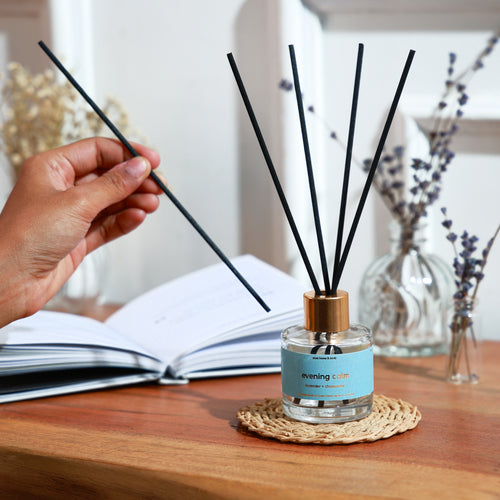 Softest at 8.9 · Evening Calm₹799Shop →
  Moves air · Sukoon₹1,899Shop →
Rebuilding the bathroom's conditions in a bedroom
You cannot shrink a bedroom, but you can take back most of the other advantages, and the striking thing is how little of that costs anything. Start with containment, because it is the largest free lever and the one most often left on the table. A bedroom with the door open onto a hall is not a 150 sq ft volume — it is a 150 sq ft room continuously exchanging air with the whole flat, and the fragrance you paid for is being diluted into a space several times larger than the one on your floor plan. Shut the door and the window for one evening and change nothing else, so you know what that alone is worth. Then dose: fit all six fibre reeds rather than three, since six is full projection and three is a soft bedside level that roughly doubles the life. Then geometry: move the bottle within reach of the bed, at roughly nose height when you are sitting up, on a surface rather than the floor or the top of a wardrobe.
Then the one that surprises people, and the best free advice in this entire subject: turn the ceiling fan on low. A reed has emission and no transport — that is precisely what limits it — and a fan is transport. In a closed bedroom with the door shut, a fan on its lowest setting does more for evenness than any reed count, any bottle size and any change of fragrance, because it is the only one of those that addresses the actual missing ingredient. Not directly under the blades at full speed, which just strips the reeds. The honest cost, which I would rather tell you than have you discover: moving air over the reeds speeds evaporation, so the bottle will empty sooner. If you would rather have the weeks than the evenness, run the fan for the hours that matter and leave it off the rest of the time. The same trade applies to a running AC in a closed room, which recirculates and distributes well while drying the air and shortening the bottle — with one placement to avoid outright, which is directly in the AC's blast, where the reeds are stripped and the fragrance is thrown at a single wall.
What none of that will do is make a 150 sq ft bedroom behave like a 50 sq ft bathroom at every point in the room at once, because a passive source cannot produce evenness across a large volume. That is worth saying plainly rather than hedging. But before that conclusion is allowed to sell you anything, notice what the reed is doing well, since this page has spent a thousand words on its limits. It is silent. It uses no power, so it keeps working through a power cut — not a trivial property in an Indian household. There is nothing to fill, charge, clean or switch on; it was working while you were at the office and it is working now. It costs roughly ₹13–₹15 a day, it is an object rather than an appliance in a room where every surface is visible, and it does not have a service life. A machine can fail. A glass bottle with fibre reeds in it cannot.
What to buy — and what the move has already ruled out
The useful consequence of your accidental experiment is that it eliminates two purchases before you make them. It rules out a replacement bottle, because the oil demonstrably works. And it rules out a stronger fragrance, because strength in the material and reach in the room are unrelated axes — the bottle that filled the bathroom would fill it just as well at 8.9 on our strength scale as at 9.5. What is left is a genuinely short list.
| Buy | What it is | When it is the right answer | Price |
|---|---|---|---|
| 1. Nothing — reproduce the bathroom's terms ★ | Door shut, six reeds, bottle near the bed at nose height, out of the draught, ceiling fan on low | First, for most people. It fixes more readers than everything below it combined, and it costs nothing | ₹0 |
| 2. A second 50ml for the bathroom | Six fibre reeds, 6–8 weeks at full dose — but two or three reeds in a 50 sq ft bathroom stretches it to close to three months | If the bathroom is now where you want that bottle to stay, and the bedroom needs its own. The most efficient placement in most homes | ₹749–₹849 |
| 3. Boond | Ultrasonic, 300ml tank, up to about 150 sq ft, roughly six hours, USB, night light | The cheapest honest way to put moved air into a bedroom of that size. Water-diluted and it adds humidity | ₹899 |
| 4. Sukoon | Ultrasonic, 500ml, 270–320 sq ft, 16–18 hours on low, three 15ml Hotel Collection scents included | Very often the correct bedroom answer, and it should never be skipped on the way to something dearer. Needs filling, and in a hard-water city it can leave a fine white dust | ₹1,899 |
| Not this: a bigger bottle | 130ml, 14–18 weeks instead of 6–8, for about ₹500 more | Buy it for fewer repurchases in a room above 150 sq ft. Never for reach — volume is duration, and the clearest proof is Megh at ₹3,499 with six litres and only ~215 sq ft, less than the ₹1,899 Sukoon's 270–320 | ₹1,249–₹1,349 |
| The honest gap: no mid-sized waterless machine | Safar ₹3,999 is waterless cold diffusion of undiluted oil, cordless, three speeds, a 1 / 2 / 3-hour timer — and it is named and sold as a car and travel diffuser. Vaayu ₹11,999 is 1000 m³, roughly 2,000–3,000 sq ft | Nothing in the range sits between them as a bedroom-sized waterless machine. Vaayu in one bedroom wastes most of what you paid for, and Safar is not set-and-forget — the timer runs hours and it needs recharging | — |
Versailles
The emails that begin I moved it to the bathroom and now it is amazing are my favourite ones to answer, because the person writing usually thinks they are reporting a curiosity and they are in fact reporting a result. They have held the product constant and varied the room, which is more rigour than most of us apply to anything we buy. The bottle was doing this all along. The bedroom was simply a harder question.
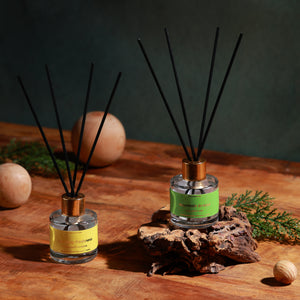
What I try to say back, and what nobody tells you at the point of sale, is that a reed diffuser is specified by the room and not by the shelf. Every figure on our own packaging is a room figure — a 50ml suits up to about 150 sq ft, a 130ml above that — and yet the thing people reach for when a room disappoints them is a larger bottle, because a larger bottle is the only lever a shop can sell you in thirty seconds. A larger bottle is more weeks. It has never once been more metres.
One small thing about heat, since it changes the arithmetic in an Indian bathroom in particular. A hot, steamy room speeds evaporation, so the bottle empties faster there — expected, and the reason two or three reeds rather than six is the right dose in that room. What heat must never do is change the smell, and that is why every SOSA reed sits on a heat-stable CCT carrier rather than DPG, which can crack and go bitter above 40°C on an ordinary afternoon here. It is an invisible decision, it costs more, and it is the reason the bottle you carried into the bathroom still smells like the bottle you bought. Everything is composed in Pune, and a part of every order funds a girl's classroom through Nanhi Kali.
Frequently asked questions
- It fills the bathroom but barely works in the bedroom — volume, containment and distance, all three at once.
- Powerful in the bathroom, weak in the living room — the largest gap in the flat, with the arithmetic.
- Why reeds seem stronger in small closed spaces — the general principle behind all of this.
- Amazing at 60 sq ft, gone at 150 — nothing about the product changed.
- Does the bathroom prove the fragrance is not weak? — yes, and here is why that matters.
- Does a reed need a small enclosed room? — to feel powerful, largely yes; to be pleasant, no.
- Why the same fragrance performs differently in two rooms — the four variables in plain terms.
- Bathroom vs bedroom vs living room — the three-way comparison, with real sizing.
- My diffuser isn't bad — is my bedroom asking more of it? — yes, and here is the arithmetic.
- Brand: the SOSA founder story.
SOSA facts verified August 2026: Reed diffusers are supplied in 50ml and 130ml only — 50ml suits rooms up to about 150 sq ft and lasts 6–8 weeks, 130ml suits rooms above 150 sq ft and lasts 14–18 weeks, at roughly ₹13–₹15 a day. Six reeds is full projection; three is a soft bedside level and roughly doubles the life; two or three reeds in a 50 sq ft bathroom can make a 50ml last nearly three months; flip the reeds every 3–5 days. Morning Freshness ₹749 / ₹1,249 · Evening Calm ₹799 / ₹1,299 · Garden Bloom ₹799 / ₹1,299 · Mountain Breeze ₹849 / ₹1,349 · Fresh Brew ₹849 / ₹1,349. Strength scale, perceived intensity rather than quality: Evening Calm 8.9 softest, Garden Bloom 8.9, Morning Freshness 9.0, Mountain Breeze 9.4, Fresh Brew 9.5 deepest. Morning Freshness uses a eucalyptus globulus base that slows lemon evaporation three to four times. Six fibre reeds rather than rattan, heat-stable CCT carrier rather than DPG, alcohol-free, phthalate-free, paraben-free, IFRA-compliant, 0 ppm formaldehyde, refillable glass bottle, tested at 45°C and 85% RH, composed in Pune. Refills 300ml ₹2,399 and 500ml ₹3,499, oil only. Machines: Boond ₹899 (300ml, up to about 150 sq ft, ~6h, USB, night light) · Sukoon ₹1,899 (500ml, 270–320 sq ft, 16–18h on low) · Megh ₹3,499 (6L, ~100h runtime but only ~215 sq ft) · Safar ₹3,999, a waterless cold-diffusion device named and sold as a car and travel perfume diffuser, with a 1 / 2 / 3-hour timer and a rechargeable battery · Vaayu ₹11,999, rated to 1000 m³, roughly 2,000–3,000 sq ft and the wrong purchase for one bedroom. No coverage figure is published for Safar and none is quoted here. Hotel Collection oils are water-based and for ultrasonic machines only; reed oil cannot be used in them. No health, air-quality, allergy, sleep or mood claims are made anywhere on this page. Free shipping above ₹499. SOSA is an independent Indian fragrance house; the Hotel Collection is SOSA's own interpretation inspired by the world's finest hotels and SOSA is not affiliated with or endorsed by any hotel brand. Prices subject to change — see the live product pages.